
Securing financing for a niche craft business can feel like navigating uncharted territory. If you own or plan to launch a specialized taxidermy business, you may already know that traditional lenders sometimes struggle to evaluate artistic or trade-based enterprises. That's where the SBA 7(a) loan program often proves valuable. It's one of the most flexible small business financing tools available in the United States, and it may be well-suited to artisan-driven businesses that generate consistent revenue but don't always fit a cookie-cutter lending mold. Understanding what documents are needed for an SBA 7(a) loan for a specialized taxidermy business is the first step toward a successful application — and that's exactly what this guide will walk you through.
Why Taxidermy Businesses May Qualify for SBA 7(a) Financing
Before diving into paperwork, it helps to understand why an SBA 7(a) taxidermy loan is even a viable path. The SBA 7(a) program is designed for small businesses that operate for profit, do business in the United States, and have a reasonable need for financing. A taxidermy operation — whether it focuses on wildlife mounts, commercial specimens, museum-quality preservation, or custom artistic work — can typically meet these baseline criteria.
Specialized taxidermy studios often require capital for several key purposes:
- Equipment purchases such as freeze-drying units, tanning supplies, and specialty tools
- Working capital to cover seasonal slowdowns in hunting-related orders
- Facility buildout or expansion for studio or retail space
- Inventory acquisition for preservatives, forms, glass eyes, and raw materials
- Marketing and business development to reach new client segments like museums or scientific institutions
The SBA doesn't restrict 7(a) loans to conventional industries. Niche businesses — including artisan crafts and trade-based services — may qualify as long as they meet the program's eligibility standards. That said, lenders will scrutinize the business model more closely when the industry is less familiar, which makes having thorough documentation even more important.
The Core Application Documents Every SBA 7(a) Borrower Needs
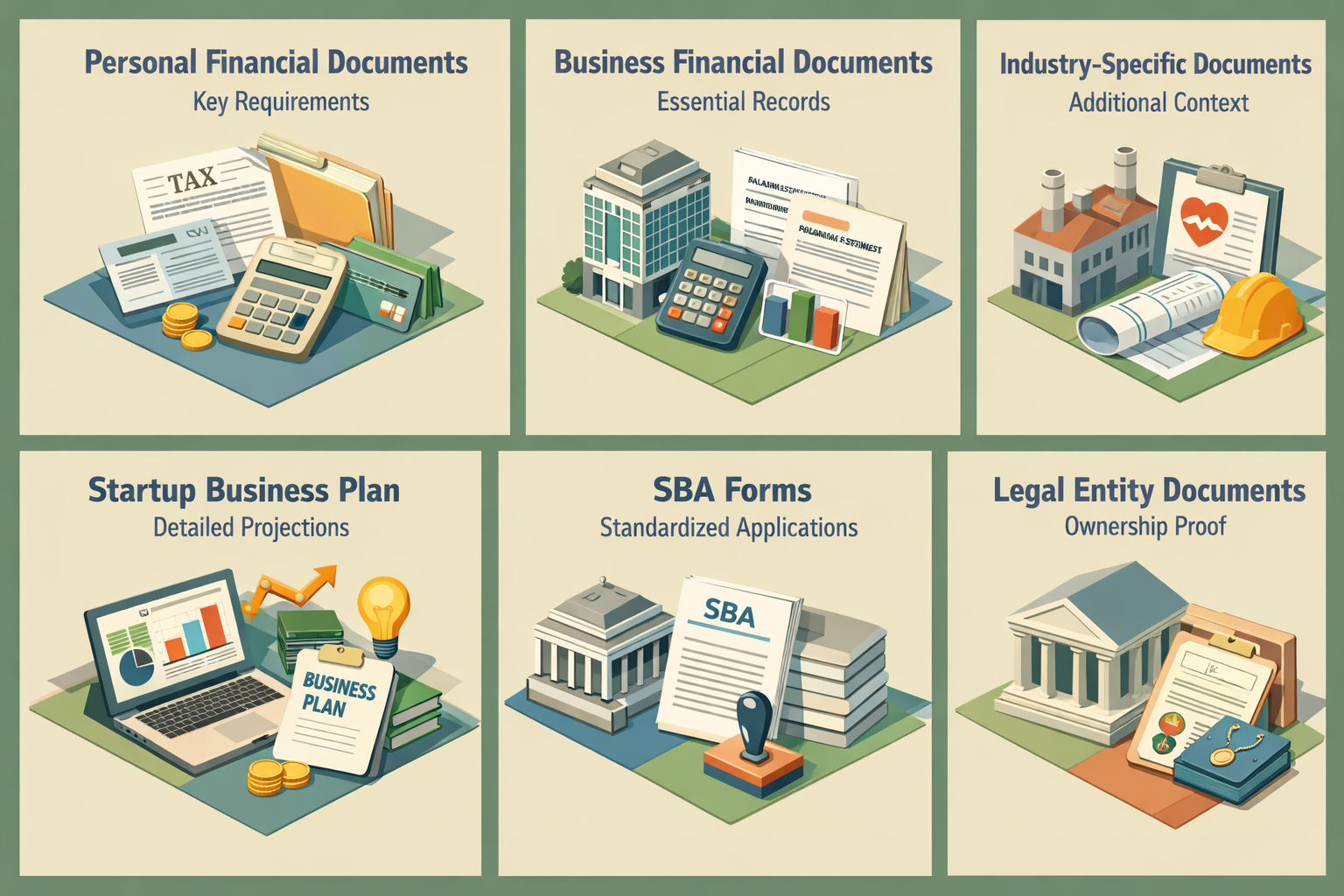
Whether you run a high-volume taxidermy studio or a boutique one-person operation, there's a standard set of documents that virtually every SBA 7(a) loan lender will request. These form the foundation of your loan package and help the lender assess your creditworthiness, business viability, and repayment capacity.
Personal Financial Documents
- Personal financial statement (SBA Form 413) — This form outlines your personal assets, liabilities, and net worth. Every owner with 20% or more stake in the business is typically required to complete one.
- Personal tax returns — Lenders usually want the last two to three years of personal federal tax returns to verify your income history and financial behavior.
- Government-issued photo ID — A valid driver's license or passport is standard.
- Resume or background statement — Especially for startup taxidermy businesses or those applying under the startup loan requirements for artisans framework, demonstrating relevant experience and training in taxidermy is important.
Business Financial Documents
- Business tax returns — Typically the last two to three years, if the business has been operating. These help lenders assess profitability trends.
- Profit and loss statements — Year-to-date figures, often prepared by an accountant, give lenders a current snapshot of business performance.
- Balance sheet — A current balance sheet listing assets (equipment, inventory, accounts receivable) and liabilities is standard.
- Business bank statements — Most lenders request three to six months of statements to verify cash flow patterns.
Industry-Specific Documents That Strengthen a Niche Business SBA Loan Application
Because taxidermy is a niche business SBA loan scenario, lenders may ask for additional context to understand your market and revenue model. Providing these proactively can demonstrate professionalism and reduce back-and-forth during underwriting.
Business Plan With Industry Context
A well-crafted business plan is arguably the most important document for any niche business applicant. For a taxidermy studio, this should include:
- A description of your services (e.g., big game mounts, birds, fish, freeze-dry pets, commercial specimen work)
- Your target customer segments (hunters, anglers, museums, scientific researchers, collectors)
- A competitive analysis of your local and regional market
- Revenue projections with realistic assumptions tied to hunting seasons, licensing, or contract work
- An explanation of how the loan funds will be used and how they'll contribute to growth or stability
Lenders who may not be familiar with the taxidermy trade will rely heavily on your business plan to understand the industry's seasonality, pricing structure, and demand drivers. A clear, confident narrative can make a meaningful difference.
Licenses, Permits, and Compliance Documentation
Taxidermy businesses are subject to federal, state, and sometimes local regulations — particularly when handling protected species under laws like the Migratory Bird Treaty Act or the Convention on International Trade in Endangered Species (CITES). Lenders may want to confirm your business is legally compliant, so gather:
- State taxidermy license or certification
- Any federal wildlife permits (U.S. Fish and Wildlife Service permits, if applicable)
- Business operating license and fictitious name registration (DBA), if relevant
- Zoning or facility use permits
Demonstrating regulatory compliance reduces lender risk concerns and shows that your operation is professionally managed.
What Documents Are Needed for an SBA 7(a) Loan for a Specialized Taxidermy Business When Starting From Scratch
If you're launching a new taxidermy studio rather than expanding an existing one, the documentation requirements shift somewhat. Since there's no operating history to review, lenders typically place greater emphasis on your personal financial strength, projected cash flows, and industry expertise.
For startup taxidermy businesses, expect to provide:
- A detailed startup business plan with realistic financial projections for at least two to three years, including monthly cash flow forecasts for the first year
- Startup cost breakdown — an itemized list of how loan funds will be spent, such as equipment, leasehold improvements, initial inventory, and working capital reserves
- Evidence of industry experience — certificates from taxidermy schools, competition awards, an apprenticeship history, or letters of recommendation from established taxidermists can all help
- Personal credit report and strong personal credit score — without a business credit history, personal creditworthiness carries more weight. Many SBA lenders look for a score of 650 or higher, though requirements vary by lender
- Collateral documentation — personal or business assets offered as security, including equipment appraisals or real estate valuations if applicable
It's worth noting that the SBA 7(a) loan program does not require perfect credit or a long operating history. However, startup applicants may face a somewhat higher bar because the lender assumes more risk. Presenting a thorough, organized package helps offset that concern.
SBA-Specific Forms and Legal Entity Documents
Beyond financial and business-specific documents, the SBA and participating lenders require several standardized forms as part of any 7(a) application. These are largely administrative but must be completed accurately to avoid delays.
Standard SBA Forms
- SBA Form 1919 (Borrower Information Form) — This is the main application form capturing details about the business, its owners, and the purpose of the loan.
- SBA Form 912 (Statement of Personal History) — Required if any principal has had legal or criminal history disclosures.
- SBA Form 413 (Personal Financial Statement) — As mentioned earlier, this covers all owners with 20% or greater ownership.
Legal Entity and Ownership Documents
- Articles of incorporation or organization — If your taxidermy business is structured as an LLC, S-corp, or C-corp, you'll need to provide your formation documents.
- Operating agreement or bylaws — These outline ownership structure and management responsibilities.
- Business ownership and affiliation disclosures — If you own interests in other businesses, lenders need to know to assess combined risk exposure.
- Lease agreement — If you're renting studio or retail space, a copy of your current lease (or a proposed lease for startups) is typically required.
How to Organize and Present Your Loan Package Effectively
Knowing what documents are needed for an SBA 7(a) loan for a specialized taxidermy business is only half the equation — how you present them matters too. Lenders process many applications, and a clean, well-organized package signals professionalism and preparedness.
Here are some practical tips for assembling your application:
- Work with an accountant or bookkeeper — Having professionally prepared financial statements rather than handwritten or informal records can significantly improve lender confidence, especially for niche or artisan businesses.
- Use a table of contents — Label each document clearly and organize your package in the order the lender requests. This reduces processing time and shows attention to detail.
- Explain unusual line items — If your profit and loss statement shows an irregular revenue spike (say, from a one-time museum commission) or a dip during a slow hunting season, include a brief written explanation. Context helps underwriters make accurate assessments.
- Be transparent about seasonality — Many taxidermy businesses experience revenue patterns tied to hunting seasons. Acknowledging this openly and showing how you manage cash flow during slower months actually builds trust rather than raising red flags.
- Consider working with an SBA Preferred Lender — These lenders have delegated authority to approve SBA loans without waiting for SBA review, which can speed up the process considerably. They may also have more experience working with unconventional business types.
●Conclusion
The path to securing an SBA 7(a) taxidermy loan may require a little more preparation than applying for a conventional business loan, but that preparation is well within reach. By assembling thorough personal and business financial records, crafting a compelling industry-specific business plan, confirming your regulatory compliance, and completing all required SBA forms, you give your application the strongest possible foundation. Niche businesses like specialized taxidermy studios aren't outside the scope of SBA lending — they simply require a more complete story to be told through documentation. If you're ready to take the next step, consider speaking with a knowledgeable lending advisor who understands small business financing and can guide you through the process. At LoanWise, we're here to help entrepreneurs in every industry find the right loan path forward.