For small business owners and entrepreneurs looking to grow, finding the right financing can feel overwhelming. There are dozens of loan products on the market, each with different terms, requirements, and use cases. But one program consistently stands out for businesses ready to invest in long-term assets: the SBA 504 loan. Whether you're looking to purchase commercial real estate, expand your facility, or acquire major equipment, SBA 504 loans may offer a compelling combination of low down payments, long repayment terms, and fixed interest rates. This article breaks down how the program works, who qualifies, and what small business owners should consider before applying.
What Is an SBA 504 Loan and How Does It Work?
The SBA 504 loan program is a government-backed financing option designed specifically to help small businesses purchase fixed assets that support growth and job creation. It's administered through the U.S. Small Business Administration in partnership with Certified Development Companies (CDCs) — nonprofit organizations that promote economic development within their communities.
Unlike a traditional bank loan where one lender funds the entire amount, SBA 504 loans use a unique three-party structure. Typically, a private lender — such as a bank or credit union — covers about 50% of the project cost. A CDC, backed by an SBA-guaranteed debenture, funds approximately 40%. The borrower then contributes a down payment of roughly 10%. This structure allows small business owners to access significant capital while keeping their upfront costs relatively manageable.
It's worth noting that the exact percentages can vary depending on factors such as the type of business, whether the project is considered a special use property, or whether the business is a startup. In some cases, the borrower's down payment requirement may be higher — closer to 15% to 20%.
What Can SBA 504 Loan Funds Be Used For?
One of the key features of this program is its focus on fixed, long-term assets. SBA 504 loan proceeds are generally intended for capital investments rather than working capital or inventory. Common eligible uses include:
- Purchasing owner-occupied commercial real estate, such as an office building, warehouse, or retail storefront
- Constructing or renovating an existing facility
- Buying major equipment or machinery with a long useful life
- Paying certain soft costs associated with the project, such as appraisals, environmental reports, or title insurance
It's important to understand what the program typically does not cover. SBA 504 funds generally cannot be used for working capital, inventory purchases, debt consolidation, or speculative real estate investments. Entrepreneurs who need flexible, short-term capital may want to explore other options, such as an SBA 7(a) loan or a business line of credit.
The emphasis on owner-occupied real estate is also significant. Borrowers typically need to occupy at least 51% of a newly purchased building or at least 60% of a newly constructed property to qualify. This makes the program particularly well-suited for established businesses that want to stop renting and invest in their own physical space.
Understanding the Loan Terms and Rate Structure
One of the most attractive features of the SBA 504 loan is its rate and term structure. The CDC portion of the loan typically carries a fixed interest rate, which can offer predictability and long-term stability for business planning. Repayment terms for the CDC portion are generally available in 10-year or 20-year maturities, and in some cases 25 years for real estate projects.
The private lender's portion of the loan — covering roughly 50% of the project — may carry its own terms, which could be fixed or variable depending on the lender. Business owners should carefully review both portions of the loan structure and compare the total cost of financing when evaluating this option.
Because the SBA guarantees the CDC's debenture, lenders may be more willing to offer competitive terms than they would on a conventional commercial loan. That said, rates and costs will still vary based on market conditions, the borrower's creditworthiness, and other factors. It's always advisable to work with a knowledgeable lending professional who can walk you through the full picture before committing.
Who Typically Qualifies for SBA 504 Financing?
The SBA 504 program is designed for for-profit businesses operating in the United States. To be eligible, a business generally needs to meet the SBA's definition of a small business, which is typically measured by net worth and net income rather than just revenue. Generally speaking, the business should have a tangible net worth of no more than $15 million and an average net income of no more than $5 million after federal income taxes for the two years preceding the application — though these figures should be verified directly with an SBA-approved lender, as program guidelines can be updated.
Beyond size standards, lenders and CDCs will also assess:
- Credit history — both the business and personal credit profiles of the principal owners
- Cash flow and debt service coverage — the ability of the business to comfortably make loan payments
- Management experience — demonstrated ability to run the business successfully
- Collateral — typically the asset being financed serves as collateral
- Job creation or retention — SBA 504 projects are expected to create or retain a certain number of jobs per $65,000 of CDC financing (or meet a community development goal)
Certain businesses are not eligible for SBA 504 financing, including non-profit organizations, passive investment businesses, and some financial institutions. Entrepreneurs should consult with a CDC or SBA-approved lender early in the process to confirm eligibility before investing significant time in an application.
How the Application Process Generally Unfolds
Applying for an SBA 504 loan is typically more involved than applying for a conventional business loan, largely because it involves multiple parties. The process generally includes the following steps:
- Find a CDC and a private lender — You'll need to work with both. Many banks have established relationships with local CDCs, which can simplify coordination.
- Gather financial documentation — Expect to provide business and personal tax returns, financial statements, a business plan, information about the project, and details about any existing debt.
- Submit your application — The CDC will submit its portion to the SBA for approval, while the private lender will underwrite its own portion separately.
- Wait for approval — SBA approval timelines can vary. Some applications may be processed within a few weeks, while more complex projects could take longer.
- Close and fund — Once approved, both portions of the loan close, though the timing of each may differ slightly.
Small business owners should plan ahead and allow adequate time for the process, especially if a real estate transaction has a specific closing deadline. Working with experienced professionals who know the SBA 504 program well can help streamline the experience.
Comparing SBA 504 Loans to Other Business Financing Options
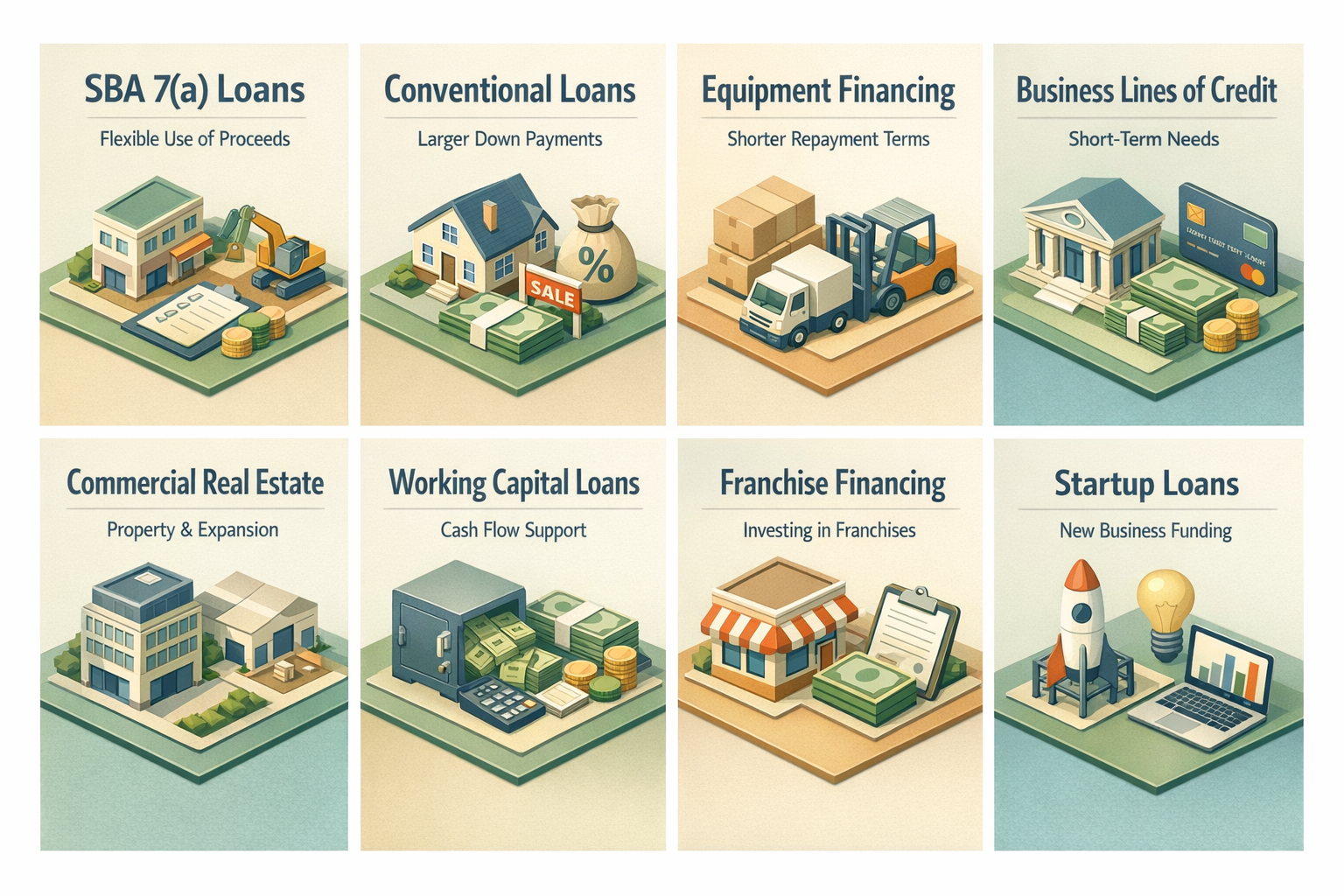
It's helpful to understand how SBA 504 loans compare to other common financing tools for small businesses and commercial borrowers. Each option has its own strengths depending on your needs:
- SBA 7(a) loans — More flexible in terms of use of proceeds, including working capital, but may carry variable rates and shorter terms for real estate compared to 504 loans.
- Conventional commercial real estate loans — Typically require larger down payments (often 25%–30%) and may not offer fixed rates for the full loan term.
- Equipment financing — Focused solely on equipment purchases, often with shorter repayment terms than SBA 504.
- Business lines of credit — Best for short-term, revolving needs rather than long-term capital investments.
For businesses that want to invest in owner-occupied finance commercial real estate or major equipment with a lower down payment and predictable fixed-rate financing, the SBA 504 program often stands out as a strong contender. However, the right choice depends on your specific situation, financial profile, and growth plans.
Tips for Strengthening Your SBA 504 Loan Application
Preparation can make a meaningful difference in the outcome of your application. Here are some practical steps small business owners and entrepreneurs can take to position themselves for success:
- Review your credit profile early — Both personal and business credit scores may influence your lender's decision. Address any errors or derogatory items before applying.
- Organize your financials — Have at least two to three years of business and personal tax returns ready, along with current financial statements.
- Document your business history and plan — Lenders and CDCs want to see a stable, well-managed business with a clear vision for growth.
- Understand your debt service coverage ratio — This ratio compares your net operating income to your total debt obligations. A stronger ratio may improve your chances of approval.
- Work with experienced advisors — An SBA-approved lender or a CDC with deep program expertise can help you navigate the process and avoid common pitfalls.
Taking time to prepare thoroughly before submitting your application could save significant time and reduce the risk of delays or denials.
●Conclusion
For small business owners and entrepreneurs ready to invest in their future, the SBA 504 loan program offers a well-structured path to long-term financing. With its unique combination of lower down payment requirements, fixed-rate stability on the CDC portion, and extended repayment terms, it's a program worth exploring seriously — particularly for those looking to purchase or improve owner-occupied commercial real estate or acquire significant equipment. Of course, every business's situation is different, and it's always wise to speak with a qualified lending professional before making any financing decisions. If you're considering this program, reaching out to an SBA-approved lender or a local CDC is a great first step toward understanding what may be possible for your business.