For small business owners looking to purchase commercial real estate, acquire heavy equipment, or invest in long-term fixed assets, the SBA 504 loan program is one of the most powerful financing tools available. With below-market fixed interest rates and long repayment terms, it's easy to see why so many entrepreneurs explore this option. But before you apply, it's essential to understand what are SBA 504 loan eligibility requirements — because not every business or project will qualify. This guide walks you through the key criteria in plain language so you can approach the process with confidence.
How the SBA 504 Loan Program Is Structured
The SBA 504 loan isn't a traditional single-lender loan. It's a three-party financing arrangement that brings together a private lender, a Certified Development Company (CDC), and the borrowing business. Typically, the structure works like this:
- The private lender — often a bank or credit union — covers roughly 50% of the total project cost.
- The CDC, which is a nonprofit organization licensed by the SBA, provides about 40% through SBA-backed debentures.
- The borrower contributes the remaining 10% as a down payment, though this may be higher for startups or special-use properties.
This structure keeps the borrower's upfront costs relatively low while giving lenders a strong security position. It also means the SBA 504 loan criteria involve both the borrowing business and the proposed project itself. Understanding this layered approach helps set realistic expectations before you begin gathering documents.
Core Business Eligibility: What the SBA Looks For
To qualify under the SBA 504 program, a business must meet several foundational requirements. These aren't optional — they form the baseline of every application review.
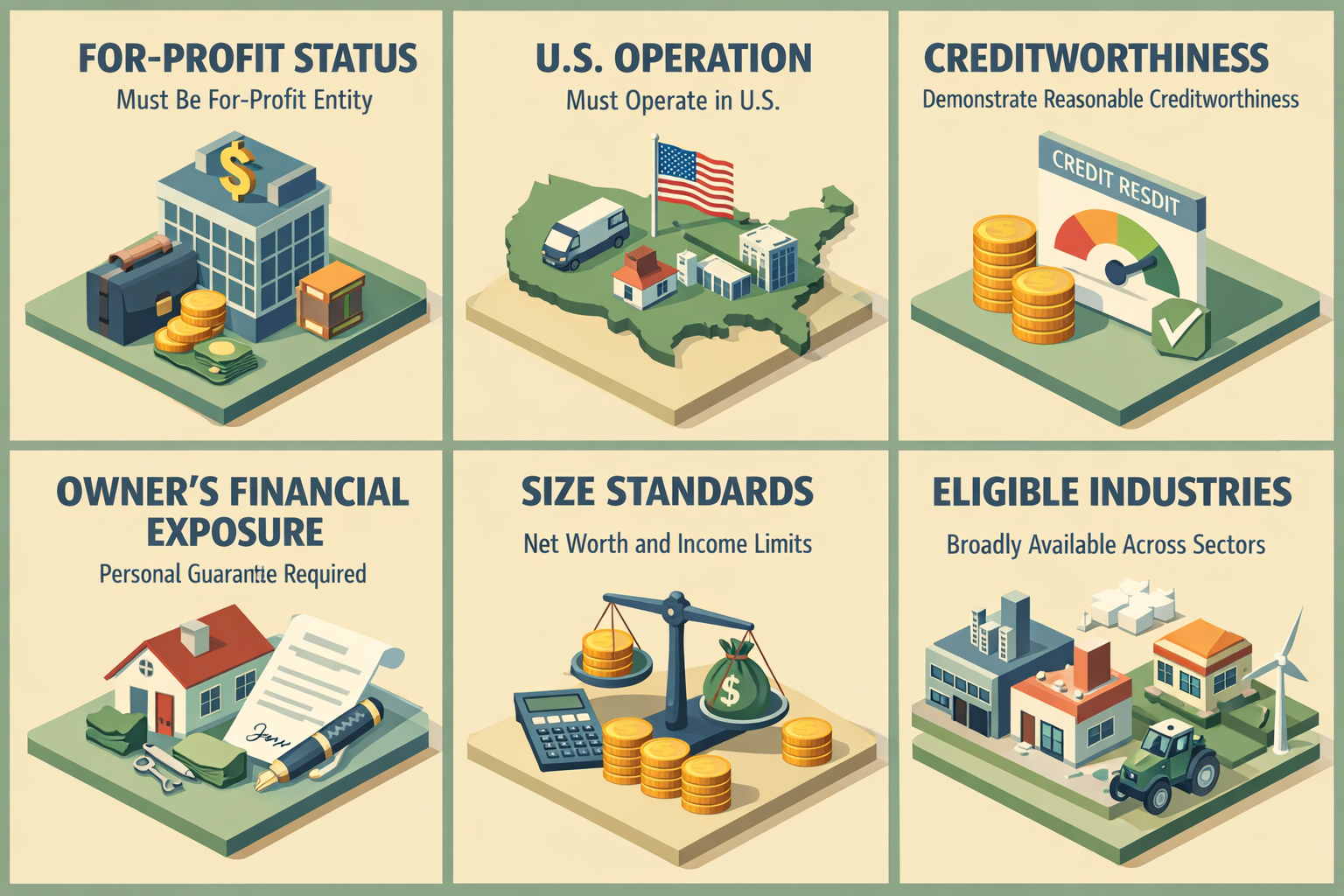
For-Profit Status
The business must be a for-profit entity. Nonprofit organizations are not eligible for SBA 504 financing, regardless of their size or industry. This distinction matters especially for organizations that may operate in a borderline commercial capacity.
U.S. Operation
The business must operate within the United States and its territories. Companies headquartered abroad or deriving the majority of their activity from outside the U.S. typically won't meet this requirement.
Creditworthiness and Financial Health
While the SBA doesn't publish a single minimum credit score for the 504 program, borrowers are generally expected to demonstrate reasonable creditworthiness. Lenders and CDCs will review your personal and business credit history, cash flow, existing debt levels, and overall financial management. A business that shows consistent revenue, manageable debt, and a responsible credit history will be in a much stronger position than one with unresolved delinquencies or recent bankruptcies.
Owner's Personal Financial Exposure
The SBA may also require a personal guarantee from owners holding 20% or more of the business. This ties personal financial responsibility to the loan, which is an important consideration for entrepreneurs going through the process for the first time.
Small Business Size Standards for the SBA 504 Program
One of the most important SBA 504 loan criteria is the size standard. Not every business qualifies as "small" by SBA definitions, and exceeding these thresholds will disqualify an applicant.
The small business size standards SBA 504 guidelines use two primary benchmarks:
- Net worth: The business must have a tangible net worth of no more than $15 million at the time of application.
- Net income: The business must have an average net income of no more than $5 million after federal income taxes for the two fiscal years prior to application.
These thresholds are relatively generous compared to some other loan programs, which means many mid-sized businesses may still qualify even if they feel like they've outgrown the "small business" label. It's worth running these numbers carefully before assuming you don't qualify.
If a business doesn't meet the above thresholds, the SBA may still consider it eligible based on alternative size standards tied to its specific industry classification under the North American Industry Classification System (NAICS). Consulting with a CDC or SBA resource partner can help clarify which standard applies to your business.
Eligible Industries for SBA 504 Financing
The SBA 504 program is broadly available across most business sectors, but there are notable exclusions. Understanding the eligible industries for SBA 504 can save time and help you avoid pursuing financing that ultimately won't work for your situation.
Generally Eligible Industries
Most for-profit businesses in the following sectors may be eligible:
- Manufacturing and industrial operations
- Retail businesses that own their commercial space
- Healthcare providers and medical practices
- Hospitality businesses such as hotels and motels
- Professional services firms
- Food service operations that own their facilities
- Agricultural enterprises (though farming operations may have additional considerations)
Ineligible or Restricted Businesses
Certain business types are explicitly excluded from the SBA 504 program, including:
- Non-profit organizations
- Passive investment businesses (businesses that exist purely to lease property to others without being an operating company)
- Businesses engaged in lending or financial speculation
- Gambling enterprises
- Businesses primarily deriving revenue from politically sensitive activities
- Businesses with prior SBA loan defaults or those currently delinquent on federal debt
It's worth noting that the line between an operating business and a passive investment entity can sometimes be nuanced. A real estate holding company that leases entirely to third parties, for example, would likely be ineligible. However, a manufacturing company that owns its own facility and leases a small portion of unused space to another tenant may still qualify under certain conditions. When in doubt, speak directly with a CDC or SBA-approved lender.
The Owner Occupancy Requirement Explained
One of the defining features of SBA 504 financing — and a key point of eligibility — is the owner occupancy requirement SBA 504 rules establish. This program is designed to help operating businesses invest in real assets they actively use, not to fund speculative real estate acquisitions.
Here's how the occupancy rules generally work:
- For existing buildings: The borrowing business must occupy at least 51% of the total usable square footage of the property being financed.
- For new construction: The owner-occupancy threshold increases to 60% initially, with a reasonable expectation that the business will occupy at least 80% of the space within ten years.
These rules are designed to ensure the SBA 504 loan supports genuine business growth rather than investment real estate activity. A business that purchases a multi-tenant office building and occupies more than half the space while leasing the remainder can still qualify — but the owner-occupancy threshold must be met and maintained.
For small business owners who are considering expansion, this requirement actually works in their favor. It encourages businesses to own the spaces where they operate, building long-term equity rather than continuing to pay rent to a landlord.
Job Creation and Community Development Goals
The SBA 504 program isn't just a lending product — it's a policy tool designed to stimulate economic growth in local communities. As part of the eligibility and approval process, projects are generally expected to contribute to one of the SBA's defined public policy goals.
The most commonly applied standard is the job creation or retention requirement. Businesses are typically expected to create or retain at least one job for every $75,000 of SBA 504 financing received (or $120,000 for manufacturers). These jobs should be created within two years of the project's completion.
If a business doesn't meet the jobs standard, it may still qualify by demonstrating that its project aligns with one of the SBA's alternative public policy goals, which may include:
- Revitalizing a low-to-moderate income area
- Supporting minority-owned or woman-owned businesses
- Promoting export expansion
- Improving energy efficiency or renewable energy capacity
- Supporting rural development
This flexibility makes the SBA 504 program accessible to a wide range of borrowers even when strict job creation targets may be difficult to achieve in the short term. Entrepreneurs who are investing in energy-efficient facilities or expanding in underserved markets, for example, may qualify through these alternative goals.
Preparing a Strong SBA 504 Application
Once you've confirmed that your business appears to meet what are SBA 504 loan eligibility requirements, the next step is building a complete and compelling application package. Preparation is everything in this process — a well-organized application can significantly reduce processing time and improve your approval odds.
Here's what you'll typically need to gather:
- Business financial statements: Two to three years of profit and loss statements and balance sheets, plus current-year interim financials.
- Personal financial statements: Completed for all owners with 20% or more ownership.
- Business and personal tax returns: Generally the past two to three years.
- Business plan or project narrative: A clear explanation of how the loan proceeds will be used and how the project supports business growth.
- Property information: Purchase agreements, appraisals, or construction plans, depending on the project type.
- Evidence of owner occupancy commitment: Documentation showing how the business will use the financed property.
- Details on job creation or public policy impact: A written statement or projection supporting your qualification under the relevant SBA goal.
Working with a CDC early in the process is strongly advisable. CDCs are experienced in packaging SBA 504 applications and can help identify any gaps before submission. Many also offer pre-qualification consultations at no cost, which can give you a realistic sense of where your application stands before investing significant time and resources.
●Conclusion
The SBA 504 loan program offers small business owners a genuinely compelling path to long-term asset ownership — but it comes with specific rules that borrowers must understand before applying. From the small business size standards SBA 504 guidelines to the owner occupancy minimums and job creation goals, each requirement serves a purpose in making sure the program reaches the businesses it was designed to help. If you believe your business may qualify, the best next step is connecting with a Certified Development Company or an SBA-approved lender who can evaluate your specific situation and guide you through the process. At LoanWise, we're here to help small business owners and entrepreneurs explore financing options with clarity and confidence — so you can focus on growing what you've built.