
For eligible veterans and active-duty service members, the VA loan program is one of the most powerful home financing tools available. It offers no down payment, competitive interest rates, and flexible qualifying standards. But when it comes to purchasing a multi-family property — like a duplex, triplex, or fourplex — with the intent to live in one of the units, many borrowers find themselves asking: what are closing costs for VA loan on multi-family property with owner occupancy? The answer involves a mix of standard mortgage fees, VA-specific charges, and some unique rules that could work in your favor. This guide breaks it all down so you can plan ahead and make the most of your VA benefit.
How VA Loans Work for Owner-Occupied Multi-Family Properties
Before diving into costs, it helps to understand the basic structure of using a VA loan for a multi-family property purchase. The VA loan program allows eligible borrowers to purchase properties with up to four units — commonly referred to as a duplex, triplex, or fourplex — as long as the borrower intends to live in one of the units as their primary residence. This owner-occupancy requirement is not optional; it's a firm condition of the VA program.
When you occupy one unit and rent out the others, you're essentially combining a personal home purchase with a real estate investment. The rental income from the additional units may even be considered when qualifying for the loan, which could help you meet income requirements. This makes multi-family VA loans particularly attractive for veterans looking to build long-term wealth while still taking advantage of their hard-earned benefit.
Because the property is classified as owner-occupied residential real estate (not a commercial investment), VA loan terms still apply — including the funding fee, appraisal requirements, and closing costs guidelines. Understanding how these elements interact is key to budgeting accurately for your purchase.
Breaking Down What Are Closing Costs for VA Loan on Multi-Family Property With Owner Occupancy
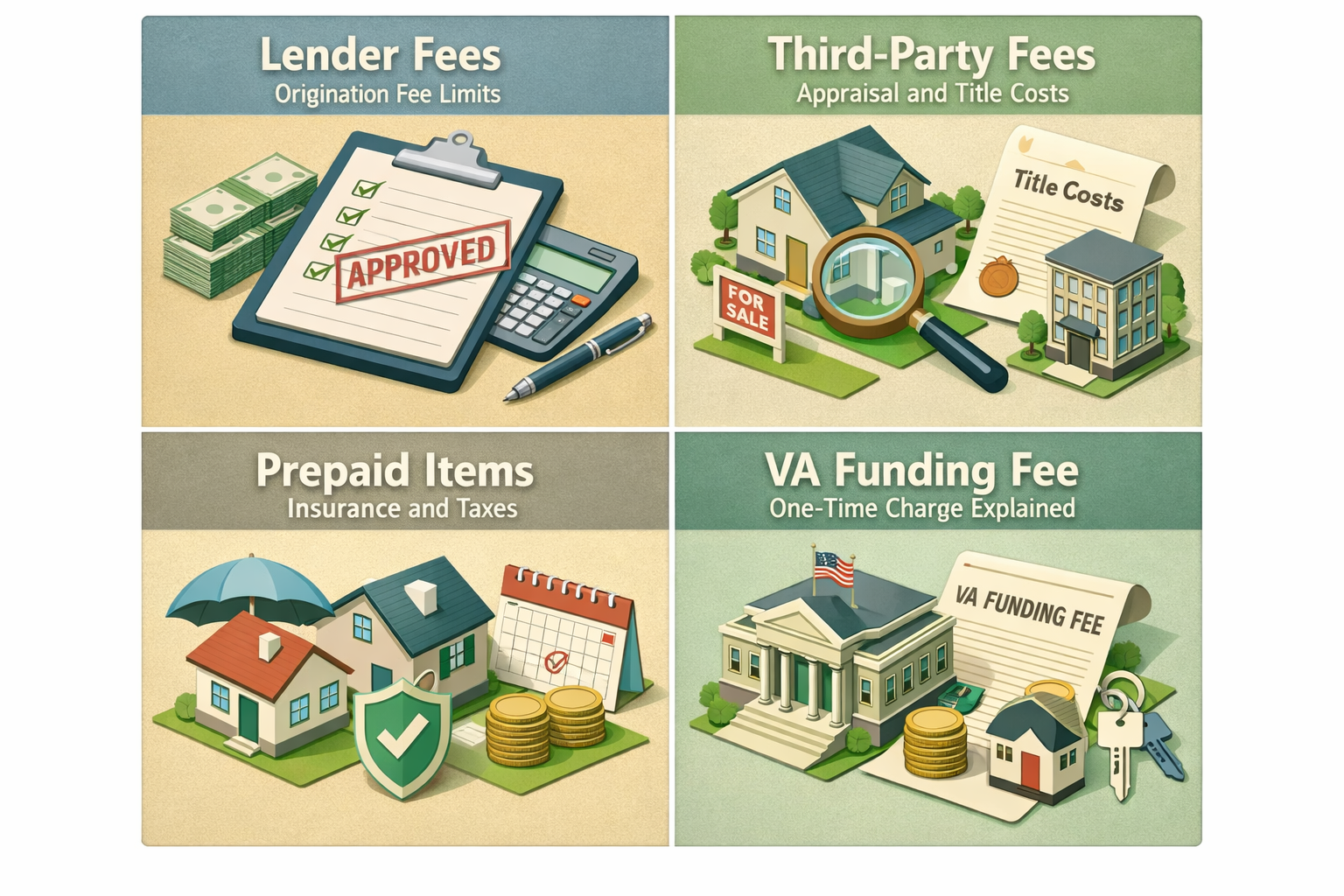
Closing costs are the fees and charges that both buyers and lenders pay to finalize a mortgage transaction. For a VA loan on a multi-family property, these costs typically fall into a few broad categories: lender fees, third-party service fees, prepaid items, and the VA funding fee. Let's look at each one.
Lender Fees
Lenders may charge an origination fee to cover the cost of processing and underwriting your loan. The VA limits origination fees to no more than 1% of the loan amount. Within this 1%, lenders can charge a flat fee or itemize specific costs like document preparation and processing. They cannot charge both a flat 1% fee and additional itemized fees simultaneously — the VA rules are designed to protect borrowers from fee stacking.
Third-Party and Settlement Fees
Beyond the lender's origination fee, you'll encounter charges from outside parties involved in the transaction. These may include:
- Appraisal fee: VA-required appraisals are conducted by VA-approved appraisers. For multi-unit properties, the appraisal may cost more than a single-family home appraisal due to the added complexity of evaluating multiple units and rental income potential.
- Title search and title insurance: These fees protect against ownership disputes and are typically required by the lender.
- Attorney or settlement agent fees: Depending on your state, a real estate attorney or escrow company may be required to oversee the closing.
- Recording fees: Charged by local government offices to record the new deed and mortgage documents.
- Survey fees: In some cases, a property survey may be required to confirm boundaries and identify any encroachments.
Prepaid Items and Escrow Deposits
Prepaid costs are not fees in the traditional sense — they're upfront payments for recurring expenses. These typically include prepaid homeowners insurance, prepaid property taxes, and prepaid mortgage interest for the days between closing and your first payment due date. For a multi-family property, insurance premiums may be slightly higher given the increased coverage needed for a larger structure with tenants.
The VA Funding Fee: A Critical Cost for Multi-Family Buyers
One of the most significant costs in any VA loan transaction is the VA funding fee. This is a one-time charge paid directly to the Department of Veterans Affairs. It helps sustain the VA loan program so future veterans can continue to benefit from it. Unlike many other closing costs, the funding fee can be rolled into the loan balance rather than paid at closing — which is a meaningful option for buyers who want to minimize out-of-pocket expenses.
The amount of the funding fee depends on several factors:
- Down payment amount: A higher down payment reduces the funding fee percentage. With no down payment, the fee is higher. With a 5% or more down payment, it decreases. With 10% or more down, it decreases further.
- First-time vs. subsequent use: First-time VA loan users typically pay a lower funding fee than those who have used the benefit before.
- Type of loan: Purchase loans carry different fee rates than refinances.
It's worth noting that certain veterans are exempt from the funding fee entirely. Those receiving VA disability compensation, surviving spouses of veterans who died in service or from a service-connected disability, and certain other eligible individuals may qualify for a full exemption. If you believe you may be exempt, confirm your status with your lender before closing to ensure the fee isn't incorrectly charged.
For a multi-family purchase with no down payment, the funding fee could represent a notable percentage of the loan amount. Rolling it into the loan is convenient, but it does mean you'll pay interest on that amount over the life of the loan — something worth considering when comparing your total cost of borrowing.
VA Loan Closing Costs Duplex Owner Occupied: What's Different About Multi-Unit Transactions
When exploring VA loan closing costs duplex owner occupied scenarios specifically, there are a few nuances that set multi-unit purchases apart from standard single-family home transactions.
Higher Appraisal Complexity
A duplex or larger multi-family property requires a more detailed appraisal than a single-family home. The VA appraiser must not only assess the physical condition of the property but also evaluate comparable rental data and the property's income-producing potential. This added complexity may translate into a higher appraisal fee compared to a typical single-family purchase.
Larger Loan Amounts and Proportionally Higher Fees
Multi-family properties tend to carry higher purchase prices than single-family homes in the same market. Since some fees — like the origination fee and funding fee — are calculated as a percentage of the loan amount, your closing costs in dollar terms may be meaningfully higher even if the percentage stays the same. Budgeting based on actual dollar amounts, not just percentages, is essential.
Potential for Rental Income to Offset Costs
While not a closing cost reduction in itself, it's worth understanding that lenders may be willing to count a portion of projected rental income from the non-owner-occupied units toward your qualifying income. This could help you qualify for a larger loan or meet debt-to-income requirements — indirectly making the transaction more financially accessible even when closing costs are higher.
Stricter Property Condition Requirements
VA appraisers enforce Minimum Property Requirements (MPRs) for all VA-financed homes. For multi-unit properties, each unit must meet these standards. If the property requires repairs to meet MPRs, you may need to negotiate with the seller to cover those costs — or budget for them separately before or at closing.
What Fees VA Prohibits Lenders From Charging
One of the biggest advantages of the VA loan program is its non-allowable fees rule. The VA explicitly prohibits lenders from charging veterans certain fees that are common in conventional mortgage transactions. Understanding these protections can help you spot overcharging and push back if necessary.
Fees that VA lenders are generally not permitted to charge include:
- Brokerage fees or commissions paid to mortgage brokers (beyond the 1% origination cap)
- Prepayment penalties
- Loan application fees (when charged outside the 1% origination cap)
- Document preparation fees (when charged separately outside the 1% cap)
- Settlement or closing fees charged by the lender itself (as opposed to legitimate third-party costs)
It's important to distinguish between what the lender can charge versus what third parties (like title companies, appraisers, or attorneys) can charge. Third-party fees are generally allowable as long as they're reasonable and customary for your area. Always review your Loan Estimate carefully and compare it line by line against your Closing Disclosure to ensure no unexpected or prohibited fees appear before you sign.
Strategies to Reduce Out-of-Pocket Closing Costs on a VA Multi-Family Purchase
Closing costs can add up, but there are practical strategies that may help you reduce what you pay out of pocket when buying a multi-family property with a VA loan.
Negotiate Seller Concessions
The VA allows sellers to pay up to 4% of the loan amount in concessions toward the buyer's closing costs, on top of any allowable lender credits. This is a meaningful opportunity — especially in a buyer-friendly market where sellers may be more willing to negotiate. Seller concessions can cover prepaid items, the VA funding fee, and other allowable closing costs.
Ask for Lender Credits
Some lenders offer lender credits in exchange for a slightly higher interest rate. This means you'd pay less at closing but more over the life of the loan through a modestly higher monthly payment. Whether this trade-off makes sense depends on how long you plan to stay in the property and your current cash flow situation.
Roll the Funding Fee Into the Loan
As mentioned earlier, rolling the VA funding fee into your loan balance is a widely used option that eliminates one of the largest single closing costs from your upfront expenses. Just be mindful of the long-term interest cost this creates.
Shop Third-Party Service Providers
In many states, you have the right to shop for certain services — like title insurance and settlement agents — rather than using whoever your lender recommends. Getting competitive quotes for these services could meaningfully reduce your total closing costs.
Close at the End of the Month
Prepaid mortgage interest covers the period from your closing date to the end of the month. Closing near the end of the month minimizes this prepaid amount, which can save you a few hundred dollars depending on your loan size and interest rate.
●Conclusion
Understanding what are closing costs for VA loan on multi-family property with owner occupancy is an essential step for any veteran or active-duty borrower looking to combine the benefits of homeownership with rental income potential. From the VA funding fee and appraisal charges to lender origination limits and non-allowable fee protections, the VA program provides meaningful guardrails that work in your favor — but the costs still add up, especially on larger multi-unit properties.
The good news is that with the right preparation, strategic negotiation, and a knowledgeable lender on your side, you can significantly reduce what you pay at closing. Whether you're eyeing a duplex to offset your mortgage with rental income or a fourplex to accelerate your real estate investment journey, a VA loan may offer a path forward that conventional financing simply can't match. At LoanWise, our team is ready to help you navigate every detail — from your first Loan Estimate to the day you pick up the keys. Reach out today to explore your VA multi-family financing options.