
For many tech professionals, executives, and corporate employees, a significant portion of income doesn't come from a regular paycheck. Instead, it arrives through stock options, restricted stock units (RSUs), or deferred compensation plans. While this kind of compensation can be quite substantial, it creates a unique challenge when it's time to buy a home. Knowing how to calculate mortgage affordability with stock options and deferred compensation is essential if you want to secure the right loan and avoid surprises during the approval process. The good news is that lenders do have established guidelines for evaluating these income types — it just takes some preparation and the right strategy.
Why Variable Income Makes Mortgage Qualification More Complex
Traditional mortgage qualification is built around predictable, recurring income. A salaried borrower with consistent W-2 earnings is relatively straightforward to underwrite. But when a meaningful share of your earnings comes from equity compensation or deferred pay, lenders need to assess whether that income is stable, likely to continue, and verifiable.
Stock options and deferred compensation are considered variable income — meaning they can fluctuate based on company performance, vesting schedules, or employer decisions. Because of this, most lenders apply additional scrutiny before counting these income sources toward your qualifying amount. They typically want to see a history of receiving this income and evidence that it's likely to continue for at least the next two to three years.
This doesn't mean you can't qualify — it simply means the process requires more documentation and, in some cases, a lender who has experience working with borrowers who have complex compensation structures.
How Lenders Evaluate Stock Options and RSUs for Mortgage Purposes
When it comes to stock-based compensation, lenders generally distinguish between vested stock options, restricted stock units (RSUs), and non-qualified stock options (NSOs). Each type is treated somewhat differently during the underwriting process.
For RSUs, lenders may count a portion of the income if you can demonstrate a consistent two-year history of receiving vested shares. They'll typically average the value of vested RSUs over the past 24 months using your tax returns and employer documentation. If your RSU income has been increasing, lenders may use a more conservative average to reduce risk.
Stock options that haven't vested yet are generally not counted as qualifying income. Only options that have been exercised and converted to actual income — reflected on your W-2 or tax return — may be considered. Lenders will also want assurance that your employer's equity program is likely to continue, often requesting a current employer letter or vesting schedule.
- Two-year history: Most lenders require at least two years of documented equity income before they'll count it.
- Income averaging: Lenders typically average the past 24 months of RSU or option income rather than using the most recent year's figure.
- Continuation requirement: There should be evidence that equity grants will continue for at least two to three more years.
- Tax return documentation: Your Schedule D, W-2 supplemental forms, and 1099s may all be reviewed.
Understanding How Deferred Compensation Is Treated by Mortgage Underwriters
Deferred compensation refers to a portion of your earnings that is set aside today and paid out at a future date — often as part of an executive compensation or retirement arrangement. Common examples include 401(k) plans, non-qualified deferred compensation (NQDC) plans, and supplemental executive retirement plans (SERPs).
The way mortgage underwriters handle deferred compensation depends heavily on whether the income is currently being received or scheduled to be received in the future. If you're already drawing from a deferred compensation plan — for example, a retiring executive receiving monthly distributions — many lenders will count that as qualifying income, provided it's documented and expected to continue for at least three years.
However, if the compensation is still being deferred and won't be paid out until retirement or a future date, it generally cannot be used to qualify for a mortgage today. In that case, lenders will focus on your current base salary and any other income you actively receive.
It's also worth noting that some non-qualified deferred compensation plans carry forfeiture risk — meaning the income could be lost if you leave your employer. Lenders are aware of this and may apply additional scrutiny or choose not to count such income at all, depending on their guidelines.
A Practical Look at How to Calculate Mortgage Affordability with Stock Options and Deferred Compensation
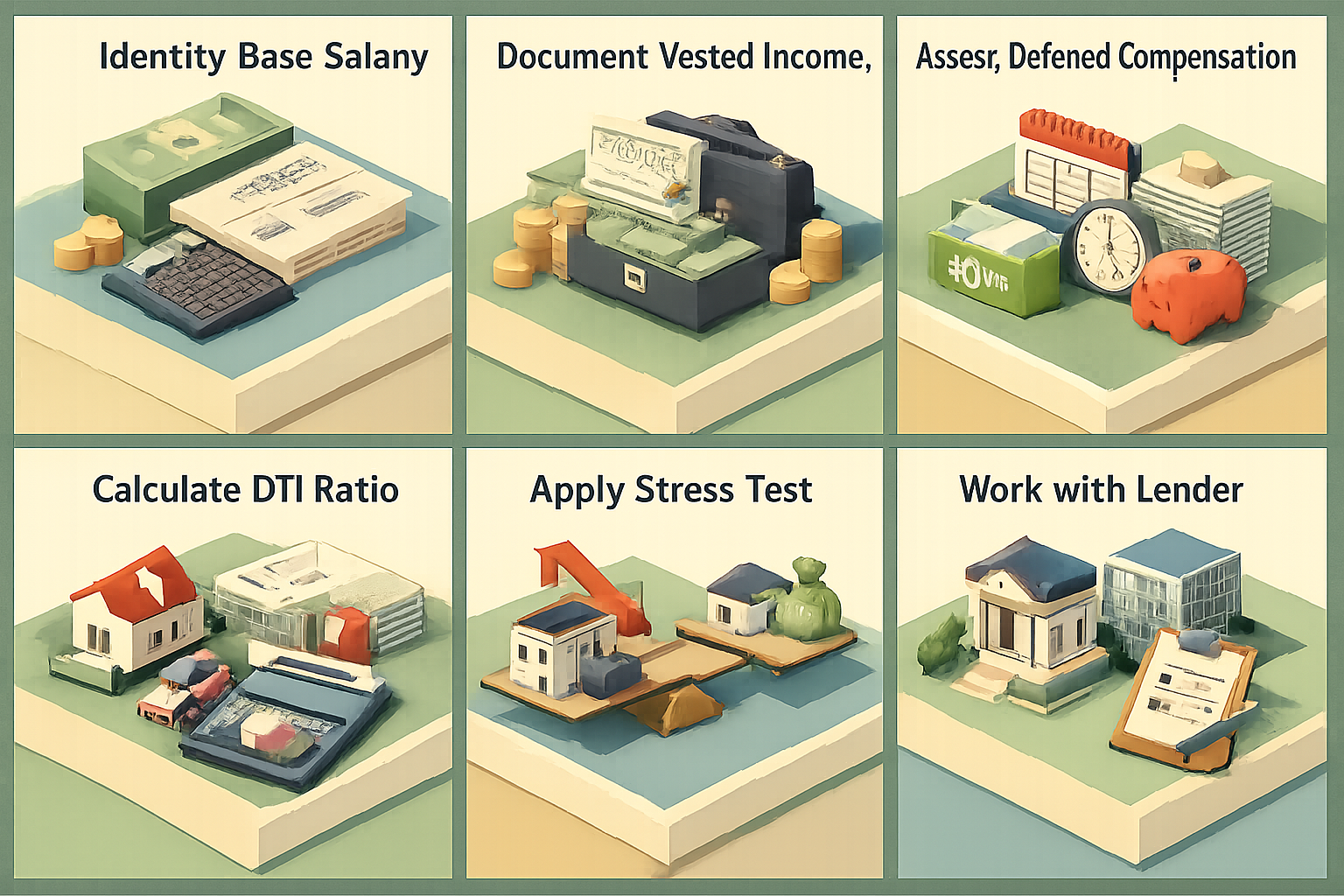
Understanding how to calculate mortgage affordability with stock options and deferred compensation starts with identifying which portions of your income a lender is likely to count. Here's a simplified framework to get you started:
- Step 1 — Identify your base salary: This is your guaranteed annual income and is generally the most straightforward component. Divide by 12 to get your monthly qualifying income baseline.
- Step 2 — Document vested RSU or option income: Pull your last two years of tax returns and identify any equity income that was exercised and reported. Average those two figures and divide by 24 to find a monthly average.
- Step 3 — Assess deferred compensation distributions: If you're currently receiving deferred compensation payments, gather statements showing the amount and expected duration. Lenders will want to confirm this continues for at least three years.
- Step 4 — Calculate your debt-to-income ratio (DTI): Add up all qualifying monthly income sources. Then divide your total monthly debt obligations — including your estimated mortgage payment — by that income figure. Most conventional lenders prefer a DTI at or below 43%, though some programs may allow higher ratios with compensating factors.
- Step 5 — Apply a stress test: Consider what your affordability looks like if your equity income drops or is excluded. This helps you identify a conservative purchase price that's sustainable even in a down year.
Working with a lender who specializes in complex income borrowers can make this process significantly smoother. They'll know which guidelines apply to your situation and can help you structure your application to maximize the income that qualifies.
Mortgage Pre-Approval for Borrowers with Stock Options and Deferred Compensation
Getting mortgage pre-approval with stock options and deferred compensation requires more documentation than a standard pre-approval. Being organized upfront can help prevent delays and strengthen your offer when you find the right property.
Here's what lenders typically request from borrowers with equity or deferred compensation income:
- Two years of complete federal tax returns (all schedules included)
- W-2s and any supplemental equity income statements for the past two years
- Most recent pay stubs showing year-to-date earnings
- Current vesting schedule from your employer
- An employer letter confirming that equity grants or deferred pay distributions are expected to continue
- Brokerage account statements showing existing vested shares (if being used as assets)
- Documentation of any NQDC plan, including distribution schedule and terms
It's also important to understand that some lenders may be more conservative than others when it comes to equity income. If one lender declines to count a portion of your compensation, another lender — particularly one with jumbo or non-QM lending experience — may have more flexible guidelines. Shopping your mortgage pre-approval stock options is always a smart move when your income profile is non-traditional.
Strategies to Strengthen Your Home Loan Application
If you're concerned that variable income might limit your borrowing power, there are several strategies that could help you present a stronger application.
Build Up Liquid Reserves
Lenders view large cash reserves favorably, especially for borrowers with variable income. Having six to twelve months of mortgage payments in liquid savings may help offset any concerns about income stability. Vested stock shares held in brokerage accounts may also count toward reserves, depending on lender guidelines.
Consider a Larger Down Payment
A higher down payment reduces the lender's risk and may give you access to better terms. It also lowers your loan-to-value (LTV) ratio, which can be helpful when lenders are applying conservative income assumptions. Borrowers with equity income often have appreciated stock holdings that could be strategically liquidated to fund a larger down payment.
Work on Your Debt-to-Income Ratio
If your qualifying income is lower than you'd like because some equity income doesn't count, reducing your monthly debt obligations can be just as effective. Paying off a car loan or student loan before applying could meaningfully improve your DTI ratio and expand your purchase budget.
Explore Jumbo and Non-QM Loan Options
High-earning executives or tech professionals often find that their home purchase ambitions exceed conventional loan limits. Jumbo lenders and non-QM programs may have more flexible approaches to counting equity income, especially if you have strong credit, substantial assets, and a well-documented income history.
●Conclusion
Navigating the mortgage process with stock options or deferred compensation doesn't have to be overwhelming. While the income analysis is more complex, lenders do have established pathways to credit these earnings — provided you have the right documentation and work with someone who understands your situation. Knowing how to calculate mortgage affordability with stock options and deferred compensation gives you a realistic picture of your buying power before you start house hunting, so you can shop with confidence. At LoanWise, we work with borrowers across a wide range of income profiles and compensation structures. Whether you're an executive preparing for your next home purchase or a tech professional exploring refinancing options, our team is here to help you find the right mortgage solution for your unique financial picture. Reach out today to start your personalized pre-approval conversation.