
When exploring VA loan benefits, understanding the funding fee structure becomes essential for military borrowers planning their home purchase or refinance. This mandatory fee helps sustain the VA loan program while typically offering more favorable terms than conventional financing options. Veterans, active-duty service members, and eligible spouses should familiarize themselves with how these fees work and when exemptions might apply to their specific situation.
What is the VA Loan Funding Fee
The VA loan funding fee represents a one-time payment required for most VA-backed mortgages, designed to help offset the program's costs to taxpayers. This fee typically ranges from 1.4% to 3.6% of the total loan amount, depending on several factors including military service type, down payment amount, and whether it's a first-time or subsequent use of VA loan benefits.
Unlike private mortgage insurance required on conventional loans, the funding fee serves as a one-time cost that can be financed into the loan amount rather than requiring upfront payment. This structure allows eligible borrowers to access homeownership without significant cash outlays while supporting the program's long-term sustainability.
The fee applies to various loan types within the VA program, including purchase loans, refinancing options, and certain assumable mortgages. However, specific exemptions exist for qualifying veterans and service members based on disability ratings and other circumstances.
Current Funding Fee Rates and Structure
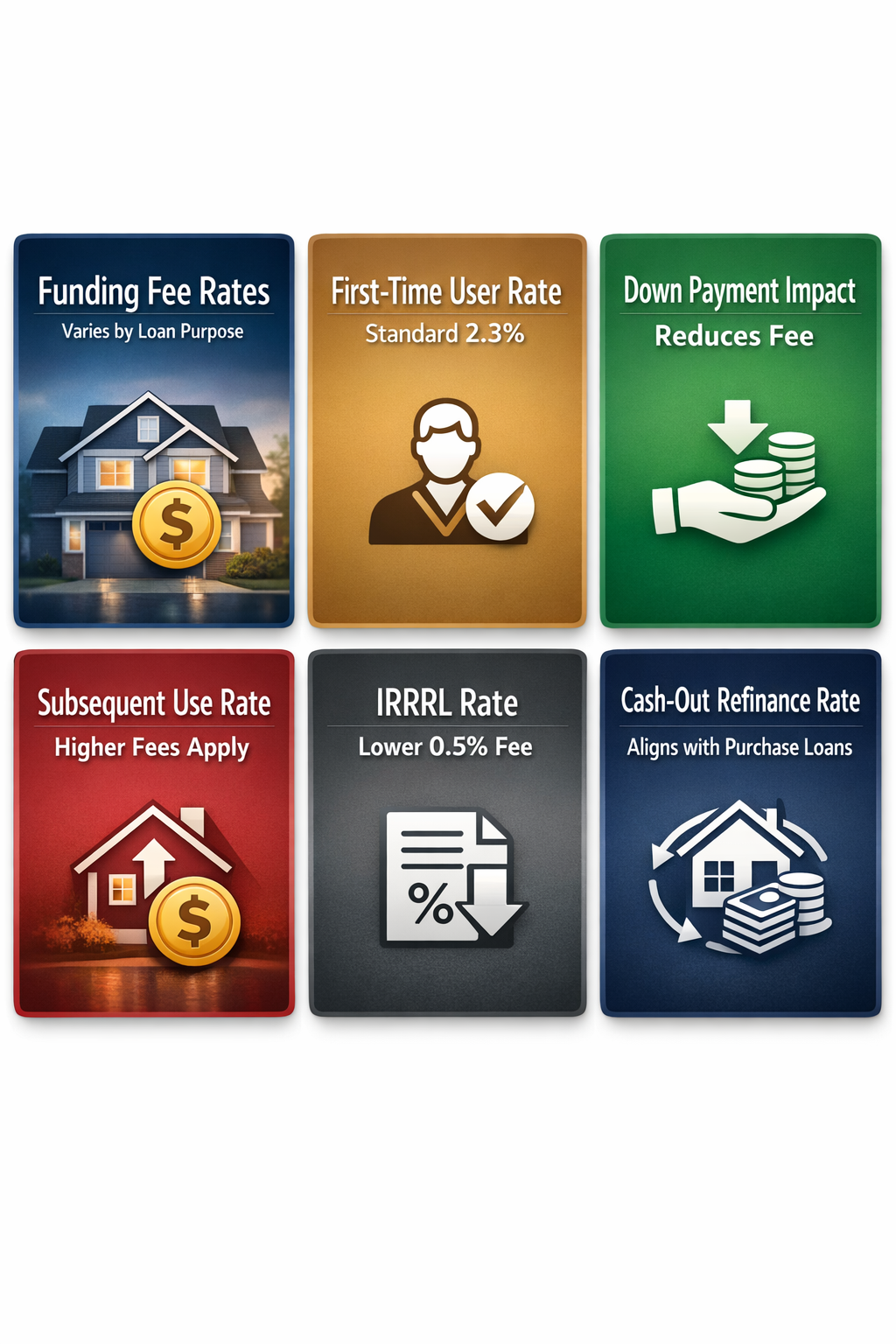
VA loan funding fee rates vary significantly based on loan purpose and borrower circumstances. For first-time users making no down payment, the standard rate typically stands at 2.3% of the loan amount. Veterans making down payments of 5% or more often qualify for reduced rates around 1.65%, while those contributing 10% or more may see rates as low as 1.4%.
Subsequent use of VA loan benefits generally carries higher funding fee rates, often ranging from 3.6% for zero-down purchases to 1.4% for loans with substantial down payments. These increased rates for repeat users help balance program costs while still providing valuable financing opportunities for eligible borrowers.
Interest Rate Reduction Refinance Loans (IRRRL), also known as VA streamline refinances, typically feature lower funding fee rates around 0.5% of the loan amount. Cash-out refinancing options usually align with purchase loan rates, reflecting the increased risk profile of these transactions.
Who Qualifies for Funding Fee Exemptions
Veterans receiving VA disability compensation for service-connected disabilities may qualify for complete funding fee exemptions, regardless of their disability rating percentage. This exemption applies to both the veteran and their surviving spouse when using VA loan benefits, providing significant cost savings during the home financing process.
Service members receiving disability retirement pay from their branch of service also qualify for exemptions, along with veterans eligible for disability compensation who haven't yet received their rating determination. Purple Heart recipients automatically qualify for exemption consideration, recognizing their service-connected injuries sustained in combat situations.
Surviving spouses of veterans who died from service-connected disabilities or while receiving VA disability compensation may access funding fee exemptions when purchasing homes through the VA loan program. These provisions ensure that families affected by service-related circumstances receive appropriate financial support during their homebuying journey.
How to Calculate Your Funding Fee
Calculating your VA loan funding fee requires identifying your specific rate category based on loan type, down payment amount, and usage history. For example, a first-time user purchasing a $400,000 home with no down payment would face a funding fee of approximately $9,200 at the standard 2.3% rate.
Veterans making down payments can significantly reduce their funding fee obligations. Using the same $400,000 purchase example, a 5% down payment ($20,000) would lower the funding fee to roughly $6,600, while a 10% down payment would reduce it to about $5,600, demonstrating the financial benefits of larger down payments.
Refinancing scenarios follow similar calculation methods, though rates may differ based on loan type. A $300,000 IRRRL would typically result in a $1,500 funding fee at the 0.5% rate, while a cash-out refinance might carry the full purchase loan rates depending on the borrower's usage history and other qualifying factors.
Payment Options and Financing Strategies
Most borrowers choose to finance their VA loan funding fee into the total loan amount, spreading the cost over the entire mortgage term. This approach eliminates upfront cash requirements while slightly increasing monthly payments and total interest paid over the loan's duration.
Paying the funding fee upfront at closing reduces the overall loan balance and can result in lower monthly payments throughout the mortgage term. Veterans with available cash reserves might consider this option, particularly for smaller loan amounts where the fee represents a manageable one-time expense.
Some lenders may offer alternative payment arrangements or timing options, though these vary by institution and loan program. Borrowers should discuss available options with their mortgage professional to determine the most suitable approach based on their financial circumstances and long-term homeownership goals.
Impact on Loan Approval and Affordability
The VA loan funding fee typically doesn't affect loan approval decisions directly, as it's built into the program structure rather than representing an additional qualification hurdle. However, financing the fee into the loan amount increases the total mortgage debt, which could impact debt-to-income ratios for borrowers near qualification thresholds.
Lenders consider the increased loan amount when calculating monthly payment obligations and overall affordability metrics. Veterans should factor both the base loan amount and funding fee into their budget planning to ensure comfortable payment levels throughout the mortgage term.
For borrowers exempt from funding fees due to disability status, the elimination of this cost can improve affordability and potentially allow for higher loan amounts within VA guidelines. This benefit often makes homeownership more accessible for disabled veterans and their families.
Comparing VA Funding Fees to Other Loan Costs
When compared to conventional loan costs, VA funding fees often represent competitive value despite the upfront expense. Conventional loans typically require private mortgage insurance for borrowers with less than 20% down payment, which can cost 0.5% to 1% of the loan amount annually, creating ongoing monthly expenses.
FHA loans carry both upfront mortgage insurance premiums (1.75% of loan amount) and ongoing monthly premiums, often resulting in higher total costs over the loan term. VA funding fees, being one-time expenses, may provide long-term savings for qualified military borrowers.
The absence of ongoing mortgage insurance with VA loans creates additional value beyond the funding fee comparison. Veterans keeping their loans for extended periods often realize significant savings compared to conventional financing options, making the initial funding fee investment worthwhile for long-term homeowners.
●Conclusion
Understanding VA loan funding fees empowers military borrowers to make informed financing decisions while maximizing their earned benefits. Whether paying upfront or financing into the loan, veterans should work with experienced mortgage professionals who understand the nuances of VA lending and can help optimize their overall financing strategy. For those qualifying for exemptions, the elimination of funding fees represents substantial savings and improved affordability in their homeownership journey.