
Buying a home is one of the most exciting financial milestones you can reach — but for gig workers carrying student loan debt, the path to homeownership can feel unusually complicated. If you earn income through freelancing, ridesharing, delivery services, or contract work, lenders may evaluate your finances differently than they would a salaried employee. Add deferred student loans into the mix, and the picture gets even more nuanced. Understanding how to calculate mortgage affordability with gig economy income and student loan deferment is the first step toward knowing where you stand and what you can realistically qualify for. This guide walks you through the key concepts, lender expectations, and practical strategies to help you move forward with confidence.
Why Gig Income Creates Unique Mortgage Qualification Challenges
Traditional mortgage underwriting was built around predictable, W-2 employment. When you earn a steady paycheck from a single employer, lenders can easily verify your income, assess your stability, and calculate your debt-to-income (DTI) ratio. Gig economy workers, however, often experience income that varies month to month, comes from multiple clients or platforms, and is reported on 1099 forms or through self-employment tax filings.
Most lenders will want to see at least two years of self-employment or gig income history before they feel comfortable using it to qualify you for a mortgage. They typically average your net income — meaning income after business expenses — over those two years. If your income has been declining, some lenders may use the lower of the two years or raise additional questions. This is important to understand before you start shopping for a home, because it could affect how much house you can actually afford.
A gig worker mortgage calculator can be a helpful starting point, but it won't replace a thorough review of your tax returns and profit-and-loss statements. Being prepared with organized documentation is one of the strongest moves you can make as a freelance or contract borrower.
Breaking Down Debt-to-Income Ratio for Freelancers and Contract Workers
Your debt-to-income (DTI) ratio is one of the most critical numbers in the mortgage approval process. It compares your total monthly debt obligations to your gross monthly income. Most conventional loan programs prefer a DTI at or below 43%, though some programs may allow higher ratios under certain conditions.
For gig workers, calculating gross monthly income isn't always straightforward. Lenders typically look at your net self-employment income — after deducting legitimate business expenses — and then divide that by 24 months to arrive at a monthly figure. This means that aggressive tax deductions, while beneficial at tax time, could reduce the income lenders count toward your mortgage affordability.
- Front-end DTI: The percentage of your gross monthly income that goes toward housing costs, including principal, interest, taxes, and insurance. Lenders often prefer this to stay below 28% to 31%.
- Back-end DTI: The percentage that covers all monthly debt obligations, including housing, car payments, credit cards, and student loans. This is where deferred student loans become especially relevant.
It's worth working with a lender or mortgage advisor who has experience with self-employed and gig borrowers. They can help you understand exactly how your income will be calculated and what steps you might take to improve your qualifying numbers before applying.
How to Calculate Mortgage Affordability With Gig Economy Income and Student Loan Deferment
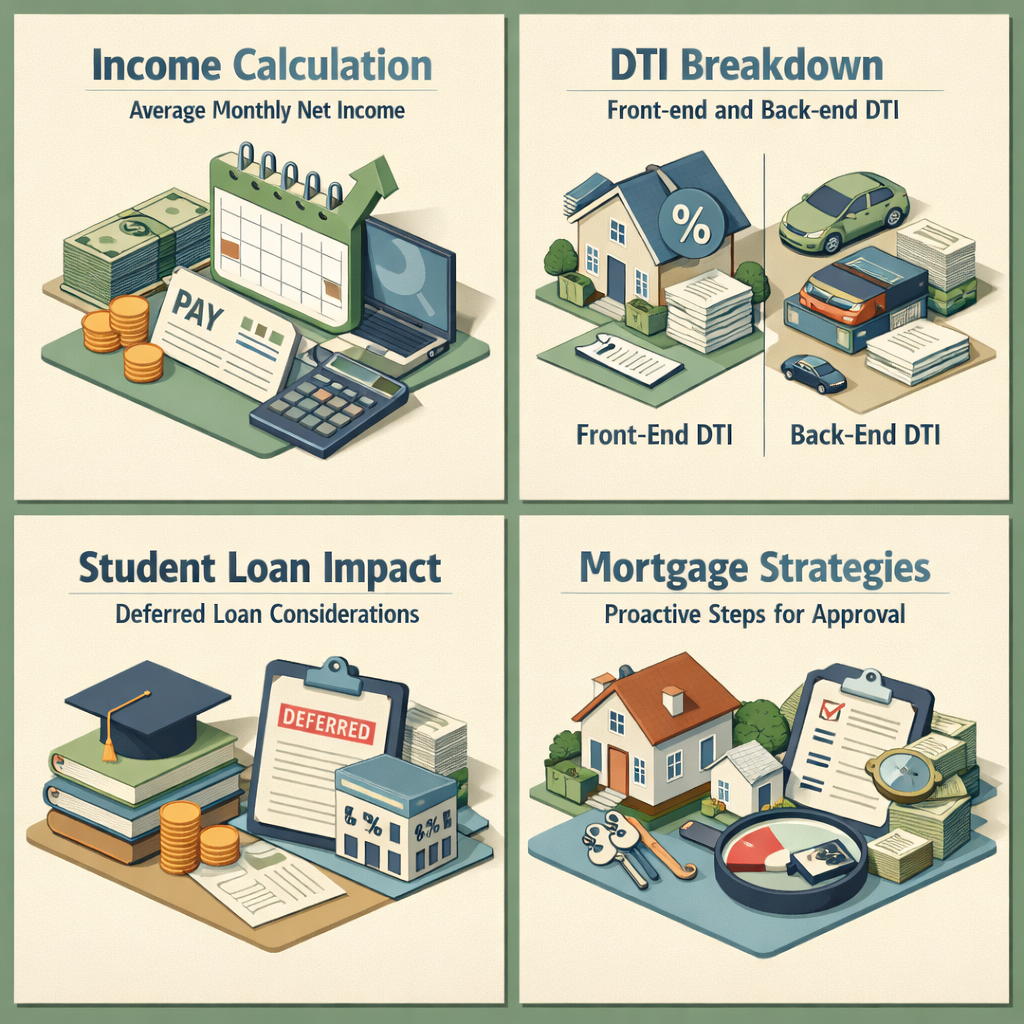
Understanding how to calculate mortgage affordability with gig economy income and student loan deferment requires looking at two moving parts at the same time: your variable income and your deferred debt. Both play a direct role in what lenders will approve you for.
Start by estimating your average monthly net income using your last two years of tax returns. If your Schedule C shows $60,000 in net profit over two years, lenders would typically use $2,500 per month as your qualifying income. From there, you'd apply the standard DTI formula:
- Multiply your monthly qualifying income by your lender's maximum DTI (e.g., 0.43 for a 43% DTI cap).
- Subtract all existing monthly debt payments — including the student loan figure the lender counts — from that result.
- The remaining amount represents the maximum monthly housing payment you may be able to afford.
The tricky part is the student loan deferment calculation. Even if your loans are currently deferred, most lenders will still count a payment against your DTI. How they calculate that payment depends on the loan program and lender guidelines. Some use a flat percentage of the outstanding loan balance — often around 1% — while others may use the fully amortized payment or the income-driven repayment amount shown on your credit report.
For example, if you have $40,000 in deferred student loans and your lender uses a 1% rule, they may count $400 per month as a debt obligation — even if you're not currently making payments. That $400 directly reduces the housing budget your DTI calculation allows.
Student Loan Impact on Mortgage Eligibility: What Borrowers Need to Know
The student loan impact on mortgage qualification is frequently misunderstood. Many borrowers assume that because their loans are deferred, lenders won't count them. Unfortunately, that's rarely how it works. Guidelines vary by loan program, but most lenders are required to account for deferred student loan debt in some form.
How Different Loan Programs Handle Deferred Student Loans
Each major mortgage program has its own approach to deferred student debt:
- Conventional loans (Fannie Mae/Freddie Mac): These programs generally require lenders to include a payment in the DTI calculation, even during deferment. The amount may be based on the loan statement, an income-driven repayment plan, or a percentage of the balance.
- FHA loans: FHA guidelines typically require lenders to count a monthly payment of at least 1% of the outstanding student loan balance if the loan is deferred, or use the actual documented payment if it's available.
- VA loans: For eligible veterans, VA guidelines may allow deferred student loans to be excluded from DTI if deferment extends beyond a certain period — though guidelines can shift, so it's wise to confirm with your lender.
- USDA loans: These programs may also apply a percentage-of-balance method for deferred loans, similar to FHA guidelines.
It's worth noting that lender overlays — additional requirements imposed by individual lenders above and beyond program minimums — can affect how your deferred loans are treated. Speaking directly with a lender experienced in non-traditional income situations is highly recommended.
Practical Strategies to Strengthen Your Mortgage Application as a Gig Worker
Knowing the challenges is only half the battle. The other half is taking proactive steps to put your best financial profile forward. Here are some approaches that may help gig economy income and student loan borrowers improve their chances of approval:
Organize Your Income Documentation Early
Lenders will want to see two years of federal tax returns, including all schedules, as well as recent bank statements and possibly a profit-and-loss statement. Getting these documents in order before you apply can speed up the process and reduce surprises. If you use accounting software or work with a CPA, having clean records is a significant advantage.
Consider Entering Repayment on Student Loans
If you're able to switch to an income-driven repayment plan before applying for a mortgage, it may result in a lower documented monthly payment. This could reduce the figure your lender counts toward your DTI, potentially improving your qualifying range. Discuss this option with your student loan servicer well in advance of your mortgage application.
Build a Larger Down Payment
A larger down payment reduces your loan amount and your monthly payment, which directly improves your DTI. It may also open doors to programs with more favorable terms. Even a modest increase in your down payment could make a meaningful difference in your qualifying numbers.
Reduce Other Monthly Debts
Paying down credit card balances or eliminating smaller installment loans before applying can free up DTI room. Lenders look at all recurring monthly obligations, so reducing those obligations — even by a few hundred dollars per month — can shift your eligibility meaningfully.
Using a Gig Worker Mortgage Calculator to Estimate Your Buying Power
A gig worker mortgage calculator can be a useful tool for building a preliminary picture of your affordability range before speaking with a lender. These calculators typically allow you to input your estimated monthly income, existing debts, expected interest rate, and down payment to generate an estimated loan amount and monthly payment.
However, it's important to use these tools thoughtfully. Most online calculators assume consistent, documented income — they won't automatically account for the nuances of how lenders average self-employment income over two years or how they treat deferred student loans. To get a more realistic estimate, try inputting your averaged net monthly income (as lenders would calculate it) and include an estimated monthly figure for your student loans, even if they're deferred.
Think of a calculator as a starting point, not a definitive answer. It can help you understand the relationship between income, debt, and purchasing power, and help you set realistic expectations as you begin your homebuying journey. For a more accurate picture, a conversation with a mortgage professional who specializes in gig and self-employed borrowers will always provide more reliable guidance.
●Conclusion
Navigating the mortgage market as a gig economy worker with deferred student loans may feel daunting, but it's absolutely manageable with the right preparation and knowledge. Understanding how to calculate mortgage affordability with gig economy income and student loan deferment puts you in a stronger position to plan, qualify, and ultimately purchase the home you've been working toward. Take time to organize your income documentation, explore how different loan programs treat your student debt, and consider working with a lender who understands the unique landscape of non-traditional borrowers. At LoanWise, we're here to help you navigate those details and find financing solutions that fit your real-world financial picture. Ready to take the next step? Connect with one of our mortgage specialists today and start your journey toward homeownership with clarity and confidence.