
Homeowners who have built or converted an accessory dwelling unit on their property are often sitting on a powerful financial asset — both in the form of added home value and steady rental income. But when it comes time to tap into that equity through a Home Equity Line of Credit, things can get a bit more nuanced. Understanding HELOC requirements for property with existing accessory dwelling unit and rental income is essential before you apply, because lenders evaluate these properties differently than standard single-family homes. From how they appraise the property to how they treat your rental income, each step of the process has its own set of rules. This guide walks you through what you need to know so you can approach your lender with confidence.
What Is a HELOC and How Does It Work for Homeowners with ADUs
A Home Equity Line of Credit, commonly called a HELOC, is a revolving credit line secured by the equity in your home. Much like a credit card, you can borrow up to a set limit, repay it, and borrow again during the draw period — which typically lasts around ten years. After that, you enter the repayment period where you pay down the balance, usually over another ten to twenty years.
For homeowners who own properties with an accessory dwelling unit — whether that's a garage apartment, a basement suite, or a detached backyard cottage — the presence of that secondary unit can influence how the property is valued and how the loan is structured. Lenders may classify the property differently depending on how many units are present and whether the ADU is legally permitted.
It's worth noting that HELOCs are typically offered on primary residences, though some lenders may extend them to investment properties under stricter terms. If your ADU is rented out and you live in the main unit, many lenders will still treat the property as owner-occupied, which could work in your favor when it comes to rate and approval eligibility.
How Lenders Classify Properties with Accessory Dwelling Units
Property classification is one of the first things a lender looks at when reviewing a HELOC application on a home with an ADU. Most lenders will classify a single-family home with one attached or detached ADU as a one-unit property with an accessory unit, rather than a two-unit or multi-family property. This distinction matters because it affects the loan-to-value limits, the underwriting guidelines, and the appraisal approach used.
However, the ADU must typically be legally recognized to receive favorable classification. This usually means:
- The unit was built with proper permits from the local municipality
- The unit meets local zoning requirements for accessory or secondary dwellings
- The unit has its own entrance, kitchen, and bathroom — making it a complete, self-contained living space
If the ADU was built without permits or doesn't meet local codes, lenders may flag it as an unpermitted structure. This could reduce the appraised value of the home, complicate the underwriting process, or even result in a denial. Homeowners in this situation might consider legalizing the unit before applying for a HELOC.
Some lenders, particularly portfolio lenders or those offering non-QM products, may still work with borrowers who have unpermitted ADUs — but the terms may be less favorable, and the documentation requirements could be more extensive.
Equity and Loan-to-Value Requirements You Should Expect
Equity is the foundation of any HELOC. It's the difference between what your home is worth and what you still owe on it. For a property with an ADU, the good news is that the secondary unit may add meaningful value to the appraised home value — which could translate into more accessible equity.
Most lenders cap the combined loan-to-value (CLTV) ratio for a HELOC at around 80% to 90% of the home's appraised value. That means if your home and ADU together are appraised at $600,000 and you owe $350,000 on your primary mortgage, you may have access to a HELOC of up to $190,000 — assuming an 90% CLTV ceiling.
The appraisal itself plays a major role here. Appraisers will typically look at comparable sales in the area, factoring in the ADU's size, condition, and legal status. A well-maintained, permitted ADU that's actively generating rental income may receive a higher comparable value than one that's vacant or unlicensed.
Keep in mind that lenders set their own internal CLTV limits, and these may vary. Some lenders are more conservative with properties that have rental units, citing added complexity or perceived risk. It's always a good idea to speak with multiple lenders to compare how each one evaluates your specific property type.
Understanding HELOC Requirements for Property with Existing Accessory Dwelling Unit and Rental Income Documentation
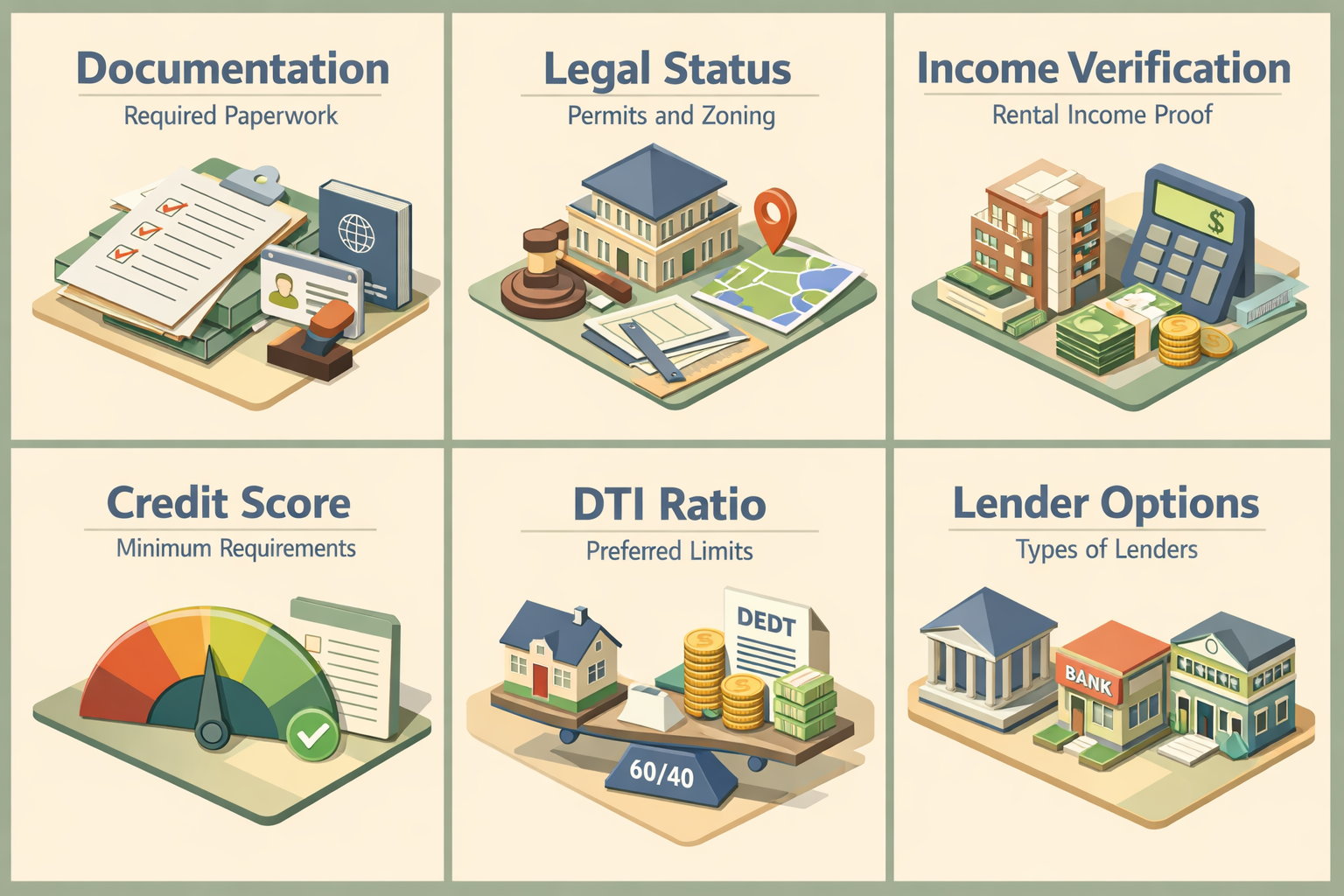
One of the most important aspects of understanding HELOC requirements for property with existing accessory dwelling unit and rental income is knowing how lenders handle the income side of the equation. Rental income from an ADU can potentially strengthen your application — but lenders have specific rules about how they count it.
Generally speaking, lenders may use HELOC requirements for property with ADUs to help offset your total debt obligations, which can improve your debt-to-income (DTI) ratio. However, they often apply a vacancy factor — typically discounting the rental income by 25% or more — to account for periods when the unit might sit empty or require maintenance.
To have rental income considered, you'll likely need to provide:
- Current lease agreement showing the monthly rent amount and lease term
- Bank statements reflecting consistent rent deposits over a defined period, often 12 to 24 months
- Schedule E from your federal tax returns showing reported rental income and allowable expenses
- Proof of local rental licensing if your city or county requires short-term or long-term rental permits
If the ADU is newly rented or you haven't yet filed taxes showing that rental income, some lenders may not count it at all. Others might use a market rent analysis from the appraiser as a bridge. It's important to ask your lender upfront how they handle rental income from ADUs so there are no surprises during underwriting.
Credit Score and Debt-to-Income Ratio Benchmarks for ADU Properties
Just like any HELOC, your personal credit profile plays a significant role in whether you get approved and what rate you'll receive. Most lenders look for a minimum credit score in the mid-to-high 600s for a HELOC, though a score of 700 or above typically opens up better options and more competitive rates.
Your debt-to-income ratio is equally important. Lenders generally prefer a DTI of 43% or lower, though some may stretch to 50% for well-qualified borrowers. If your ADU rental income is accepted and properly documented, it could help lower your effective DTI — making your application more attractive.
Here are a few credit-related factors to keep in mind:
- Payment history on your primary mortgage matters a great deal. Consistent, on-time payments signal reliability to lenders.
- Existing debt obligations, including car loans, student loans, and credit card balances, are factored into your DTI calculation.
- Credit utilization on revolving accounts should ideally be kept below 30% to maintain a strong score.
If your credit needs work before applying, spending a few months paying down balances and resolving any errors on your credit report could meaningfully improve your approval odds and the terms you receive.
Practical Tips for Strengthening Your HELOC Application as an ADU Owner
Being well-prepared before you apply can make the difference between an approval and a frustrating delay. Here are some actionable steps that homeowners with ADUs might take to put their best foot forward:
- Confirm the ADU is legally permitted. Pull your local building department records and verify the unit has approved permits. If it doesn't, consider consulting a contractor or architect about the legalization process.
- Organize your rental income documentation early. Gather at least two years of tax returns, current lease agreements, and bank statements showing rent deposits. The more consistent and documented your income history, the better.
- Get a preliminary property valuation. Understanding your home's current market value — including the ADU's contribution — helps you estimate how much equity you may be able to access before you formally apply.
- Shop multiple lenders. Not every lender handles ADU properties the same way. Some may be more experienced with these property types and offer more favorable underwriting treatment.
- Reduce existing debt where possible. Lowering your DTI before applying strengthens your position, especially if your rental income isn't being counted in full.
- Ask about non-QM or portfolio loan options. If traditional lenders aren't a good fit for your situation, some specialty lenders offer products designed for borrowers with complex income structures or unique property types.
●Conclusion
Navigating the world of home equity lending becomes a bit more layered when an accessory dwelling unit is part of the picture — but it's absolutely manageable with the right preparation. Understanding HELOC requirements for property with existing accessory dwelling unit and rental income means looking at the full picture: your property's legal status, your equity position, your credit profile, and how your rental income will be evaluated. Each of these pieces contributes to whether a lender sees your application as a strong opportunity or a complicated risk. The good news is that with a permitted ADU, solid rental income documentation, and a healthy credit profile, you may be in an excellent position to leverage your home's value through a HELOC. If you're ready to explore your options, speaking with an experienced mortgage advisor at LoanWise can help you map out the right path forward for your unique property and financial goals.