
If you own a home with a detached guest house that brings in rental income, you may be sitting on a powerful financial asset. A Home Equity Line of Credit — commonly known as a HELOC — could allow you to access that equity for home improvements, debt consolidation, or other financial goals. But understanding HELOC requirements for property with detached guest house and rental income can feel complicated. Lenders treat these properties differently than standard single-family homes, and the way they count your rental income adds another layer of complexity. This guide breaks it all down so you can approach the process with confidence.
What Makes a Detached Guest House Property Unique for Lenders
A detached guest house — sometimes called an accessory dwelling unit (ADU), a carriage house, or an in-law suite — is a separate living structure on the same lot as your primary residence. Unlike an attached addition or a finished basement apartment, a detached unit stands on its own, often with its own entrance, kitchen, and utilities.
From a lender's perspective, this distinction matters quite a bit. When you apply for a HELOC, the lender needs to classify your property correctly. Most detached guest houses are evaluated as part of a single-family property with an ADU, provided the main home remains your primary residence. However, if the setup resembles a two-unit or multi-family property, lenders may apply different guidelines, underwriting standards, and loan-to-value (LTV) limits.
The classification can affect everything from your maximum credit limit to your interest rate. That's why it's worth asking your lender upfront how they intend to categorize your property before submitting a full application. Some lenders may require a formal property appraisal that specifically identifies the ADU and its contribution to overall home value.
Core HELOC Eligibility Requirements You Should Know
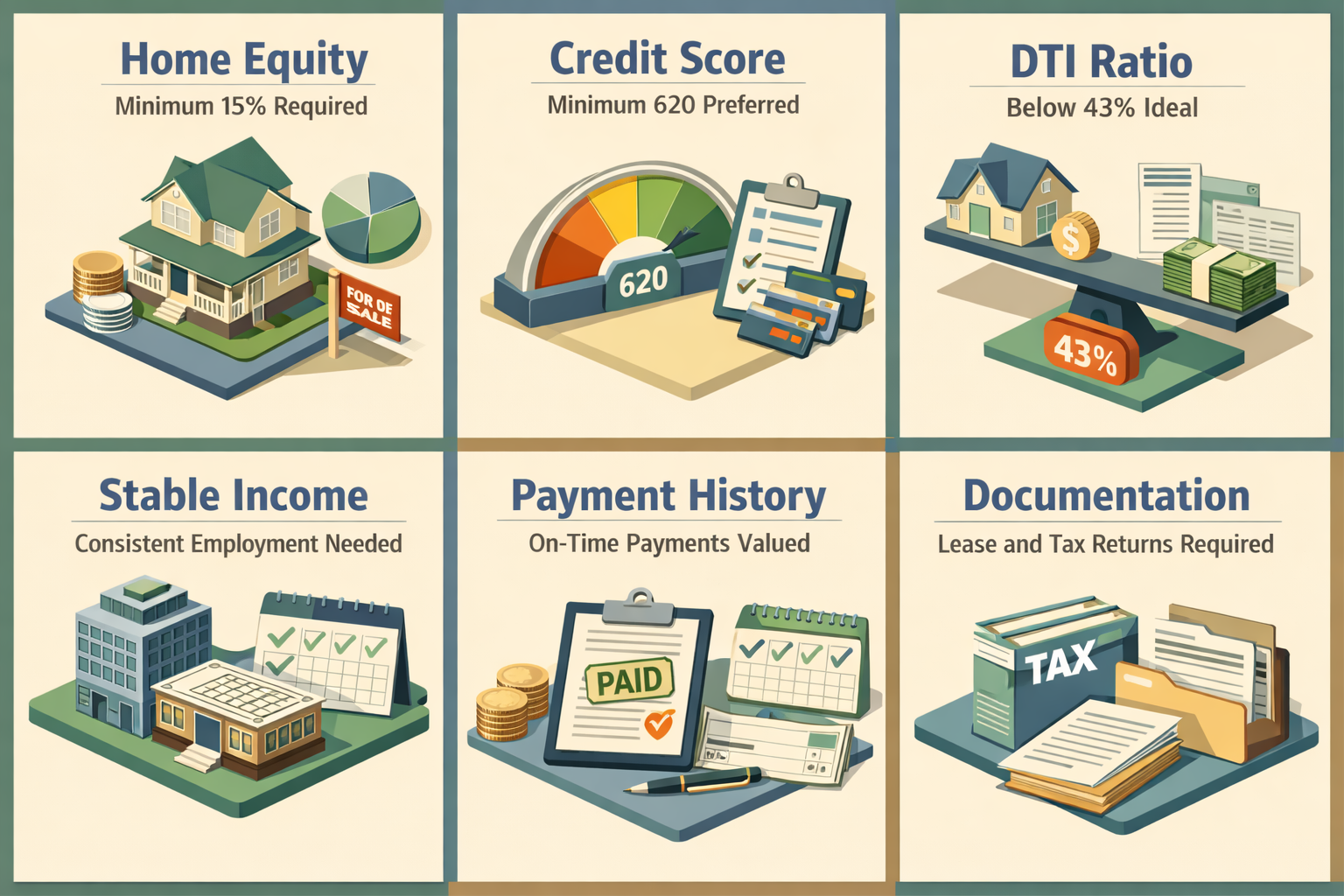
Regardless of whether your property has a guest house, all HELOC applicants must meet certain foundational criteria. Understanding these baseline standards is essential before digging into the nuances of rental income factors and ADU classification.
- Home Equity: Most lenders require that you maintain at least 15% to 20% equity in your home after the HELOC is established. This means your combined loan-to-value ratio — your mortgage balance plus the HELOC limit divided by your home's appraised value — typically cannot exceed 80% to 85%.
- Credit Score: A credit score of at least 620 is often the minimum threshold, though many lenders prefer scores of 680 or higher for more favorable terms. Higher scores may also unlock better interest rates on your line of credit.
- Debt-to-Income Ratio (DTI): Lenders evaluate your total monthly debt obligations relative to your gross monthly income. A DTI below 43% is commonly preferred, though some lenders may allow slightly higher ratios depending on other compensating factors.
- Stable Income and Employment: Lenders want to see consistent, verifiable income. Self-employed borrowers or those with variable income may need to provide additional documentation such as two years of tax returns.
- Payment History: A strong track record of on-time mortgage payments signals reliability and can strengthen your overall application.
Meeting these core requirements is a solid starting point. But when rental income and a detached unit are part of the picture, the evaluation process becomes more detailed.
How Lenders Evaluate Rental Income from Your Guest House
One of the most common questions homeowners with detached guest houses ask is whether their rental income will help them qualify for a larger HELOC. The short answer is: it might — but the process is more nuanced than simply adding your rent checks to your income total.
Lenders typically want to verify that the rental income is stable, documented, and likely to continue. Here's how they often approach it:
- Documentation Requirements: Lenders commonly ask for a signed lease agreement, rent receipts, or bank statements showing consistent deposits. If you've been renting the unit for at least one to two years, your tax returns — specifically Schedule E — may be used to show rental income history.
- Income Calculation: Many lenders apply a vacancy factor when calculating usable rental income. They might use only 75% of your gross rental income to account for potential vacancies or maintenance costs. So if your guest house brings in $1,500 per month, the lender might count approximately $1,125 toward your qualifying income.
- Rental History Matters: If you've only recently started renting the unit, some lenders may not count the income at all, or may apply stricter documentation requirements. A longer rental history tends to be viewed more favorably.
- Short-Term vs. Long-Term Rentals: Income from short-term rental platforms may be treated differently than income from traditional long-term leases. Some lenders are more cautious with short-term rental income due to its variable nature, though policies vary widely by institution.
It's worth noting that even if rental income isn't fully counted toward qualifying income, it can still demonstrate your overall financial stability and ability to manage your obligations.
Understanding HELOC Requirements for Property with Detached Guest House and Rental Income: The Appraisal Factor
One of the most important steps in the HELOC process for a property with a detached guest house is the appraisal. Your home's appraised value determines how much home equity you have to draw from, so understanding how appraisers handle ADUs is critical.
A licensed appraiser will assess your property as a whole, comparing it to similar homes in your area — often referred to as comparable sales or "comps." In neighborhoods where detached guest houses are common, the appraiser may find solid comps that reflect the added value of the ADU. In areas where ADUs are less common, finding accurate comps can be more challenging, and the additional value of the guest house may not be fully reflected in the appraised value.
Here are a few things to keep in mind regarding appraisals for properties with ADUs:
- Permitted Structures: If your detached guest house was built with proper permits and meets local zoning requirements, it's far more likely to be recognized as a value-adding feature. Unpermitted structures may be excluded from the appraisal or could actually reduce your appraised value due to potential legal complications.
- Income Approach: In some cases, appraisers may use an income approach to value your property, especially if the rental income is significant and well-documented. This method considers what an investor would pay for the property based on its income-generating potential.
- Market Conditions: Local real estate demand and ADU acceptance vary by market. In high-demand urban or suburban areas, guest houses often add meaningful value. In rural areas, this may be less pronounced.
Ensuring your guest house is permitted, well-maintained, and accurately described to the appraiser can help you get the most accurate valuation possible.
Property Classification and How It Shapes Your HELOC Terms
How your lender classifies your property could have a significant impact on the HELOC terms you're offered. This is an area where homeowners are often caught off guard, so it's worth understanding upfront.
If your property is classified as a single-family home with an ADU, you'll likely qualify under standard residential HELOC guidelines. These typically offer the most competitive interest rates and the highest LTV allowances.
However, if the lender classifies your property as a two-unit or multi-family property — based on factors like separate utilities, separate entrances, or the income-producing nature of the guest house — you may face stricter requirements. These can include:
- Lower maximum LTV ratios (potentially capped at 70% to 75% combined LTV)
- Higher credit score minimums
- More extensive income documentation requirements
- Potentially higher interest rates
Because classification can vary from lender to lender, it's worth shopping around. One lender might classify your property as a two-unit, while another might view it as a single-family home with an accessory unit. Getting pre-qualified with multiple lenders before committing to a full application can save you both time and money.
Tips to Strengthen Your HELOC Application as a Rental Property Owner
If you're planning to apply for a HELOC on a property with a detached guest house, a few strategic steps can help you put your best foot forward with lenders.
- Get Your Documentation in Order: Gather your lease agreements, rent payment history, bank statements, and the last two years of tax returns including Schedule E. Having this documentation ready shows lenders that your rental income is legitimate and consistent.
- Verify Your Permits: Confirm that your guest house was built with proper permits and complies with local zoning regulations. If there are permit issues, resolving them before applying could improve both your appraisal and your lender's willingness to extend credit.
- Improve Your Credit Score: If your credit score is near the lower end of the acceptable range, taking a few months to pay down revolving balances and address any negative marks could meaningfully improve your approval odds and the rate you're offered.
- Reduce Your DTI: Paying off smaller debts before applying can lower your debt-to-income ratio, making you a more attractive borrower — especially when some of your rental income might be discounted by the lender.
- Work with an Experienced Lender: Not all lenders have equal experience with ADU properties and rental income. Seeking out a lender who regularly works with these types of properties can lead to smoother underwriting and more flexible guidelines.
Preparation is one of the most powerful tools you have when navigating a HELOC application on a non-traditional property.
HELOC Guest House Rental Income Requirements: Common Mistakes to Avoid
Even well-qualified borrowers can run into trouble during the HELOC process when a detached guest house and rental income are involved. Here are some of the most common pitfalls to watch out for:
- Assuming All Rental Income Will Be Counted: As noted earlier, lenders often apply a vacancy discount — typically around 25% — to rental income. Don't build your application around the assumption that every dollar of rent will be counted toward qualifying income.
- Overlooking Unpermitted Structures: An unpermitted guest house can create serious complications during underwriting and appraisal. Lenders may refuse to count the structure at all, and appraisers may flag it as a liability rather than an asset.
- Ignoring Lender-Specific Policies: HELOC guidelines for ADU properties aren't uniform across the industry. What works at one institution may not work at another. Always ask directly how a lender handles detached guest houses before starting the application process.
- Underestimating the Importance of the Appraisal: Your equity is only as strong as your appraisal. If your guest house doesn't add recognized value to the appraisal, you may have less available equity than expected — which directly limits your HELOC credit line.
- Not Disclosing Rental Arrangements: Transparency with your lender is essential. Trying to hide or downplay rental income or the existence of the guest house can create legal and underwriting complications. Always be upfront about your property's full situation.
Avoiding these mistakes can help your application move through underwriting more smoothly and reduce the likelihood of unexpected roadblocks.
●Conclusion
Understanding HELOC requirements for property with detached guest house and rental income takes some extra homework, but it's absolutely manageable with the right preparation. Your property's unique features — especially a well-documented, permitted guest house with a solid rental history — could actually work in your favor by demonstrating added value and income strength. The key is knowing how lenders evaluate these factors and positioning your application accordingly. If you're ready to explore your options, consider speaking with a lending professional who has experience with ADU properties. With the right guidance, your home's equity could become a flexible and powerful financial resource.