Purchasing a condominium with an FHA loan can be a smart path to homeownership, especially for first-time buyers who may not have a large down payment saved. But before you hand over your keys, there's one important question every buyer should understand: what are closing costs for FHA loan on a condo with FHA approval? The answer involves more than just a single number. It includes a range of fees tied to the loan itself, the lender, the property, and the FHA approval status of the condo community. This guide walks you through each component so you can approach closing day with confidence.
Why FHA Condo Loans Have Unique Requirements
FHA loans are insured by the Federal Housing Administration and designed to help buyers with lower credit scores or smaller down payments access homeownership. When you're buying a condo rather than a single-family home, however, the process becomes a bit more involved. That's because the FHA doesn't just evaluate the borrower — it also evaluates the entire condominium project or community.
For an FHA loan to be used to purchase a condo unit, the condo development typically must meet FHA approval standards. This is often referred to as FHA condo project approval. The development must generally meet requirements related to owner-occupancy ratios, financial reserves, insurance coverage, and HOA stability. Without this approval, an FHA loan may not be usable for that specific property — unless the borrower qualifies for a single-unit approval, which is a more limited pathway introduced to expand FHA access to non-approved buildings.
Understanding these requirements matters because they can directly affect your closing timeline and, in some cases, your closing costs. For instance, if the condo project needs to go through approval steps during your transaction, additional documentation and possibly fees could be involved.
Breaking Down the FHA Condo Closing Costs Mortgage Approval Process
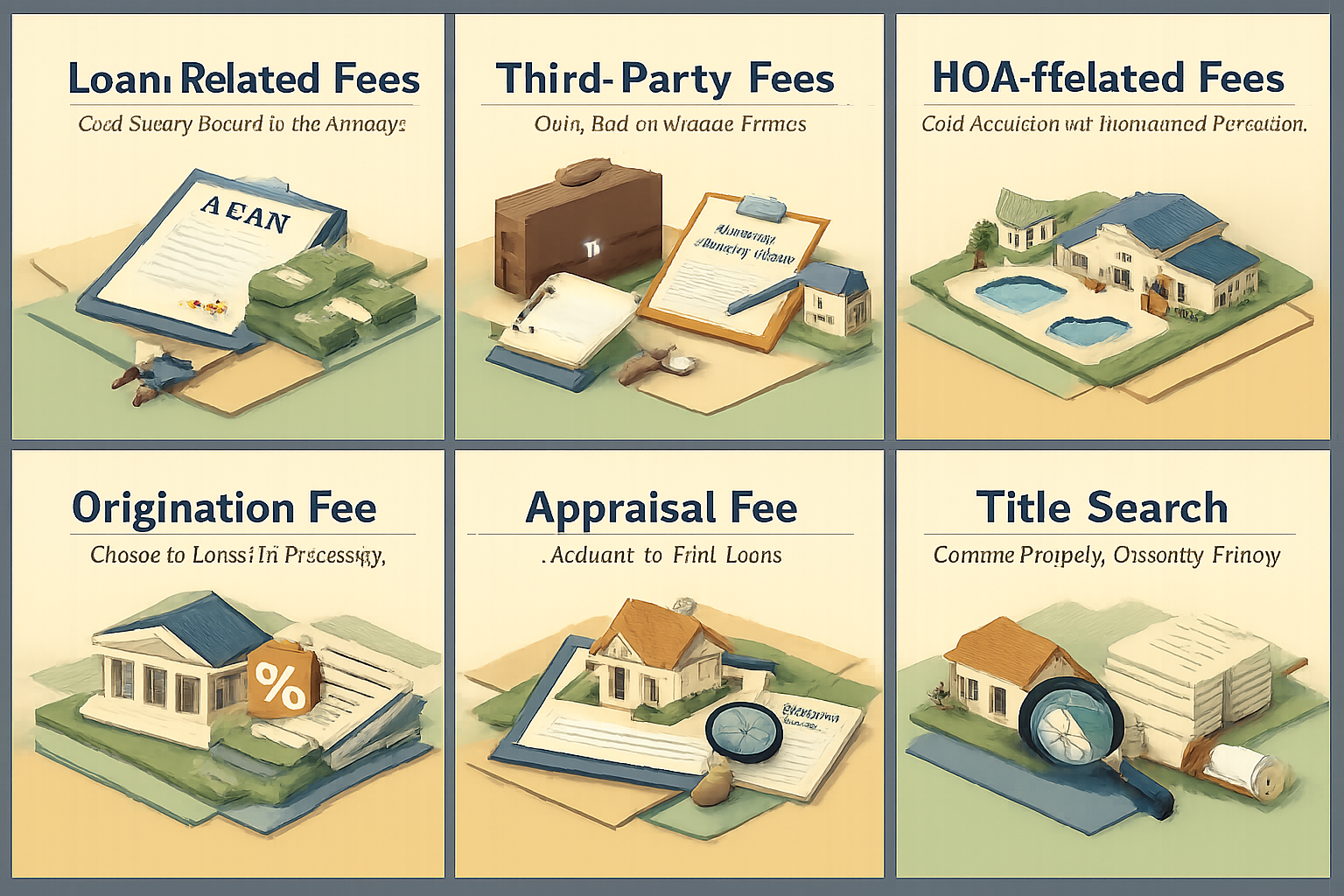
When you're navigating the FHA condo closing costs mortgage approval process, it helps to think of closing costs in two main categories: loan-related fees and third-party fees. Both apply to FHA condo purchases, and together they typically add up to a meaningful portion of your transaction budget.
Loan-Related Fees
These are costs associated directly with your FHA mortgage and the lender processing it. Common loan-related closing costs may include:
- Origination fee: Charged by the lender for processing your loan application. This may be a flat fee or a percentage of the loan amount.
- Discount points: Optional fees paid upfront to lower your interest rate. Not every borrower chooses to pay these, but they're worth discussing with your loan officer.
- Upfront Mortgage Insurance Premium (UFMIP): This is one of the most distinctive FHA closing costs. The FHA requires borrowers to pay an upfront mortgage insurance premium, which is typically 1.75% of the base loan amount. This can often be financed into the loan rather than paid out of pocket at closing, but it still contributes to your overall loan balance.
- Prepaid interest: Interest that accrues between the closing date and the first day of the following month, paid at closing.
Third-Party and Government Fees
These costs are generally paid to outside parties involved in the transaction and are not set by your lender. They may include:
- Appraisal fee: FHA loans require an FHA-approved appraiser to evaluate the property. Condo appraisals can sometimes cost slightly more than standard home appraisals due to the additional complexity of assessing a unit within a larger development.
- Title search and title insurance: Required to confirm the property's ownership history is clean and to protect the lender — and optionally the buyer — from future title disputes.
- Home inspection fee: While not strictly required by FHA, most buyers and lenders strongly recommend a professional inspection, especially in a multi-unit building.
- Recording fees: Charged by local government offices to officially record the transfer of ownership.
- Attorney fees: Depending on the state, an attorney may be required to oversee the closing process.
Condo-Specific Costs That May Affect Your Closing Budget
Buying a condo comes with a few additional financial considerations that single-family home buyers don't typically encounter. Some of these costs may appear at or around closing, and they're worth budgeting for in advance.
HOA-Related Fees at Closing
Many condo communities are managed by a homeowners association (HOA). At closing, you may be required to pay:
- HOA transfer fees: A charge for transferring the HOA membership from the seller to you as the new buyer.
- HOA initiation or move-in fees: Some communities charge a one-time fee when a new owner joins.
- Prorated HOA dues: If closing happens mid-month, you may owe a partial month's worth of HOA dues at settlement.
Condo Approval Review Costs
If your condo project is not already on the FHA-approved list, additional steps may be needed. In some cases, the seller, HOA, or even the buyer may need to gather and submit documentation for project review. While the FHA itself doesn't charge for this review, the HOA or management company might charge for providing the necessary documents. These costs can vary and are not always predictable, so it's smart to ask your real estate agent or lender about the approval status of any condo you're seriously considering.
Master Insurance Policy Review
FHA requires that condo projects maintain adequate insurance, including a master policy. Your lender may require a review of this policy, and while this is usually handled behind the scenes, any gaps in coverage could require the HOA to purchase additional insurance before closing can proceed — potentially causing delays.
Estimating the Total Cost: What Homebuyers Can Typically Expect
So, in practical terms, how much should you budget for closing costs on an FHA condo loan? While exact figures depend on your loan amount, location, lender, and the specific condo community, closing costs on FHA loans generally range from roughly 2% to 6% of the purchase price — though this estimate can vary. Keep in mind that the upfront mortgage insurance premium alone adds 1.75% of the loan amount, which can be a significant line item if not financed into the loan.
Here's a simplified example to illustrate: If you're purchasing a condo for $250,000 with a 3.5% down payment (the minimum FHA down payment for borrowers with qualifying credit scores), your base loan amount would be approximately $241,250. The UFMIP would then be approximately $4,222 — either financed into the loan or paid at closing. Add lender fees, appraisal, title, and HOA-related costs, and your total expenses could reasonably fall somewhere in the range of $7,000 to $14,000 depending on the specifics.
This is why it's so important to review your Loan Estimate, which your lender is required to provide within three business days of receiving your completed application. This document breaks down all anticipated closing costs and gives you a clear picture of what you'll owe at settlement.
How to Reduce What You Pay Out of Pocket at Closing
The good news is that FHA borrowers have several strategies available to help reduce the cash they need to bring to closing. None of these eliminate closing costs entirely, but they can make homeownership more accessible for buyers who are working with limited savings.
Seller Concessions
Under FHA guidelines, sellers may contribute up to 6% of the purchase price toward the buyer's closing costs. This is known as a seller concession or seller contribution. Negotiating seller concessions is especially common in slower real estate markets where sellers are motivated to close quickly. It's worth discussing this option with your real estate agent when making an offer.
Lender Credits
Some lenders offer lender credits, where they agree to cover a portion of your closing costs in exchange for a slightly higher interest rate. This can make sense if you're planning to stay in the home for a shorter period and prefer to preserve cash now rather than pay lower interest over time. Ask your loan officer to walk you through both scenarios.
Down Payment Assistance Programs
Many state and local housing agencies offer down payment assistance programs that can also be applied to closing costs. These programs often come in the form of grants or low-interest secondary loans and may be available to first-time homebuyers or buyers who meet certain income thresholds. Eligibility requirements vary by program and location.
Finance the UFMIP
As mentioned earlier, the upfront mortgage insurance premium can be rolled into the loan amount rather than paid at closing. While this increases your monthly payment slightly, it frees up cash that can be used for other closing expenses or reserves.
Navigating the FHA Condo Approval Process Before You Close
One of the most important steps for buyers using FHA financing to purchase a condo is confirming that the property is eligible. The FHA maintains a searchable online database of approved condo projects, and your real estate agent or lender can help you check whether a specific building is currently approved.
If the condo isn't on the approved list, you may still have options:
- Full project approval: The HOA or management company submits documentation to HUD for full project review. This process can take time and may not always be completed within a buyer's desired closing window.
- Single-unit approval (spot approval): Introduced by HUD in 2019, this pathway allows individual condo units in non-approved projects to qualify for FHA financing, provided the project meets certain baseline criteria. Not all projects will qualify, but this option has expanded access for many buyers.
Being aware of the condo's approval status early in your home search can save you significant time and frustration. If you fall in love with a unit in a non-approved building, your lender can help you assess whether single-unit approval is a realistic path forward before you get too far into the process.
Understanding what are closing costs for FHA loan on a condo with FHA approval also means understanding that the approval status can affect your timeline — and a delayed closing can sometimes result in rate lock extension fees or other costs. Planning ahead is your best defense.
Working with the Right Lender Makes All the Difference
Not all lenders are equally experienced with FHA condo transactions. Because condo purchases involve an extra layer of review — both of the borrower and the project — it's important to work with a lender who has hands-on experience navigating these requirements. An experienced FHA lender can help you:
- Verify the condo project's approval status quickly
- Identify whether single-unit approval is available if needed
- Provide an accurate Loan Estimate so you can budget confidently
- Explore strategies to reduce your out-of-pocket closing costs
- Coordinate with the HOA to gather required documentation efficiently
Ask any lender you're considering about their experience with FHA condo loans specifically. The right partner can make the process smoother, faster, and far less stressful.
●Conclusion
Understanding what are closing costs for FHA loan on a condo with FHA approval is an essential step in preparing for a successful purchase. From the upfront mortgage insurance premium to HOA transfer fees and title costs, closing on a condo with FHA financing involves a number of moving parts — but none of them are insurmountable with the right preparation. Review your Loan Estimate carefully, explore strategies like seller concessions and lender credits, and confirm your condo's FHA approval status early. With a knowledgeable lender by your side, you can walk into closing day informed, prepared, and ready to enjoy your new home.