
Real estate investors who own single-family rental properties often build substantial equity over time — and that equity can be a powerful financial tool. A Home Equity Line of Credit, or HELOC, may allow you to access that built-up value without selling your properties. But understanding HELOC requirements for a single-family rental property portfolio is a different challenge than applying for a HELOC on your primary home. Lenders treat investment properties with greater scrutiny, and the qualification standards are typically more demanding. Whether you're looking to expand your portfolio, renovate existing rentals, or consolidate short-term debt, knowing what lenders expect can save you a great deal of time and frustration.
Why Investment Property HELOCs Work Differently Than Primary Residence Lines
When a lender evaluates a HELOC on your primary residence, they're working with the assumption that you're highly motivated to protect the home you live in. With a rental property, that dynamic shifts. Lenders generally view investment properties as higher-risk collateral, because borrowers are statistically more likely to default on a property they don't personally occupy during times of financial hardship.
As a result, lenders may impose stricter terms on a HELOC for rental property investors. These could include higher minimum credit score thresholds, lower loan-to-value limits, higher interest rates, and more rigorous income documentation requirements. It's not unusual for lenders to require a full appraisal of the property rather than an automated valuation model, particularly for non-owner-occupied homes.
Some lenders may also limit the number of financed properties they'll consider when evaluating your application. If you own a large portfolio, finding a lender willing to work with investors who have five, six, or even ten mortgaged properties can take some legwork. Not all banks and credit unions offer investment property HELOCs at all, so it's worth confirming product availability before spending time on applications.
Equity and Loan-to-Value Benchmarks Lenders Typically Expect
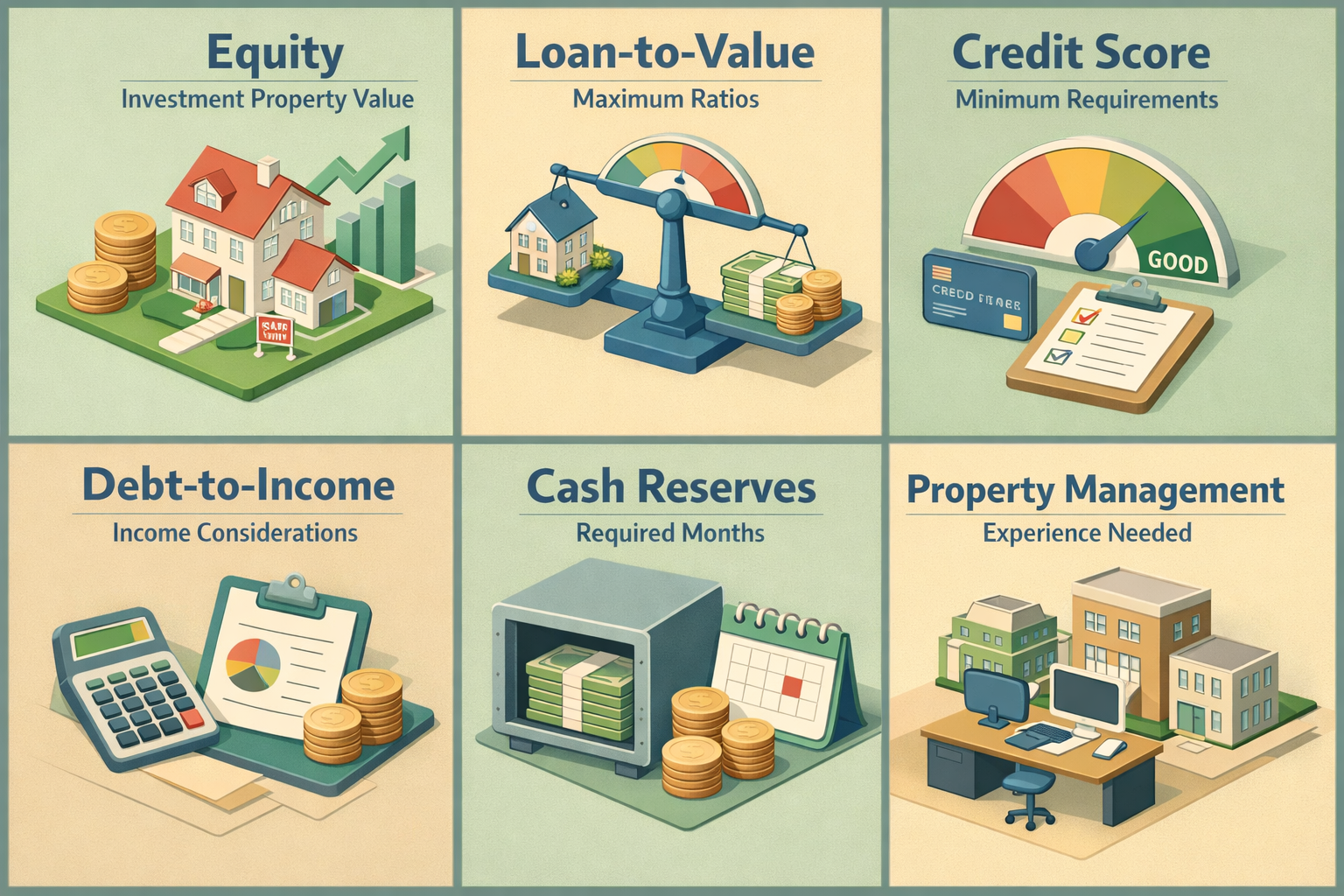
Equity is the foundation of any HELOC application, and for investment properties, lenders tend to require a more conservative cushion than they would for a primary home. On a primary residence, some lenders allow combined loan-to-value (CLTV) ratios up to 85% or even 90%. For a single-family rental, many lenders cap the CLTV at 70% to 80%, meaning you may need to retain more equity in the property before becoming eligible.
For example, if a rental home is appraised at $350,000 and your existing mortgage balance is $200,000, you have approximately $150,000 in equity. If a lender's maximum CLTV on investment property is 75%, the most you might access through a HELOC could be around $62,500 — after accounting for the existing loan. These numbers can vary significantly depending on the lender and current market conditions, so running the math with multiple lenders is a smart approach.
When financing a rental portfolio with multiple properties, some lenders may consider the aggregate equity across your holdings, while others will only evaluate the single property pledged as collateral. Understanding which approach a lender uses can meaningfully affect how much capital you're able to unlock.
Credit Score and Debt-to-Income Standards for Rental Portfolio Borrowers
Your personal credit profile plays a central role in any investment property HELOC decision. While standards can vary by lender, many institutions may look for a minimum credit score somewhere in the range of 680 to 720 for investment property lines of credit — and some may set the bar even higher. A stronger credit score not only improves your chances of approval but could also help you qualify for a more competitive interest rate.
Debt-to-income (DTI) ratio is another critical factor. Lenders want to see that your monthly debt obligations — including existing mortgages on all properties — don't consume too large a share of your income. For investment property borrowers, some lenders may allow a higher DTI if rental income offsets the debt burden, but this depends on how the lender calculates qualifying income.
Speaking of rental income, lenders may only count a portion of your gross rental receipts — often around 75% — to account for vacancies and maintenance costs. This conservative calculation can compress your qualifying income, so it's important to understand how your lender treats rental revenue before assuming that full rental income will work in your favor. Providing documentation such as tax returns, Schedule E filings, and current lease agreements can help support your income picture.
How Cash Reserves and Property Management History Factor In
Lenders evaluating a multiple rental property HELOC application often look closely at your cash reserves. Unlike a primary home purchase where a few months of reserves may suffice, investment property lenders might want to see reserves covering six to twelve months of payments across your entire portfolio. This requirement reflects the understanding that rental income can be interrupted by vacancies, evictions, or major repairs.
Your history as a landlord may also carry weight. Some lenders prefer borrowers who have managed rental property investors for at least two years, as this suggests experience navigating the operational realities of being a landlord. If you're a newer investor, you may face additional scrutiny or more conservative lending terms.
Property condition matters too. A lender will want the collateral property to be in rentable or market-ready condition. If the home is vacant or requires significant repairs, some lenders may decline the application or require that improvements be made before closing. Keeping your properties well-maintained isn't just good landlord practice — it's a factor that can support your borrowing capacity.
The Strategy Behind Cross-Collateralizing Rental Properties for a HELOC
Cross-collateralizing rental properties for a HELOC is a strategy some investors explore when a single property doesn't hold enough equity on its own to justify the line of credit they need. In a cross-collateralization arrangement, a lender may secure the HELOC against multiple properties simultaneously, giving them more collateral coverage and potentially allowing you to access greater borrowing power.
This approach isn't universally available, and not all lenders offer it. When they do, the terms and documentation requirements can be more complex. Each property involved in the arrangement will likely need to be appraised, and the lender may require clear title on all properties listed as collateral. Additionally, because the lender holds a lien on multiple assets, a default could put more than one property at risk — a trade-off that deserves careful consideration.
For investors with a well-diversified portfolio of single-family rentals, cross-collateralization may unlock financing a rental portfolio that would otherwise be out of reach. However, it's worth consulting with a financial advisor or mortgage professional before pursuing this route, as the implications for your overall portfolio strategy can be significant.
Documentation and Application Preparation for Investment Property HELOCs
Preparing a strong HELOC application for a rental property starts with gathering the right documentation. Most lenders will request a combination of personal and property-level financial records. On the personal side, expect to provide recent tax returns — typically two years — W-2s or 1099s, bank statements, and a list of all financed properties with their associated mortgage balances and monthly payments.
For the rental properties themselves, lenders may ask for current lease agreements, rent rolls, mortgage statements for each financed property, proof of insurance, and recent appraisals or property tax statements. If you manage properties through an LLC or other business entity, the lender may also require operating agreements, business tax returns, and documentation showing your ownership stake.
Getting your paperwork in order before applying can speed up the underwriting process considerably. Disorganized or incomplete documentation is a common cause of delays and may even lead to denial. Working with a knowledgeable mortgage professional who has experience with investment property financing can help you anticipate lender requests and present your application in the most favorable light.
●Conclusion
Understanding HELOC requirements for a single-family rental property portfolio is essential for any real estate investor looking to leverage their equity strategically. The qualification process is more involved than a standard primary residence HELOC, but for investors who meet the criteria, a HELOC can be a flexible and cost-effective tool for growing a rental portfolio, funding improvements, or managing short-term financial needs. From equity thresholds and credit standards to cash reserves and cross-collateralization strategies, each element of the application deserves careful attention. If you're ready to explore your options, connecting with a lender experienced in investment property financing is a strong first step. At LoanWise, we're here to help you navigate the process with clarity and confidence.