
Inheriting a share of a property sounds like a financial windfall — and it can be. But when that property already carries a mortgage, and you're applying for your own home loan, things get a lot more complicated. Lenders need to assess your debt-to-income (DTI) ratio carefully, and inherited partial ownership introduces variables that don't fit neatly into a standard mortgage application. Understanding how to calculate DTI with inherited partial ownership and existing mortgage obligations is essential if you want to move forward confidently with a home purchase or refinance. This guide walks you through the process step by step so you know exactly what to expect.
What DTI Means and Why It Matters for Mortgage Approval
Your debt-to-income ratio is one of the most important numbers a mortgage lender will examine. It compares your total monthly debt obligations to your gross monthly income. Lenders use this figure to determine how much of a financial burden you can reasonably carry without defaulting on a loan.
DTI is typically expressed as a percentage. For example, if your gross monthly income is $6,000 and your total monthly debt payments are $2,100, your DTI would be 35%. Most conventional loan programs prefer a debt-to-income ratio at or below 43%, though some programs may allow higher ratios depending on compensating factors like strong credit or significant cash reserves.
There are actually two types of DTI that lenders consider:
- Front-end DTI: This covers only housing-related expenses, including your proposed mortgage payment, property taxes, homeowner's insurance, and HOA fees if applicable.
- Back-end DTI: This includes all monthly debt obligations — housing costs plus car loans, student loans, credit card minimum payments, personal loans, and any other recurring financial commitments.
Back-end DTI is usually the figure lenders focus on most heavily. When you've inherited partial ownership of a property that still has a mortgage attached to it, determining what counts toward your back-end DTI becomes a nuanced exercise.
How Inherited Partial Ownership Works in a Lending Context
When a property is inherited, it's not uncommon for multiple heirs to share ownership. This is known as tenancy in common or, in some cases, joint tenancy, depending on how the estate was structured. Each heir holds a percentage interest in the property rather than outright sole ownership.
The complicating factor is that the original mortgage on the property doesn't automatically disappear after an inheritance. In most cases, the loan remains tied to the property and may continue to be serviced by one or more of the co-owners. Lenders will want to understand your relationship to this debt before approving your new mortgage application.
Here's what typically happens from a lender's perspective:
- If your name is on the inherited mortgage, lenders will likely count the full monthly payment against your DTI unless you can prove that another party is making the payments.
- If your name is not on the mortgage but you're a co-owner of the property, lenders may still factor in some portion of the obligation depending on the loan program guidelines.
- If rental income is generated from the inherited property, a portion of that income may be used to offset the mortgage payment, potentially reducing the impact on your DTI.
Understanding exactly how your ownership stake interacts with the existing mortgage is the first step toward building a solid mortgage application.
Step-by-Step: How to Calculate DTI With Inherited Partial Ownership and Existing Mortgage
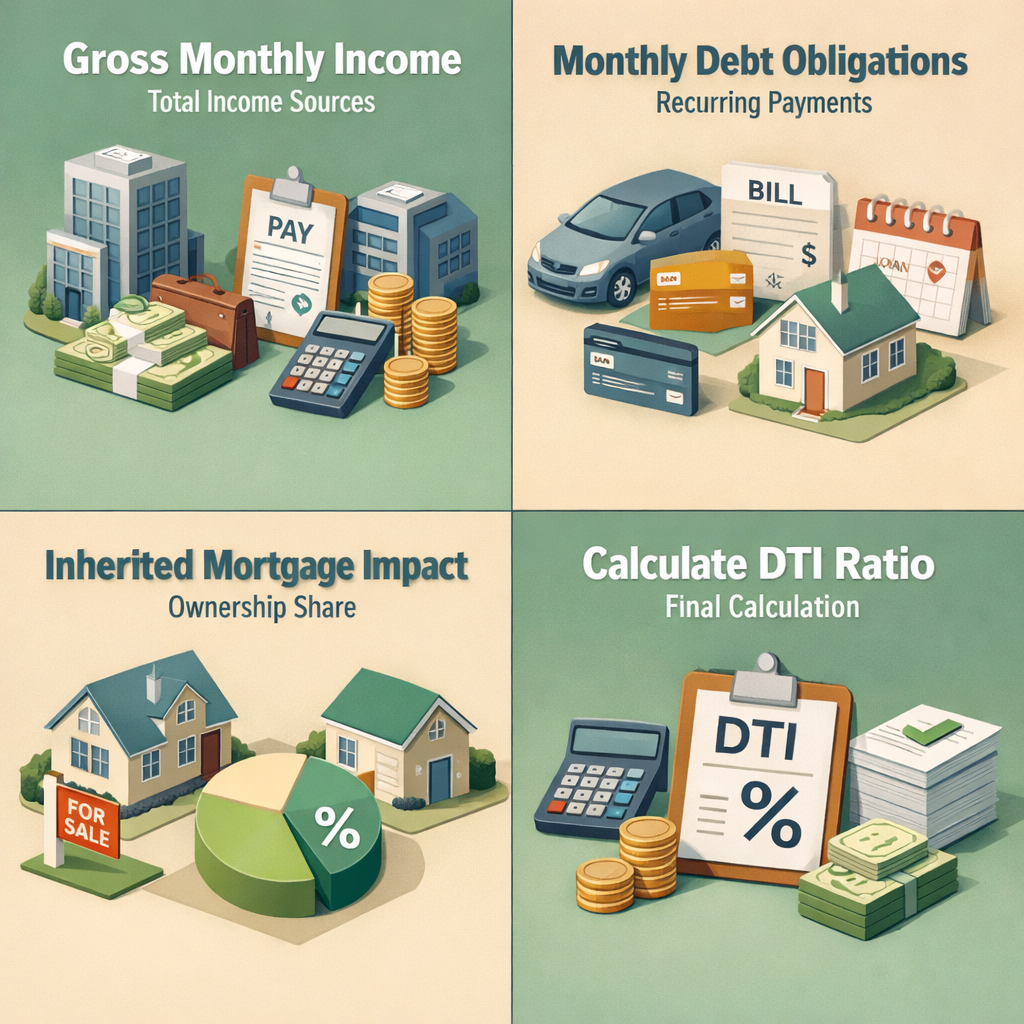
Working through how to calculate DTI with inherited partial ownership and existing mortgage obligations requires gathering specific financial information and understanding lender guidelines. Here's a practical breakdown of the process:
Step 1 — Identify Your Gross Monthly Income
Add up all verifiable sources of gross monthly income. This may include wages, self-employment income, rental income, Social Security benefits, or any other documented regular income. If the inherited property generates rental income, lenders may allow you to count a portion of it — typically around 75% of the gross rental income after subtracting vacancy and maintenance allowances — though exact guidelines vary by loan program and lender.
Step 2 — List All Monthly Debt Obligations
Include every recurring debt payment. This covers your proposed new mortgage payment, any existing personal loans, auto loans, student loans, credit card minimums, and the inherited property's mortgage payment if it's being counted against you.
Step 3 — Determine the Inherited Mortgage's Impact
This is where the DTI calculation gets specific to your situation. If you own, say, a 50% share of an inherited property and the mortgage payment is $1,800 per month, lenders may count some or all of that payment depending on whether you're on the loan and whether rental income offsets it. Some lenders may only hold you responsible for your proportional share (in this example, $900), while others may require the full payment to be counted. It's critical to confirm this with your lender or loan officer early in the process.
Step 4 — Calculate Your DTI Ratio
Divide your total monthly debt obligations by your gross monthly income, then multiply by 100 to get a percentage. For example:
- Gross monthly income: $7,500
- Proposed new mortgage: $1,600
- Inherited property mortgage share counted: $900
- Other debts (auto, cards): $400
- Total monthly debts: $2,900
- DTI: $2,900 ÷ $7,500 = 38.7%
This result would generally fall within acceptable ranges for most conventional loan programs, though individual lender standards may vary.
When Rental Income From the Inherited Property Can Help Your Case
One of the most favorable scenarios for borrowers dealing with inherited partial ownership is when the property is being rented out. Lenders may allow documented rental income to offset the mortgage obligation tied to the inherited property, which can meaningfully improve your DTI.
To use rental income in your application, lenders typically require:
- A current signed lease agreement proving the property is actively rented
- Documentation showing receipt of rental payments, such as bank statements
- In some cases, a history of rental income reported on your tax returns, often spanning two years
Most loan programs apply a vacancy factor — usually reducing the countable rental income to around 75% of the gross amount — to account for periods when the property might be unoccupied. Even with this reduction, rental income can be a powerful tool for lowering your effective DTI.
For example, if the inherited property generates $1,500 per month in gross rent and the mortgage payment is $1,200 per month, a lender might count $1,125 (75% of $1,500) as usable income. This could effectively neutralize the mortgage payment and even contribute positively to your income side of the DTI equation, depending on lender guidelines.
It's worth noting that lenders may have different requirements depending on whether the loan is a conventional product, an FHA loan, or another program type. Consulting with a knowledgeable loan officer is the best way to understand which rules apply to your specific case.
How Lenders Verify Ownership and Debt Responsibility
When you disclose an inherited property on a mortgage application, lenders will take steps to verify both your ownership stake and any related debt obligations. This process may include reviewing:
- Probate documents or the estate deed showing your legal ownership percentage
- The current mortgage statement for the inherited property to confirm the outstanding balance and monthly payment amount
- Credit reports to determine whether the inherited mortgage appears as a liability on your credit file
- Title records to confirm current ownership and any liens on the property
If the inherited mortgage does not appear on your credit report — because only the original borrower's name is on the loan — lenders may still ask for documentation to understand the property's financial obligations. Transparency here is important. Failing to disclose an inherited property with an existing mortgage could create problems during underwriting or at closing.
Some lenders may also request a partition agreement or written agreement among co-heirs outlining each party's financial responsibility for the property. Having clear documentation can help streamline the lender's review process and may work in your favor when it comes to how the shared mortgage obligation is treated in your DTI calculation.
Strategies to Improve Your DTI When Dealing With an Inherited Property
If your initial DTI calculation comes back higher than you'd like, there are several strategies that may help bring it down to an approvable range:
Pay Down Existing Debts
Reducing or eliminating high-balance revolving debts like credit cards can lower your monthly minimum payments and meaningfully reduce your back-end DTI. Even paying down a card to below 30% utilization can have a positive effect on your overall financial profile.
Increase Documented Income
If you have additional income sources that aren't currently being counted — such as freelance work, a part-time job, or investment income — work with your loan officer to determine whether those sources can be documented and included in your qualifying income.
Refinance or Sell the Inherited Property
If co-heirs agree, refinancing the inherited property's existing mortgage into a lower payment could reduce your DTI obligation. Alternatively, selling your share of the inherited property would eliminate the debt entirely, though this is a significant decision that involves coordination with other heirs and potential tax considerations.
Explore Non-QM Loan Programs
Some borrowers in complex ownership situations may benefit from non-qualified mortgage (non-QM) programs, which often use alternative methods to assess creditworthiness beyond a standard DTI threshold. These products may be available through specialty lenders and could be worth exploring if traditional loan programs aren't a fit.
Work With a Co-Borrower
Adding a co-borrower with strong income and low debts to your mortgage application can improve the combined DTI ratio and strengthen your overall application profile.
What to Expect During Underwriting With Inherited Ownership on Your File
Underwriters are trained to look carefully at complex financial situations, and inherited partial ownership is one that often requires additional review. You should be prepared for the underwriter to ask for supplemental documentation explaining the ownership structure, the mortgage payment history on the inherited property, and how any rental income is being managed.
Providing a clear letter of explanation can be extremely helpful. This is a short written statement that explains your ownership stake, who is responsible for making the mortgage payments, and whether the property generates rental income. Clear, honest documentation tends to smooth the underwriting process and reduce back-and-forth delays.
It's also worth knowing that underwriting guidelines can differ meaningfully between loan programs. FHA loans, for instance, have specific rules about how rental income is counted and how co-borrower obligations are handled. Conventional loans backed by Fannie Mae or Freddie Mac also have their own guidelines that may treat shared property obligations differently. Your loan officer should be able to guide you through which program best fits your situation.
Being proactive and organized — gathering deeds, estate documents, mortgage statements, and lease agreements before the underwriter requests them — can help keep your loan moving forward on schedule.
●Conclusion
Navigating the mortgage process when you've inherited a partial share of a property with an existing loan isn't simple, but it's absolutely manageable with the right information and guidance. Understanding how to calculate DTI with inherited partial ownership and existing mortgage obligations gives you a major advantage: you can anticipate lender questions, prepare the right documentation, and explore strategies to keep your DTI within approvable limits. Whether the inherited property is generating rental income, shared among multiple heirs, or still being sorted through an estate, a knowledgeable loan officer can help you map out the best path forward. At LoanWise, we're here to help you make sense of complex financing situations so you can move toward your homeownership goals with confidence.