
Retirement doesn't have to mean the end of your homeownership journey. Many Americans today are purchasing homes or refinancing their existing properties while living on a combination of retirement pension income and part-time work earnings. If that sounds like your situation, you're likely wondering whether a lender will take both income streams seriously — and more importantly, how much home you can actually afford. Understanding how to calculate mortgage affordability with retirement pension and part-time job income is the first step toward making a confident and informed decision. This guide breaks down the process in plain language so you can approach your lender — or your own budget — with clarity.
Why Mixed Income Sources Matter in Mortgage Qualification
When you apply for a mortgage, lenders don't just look at your paycheck. They evaluate all verifiable, stable income sources that contribute to your ability to repay the loan. For retirees who also work part-time, this typically means combining two distinct income types: a pension or retirement benefit and wages from part-time employment.
The reason this matters is that lenders use your total qualifying income to determine how large of a monthly payment you can safely handle. A higher qualifying income generally means you may be eligible for a larger loan amount or a more competitive interest rate. However, not all income is treated equally. Lenders apply specific documentation and consistency standards to each type, so understanding the rules for both pension income and part-time wages is essential before you begin the affordability calculation process.
It's also worth noting that federal fair lending laws prohibit lenders from discriminating based on age. This means a 65-year-old applicant with stable pension income and part-time earnings deserves the same consideration as a younger borrower with a full-time salary — provided the income is documented and consistent.
How Lenders Typically Evaluate Retirement Pension Income
Pension income is generally viewed favorably by mortgage lenders because it tends to be stable, predictable, and not tied to the fluctuations of an employer or a volatile job market. Common sources of pension or retirement income that lenders may consider include:
- Social Security retirement benefits
- Private employer pension plans
- Government or military retirement benefits
- Annuity income from retirement accounts
- Distributions from IRAs or 401(k) accounts (with conditions)
To use pension income in your mortgage application, lenders will typically require documentation such as award letters, pension benefit statements, or bank statements showing regular deposits. Most lenders want to see that the income has been received consistently and is likely to continue for at least three years into the future, though specific requirements can vary by loan program and lender.
For Social Security income, lenders may also apply a gross-up adjustment. Because Social Security benefits are often partially or fully tax-exempt, some lenders are permitted to increase the stated amount by a certain percentage — commonly around 15% to 25% — when calculating qualifying income. This could meaningfully improve your affordability picture. Always confirm this option with your loan officer, as guidelines differ between conventional, FHA, and VA loan programs.
How Part-Time Job Income Fits Into the Affordability Equation
Part-time employment income can absolutely be counted toward mortgage qualification, but lenders are typically more cautious with it than they are with pension income. The key concern is consistency. Lenders want to feel confident that the income you're earning today will continue into the foreseeable future.
In most cases, lenders will want to see a minimum of two years of consistent part-time employment in the same field or with the same employer. This history helps demonstrate that the income is reliable rather than seasonal or temporary. If you've recently started a part-time job, it may be more difficult to include it in your qualification until that track record is established.
The income used is typically averaged over the two-year period as reported on your tax returns and W-2 forms. If your part-time hours or earnings have increased recently, lenders may use a blended average, which could result in a slightly lower qualifying income than your current earnings suggest. On the other hand, if your income has been steadily growing, some lenders may take that trend into account.
It's also important to consider whether your part-time work is classified as employee income or self-employment income. Independent contractors and freelancers are treated differently, and self-employment income typically requires two years of tax returns, profit-and-loss statements, and additional documentation.
The Step-by-Step Process to Calculate Mortgage Affordability With Retirement Pension and Part-Time Job Income
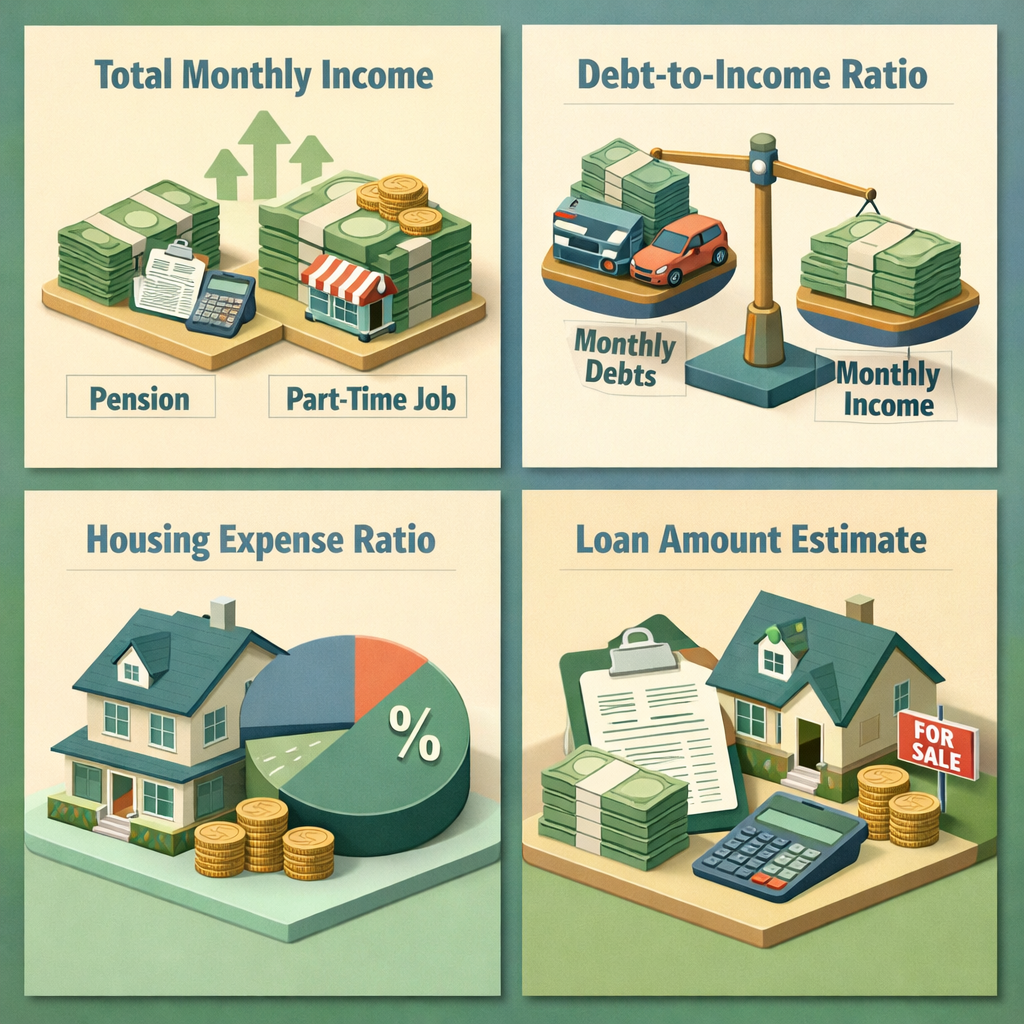
Now that you understand how each income source is evaluated, let's walk through how to calculate mortgage affordability with retirement pension and part-time job earnings combined. The process involves a few key financial ratios and calculations that lenders use universally.
Step 1 — Determine Your Total Monthly Qualifying Income
Add together all of your verifiable monthly income sources. For example, if you receive a monthly pension of $2,200 and earn an average of $900 per month from your part-time job, your total gross qualifying income would be approximately $3,100 per month. If a Social Security gross-up applies, factor that in as well.
Step 2 — Calculate Your Debt-to-Income Ratio
The debt-to-income (DTI) ratio is one of the most critical numbers in the affordability calculation. It compares your total monthly debt obligations to your gross monthly income. Most conventional loan programs prefer a DTI at or below 43%, while some programs may allow slightly higher ratios with compensating factors.
To calculate your DTI, add up all monthly debt payments — including estimated mortgage payment, car loans, credit card minimums, and other obligations — then divide that total by your gross monthly income. For instance, if your total monthly debts including a proposed mortgage payment of $1,000 come to $1,400 and your income is $3,100, your DTI would be approximately 45%. That might require a smaller loan amount or some debt payoff to bring the ratio into an acceptable range.
Step 3 — Apply the Housing Expense Ratio
Lenders also look at your front-end ratio, which measures just your housing costs — principal, interest, taxes, and insurance (PITI) — as a percentage of gross income. A common guideline is to keep housing costs at or below 28% to 31% of gross monthly income, though this can vary. Based on a $3,100 monthly income, that would suggest a target housing payment in the range of $868 to $961 per month.
Step 4 — Estimate the Loan Amount You May Qualify For
Once you have a comfortable monthly payment range, you can work backward to estimate a loan amount. Using an online mortgage calculator or speaking with a loan officer, input your target payment, current interest rate, and loan term to see the approximate loan principal. Keep in mind that property taxes and homeowners insurance vary by location and can significantly affect your total monthly housing cost.
Compensating Factors That Can Strengthen Your Application
If your income calculation puts you close to — but not quite within — the standard qualifying thresholds, there are several compensating factors that lenders may consider when reviewing your application. These factors don't replace income requirements, but they can tip the scales in your favor.
- Substantial down payment: A larger down payment reduces the lender's risk and may allow for more flexibility in income qualification. It also reduces your loan-to-value ratio, which can improve your rate.
- Strong credit score: A higher credit score signals responsible financial behavior and may open access to programs with more favorable DTI allowances.
- Significant liquid reserves: If you have retirement savings, investments, or other liquid assets that could cover several months of mortgage payments, lenders often view this very positively.
- Low existing debt: If your current monthly obligations are minimal, your DTI will naturally be lower, giving more room for a mortgage payment.
- Long employment history at part-time job: Even if the income amount is modest, a lengthy history with the same employer or in the same field reinforces stability.
Combining pension income with part-time earnings and demonstrating these compensating factors can make you a more competitive borrower than you might initially expect.
Loan Programs Well-Suited for Retirees With Mixed Income
Not all mortgage programs are created equal when it comes to accommodating mixed income types. Here's a brief overview of programs that may be worth exploring:
Conventional Loans
Conventional loans backed by Fannie Mae or Freddie Mac have clear guidelines for documenting pension and part-time income. These programs may allow the Social Security gross-up and typically have competitive rates for borrowers with good credit and stable income histories.
FHA Loans
FHA loans are government-backed and may be more accessible for borrowers with moderate credit scores or higher DTI ratios. They also accommodate a wide variety of income types, including retirement and part-time earnings. The minimum down payment requirement is typically lower than conventional loans, which may be helpful if you're conserving retirement assets.
VA Loans
If you're a veteran or surviving spouse, VA loans offer significant advantages — no down payment requirement, no private mortgage insurance, and flexible income guidelines. Military pension income is fully recognized, and part-time income can be included with proper documentation.
Asset Depletion or Asset Dissipation Loans
Some lenders offer specialized programs that calculate qualifying income based on retirement account balances rather than monthly distributions. This could be especially helpful if you have significant savings but modest regular income. These programs are sometimes categorized as non-QM (non-qualified mortgage) products and may carry different rate structures.
Practical Tips to Improve Your Affordability Before Applying
If you've run through the affordability calculation for retirement income and part-time job earnings and the numbers aren't quite where you'd like them to be, don't be discouraged. There are actionable steps you can take before submitting a mortgage application to improve your qualifying position.
- Pay down high-balance revolving debts to reduce your monthly obligations and improve your DTI ratio.
- Review your credit report for errors and dispute any inaccuracies that may be dragging down your score.
- Delay the application slightly if you've recently started your part-time job, allowing more time to build a consistent employment history.
- Consider a co-borrower such as a spouse or adult child with stable income who could strengthen the overall application.
- Choose a smaller loan amount by selecting a more modestly priced home or making a larger down payment to bring your monthly obligation within a comfortable range.
- Consult with a mortgage professional who has experience working with retirees and blended income scenarios. They can identify the right program and help you present your income documentation in the strongest possible way.
Small adjustments can make a meaningful difference. The goal is to enter the application process with the most complete and favorable financial picture possible.
●Conclusion
Navigating the mortgage process on a combination of retirement pension income and part-time earnings may feel complex at first, but it's far from impossible. Lenders are equipped to work with borrowers in exactly this situation — and with the right documentation, a clear understanding of your debt-to-income ratio, and knowledge of programs designed to accommodate blended income sources, homeownership is a very realistic goal. Whether you're purchasing a new home, downsizing, or considering a refinance, taking the time to properly understand how to calculate mortgage affordability with retirement pension and part-time job income puts you in a much stronger position. When you're ready to take the next step, the experienced team at LoanWise is here to help you explore your options with confidence.