
Geodesic dome homes are striking, energy-efficient, and unlike anything you'll find in a typical neighborhood. Their curved walls, triangulated panels, and distinctive silhouettes make them stand out — but that same uniqueness can complicate the mortgage process. If you're exploring understanding FHA loan requirements for a geodesic dome home with unique foundation, you're already asking the right questions. FHA loans are a popular path for buyers who want a low down payment and flexible credit requirements, but these government-backed loans come with specific property standards that don't always fit neatly around alternative structures. This article breaks down what you need to know before you apply, from appraisal hurdles to foundation requirements and practical strategies that may improve your chances of approval.
What Makes Geodesic Dome Homes Different from Conventional Properties
Geodesic dome homes are built using a framework of interconnected triangles that form a spherical or partial-spherical shell. This design distributes structural loads evenly across the surface, making the homes remarkably strong and often highly energy-efficient. Some owners report significantly lower heating and cooling costs compared to traditional rectangular homes, and the open interior floor plans can be genuinely breathtaking.
However, lenders and appraisers tend to view them as non-traditional or unique properties. That classification matters because it affects how the home is valued, how comparable sales are identified, and whether the property meets FHA's minimum property standards. From a financing standpoint, the unusual shape, the way interior walls are configured, and the often custom-built foundation all introduce variables that a standard mortgage underwriting process may not handle smoothly.
Common foundation types for dome homes include concrete slab, pier-and-beam, and poured perimeter foundations — but many dome homes are set on custom or unconventional bases that don't match the profiles lenders are accustomed to evaluating. That's one key reason why understanding FHA loan requirements for a geodesic dome home with unique foundation matters so much before you fall in love with a property.
How FHA Loan Eligibility Works for Alternative Structure Homes
The Federal Housing Administration insures FHA loans, which means lenders face less risk when they offer these mortgages to qualifying borrowers. In exchange, the FHA sets rules — not just about borrower qualifications, but also about the properties themselves. These are known as the FHA's Minimum Property Standards (MPS) and they're designed to ensure the home is safe, sound, and structurally secure.
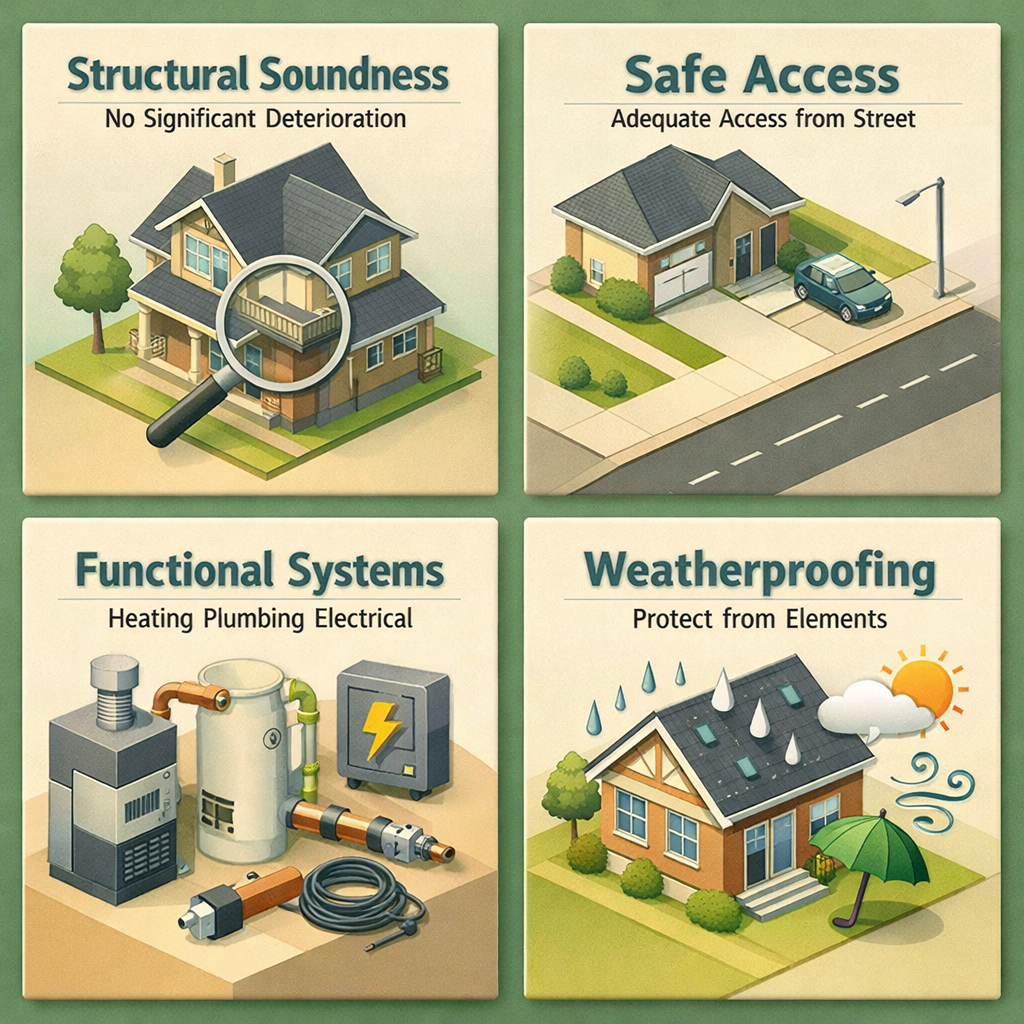
For a geodesic dome home to be eligible for FHA financing, it generally must meet the same baseline standards as any other residential property. That includes:
- Structural soundness: The home must show no signs of significant deterioration, and the foundation must be adequate for the structure it supports.
- Safe access: The home must have safe and adequate access from a public or private street.
- Functional systems: Heating, plumbing, and electrical systems must be in good working order.
- Weatherproofing: The roof and exterior must protect the home from the elements.
- Adequate living space: The home must have a continuous living space with a kitchen and bathroom.
The challenge with dome homes isn't necessarily that they fail these standards — many are well-built and well-maintained. The challenge is that appraisers and underwriters may be less familiar with how to evaluate them, which can slow down or complicate the process. Lenders that specialize in unique home financing or alternative structure loans may be better equipped to handle these situations.
The FHA Loan Appraisal for Dome Homes: What to Expect
One of the biggest hurdles in obtaining an alternative structure FHA loan for a dome home is the appraisal. FHA appraisals serve two purposes: they confirm the home's market value and verify that it meets the FHA's property standards. Both tasks can become complicated when the property is a geodesic dome.
The most significant appraisal challenge is finding comparable sales — what the industry calls "comps." Appraisers are required to identify similar properties that have sold recently in the same market area. For a geodesic dome home, finding true comps is often difficult because there simply aren't many dome homes in most markets, let alone ones that have sold recently.
When comps are scarce, appraisers may need to use paired sales analysis or expand their search radius significantly. They might also need to apply adjustments for unique features that don't have a clear market value. The result is an appraisal that may require more documentation, more time, and potentially more back-and-forth with the lender's underwriting team.
Here are a few things that may help smooth the FHA loan appraisal for dome homes:
- Work with an experienced appraiser: Ask your lender to assign an appraiser who has experience with non-traditional or custom-built homes.
- Provide documentation: Gather any builder specifications, engineering reports, or construction records that confirm the home's quality and structural integrity.
- Highlight energy efficiency: Dome homes often have exceptional energy performance, which could be a value-positive factor if documented properly.
- Be patient: Unique property appraisals may take longer than standard ones — budget extra time in your purchase timeline.
Foundation Requirements and Why They Matter for Dome Home Financing
The foundation of a home is one of the most closely scrutinized elements during any mortgage review, and this is especially true for FHA loans. FHA guidelines require that the foundation be structurally sound and appropriate for the local soil conditions and climate. For geodesic dome homes, this requirement can become a focal point of concern.
Many dome homes are built on non-standard foundations — some sit on wood posts, some on a ring of concrete piers, and others on custom slab designs shaped to accommodate the circular footprint. While these foundations may be perfectly sound from an engineering standpoint, they can raise questions during the appraisal and underwriting process simply because they look different from what underwriters typically review.
If you're buying a dome home, consider taking these proactive steps regarding the foundation:
- Commission a foundation inspection: Before applying for an FHA loan, hire a licensed structural engineer to inspect the foundation and provide a written report confirming its adequacy. This documentation may carry significant weight with your lender.
- Check for permits and compliance: Confirm that the foundation — and the structure overall — was built with the proper permits and meets local building codes. FHA appraisers will typically flag unpermitted construction.
- Address any visible issues: Cracks, settling, water intrusion, or deterioration around the foundation area should be repaired before the appraisal if possible.
- Know your soil conditions: In areas with expansive soils, high moisture levels, or seismic activity, foundation adequacy is even more critical to demonstrate.
A well-documented, structurally sound foundation — even if it's unconventional in design — can go a long way toward satisfying FHA requirements and giving your lender the confidence to proceed.
Borrower Qualification Tips for Unique Home Financing with FHA
While the property itself faces scrutiny, your personal financial profile is equally important. FHA loans are known for being accessible to a wider range of borrowers, and that flexibility can be genuinely valuable when you're already navigating the complexity of financing a geodesic dome home.
Here's what how lenders look for when you apply for an FHA loan:
- Credit score: Borrowers with a credit score of 580 or higher may qualify for the FHA's minimum down payment of 3.5%. Those with scores between 500 and 579 may still qualify but may be required to put down 10%.
- Debt-to-income ratio (DTI): FHA guidelines generally allow a DTI of up to 43%, though some lenders may go higher with compensating factors such as strong savings or a stable employment history.
- Employment and income verification: Lenders will want to see consistent employment history — typically two years in the same field — and reliable income documentation.
- Down payment source: FHA allows down payment funds to come from gifts, grants, or down payment assistance programs, which can be helpful for buyers stretching their budget to afford a unique property.
When you're pursuing unique home financing, having a stronger-than-minimum borrower profile can help offset some of the property-related uncertainty. If your credit score is well above the minimum threshold and your DTI is comfortably low, lenders may be more willing to work through the additional complexity that a dome home appraisal involves.
Alternative Financing Paths If FHA Approval Proves Difficult
Not every geodesic dome home will qualify for FHA financing, and it's worth knowing your options before you're deep into the buying process. If FHA proves to be a difficult path, there are other financing avenues worth exploring.
Conventional loans through Fannie Mae or Freddie Mac may be available for unique properties, though they also have their own appraisal and eligibility requirements. Some conventional lenders may have more flexibility in how they evaluate non-traditional homes, especially if the property has strong comparables or a compelling appraisal report.
Portfolio lenders — banks and credit unions that hold loans on their own books rather than selling them to the secondary market — sometimes offer more flexibility with unique property types. Because they're not bound by the same secondary market guidelines, they may be willing to lend on a dome home when other lenders won't. The trade-off is often a higher interest rate or a larger down payment requirement.
Construction-to-permanent loans may be relevant if you're building a new geodesic dome home rather than purchasing an existing one. These loans cover the construction phase and then convert to a standard mortgage once the home is complete. Some FHA programs, such as the FHA 203(k) rehabilitation loan, could also be worth exploring if the dome home needs significant renovation work — though eligibility would still depend on the property meeting FHA standards.
It's also worth speaking with a mortgage broker who has experience with alternative structure FHA loan applications. A knowledgeable broker may have access to lenders that specialize in non-traditional properties and can help you improve your approval chances find the best possible path forward.
●Conclusion
Financing a geodesic dome home isn't impossible — but it does require preparation, patience, and the right team of professionals. Understanding FHA loan requirements for a geodesic dome home with unique foundation is a smart first step, and the insights in this article should help you approach the process with realistic expectations. From the appraisal challenges to the foundation documentation, every detail matters when you're working with a property that falls outside the conventional norm. If you're ready to explore your financing options, LoanWise can help you connect with lenders who understand unique home financing and can guide you toward the right loan for your situation. Don't let the unconventional shape of your dream home stand between you and homeownership — with the right approach, the path forward is often clearer than it first appears.