
Buying a home with VA financing is one of the most powerful benefits available to eligible service members, veterans, and surviving spouses. But what happens when a co-borrower on the loan has student loans that are currently in deferment? Understanding the requirements for VA loan with co-borrower student loan deferment can be the difference between a smooth approval and an unexpected roadblock. Deferred student loan debt doesn't simply disappear from a lender's calculations — and knowing how it's treated under VA guidelines could help you plan a smarter path to homeownership.
What Is a VA Loan and Who Can Use One?
A VA loan is a government-backed mortgage program administered by the U.S. Department of Veterans Affairs. It's designed to help eligible veterans, active-duty service members, National Guard members, reservists, and qualifying surviving spouses purchase or refinance a home — often with no down payment required and without private mortgage insurance (PMI).
One of the unique advantages of VA loans is their flexibility. Unlike conventional loans, VA loans tend to have competitive interest rates and more forgiving qualification standards. However, they do follow specific underwriting guidelines — and those guidelines matter a great deal when a co-borrower enters the picture with deferred student loans on their credit profile.
It's worth noting that VA loans can only be guaranteed for eligible veterans or service members. That means if you're adding a co-borrower who isn't VA-eligible, the lender may only be able to guarantee the eligible borrower's portion of the loan. This distinction can affect how the lender evaluates the overall application, including how deferred debts from the non-veteran co-borrower are handled.
Understanding Co-Borrowers on a VA Loan
A co-borrower — sometimes called a co-applicant — is someone who shares legal responsibility for repaying the mortgage. Adding a co-borrower to a VA loan can strengthen an application by combining income, but it also means both borrowers' debts and credit profiles are reviewed by the lender.
VA guidelines distinguish between two types of co-borrowers:
- Veteran co-borrowers: Another VA-eligible individual who shares the loan. Their full VA entitlement may be available, and the loan is fully guaranteed.
- Non-veteran co-borrowers: A civilian spouse or other individual who doesn't hold VA eligibility. In these cases, the VA may only guarantee the veteran's share of the loan, which could affect lender requirements.
Regardless of co-borrower type, both applicants' financial profiles — including any student loan obligations — will be factored into the underwriting process. That's why understanding how deferred student loans are treated is so important for co-borrowers who may still be in school, recently graduated, or in a grace period.
How VA Guidelines Typically Handle Deferred Student Loans
This is where many applicants are caught off guard. Even if a student loan is currently in deferment — meaning no payments are currently due — VA loan guidelines generally still require lenders to account for that debt in the borrower's debt-to-income (DTI) ratio.
According to VA lending guidelines, if a student loan is deferred for 12 months or more beyond the loan closing date, the lender may be able to exclude that payment from the DTI calculation. However, if the deferment period ends within 12 months of closing, the lender is typically required to include a projected monthly payment in the debt calculation.
When no actual monthly payment is documented, lenders often use one of the following methods to estimate the payment:
- A percentage of the outstanding loan balance — commonly around 5% of the total balance divided by 12 months
- A payment figure provided by the loan servicer or shown on the credit report
- The income-driven repayment (IDR) amount, if applicable and documented
It's important to understand that individual lenders may apply these guidelines with some variation, as they operate within VA's broader framework but maintain their own overlays. Always confirm the specific approach with your lender early in the process.
Requirements for VA Loan with Co-Borrower Student Loan Deferment
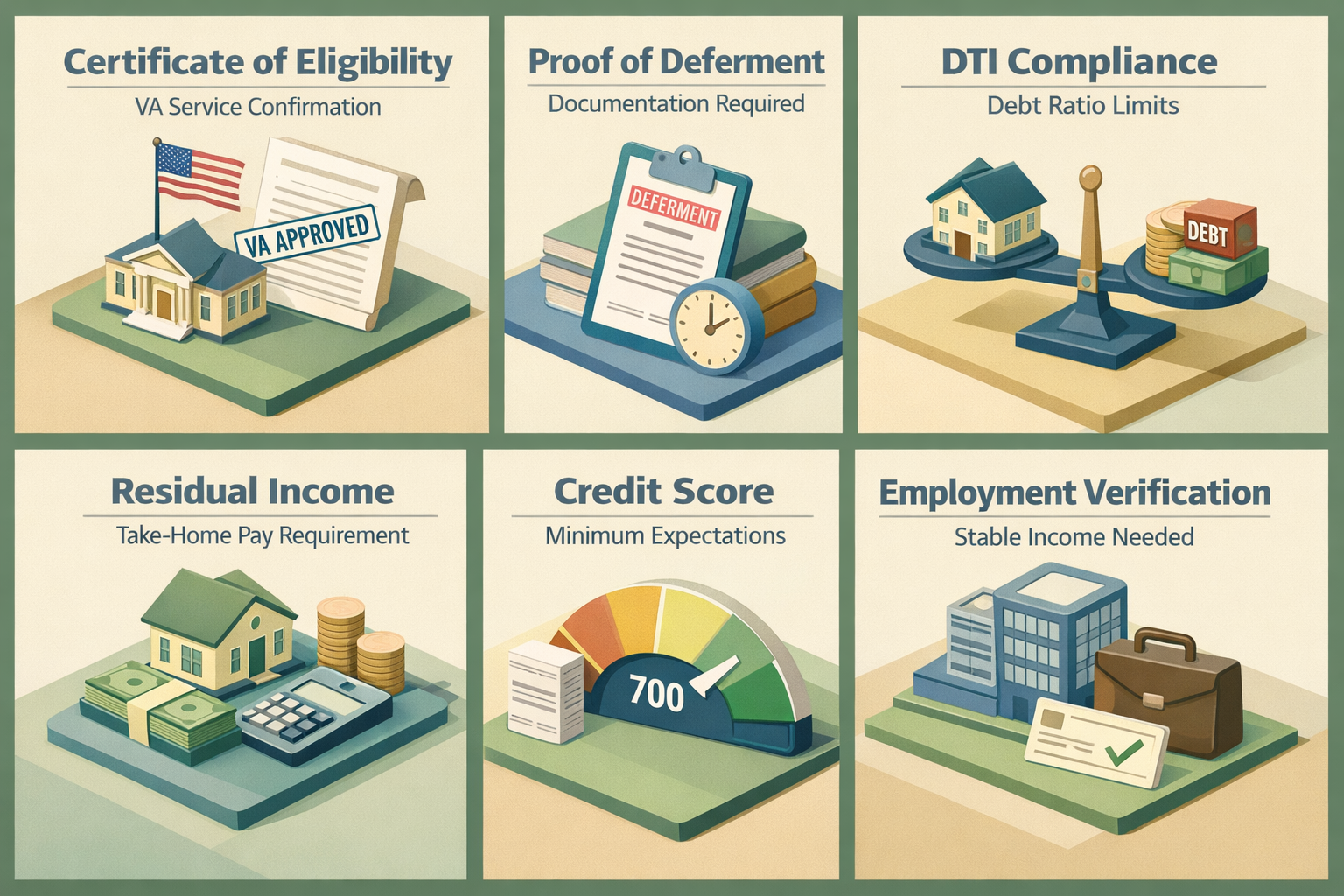
Meeting the requirements for VA loan with co-borrower student loan deferment involves satisfying both the standard VA eligibility criteria and the specific documentation expectations tied to the deferred debt. Here's what you'll generally need to prepare:
1. Certificate of Eligibility (COE)
The veteran or eligible service member must obtain a Certificate of Eligibility from the VA. This document confirms that the borrower meets service requirements and has remaining VA entitlement. A co-borrower has deferred student loans does not need to produce a COE unless they are also VA-eligible.
2. Proof of Deferment Status and Duration
Lenders will typically request official documentation from the student loan servicer confirming the deferment — including the start date and expected end date. This helps the underwriter determine whether the deferment extends beyond 12 months from the anticipated closing date, which may influence whether the payment must be included in DTI calculations.
3. Debt-to-Income Ratio Compliance
VA guidelines recommend a DTI ratio of no more than 41%, though exceptions can sometimes be approved with strong compensating factors. When a co-borrower's deferred loans are factored in, the combined DTI of both applicants must still fall within acceptable limits. If deferred payments push the DTI over the threshold, the application may require compensating factors such as strong residual income, significant cash reserves, or excellent credit scores.
4. Residual Income Standards
One of the most distinguishing features of VA loan underwriting is the residual income requirement. Unlike most other loan programs, the VA requires borrowers to demonstrate a minimum level of take-home pay remaining after all monthly obligations — including estimated housing costs — are covered. Even if a co-borrower's deferred loans are excluded from the DTI calculation, the residual income benchmark still applies and must be met based on household size and geographic region.
5. Credit Score Expectations
The VA itself does not set a minimum credit score, but most lenders impose their own minimum — often around 620, though this varies by institution. Both the primary borrower and the co-borrower's credit scores will be reviewed. Deferred student loans that are in good standing generally won't harm credit scores, but any past delinquencies on those accounts could.
6. Employment and Income Verification
Both borrowers must provide documentation of stable income. For a co-borrower who may be recently graduated or still studying, this could include offer letters, pay stubs, or tax returns. Lenders want to see reliable income that can support the projected mortgage payment alongside any upcoming student loan obligations once deferment ends.
VA Loan Eligibility with Student Loan Deferment: Common Scenarios
Understanding VA loan eligibility with student loan deferment often comes down to timing and documentation. Here are a few scenarios that illustrate how lenders might approach this situation:
Scenario A: Deferment Ends More Than 12 Months After Closing
If the co-borrower's student loans are deferred well beyond the expected closing date, some lenders may be able to exclude that monthly payment from the DTI calculation. This can significantly improve the application's debt profile on paper — but you'll need solid documentation to support this exclusion.
Scenario B: Deferment Ends Within 12 Months of Closing
This is where things get more complex. The lender is typically required to factor in a projected monthly payment, even though no payment is currently due. Borrowers in this situation may need to show higher residual income or provide a documented payment plan to satisfy underwriting requirements.
Scenario C: Income-Driven Repayment After Deferment
If the co-borrower anticipates switching to an VA loan eligibility with student loan deferment plan once deferment ends, lenders may use that documented IDR payment — even if it's very low or $0 — depending on the specific loan program and lender overlay. This option should be explored carefully with a VA-approved lender.
Tips to Strengthen Your VA Loan Application
Even if deferred student loan debt creates some underwriting complexity, there are strategies that may help improve your overall loan profile:
- Get your deferment documentation early. Request an official letter from your student loan servicer that clearly states the deferment period. This gives your lender what they need to make an accurate determination about DTI impact.
- Build your residual income cushion. Since residual income is central to VA underwriting, having more income left over after obligations are met can offset concerns about future student loan payments.
- Improve credit scores before applying. Both borrowers should aim for the strongest possible credit profiles. Pay down revolving balances and avoid new credit inquiries in the months leading up to application.
- Work with a VA-experienced lender. Not all mortgage lenders handle VA loans with the same level of expertise. A lender who regularly works with VA financing will be better equipped to navigate co-borrower and student loan complexities.
- Consider the timing of your application. If deferment is set to end soon, it may be worth either accelerating the home purchase or waiting until an income-driven payment plan is in place — whichever results in a more favorable DTI picture.
●Conclusion
Navigating the requirements for VA loan with co-borrower student loan deferment takes preparation, but it's absolutely manageable with the right information and the right lending partner. VA loans remain one of the most borrower-friendly mortgage options available, and deferred student loans don't automatically disqualify a co-borrower from participating in the purchase. What matters most is how that debt is documented, how it affects the DTI ratio, and whether residual income requirements can still be met. If you're a veteran or service member ready to explore your home financing options, working with a knowledgeable VA lender early in the process can save time and prevent surprises. Reach out to a LoanWise mortgage specialist today to understand exactly where you stand — and what steps to take next.