
Buying a high-value home in the United States is an exciting milestone, but financing it can feel especially complex when your income comes from foreign dividends and your citizenship is still pending. Jumbo loans — mortgages that exceed conventional conforming loan limits — already come with stricter underwriting standards. Add in international income sources and a non-citizen immigration status, and you're navigating one of the more nuanced corners of the mortgage market. The good news is that many lenders do work with borrowers in this situation. Understanding the requirements for jumbo loan with foreign dividend income and pending US citizenship is the first step toward turning that dream home into a reality.
What Makes Jumbo Loans Different From Conventional Mortgages
A jumbo loan is a mortgage that surpasses the conforming loan limits set by the Federal Housing Finance Agency (FHFA). Because these loans can't be purchased by Fannie Mae or Freddie Mac, lenders hold them in their own portfolios. That means lenders take on more risk, and they respond by setting higher qualification standards than you'd typically see with a conventional loan.
In practice, this often translates to requirements like a higher credit score, a larger down payment, lower debt-to-income ratios, and more extensive documentation of your financial profile. For borrowers with straightforward W-2 income and US citizenship, the process is already rigorous. For those relying on jumbo loan foreign income US citizenship considerations — particularly when citizenship is still pending — the review process can be even more detailed.
Lenders offering jumbo products generally want to see strong financial reserves, stable income history, and minimal credit risk. Understanding what they're looking for helps you prepare a more compelling application.
How Lenders View Pending US Citizenship Status
Many people assume that you must be a US citizen to qualify for a mortgage, but that's not necessarily the case. Lenders typically assess residency and immigration status as part of their risk evaluation, and numerous loan programs are available to non-citizens, including those with pending citizenship applications.
Borrowers who are lawful permanent residents — commonly known as green card holders — are generally treated similarly to US citizens by most lenders. If you hold a valid green card and are in the naturalization process, your status may actually be quite favorable in lenders' eyes. On the other hand, if you're on a work visa or other temporary immigration status with a pending citizenship application, lenders may ask for additional documentation to assess the stability of your US residency.
For jumbo loan foreign income and pending citizenship cases specifically, lenders are likely to look closely at your visa classification, the expiration date of your current status, your history of continuous residency in the US, and any documentation related to your citizenship application. Some portfolio lenders — those who hold their own loans rather than selling them on secondary markets — may have more flexible guidelines in this area. It's worth noting that requirements can vary significantly from one lender to the next, so shopping around is especially important in this situation.
Understanding Foreign Dividend Income in the Eyes of a Mortgage Underwriter
Dividend income from foreign investments adds another layer of complexity to the jumbo loan process. Mortgage underwriters are trained to assess income stability and continuity. Domestic dividend income already requires careful documentation; foreign dividend income introduces currency exchange considerations, tax reporting requirements, and questions about the ongoing reliability of those earnings.
To use foreign dividend income when qualifying for a jumbo loan, you'll typically need to demonstrate a consistent history of receiving those payments — often over a period of at least one to two years. Lenders will want to see that the income is likely to continue for at least three years into the future, though this varies by lender. The income also needs to be properly reported on your US tax returns, especially if you're a resident alien or lawful permanent resident with worldwide income reporting obligations.
Some lenders may apply a currency risk discount, reducing the qualifying amount of foreign income to account for potential exchange rate fluctuations. Others may decline to count foreign dividend income at all and instead focus on your US-based assets and earnings. Portfolio lenders and private banks with experience serving international clients may be better equipped to evaluate this type of income fairly and consistently.
- Two-year income history: Most lenders want at least two years of documented foreign dividend income.
- Tax return evidence: Income must typically appear on filed US tax returns or equivalent foreign tax documentation.
- Continuity verification: Evidence that dividends are expected to continue, such as investment account statements or brokerage letters, may be required.
- Currency conversion: Lenders may convert income to US dollars using a specific exchange rate methodology, and some apply a discount for volatility.
Key Documentation You'll Need to Prepare
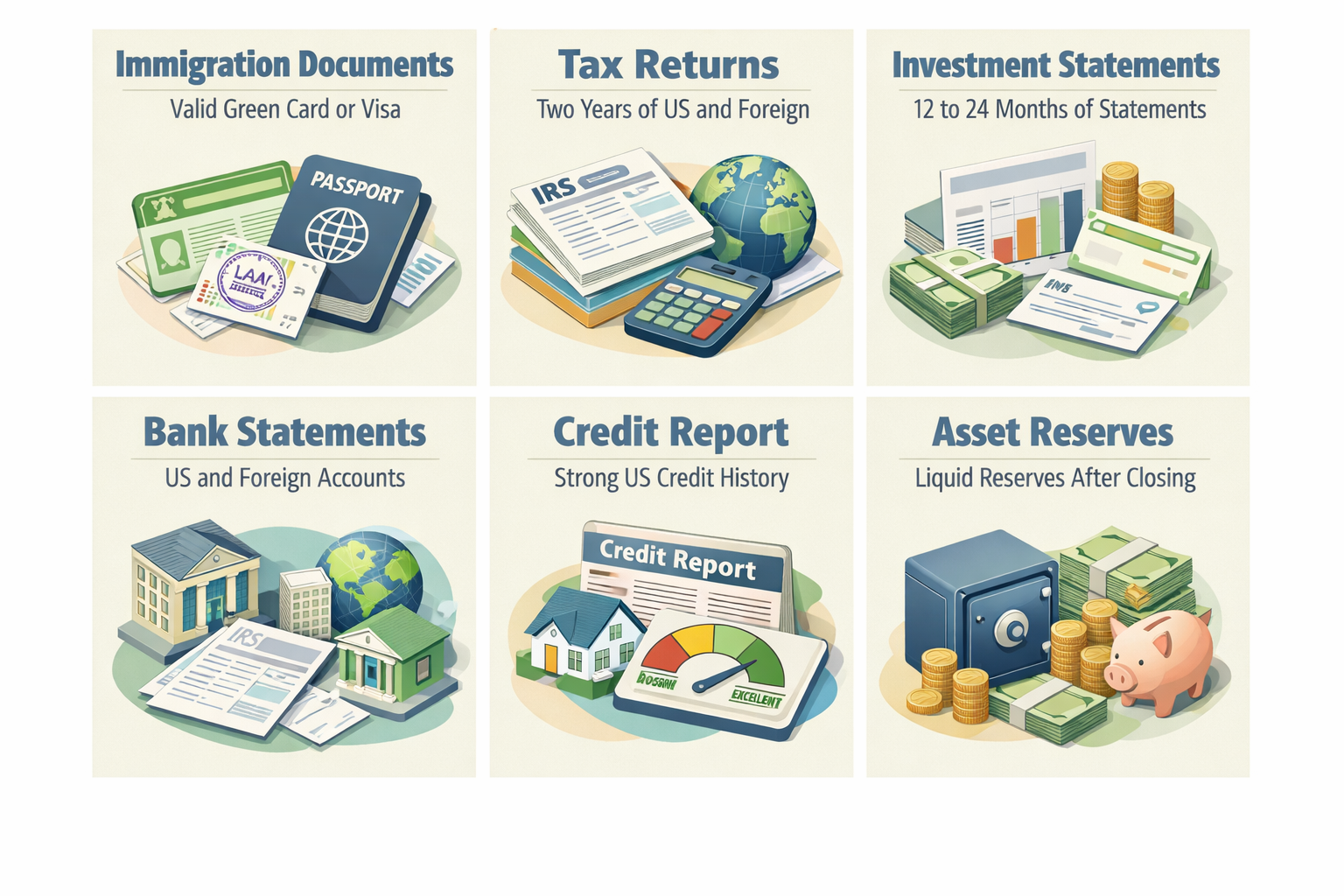
Preparation is everything when it comes to a complex jumbo loan application. Because the requirements for jumbo loan with foreign dividend income and pending US citizenship touch on multiple areas of underwriting, you'll want to gather an extensive document package well before you begin the application process.
Here's a general overview of what lenders may request:
- Immigration and residency documents: Valid green card, visa, or I-485 pending application confirmation, along with any supporting USCIS notices.
- US and foreign tax returns: Typically two years of US federal tax returns (Form 1040) and, if applicable, foreign tax filings that substantiate dividend income.
- Investment account statements: At least 12 to 24 months of statements from the brokerage or financial institution distributing the foreign dividends.
- Proof of income continuity: Letters from investment managers, fund prospectuses, or other documentation suggesting ongoing dividend payments.
- Bank statements: US and potentially foreign bank account statements showing deposits consistent with the income claimed.
- Credit report: A strong US credit history is typically required; international credit history alone is usually not sufficient.
- Asset reserves: Jumbo lenders often require six to twelve months of mortgage payments held in liquid reserves after closing.
The more organized and thorough your documentation, the smoother the underwriting process is likely to be. Working with an experienced mortgage broker who has handled international borrower cases can help you anticipate underwriting questions before they arise.
Credit Score and Financial Profile Expectations for Jumbo Borrowers
Jumbo loans typically require a higher credit score than conventional conforming mortgages. While requirements vary, many lenders look for a minimum FICO score in the range of 700 to 720, with more competitive terms available to borrowers scoring 740 or higher. If your credit file is limited because you're relatively new to the US financial system, this could present a challenge.
One strategy for building US credit history quickly involves opening secured credit cards, becoming an authorized user on an established account, or obtaining a credit-builder loan. Even a few years of consistent, on-time payments across multiple credit types can significantly strengthen your profile. Some lenders may also consider international credit reports or letters of reference from foreign banks, though these are typically supplemental rather than primary sources of credit evaluation.
Beyond credit scores, lenders will evaluate your overall financial strength, including your debt-to-income (DTI) ratio. For jumbo loans, many lenders prefer a DTI of 43 percent or lower, though some portfolio lenders may allow slightly higher ratios depending on compensating factors such as substantial assets or strong reserves. A large down payment — often 20 percent or more — can also improve your approval odds and may reduce the lender's concern about residency status and foreign income complexity.
Choosing the Right Lender for This Type of Loan
Not every lender is equipped or willing to handle the combination of a jumbo loan, foreign dividend income, and pending citizenship. Traditional retail banks with strict conforming guidelines may decline the application outright or struggle to accommodate the documentation. This is where working with a knowledgeable mortgage advisor becomes especially valuable.
Portfolio lenders — institutions that originate and hold their own loans rather than selling them to the secondary market — tend to have more flexible underwriting guidelines. Private banks and wealth management lending divisions are also worth exploring, particularly if you have substantial investable assets. These institutions often specialize in serving high-net-worth clients with complex financial profiles and international backgrounds.
Non-QM (non-qualified mortgage) lenders are another avenue to consider. These lenders design loan products specifically for borrowers who don't fit the standard qualifying boxes, including those with foreign dividend income and pending US citizenship or non-traditional documentation. While non-QM loans may come with slightly higher interest rates to reflect the increased risk and complexity, they can provide a viable path to homeownership for qualified borrowers who might otherwise be turned away.
When comparing lenders, ask specifically about their experience with foreign income documentation, their policies on pending citizenship status, and their asset depletion or foreign income calculation methods. The right lender will not only understand your situation but will be able to walk you through their specific underwriting process in clear terms.
Practical Tips to Strengthen Your Jumbo Loan Application
If you're planning to apply for a jumbo loan with foreign dividend income and a pending citizenship application, a few strategic steps could meaningfully improve your chances of approval.
- Start early: Begin assembling your documentation months before you plan to apply. Gathering two years of tax returns, investment statements, and immigration records takes time.
- Maximize your down payment: A larger down payment reduces the lender's exposure and signals financial strength. Aim for at least 20 to 25 percent if possible.
- Maintain strong US cash reserves: Lenders want to see that you can cover mortgage payments even if your foreign income experiences a temporary disruption.
- Report all income correctly: Ensure that your foreign dividend income is accurately reported on your US tax returns. Inconsistencies between what you claim and what's documented can raise red flags during underwriting.
- Work with a bilingual or internationally experienced mortgage broker: A broker who understands both US lending standards and international financial systems can bridge communication gaps and advocate effectively on your behalf.
- Consult a tax professional: An international tax advisor can help you structure your foreign income documentation in a way that satisfies US mortgage underwriting requirements.
- Be transparent: Disclose everything upfront. Lenders are far more comfortable working through complexity when borrowers are forthcoming from the start.
Every borrower's situation is different, and what works for one person may not be the right approach for another. A thorough consultation with a licensed mortgage professional familiar with the requirements for jumbo loan with foreign dividend income and pending US citizenship is one of the most valuable investments you can make before starting this process.
●Conclusion
Qualifying for a jumbo loan when you have foreign dividend income and a pending US citizenship application is genuinely challenging, but it's far from impossible. The key is understanding that this type of application requires careful preparation, the right lender relationship, and thorough documentation at every step. Portfolio lenders, private banks, and non-QM mortgage providers may offer the most flexibility for borrowers in this position. By building a strong financial profile, presenting your income history clearly, and working with professionals who specialize in complex mortgage scenarios, you can put yourself in a solid position to finance a high-value home purchase. LoanWise is here to help you explore your options and connect with lenders equipped to handle your unique financial situation.