
If you earn commission-based income and carry student loan debt that's currently in deferment, getting approved for a mortgage can feel more complicated than it should. Lenders don't always view variable income or paused loan payments the same way borrowers do — and that gap in understanding can lead to surprises during the approval process. Knowing how to calculate DTI with commission income and student loan deferment is one of the most important steps you can take before applying for a home loan. This guide breaks down exactly how lenders approach both factors, what formulas they use, and how you might position yourself for the best possible outcome.
What the Debt-to-Income Ratio Actually Measures
Your debt-to-income ratio, commonly called DTI, is a percentage that compares your monthly debt obligations to your gross monthly income. Lenders use it to gauge how much of your paycheck is already spoken for before you add a mortgage payment. It's one of the most heavily weighted factors in the mortgage underwriting process, often carrying as much influence as your credit score.
There are actually two versions of DTI that lenders typically review. The first is the front-end ratio, which only includes your proposed housing costs — things like your principal, interest, property taxes, homeowners insurance, and any HOA fees. The second is the back-end ratio, which adds all your recurring monthly debts to that housing figure. When lenders talk about DTI in general terms, they're almost always referring to the back-end ratio.
The basic formula looks like this: divide your total monthly debt payments by your gross monthly income, then multiply by 100 to get a percentage. For example, if your monthly debts total $2,000 and your gross income is $6,000, your DTI is roughly 33%. Most conventional loan programs prefer to see a back-end DTI below 43%, though some programs allow higher ratios with compensating factors. FHA loans may permit DTIs up to 50% in certain circumstances, while VA and USDA guidelines vary as well.
Where things get nuanced — and where many commission income earners with student loans run into trouble — is in how lenders define "income" and "debt" for calculation purposes. Both definitions can shift depending on your specific situation.
How Lenders Qualify Commission Income for Mortgage Purposes
Commission income is treated differently than a salaried paycheck. Because it can fluctuate month to month, lenders typically want to see a documented history of earnings before they'll include it in your qualifying income. Most lenders and loan programs require at least two years of commission income history, verified through tax returns, W-2s, and sometimes year-to-date pay stubs.
Rather than using your most recent month's commission check, underwriters usually average your commission earnings over a 24-month period. This averaged figure becomes the income number used in your DTI calculation. If your commissions have been declining over that period, lenders may use the lower, more recent figure — or may scrutinize the trend more closely before approving your file.
It's also worth noting that commission income reported on tax returns is often reduced by business-related deductions. If you write off significant work expenses, those deductions could lower your qualifying income even if your gross commissions were strong. This is a common surprise for salespeople, real estate agents, and other commission-based professionals who aggressively use Schedule C or Form 2106 deductions.
Here are a few things commission earners should keep in mind when preparing for a mortgage application:
- Consistent growth matters: Lenders are more comfortable when your commission income has stayed flat or increased year over year.
- Minimize unreimbursed employee expenses: These deductions reduce your usable income in underwriting.
- Year-to-date earnings: Lenders may compare your current pace of earnings to prior years to confirm stability.
- Self-employed vs. W-2 commission: W-2 commission earners generally have a simpler documentation path than self-employed commission workers.
Once lenders settle on a qualifying income figure, that number goes into the denominator of your DTI calculation. Getting this number as accurate — and as high — as possible is critical for commission earners.
The Student Loan Deferment Problem Most Borrowers Don't Expect
Many borrowers assume that if their student loans are in deferment, those loans won't count against their DTI. After all, they're not making payments right now — so why would a lender include them? Unfortunately, that's not how most mortgage programs work, and misunderstanding this point is one of the most common reasons mortgage applications run into trouble for the debt to income ratio commission earners student loans combination.
Even when your student loans are deferred, lenders are required by most guidelines to include a projected monthly payment in your DTI calculation. The logic is straightforward: the deferment period will eventually end, and those payments will resume. Lenders want to be confident you can handle the full debt load, not just what you're paying today.
How lenders calculate that projected payment depends on the loan program you're applying for:
- Conventional loans (Fannie Mae): Lenders typically use the actual payment listed on your credit report, or if that figure is zero or unavailable, they may use 1% of your outstanding student loan balance as a monthly payment estimate.
- Conventional loans (Freddie Mac): Similar approach — if your actual payment is zero, a payment may be calculated at 0.5% of the outstanding balance per month.
- FHA loans: FHA guidelines generally require lenders to use either the actual monthly payment or 0.5% of the total outstanding balance, whichever is greater.
- VA loans: VA guidelines may allow lenders to exclude deferred student loans if the deferment extends beyond a certain period — this is one of the more favorable treatments available.
- USDA loans: USDA may also require use of a calculated payment when actual payments are zero.
These differences can have a significant impact on your DTI. A borrower with $80,000 in deferred student loan debt could see a monthly obligation of $400 to $800 added to their DTI calculation depending on the loan program — even though they're not currently paying a dime toward those loans.
How to Calculate DTI With Commission Income and Student Loan Deferment Step by Step
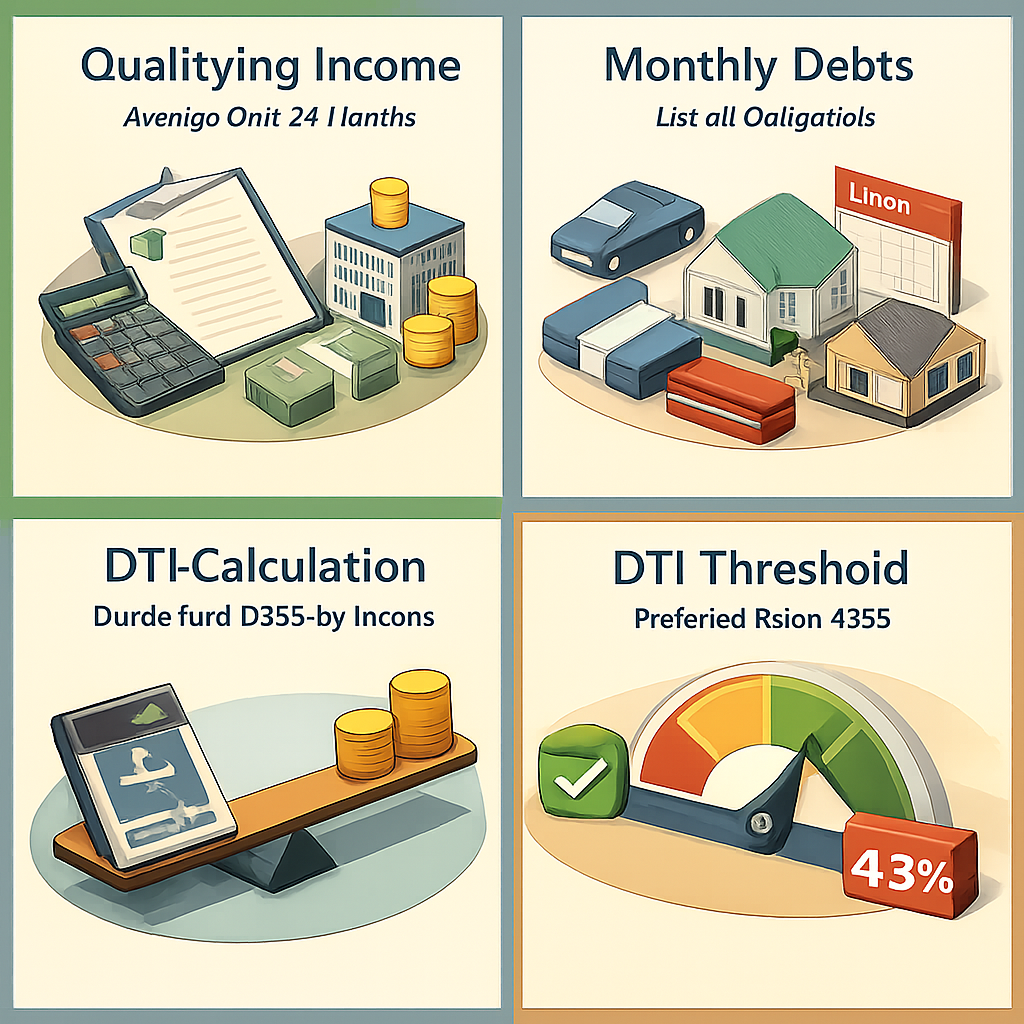
Understanding how to calculate DTI with commission income and student loan deferment becomes much clearer when you walk through a practical example. Let's say you're a sales professional applying for a conventional loan backed by Fannie Mae guidelines.
Step 1 — Determine qualifying income. Over the past two years, your commission income totaled $144,000. Dividing by 24 months gives you a qualifying monthly income of $6,000.
Step 2 — List all monthly debts. Your recurring monthly obligations include:
- Proposed mortgage payment (principal, interest, taxes, insurance): $1,800
- Car loan payment: $350
- Credit card minimum payments: $150
- Student loans (currently deferred, balance of $60,000): Lender uses 1% = $600 estimated monthly payment
Step 3 — Total your monthly debts. Add them up: $1,800 + $350 + $150 + $600 = $2,900.
Step 4 — Divide by gross monthly income. $2,900 ÷ $6,000 = 0.4833, or approximately 48.3% DTI.
In this example, the back-end DTI comes in above the preferred 43% threshold for a standard conventional loan. The student loan deferment calculation alone added $600 to the monthly debt figure — a meaningful chunk. Without that, the DTI would have been roughly 38.3%, which would likely sail through underwriting.
This is why knowing your numbers in advance is so valuable. You can explore strategies to reduce your debt-to-income ratio before submitting a full application, rather than discovering the issue during underwriting when your options are more limited.
Strategies to Improve Your DTI Before Applying for a Home Loan
The good news is that DTI isn't a fixed number — it's something you can actively work to improve. For commission earners dealing with deferred student loans, there are several approaches worth considering.
Explore Income-Driven Repayment Plans
One of the most effective strategies for managing the student loan side of your DTI is to exit deferment and enroll in an income-driven repayment (IDR) plan. If your IDR plan results in a documented monthly payment — even a very low one — some lenders may be able to use that actual payment rather than the estimated 0.5% or 1% calculation. This could significantly reduce the student loan portion of your monthly debt load. Check with your loan officer about which programs allow this treatment, as guidelines vary.
Pay Down High-Balance Revolving Debt
If you carry balances on credit cards, reducing those balances can lower your minimum monthly payments and improve your DTI relatively quickly. This is often one of the fastest ways to create breathing room in your debt calculation.
Avoid Taking On New Debt Before Applying
Any new monthly obligation — a car loan, a personal loan, a new credit card — adds to your DTI numerator. If you're planning to apply for a mortgage in the next six to twelve months, it's generally wise to hold off on new financing commitments.
Boost Your Documented Commission History
If possible, give yourself time to build a stronger two-year average. A year with notably higher commissions can lift your qualifying income and lower your effective DTI ratio, even if your debts stay the same.
Choose the Right Loan Program
As noted earlier, VA loans may offer more favorable treatment of deferred student loans for eligible veterans and service members. Borrowers who qualify for VA financing may find it opens doors that conventional or FHA programs don't. Discuss your specific situation with a knowledgeable loan officer who can compare program guidelines side by side.
Working With a Lender Who Understands Variable Income and Student Debt
Not every lender handles commission income and student loan deferment the same way — and some are simply better equipped to work with complex financial profiles than others. Finding a mortgage professional who has experience with commission earners can make a real difference in both the accuracy of your pre-approval and your overall experience.
A well-prepared loan officer will know to pull two years of tax returns and W-2s early in the process, identify any deductions that might reduce your qualifying income, and clearly explain how your deferred student loans will be treated under each loan program you're considering. They should walk you through multiple scenarios — perhaps comparing a conventional loan versus an FHA loan — so you can see exactly how DTI is affected by each program's guidelines.
It's also worth asking whether the lender has access to non-QM (non-qualified mortgage) products. These programs operate outside the standard Fannie Mae and Freddie Mac guidelines and may offer more flexibility for borrowers with commission income, higher DTIs, or unique financial situations. Non-QM loans typically carry higher interest rates, but for some borrowers they may be the best path to homeownership while they work toward improving their overall financial profile.
Transparency matters throughout this process. Be upfront with your lender about your income structure, your student loan status, and any other financial details that might affect your application. The more complete the picture they have from the start, the better positioned they are to find the right solution for you.
●Conclusion
Navigating the mortgage process as a commission earner with deferred student loans requires a bit more planning than a straightforward salaried application — but it's absolutely achievable. The key is understanding how to calculate DTI with commission income and student loan deferment before you sit down with a lender, so you're not caught off guard by the numbers. Know how your commission income will be averaged, understand how your student loan balance will be estimated as a monthly payment, and take proactive steps to strengthen your DTI wherever you can. With the right preparation and the right lending partner, homeownership is well within reach. Connect with a LoanWise mortgage specialist today to review your full financial picture and explore loan options tailored to your situation.