
The short-term rental market has opened exciting doors for real estate investors and homeowners alike. Platforms like Airbnb and VRBO have made it possible to generate meaningful income from vacation properties — income that some borrowers hope to use when applying for a large mortgage. But qualifying for a jumbo loan with short-term rental income isn't always straightforward. Lenders apply stricter standards to these loans, and short-term rental income comes with its own unique documentation challenges. Whether you're an Airbnb host eyeing a luxury beach house or an investor expanding your vacation portfolio, understanding the core requirements can make the difference between an approval and a denial. This guide walks you through what lenders typically expect and how you can best position yourself for success.
What Makes a Jumbo Loan Different from a Conventional Mortgage
A jumbo loan is any mortgage that exceeds the conforming loan limits set by the Federal Housing Finance Agency (FHFA). In most parts of the United States, that limit sits at $766,550 for a single-family home in 2024, though higher-cost areas may have elevated limits. Because jumbo loans can't be purchased by Fannie Mae or Freddie Mac, lenders take on more risk — and that means they typically enforce tighter qualification standards.
Borrowers seeking a jumbo mortgage for Airbnb hosts or vacation rental properties need to understand that these loans are portfolio products. Each lender sets its own rules, which can vary considerably from one institution to the next. There's no universal government-backed guideline to follow, so flexibility and lender choice become especially important. Some lenders may be more comfortable with short-term rental income than others, making it worth shopping around carefully.
Common ways jumbo loans differ from conventional mortgages include:
- Higher credit score requirements — lenders often expect scores of 700 or above, with many preferring 720 or higher
- Larger down payment expectations — typically ranging from 10% to 30% depending on the loan size and property type
- Lower debt-to-income (DTI) ratios — many lenders cap DTI at 43%, though some may allow slightly higher with compensating factors
- More extensive asset and reserve requirements — borrowers may need to demonstrate 12 or more months of mortgage payments in liquid reserves
- Stricter income documentation — all income sources, including rental income, must be thoroughly verified
Understanding these baseline differences helps set realistic expectations before you dive into the rental income documentation process.
How Lenders View Short-Term Rental Income
Short-term rental income — the kind earned through platforms like Airbnb, VRBO, or Vacasa — is treated very differently from traditional long-term rental income. With a long-term rental, a signed lease provides a predictable, contractual income stream. Short-term rentals, by contrast, are subject to seasonal demand, market fluctuations, local regulations, and platform policy changes. Lenders view this variability as a risk factor.
That said, many lenders may consider short-term rental income if it's properly documented and has a reliable history. The key phrase here is "reliable history." Most lenders want to see at least one to two years of verified rental income before they'll factor it into your qualifying income calculations. Some lenders may even require a third-party income analysis or a market study from a licensed appraiser familiar with short-term rental performance in the area.
When evaluating vacation rental income loan applications, lenders typically look at:
- Platform income statements — official earnings summaries from Airbnb, VRBO, or similar platforms showing gross and net payouts
- Tax returns (Schedule E) — two years of federal returns that show rental income and allowable expenses
- Profit and loss statements — especially for self-employed borrowers or those managing multiple properties
- Occupancy rates and seasonality patterns — to assess the sustainability of the income stream
- Local regulatory compliance — proof that short-term rentals are legally permitted in the property's jurisdiction
It's worth noting that lenders often apply a discount or "haircut" to rental income when calculating your qualifying amount. For example, they might use only 75% of the gross income reported to account for vacancy, expenses, and market risk. This conservative approach helps lenders manage exposure on large loan balances.
Core Requirements for a Jumbo Loan with Short-Term Rental Income
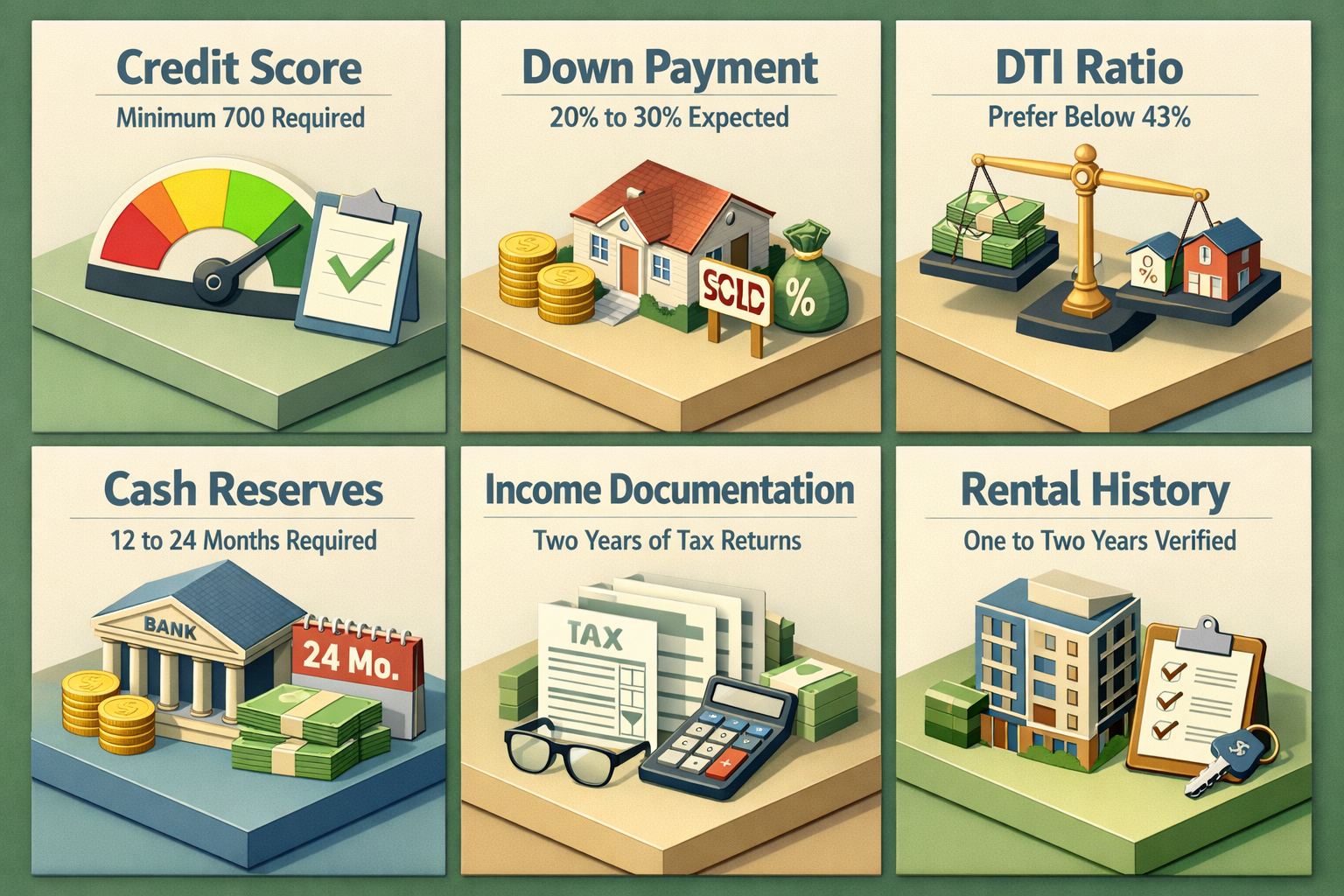
Meeting the requirements for a jumbo loan with short-term rental income involves satisfying both the standard jumbo loan criteria and additional documentation specific to rental activity. Here's a closer look at what you'll typically need to prepare:
Credit Score and Financial Profile
A strong credit score is non-negotiable for jumbo financing. Most lenders want to see a minimum FICO score of 700, and those offering the most competitive rates often prefer scores of 720 to 740 or higher. In addition to your score, lenders will review your overall credit profile — including your payment history, outstanding debts, and credit utilization. Any recent late payments, collections, or bankruptcies could significantly hurt your chances.
Down Payment and Equity Requirements
Expect to bring a substantial down payment to the table. For a primary residence, some jumbo lenders may accept as little as 10% down, but for a vacation or investment property with short-term rental income, the requirement often climbs to 20% to 30%. A larger down payment reduces lender risk and can also improve your rate and terms. If you're refinancing an existing short-term rental property, you'll likely need meaningful equity — often at least 20% to 30% — to qualify.
Debt-to-Income Ratio
Your DTI ratio measures how much of your gross monthly income goes toward debt payments. For jumbo loans, lenders typically prefer a DTI below 43%, though some may allow slightly higher ratios if you have strong compensating factors like significant liquid reserves or a high credit score. When short-term rental income is included in your qualifying income, lenders will likely apply a conservative calculation, which could affect how much income actually offsets your debt obligations.
Cash Reserves
Jumbo lenders are especially focused on reserves — the liquid assets you'd have left after closing. For properties with short-term rental income, some lenders may require 12 to 24 months of mortgage payments in verified reserves. These funds act as a safety net in case rental demand drops or the property sits vacant for an extended period. Acceptable reserve assets typically include savings accounts, money market accounts, and certain retirement funds.
Documentation Strategies for Airbnb and Vacation Rental Hosts
One of the biggest hurdles for a jumbo mortgage for Airbnb hosts is assembling the right documentation. Lenders need to see a clear, consistent picture of your rental income — and that means getting organized well before you apply. Here are some practical strategies to help you build a strong application file:
- Download official income reports from your rental platform(s) going back at least 24 months. Airbnb and VRBO both offer downloadable earnings summaries that lenders may accept as supporting documentation.
- File complete and accurate tax returns. Lenders will almost certainly request two years of federal tax returns. Make sure your Schedule E accurately reflects rental income and legitimate deductions without over-reporting expenses that might reduce your qualifying income below what you need.
- Work with an accountant experienced in rental properties. A CPA who understands short-term rental taxation can help you structure your returns in a way that presents your income favorably while remaining fully compliant.
- Obtain a rental income analysis or appraisal addendum. Some lenders require a market rent survey or a Form 1007 (Single Family Comparable Rent Schedule) completed by a licensed appraiser. This provides an objective estimate of the property's rental income potential.
- Document local regulations and permits. Provide evidence that your short-term rental is legally permitted — this might include a city license, HOA approval, or a local ordinance compliance letter.
- Maintain clean business records. If you manage your rentals through a business entity, lenders may request business bank statements, profit and loss statements, or business tax returns in addition to personal financial documents.
Being proactive with documentation can significantly speed up the underwriting process and reduce the likelihood of frustrating back-and-forth requests from your lender.
Non-QM Loans and Alternative Financing Paths for Short-Term Rental Investors
If traditional jumbo lenders aren't comfortable with your short-term rental income, there's another category of lending worth exploring: Non-QM (non-qualified mortgage) loans. These are portfolio loans that don't conform to the standard qualified mortgage guidelines set by the Consumer Financial Protection Bureau (CFPB). Non-QM lenders often have more flexible income verification standards, making them a practical option for borrowers whose income doesn't fit neatly into a W-2 box.
One popular Non-QM product for rental investors is the DSCR loan — Debt Service Coverage Ratio loan. Instead of qualifying based on your personal income, a DSCR loan evaluates whether the property's rental income is sufficient to cover its mortgage payment. Lenders typically look for a DSCR of 1.0 or higher, meaning the property generates at least as much income as it costs to carry. Some lenders may accept a DSCR below 1.0 with a larger down payment or higher interest rate.
For Airbnb hosts specifically, some Non-QM lenders will use projected short-term rental income — based on market analysis tools like AirDNA — rather than requiring a full two-year income history. This can be a game-changer for newer hosts or investors purchasing their first vacation rental.
Keep in mind that Non-QM and DSCR loans for financing with short-term rental income often come with:
- Higher interest rates compared to conventional jumbo products
- Larger required down payments (often 20% to 30%)
- Shorter prepayment penalty periods in some cases
- Limited availability through specialized lenders or brokers
Working with a mortgage broker who has experience in investment and vacation rental financing can help you identify the most suitable product for your situation.
Tips to Strengthen Your Jumbo Loan Application as a Short-Term Rental Borrower
Beyond meeting the minimum requirements for jumbo loan approval, there are several steps you can take to make your application as competitive as possible. Lenders appreciate borrowers who demonstrate financial discipline and awareness of their own risk profile.
- Build up your cash reserves well in advance. The more liquid assets you can show, the more comfortable lenders will feel approving a large loan tied to variable rental income. Consider shifting funds into easily verifiable accounts at least 60 to 90 days before applying.
- Pay down existing debt. Reducing credit card balances and installment loan obligations lowers your DTI and signals financial responsibility. Even modest reductions can meaningfully shift your ratio.
- Maintain consistent rental activity. A property with a strong, consistent booking history is far easier to underwrite than one with large gaps or seasonal extremes. If possible, establish or reinforce your rental track record before applying.
- Avoid major financial changes before applying. Don't open new credit accounts, make large unexplained deposits, or change employment status in the months leading up to your application. Stability is a green flag for underwriters.
- Choose the right lender. Not every bank or mortgage company has experience with short-term rental income analysis. Seek out lenders or brokers who specialize in investment property financing or Non-QM products — they'll be better equipped to navigate the unique documentation requirements.
- Consider a co-borrower. If your income alone doesn't comfortably meet the DTI requirements, adding a financially strong co-borrower may improve your qualification profile.
●Conclusion
Qualifying for a requirements for jumbo loan with short-term rental income is absolutely achievable — but it requires careful preparation, the right documentation, and a lender who understands the vacation rental landscape. From building a solid credit profile and assembling two years of rental income history to exploring DSCR and Non-QM products, there are multiple pathways to financing your next high-value property. The short-term rental market continues to evolve, and lenders are increasingly developing products designed to serve hosts and investors in this space. The more organized and informed you are going into the process, the better your odds of securing favorable terms. If you're ready to explore your options, connect with a LoanWise lending specialist today — we're here to help you find the right mortgage for your unique financial picture.