
For many veterans and active-duty service members, the VA loan program is one of the most powerful home financing tools available. It offers no down payment requirements, competitive interest rates, and flexible credit guidelines. But what happens when you want to buy a home with a co-borrower who carries student loan debt — and you don't have a co-signer to fall back on? Understanding how to qualify for a VA loan with co-borrower student loan debt and no co-signer is entirely possible, but it does require a clear strategy and a solid grasp of how lenders evaluate your overall financial picture. This guide walks you through everything you need to know.
Understanding VA Loan Eligibility and Who Can Be a Co-Borrower
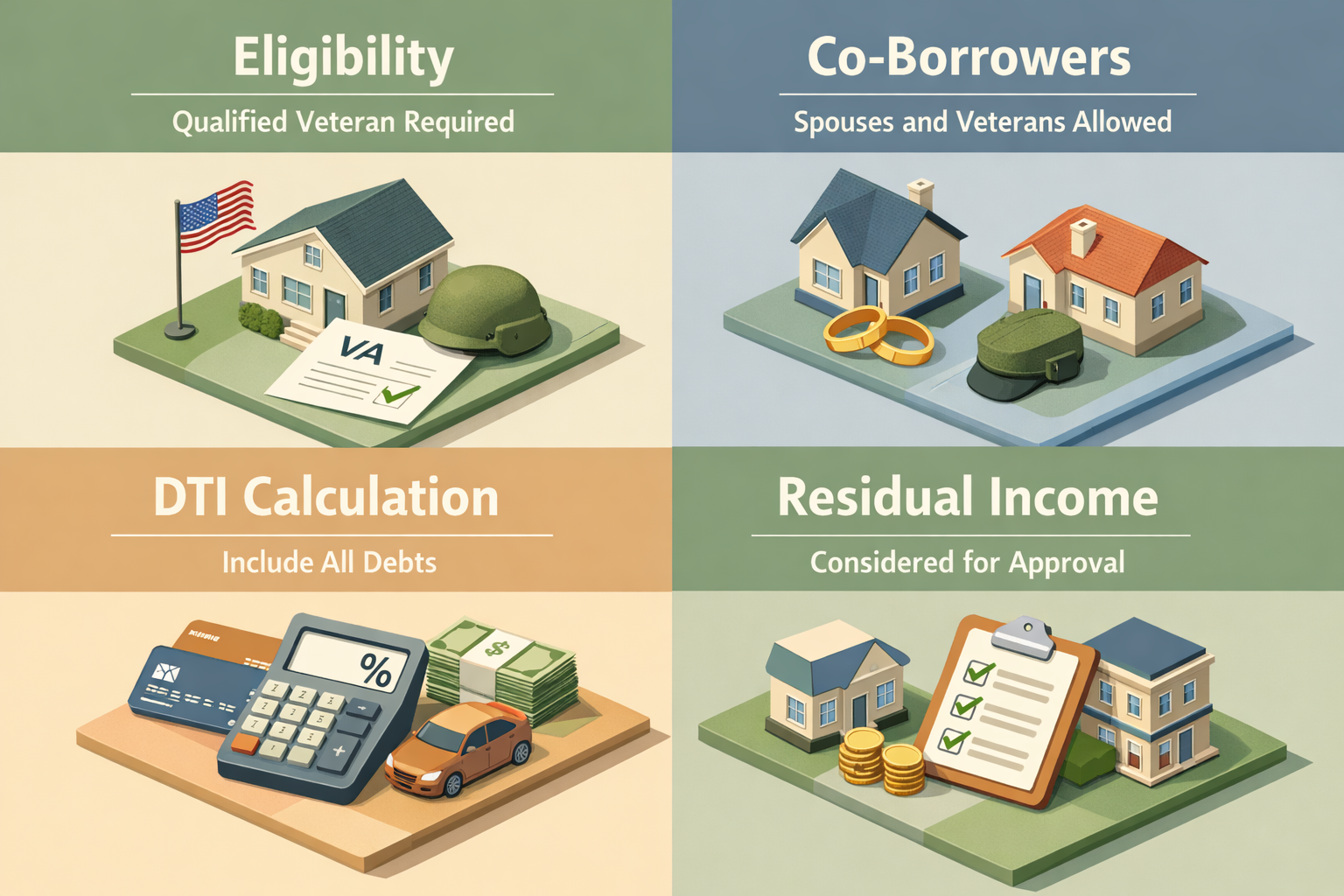
Before diving into student debt specifics, it's important to understand the foundation of VA loan eligibility. The Department of Veterans Affairs guarantees a portion of the loan, which reduces risk for lenders and allows them to offer favorable terms. To be eligible, at least one borrower on the loan must be a qualified veteran, active-duty service member, or surviving spouse with a valid Certificate of Eligibility (COE).
When it comes to co-borrowers, VA loan rules are more nuanced than conventional mortgage guidelines. A co-borrower is someone who shares ownership of the home and is equally responsible for repaying the mortgage. Their income, credit history, and debts — including student loan debt — will all factor into the lender's underwriting decision.
Importantly, VA guidelines distinguish between co-borrowers who are also veterans and those who are civilians. When a civilian is added as a co-borrower, lenders may apply slightly different rules. For example, the VA guarantee may only cover the veteran's portion of the loan, which could affect how much of the loan benefit is available. That said, having a civilian co-borrower is still permitted and can be a practical option for many borrowing situations.
- Eligible co-borrowers include spouses, other veterans, and in some cases civilian partners depending on lender policy.
- Co-borrowers are different from co-signers. A co-signer typically helps with credit qualification but doesn't hold ownership interest — and VA loans generally do not allow non-occupant co-signers who aren't veterans.
- Both borrowers' financial profiles are evaluated, meaning student loan debt belonging to either party will be counted in the debt-to-income (DTI) ratio calculation.
How Student Loan Debt Affects VA Loan Qualification
Student loan debt is one of the most common financial hurdles for borrowers applying for any type of mortgage. For VA loans specifically, lenders must account for student loan payments when calculating the co-borrower's monthly obligations. How that debt is counted can vary depending on the repayment status of the loans.
According to VA guidelines, lenders are generally required to include a monthly payment for student loans in the DTI calculation, even if the loans are in deferment. The specific method used to calculate that payment may differ by lender and loan type, but a common approach is to use a percentage of the outstanding loan balance — often around 5% divided by 12 months — as the estimated monthly payment if no actual payment is currently being made.
This matters because the VA does not set a hard maximum DTI ratio, but most lenders prefer to see a DTI of 41% or lower as a general benchmark. Exceeding that threshold doesn't automatically disqualify a borrower, but it may require the loan to meet additional compensating factors to move forward.
Income-Driven Repayment Plans and VA Loans
If the co-borrower is enrolled in an income-driven repayment (IDR) plan with a verified monthly payment, some VA-approved lenders may use that actual payment amount in the DTI calculation instead of a calculated estimate. This can significantly reduce the apparent debt burden and help keep the DTI within an acceptable range. It's worth confirming this with your specific lender, as policies can vary.
Key takeaways for managing student debt in a VA loan application include:
- Gather documentation of your co-borrower's current repayment plan and monthly payment amount.
- If loans are in deferment, ask your lender how they'll calculate the monthly obligation.
- Consider switching to an IDR plan before applying if it results in a lower documented monthly payment.
- Understand that both borrowers' total monthly debts — not just student loans — contribute to the overall DTI ratio.
Why VA Loans Don't Allow Traditional Co-Signers and What That Means for You
One of the more misunderstood aspects of VA loan co-borrower student debt no co-signer scenarios is the co-signer limitation itself. Unlike FHA or conventional loans, VA mortgages don't permit a traditional non-occupant co-signer who simply lends their credit score to boost your application without living in the home or having a stake in ownership.
This rule exists because the VA's guarantee structure is tied to the veteran's entitlement and the property being the borrower's primary residence. Adding a non-occupant, non-veteran co-signer would complicate that guarantee framework. So if you're hoping to use a parent's strong credit profile as a credit backstop while you and your partner navigate student loan debt, that particular strategy won't work within VA loan rules.
However, this limitation doesn't mean you're out of options. There are several effective paths forward:
- Strengthen your own financial profile by paying down other debts before applying, which lowers your overall DTI ratio.
- Work on credit scores for both borrowers — higher scores may give lenders more confidence even when DTI is elevated.
- Use residual income as a compensating factor. The VA places significant weight on residual income, which is the money left over after all monthly obligations are paid. Strong residual income can help offset a higher DTI in many cases.
- Consider a joint VA loan with another eligible veteran if that option is available to your situation.
It's also worth noting that if both you and your co-borrower are veterans, you may each be able to combine your VA entitlements, which could open up larger loan amounts and more favorable terms depending on your circumstances.
The Role of Residual Income in Strengthening Your Application
One of the features that makes the VA loan program uniquely borrower-friendly is its emphasis on residual income — a concept that goes beyond simple DTI calculations. Residual income refers to the net amount of money a household has remaining after all major monthly expenses are paid, including the new mortgage payment, taxes, insurance, and recurring debts like student loans.
The VA establishes minimum residual income thresholds based on family size and geographic region. Borrowers who meet or exceed these thresholds may be viewed more favorably by lenders, even if their DTI is above the preferred 41% guideline. In fact, a strong residual income figure is one of the most powerful compensating factors available to VA loan applicants.
For borrowers navigating student loan debt on a co-borrower's profile, demonstrating robust residual income can make a meaningful difference. Here's how to approach it:
- Calculate your household's expected residual income after accounting for all monthly debts including student loan payments.
- Compare your result against the VA's regional residual income tables, which your lender should be able to provide.
- If your residual income is well above the minimum threshold, document it clearly and bring it to your lender's attention as a strength of your file.
- Look for ways to increase household income before applying, such as picking up additional employment or documenting side income sources that have a two-year verifiable history.
Residual income analysis is one reason why many veterans who might struggle to qualify for a VA loan under a conventional loan's strict DTI caps can still successfully close on a VA mortgage. It's a reflection of the program's intent to support the real financial wellness of military families.
Practical Steps to Qualify for a VA Loan When Your Co-Borrower Has Student Debt
Learning how to qualify for a VA loan with co-borrower student loan debt and no co-signer is largely about preparation. The more organized and financially positioned you are before submitting your application, the smoother the underwriting process is likely to be. Here's a practical roadmap to follow:
Step 1: Obtain Your Certificate of Eligibility
The COE is your proof of VA loan eligibility. You can request it through the VA's eBenefits portal, through your lender, or by submitting the appropriate form directly to the VA. Without this document, the loan process cannot begin.
Step 2: Pull Credit Reports for Both Borrowers
Review both your credit report and your co-borrower's report for accuracy. Dispute any errors that could be dragging scores down. Most VA-approved lenders look for a minimum credit score — often around 620, though this varies by lender — but higher scores tend to support faster approvals and better rate offers.
Step 3: Document All Student Loan Repayment Information
Gather the most recent statements for your co-borrower's student loans. If they're on an IDR plan, obtain written documentation of the current monthly payment from the loan servicer. This gives the lender a clear and accurate figure to use in DTI calculations rather than a potentially higher estimated amount.
Step 4: Calculate Your DTI Before Applying
Add up all monthly debt obligations for both borrowers and divide by the combined gross monthly income. If the result is above 41%, look for debts you can pay off before applying to bring the ratio down. Even eliminating one or two smaller recurring debts can shift the DTI meaningfully.
Step 5: Work with a VA-Experienced Lender
Not all lenders interpret VA guidelines the same way, especially when it comes to student loan calculations and residual income. Working with a lender who has significant experience with VA loans can help you navigate overlapping policies and find the best path to approval.
Common Mistakes to Avoid When Applying with a Co-Borrower and Student Debt
Even well-prepared borrowers can stumble during the VA loan process if they're not aware of certain pitfalls. Here are some of the most common mistakes to watch for when your application involves a co-borrower carrying student loan debt:
- Assuming deferred loans won't count. Many borrowers are surprised to learn that student loans in deferment may still be counted in the DTI calculation. Don't assume that because payments aren't currently due, they won't be factored into your qualification.
- Omitting income sources. Both borrowers should document all legitimate, verifiable income sources. Leaving out part-time income, rental income, or other documented earnings can make your financial picture look weaker than it actually is.
- Making large purchases before closing. Opening new credit accounts or taking on new debt after pre-approval but before closing can disrupt your DTI ratio and potentially derail the loan. Encourage your co-borrower to avoid new financial commitments during this period.
- Choosing the wrong lender. Some lenders are less familiar with VA loan nuances. A lender who miscalculates student loan payments or misunderstands residual income requirements could give you an inaccurate picture of your qualification chances.
- Skipping pre-approval. Getting pre-approved before house hunting helps you understand exactly where you stand and gives sellers confidence in your offer. It also surfaces any issues early enough to address them before you're under contract.
Avoiding these mistakes won't guarantee approval, but it can significantly improve the consistency and reliability of your application from start to finish.
●Conclusion
Qualifying for a VA home loan when your co-borrower has student loan debt — and without the support of a traditional co-signer — may sound complicated, but it's a realistic goal for many military borrowers. The VA loan program was designed with flexibility in mind, and tools like residual income analysis, combined entitlements, and IDR plan documentation can all work in your favor. The key is to approach the process with clear documentation, a realistic view of your current DTI, and a lender who genuinely understands VA guidelines. At LoanWise, we're here to help veterans and military families navigate these complexities with confidence. If you're ready to explore your VA loan options, connect with one of our experienced loan advisors today and take the first step toward homeownership.