
Losing a job is stressful enough on its own. When you're also managing a mortgage — or hoping to purchase a new home — the financial picture becomes even more complex. If you've recently received a severance package, you may be wondering whether that income can help you qualify for a new loan or support an affordability analysis for your existing obligations. Understanding how to calculate mortgage affordability with a severance package and existing mortgage is essential for making smart, informed decisions during this transition period. This article walks you through the key factors lenders consider, how severance income is typically treated, and what steps you can take to strengthen your financial position.
What Lenders Look for When Evaluating Income Stability
When you apply for a mortgage — or seek to refinance an existing one — lenders are primarily concerned with one thing: your ability to repay the loan consistently over time. To assess this, they look at the stability, continuity, and predictability of your income. Regular W-2 employment income is straightforward to document, but severance pay introduces a layer of complexity that borrowers should understand before approaching a lender.
Lenders typically require that income used to qualify for a mortgage be expected to continue for at least two to three years into the future. Severance pay, by its nature, is a temporary and finite source of funds. As a result, most lenders do not count severance income as qualifying income for standard mortgage calculations. However, it may still play an important role in your overall financial picture — particularly when it comes to demonstrating cash reserves or covering short-term obligations.
It's also worth noting that lenders will request documentation such as your severance agreement, bank statements, and any documentation of future employment offers or contracts. If you have secured a new job offer — even one that hasn't started yet — some lenders may be willing to use that anticipated income as a qualifying factor, depending on the program and their internal guidelines.
How Severance Package Mortgage Impact Is Assessed by Underwriters
The severance package mortgage impact largely depends on how your lender classifies the funds and what other income sources you have available. Here's how underwriters commonly approach this situation:
- Cash reserves: Severance funds deposited into a bank account may count as liquid reserves. Lenders often look at how many months of mortgage payments you can cover using available assets. A strong reserve position can offset the risk of reduced or absent employment income.
- Non-qualifying income: If severance is your only income source, it's unlikely to be used to calculate your qualifying income ratio. That said, some non-QM (non-qualified mortgage) lenders may consider it under certain asset depletion or alternative income documentation programs.
- Bridge gap documentation: If you're between jobs, some lenders may allow a brief employment gap if you can show evidence of a new position starting within a defined timeframe — typically 30 to 60 days from closing.
It's important to be transparent with your lender about your employment situation. Attempting to conceal a job loss or misrepresent income could have serious legal and financial consequences. Instead, work with a mortgage professional who has experience helping borrowers navigate transitional income scenarios.
Running an Existing Mortgage Calculation During a Career Transition
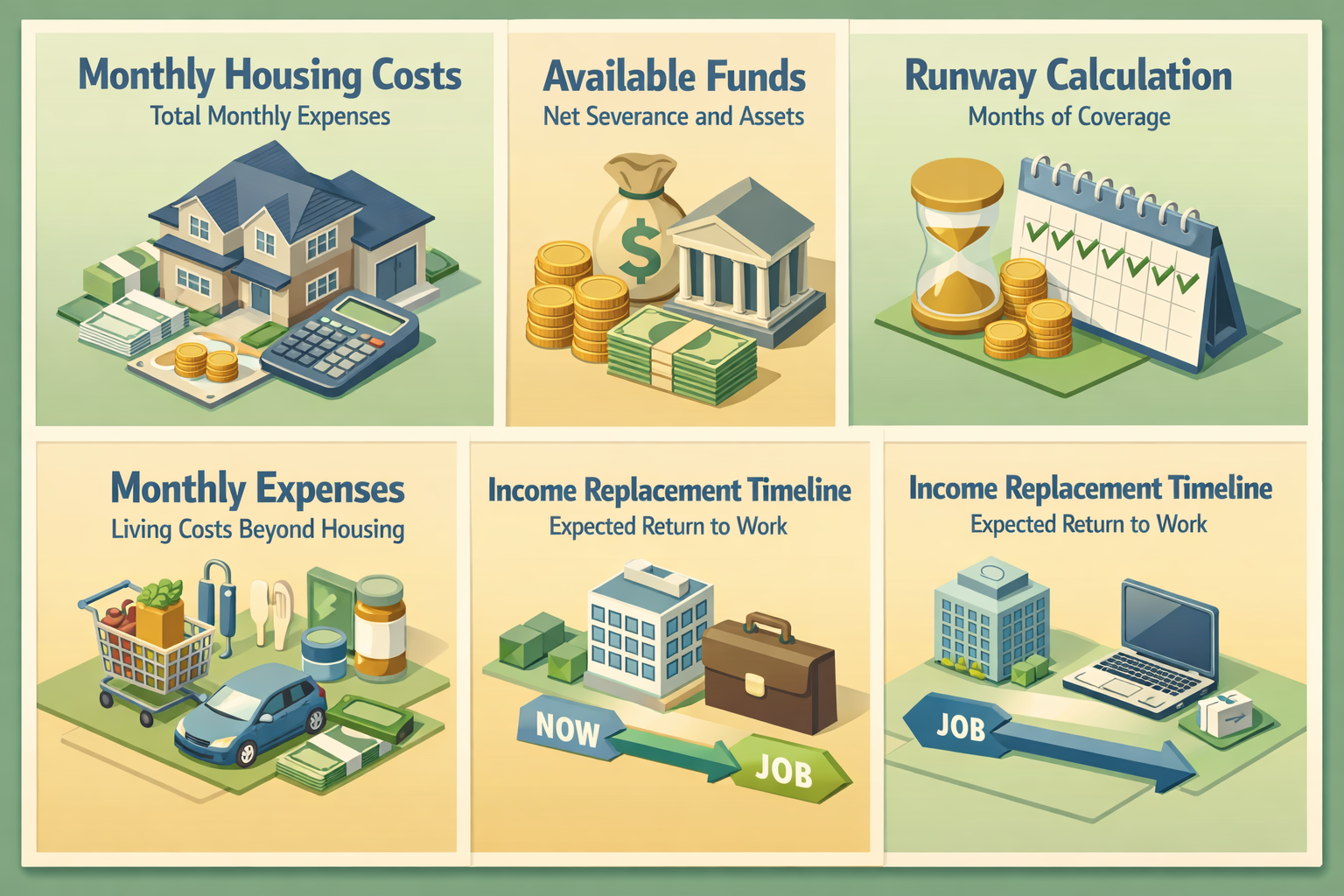
If you already have a mortgage and are concerned about how your severance package fits into your current obligations, an existing mortgage calculation can help you determine how long your funds will last and what adjustments you may need to consider. Here's a simple framework to get started:
- Step 1 – Total your monthly housing costs: Add your principal, interest, taxes, insurance, and any HOA fees. This is your total monthly housing expense.
- Step 2 – Identify your available funds: Total the net severance amount you received after taxes, along with any savings, investments, or other liquid assets.
- Step 3 – Calculate your runway: Divide your total available funds by your total monthly housing costs. This tells you how many months you can sustain your mortgage without new income.
- Step 4 – Factor in other monthly expenses: Don't forget living costs beyond housing — utilities, groceries, insurance premiums, and minimum debt payments. These reduce your effective runway significantly.
- Step 5 – Identify your income replacement timeline: Estimate when you expect to return to regular employment or generate new income. Compare this to your financial runway to identify any gaps.
This exercise won't replace a formal lender assessment, but it gives you a realistic sense of where you stand. Many financial advisors recommend completing this type of analysis within the first week of receiving a severance offer so you can plan proactively rather than reactively.
How to Calculate Mortgage Affordability with Severance Package and Existing Mortgage
When the goal is to understand how to calculate mortgage affordability with a severance package and existing mortgage, the debt-to-income (DTI) ratio is the central metric lenders use. DTI compares your total monthly debt obligations to your gross monthly income. For conventional mortgage programs, lenders typically prefer a DTI at or below 43%, though some programs may allow higher ratios with compensating factors.
Here's how to calculate mortgage affordability in a transitional income scenario:
- Gross monthly income: If you're between jobs, this figure may be based on anticipated new employment income, verified by an offer letter. If no new job is confirmed, some lenders may decline to proceed until income is established.
- Monthly debt obligations: This includes your existing mortgage payment, minimum credit card payments, auto loans, student loans, and any other recurring debt. If you're applying for a new mortgage while keeping the existing one — for example, as a real estate investor or in a relocation scenario — both properties' payments factor into your DTI.
- Severance as reserves, not income: As noted, severance typically counts toward reserves rather than qualifying income. However, having six or more months of reserves can be a strong compensating factor that may allow lenders to approve loans with higher DTI ratios or other risk factors.
For example, if your anticipated new job pays $6,000 per month gross, and your total monthly debts (including your existing mortgage and a prospective new mortgage) total $2,400, your DTI would be 40% — within the typical acceptable range. Your severance funds would then serve as a reserve cushion that further reassures the lender of your ability to handle short-term financial disruptions.
Affordability Analysis: Stress-Testing Your Numbers Before Applying
A thorough affordability analysis goes beyond what a lender requires — it helps you determine what you can genuinely handle without financial strain. When severance is in the picture, stress-testing your numbers is especially important.
Consider running your affordability analysis under multiple scenarios:
- Best case: You secure new employment within 30 days and your income resumes at or above its previous level. Your severance funds remain largely intact as a reserve.
- Moderate case: Your job search takes three to six months. You draw on severance to cover housing costs and living expenses, then resume regular income contributions to your mortgage.
- Conservative case: Your return to full-time employment takes longer than expected, or you accept a position with reduced income. How does this impact your ability to sustain both an existing mortgage and any new financing?
Running all three scenarios can highlight vulnerabilities in your plan. If even the moderate case leaves you struggling, it may be worth delaying a new purchase or refinance until your income situation stabilizes. Alternatively, you might explore options such as mortgage forbearance, loan modification, or a temporary interest-only payment structure with your current lender — though availability of these options varies by lender and loan type.
Working with a HUD-approved housing counselor or a licensed mortgage professional during this evaluation can provide guidance tailored to your specific situation.
Strategies to Improve Your Position Before Applying for Financing
Even if your current situation isn't ideal, there are practical steps you can take to strengthen your mortgage application or stabilize your existing loan obligations during a severance period.
- Secure employment first when possible: Waiting until you have a confirmed job offer — or better yet, a first paycheck — puts you in a significantly stronger position with most lenders. Some programs require as little as 30 days of new employment history to qualify.
- Preserve your credit score: Avoid missing any payments during your transitional period. Even one late payment can meaningfully affect your credit score, which directly impacts the mortgage rates and terms available to you.
- Reduce existing debt: If your severance allows it, paying down high-balance credit cards or installment loans can lower your DTI ratio and improve your eligibility for better loan terms.
- Build documented reserves: Keep severance funds in a traceable, accessible account. Lenders will want to see 60 days of bank statements, so avoid large unexplained withdrawals or transfers during this window.
- Consider non-QM loan options: If you're self-employed, operating as a contractor, or have irregular income following a layoff, non-qualified mortgage programs may offer more flexible documentation requirements. These loans often carry higher interest rates but can serve as a bridge for borrowers in non-traditional income situations.
Working with the Right Lending Partner During Income Transitions
Not all lenders approach severance income and transitional employment the same way. Some lenders have stricter guidelines that make approval nearly impossible without active, verifiable employment income. Others — particularly portfolio lenders or those offering non-QM products — may have more flexibility to evaluate your complete financial picture.
When looking for the right mortgage professional, consider asking the following questions:
- Do you work with borrowers who are between jobs or recently laid off?
- How do your programs treat severance pay — as reserves, income, or both?
- What documentation will I need if I have a pending job offer but haven't started yet?
- Are there non-QM or alternative documentation loan options available to me?
A knowledgeable loan officer will be able to walk you through your options honestly, including whether it makes sense to apply now or wait until your income picture is clearer. The goal isn't just to get approved — it's to get approved for a loan you can comfortably manage over the long term.
At LoanWise, our lending specialists understand that life doesn't always follow a predictable path. Whether you're refinancing your existing home, purchasing a new property, or simply trying to understand your options during a career transition, we're here to help you navigate the process with clarity and confidence.
●Conclusion
Understanding how to calculate mortgage affordability with a severance package and existing mortgage requires a clear-eyed look at your income timeline, your debt obligations, and how lenders interpret transitional financial situations. While severance pay may not qualify as traditional income for mortgage purposes, it can still play a meaningful role as a reserve asset — and with careful planning, you may be in a stronger position than you realize. Take the time to run your own affordability analysis, stress-test your scenarios, and consult with a mortgage professional who has experience with non-standard income situations. The right guidance today can make all the difference in your financial stability tomorrow. Ready to explore your options? Connect with a LoanWise mortgage specialist to get a personalized assessment of your situation.