
Losing a job while trying to buy a home can feel overwhelming — but it doesn't necessarily mean your homeownership goals have to wait indefinitely. Many borrowers find themselves in this exact situation, especially when a sibling or close family member steps in to help with the down payment. Understanding the requirements for a conventional loan with 10% down from sibling gift funds after job loss is essential before you apply. The process involves navigating Fannie Mae and Freddie Mac guidelines, documenting gift funds properly, and demonstrating to lenders that you're a creditworthy borrower despite a recent employment gap. This article walks you through every key consideration so you can approach your lender with confidence.
How Conventional Loan Requirements Work for Standard Borrowers
A conventional loan is a mortgage that's not backed by a government agency like the FHA or VA. Instead, these loans typically conform to guidelines set by Fannie Mae or Freddie Mac, the two government-sponsored enterprises that purchase mortgages from lenders on the secondary market. Because of this structure, conventional loan requirements tend to be more stringent than those of government-backed programs.
For a standard conventional loan, lenders generally look for the following:
- Credit score: Most lenders require a minimum credit score of 620, though higher scores often unlock better interest rates.
- Debt-to-income ratio (DTI): Lenders typically prefer a DTI at or below 45%, though some may allow up to 50% with strong compensating factors.
- Stable income and employment history: A consistent two-year employment history is the standard benchmark lenders use to evaluate income stability.
- Down payment: Conventional loans can require as little as 3% down for qualifying borrowers, but a 10% down payment removes the need for private mortgage insurance (PMI) sooner and may improve your approval odds.
- Reserve funds: Some lenders may require two to six months of mortgage payments held in reserve after closing.
These baseline conventional loan requirements form the foundation of any application. When factors like job loss and gift fund usage come into play, the approval process becomes more nuanced — but not necessarily impossible.
Using a Sibling's Gift for Your 10% Down Payment
One of the more encouraging aspects of conventional loan guidelines is that gift funds from family members are generally permitted for down payments. A sibling qualifies as an eligible donor under Fannie Mae and Freddie Mac guidelines, which define acceptable gift sources as family members related by blood, marriage, adoption, or legal guardianship.
That said, there are specific rules that govern how a sibling gift down payment must be handled to satisfy lender and investor requirements:
- Gift letter requirement: Your sibling must provide a signed gift letter stating the amount of the gift, the date it was transferred, the relationship to the borrower, and — critically — that the funds are a gift and not a loan. No repayment can be expected or implied.
- Paper trail documentation: Lenders will want to see evidence that the funds were transferred from your sibling's account to yours. This typically includes bank statements from both parties showing the withdrawal and deposit.
- Seasoned funds: If the gifted funds have been in your account for 60 days or more (the typical seasoning period), lenders may not require the full paper trail back to the donor's account. However, rules can vary by lender and loan program.
- No minimum borrower contribution for some LTVs: For a primary residence purchased with a 10% down payment, Fannie Mae guidelines may allow the entire down payment to come from gift funds, though lenders may layer on additional overlays.
It's worth confirming with your specific lender whether any additional documentation is required, as lender overlays — internal policies stricter than agency guidelines — are common when gift funds are involved.
The Real Challenge: How Job Loss Affects Loan Eligibility
Employment history is one of the most critical pillars of mortgage underwriting. Lenders need confidence that you can repay the loan, and income stability is central to that assessment. A recent job loss introduces significant risk in the underwriter's eyes, which is why this is often the most difficult hurdle for borrowers navigating the requirements for a conventional loan with 10% down from sibling gift funds after job loss.
Here's how job loss typically affects your application:
- If you're currently unemployed: Most conventional lenders will not approve a mortgage without verified current income. Unemployment benefits are generally not accepted as qualifying income under Fannie Mae and Freddie Mac guidelines.
- If you've recently returned to work: Lenders may still approve your loan if you've secured new employment. The key factors include whether your new job is in the same field, whether it's salaried or hourly versus commission-based, and how long you've been in the new role. For salaried W-2 employment, some lenders may approve with as little as 30 days of pay stubs if the offer letter documents the income clearly.
- If you're self-employed after job loss: Transitioning to self-employment after losing a job adds complexity. Lenders typically require two years of self-employment history documented through tax returns before they'll count that income.
- Employment gaps on record: A gap in your employment history doesn't automatically disqualify you, but lenders will want a written explanation. A reasonable explanation — such as medical leave, caregiving, or a documented layoff — combined with stable re-employment may satisfy underwriting concerns.
Understanding how lenders view your specific situation is essential before you apply. Speaking with a loan officer early can help you identify whether you should wait, or whether a current employer's offer letter and pay stubs could support your application today.
Timing Your Application After a Job Loss
Timing matters significantly in job loss financing scenarios. Applying too soon after a job loss, without sufficient income documentation, could result in a denial that affects your credit profile. Strategic timing can improve your chances considerably.
Consider these timing-related strategies:
- Wait for income stability: If you've started a new job, allow at least 30 days of pay stubs to accumulate for a salaried role. For variable income roles, waiting longer — sometimes six months to a year — may strengthen your application.
- Rebuild reserves if needed: A 10% down payment coming from your sibling as a gift is a strong foundation, but lenders may feel more comfortable if you also bring personal savings to the table as reserves. Demonstrating financial responsibility on your part can serve as a compensating factor.
- Monitor your credit: Job loss can sometimes lead to missed payments or higher credit utilization if finances tighten. Before applying, pull your credit reports and address any negative items. A score of 680 or higher will open more lender options.
- Get pre-qualified first: A soft inquiry pre-qualification (not a hard pull) with a knowledgeable lender can help you understand your realistic options without damaging your credit. Use this step to gauge how underwriters are likely to view your file.
Many lenders are willing to work with borrowers who have a clear, documented explanation for their employment gap — especially when re-employment is established and the rest of the financial profile is solid.
Documentation You'll Need to Prepare for Approval
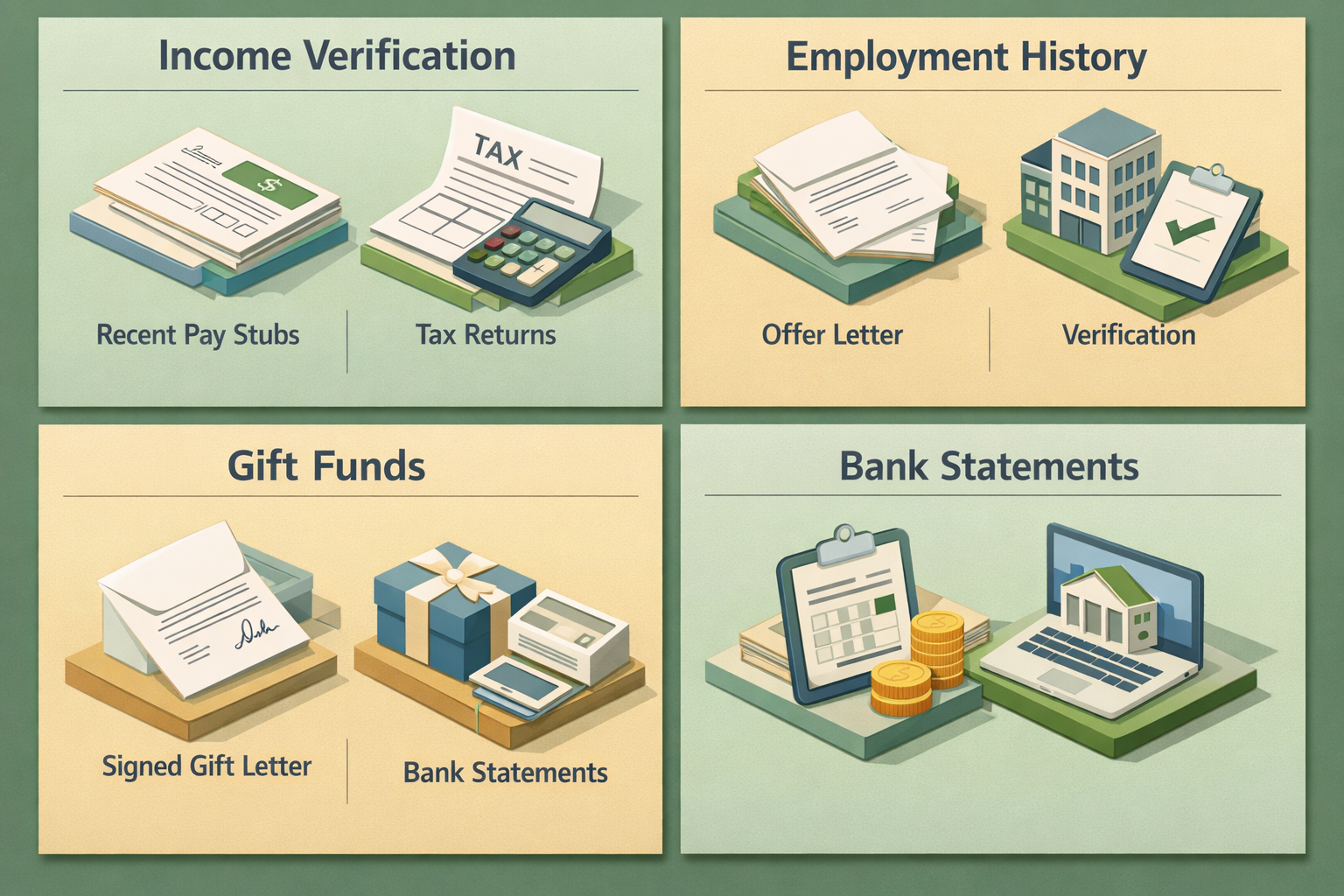
Conventional loan underwriting is document-intensive under the best of circumstances. When you're combining a sibling gift down payment with a history of job loss, expect underwriters to scrutinize your file closely. Being prepared with thorough documentation can make a meaningful difference in how quickly — and smoothly — your loan moves through the process.
Here's a comprehensive list of what you'll likely need:
- For income verification: Most recent pay stubs (30 days minimum), W-2 forms for the past two years, and federal tax returns for the past two years. If your income changed due to job loss, be ready to explain the gap in writing.
- For employment history: An offer letter from your new employer (if recently hired), contact information for your employer for verbal verification, and a written explanation letter covering any gaps in employment.
- For the gift funds: A signed gift letter from your sibling, your sibling's bank statements showing the withdrawal, and your bank statements showing the deposit of the gift funds.
- For assets and reserves: Two to three months of bank statements for all accounts, investment account statements if applicable, and documentation of any other assets that demonstrate financial stability.
- For credit: Authorization for the lender to pull your credit report. If there are derogatory items related to the job loss period, prepare a brief written explanation for each.
The more organized and transparent your documentation package, the better positioned you'll be when the underwriter reviews your file. Lenders appreciate borrowers who proactively address potential red flags rather than waiting for questions to arise.
Compensating Factors That Could Strengthen Your Application
Conventional loan underwriting isn't always black and white. When one area of your application is weaker — such as a recent job loss — strong performance in other areas can sometimes offset the risk in an underwriter's eyes. These are known as compensating factors, and they can play a meaningful role in borderline approvals.
Common compensating factors for 10% down payment conventional loan applications include:
- Higher credit score: A credit score of 740 or above signals strong creditworthiness and may give lenders more flexibility on other risk factors.
- Low debt-to-income ratio: If your recurring monthly debts are minimal relative to your income, a lower DTI could offset concerns about income continuity.
- Significant reserves: Holding six or more months of mortgage payments in savings after the down payment and closing costs demonstrates financial resilience.
- Long history with the same career field: Even if you changed employers, staying within the same industry or profession shows that your skill set is marketable and your income trajectory is likely to continue.
- Re-employment in a higher-paying role: If your new job pays more than your previous position, this can actually strengthen your application by improving your DTI ratio.
- Large down payment contribution beyond the gift: If you can supplement your sibling's gift with any personal savings toward the down payment, even a small amount, it demonstrates financial participation and responsibility.
It's also worth exploring whether an automated underwriting system (AUS) approval — through Fannie Mae's Desktop Underwriter or Freddie Mac's Loan Product Advisor — might clear your file even if a manual review seems uncertain. AUS approvals can sometimes be more flexible with conventional loan requirements built into their algorithms.
●Conclusion
Navigating the requirements for a conventional loan with 10% down from sibling gift funds after job loss requires careful preparation, honest assessment of your financial profile, and a willingness to document every aspect of your situation thoroughly. While the combination of a gift-funded down payment and a recent employment disruption does add complexity, it doesn't automatically close the door on homeownership. With re-established income, a well-prepared file, and a knowledgeable lending partner, many borrowers in similar situations do successfully close on conventional loans. The key is to work with a lender who understands gift fund guidelines and has experience helping borrowers navigate employment history challenges. At LoanWise, our team is ready to help you evaluate your options and map out a realistic path forward — whatever your current circumstances may be.