
Securing a large home loan in the United States can be complex under any circumstances, but when foreign rental income and a US co-signer are part of the equation, the process becomes even more nuanced. Many international borrowers, foreign nationals, and US residents with overseas property holdings are finding that high-value home purchases require a deeper understanding of lender expectations. The requirements for jumbo loan with foreign rental property income and US co-signer touch on everything from income documentation to credit evaluation and legal considerations. This guide walks through each major factor so borrowers can feel more prepared before approaching a lender.
What Makes Jumbo Loans Different From Conventional Financing
A jumbo loan is a mortgage that exceeds the conforming loan limits set by the Federal Housing Finance Agency (FHFA). In most US counties, that limit sits above $766,000 for 2024, though high-cost areas may have higher thresholds. Because jumbo loans are not backed by Fannie Mae or Freddie Mac, lenders take on more risk and typically impose stricter qualification criteria.
For borrowers relying on foreign rental property income or using a US co-signer, the scrutiny is often even greater. Lenders want to be confident that the loan will be repaid, and non-traditional income sources require additional verification steps. It's important to understand that jumbo loan guidelines vary significantly from one lender to another, since there is no standardized federal backing guiding these products.
- Loan amounts exceed conforming limits, meaning higher down payments are often required.
- Credit standards tend to be stricter, with many lenders preferring scores of 700 or higher.
- Debt-to-income (DTI) ratios may be evaluated more conservatively.
- Reserves — liquid assets held after closing — are commonly required, sometimes covering 12 or more months of payments.
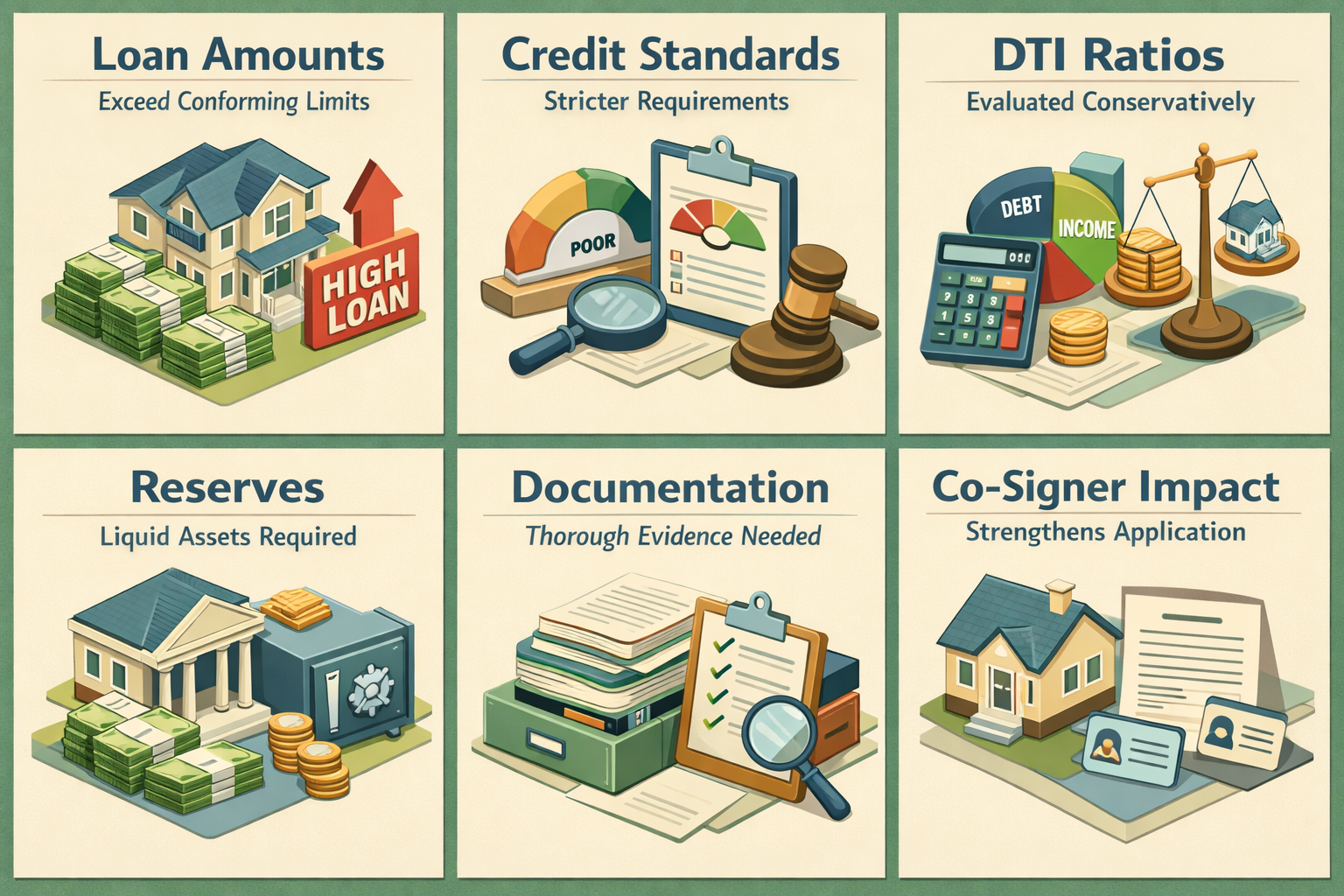
Understanding these baseline expectations helps borrowers with complex income profiles plan strategically before applying.
How Lenders Evaluate Foreign Rental Property Income
Foreign rental income refers to rent collected from properties located outside the United States. While some lenders are willing to consider this type of income, it's typically treated differently from domestic rental income. Lenders may apply additional scrutiny because verifying overseas income can be more challenging, and currency exchange fluctuations can affect the stability of that income stream.
When evaluating foreign rental income, lenders generally look for evidence that the income is consistent, documentable, and likely to continue. Here are some factors that commonly come into play:
- Rental agreements or lease contracts translated into English and certified, showing the terms and rental amounts.
- Bank statements demonstrating regular deposits consistent with the stated rental amount, ideally spanning 12 to 24 months.
- Tax returns or equivalent filings from the borrower's home country showing rental income declared to local authorities.
- Property ownership documentation proving the borrower legally owns the overseas property generating the income.
- Currency conversion records if rent is paid in a foreign currency, showing how amounts convert to US dollars.
Lenders may only count a percentage of the gross foreign rental income — often ranging from 75% to 85% — to account for vacancy periods and maintenance expenses. However, exact percentages can vary by lender, so it's wise to ask directly about how they calculate usable income from foreign sources.
The Role of a US Co-Signer in a Jumbo Loan Application
A US co-signer — sometimes called a co-borrower depending on the structure — can strengthen a jumbo loan with foreign rental income application by adding their credit profile, income, and assets to the file. For borrowers whose primary income source is foreign rental income, having a creditworthy US co-signer may help bridge gaps in qualification, particularly around credit history and domestic income verification.
It's important to understand the difference between a co-signer and a co-borrower. A co-borrower shares ownership of the property, while a co-signer guarantees the loan but may not hold title. Lenders handle these roles differently, and the distinction can affect how income and liabilities are calculated for qualification purposes.
Key considerations when adding a US co-signer include:
- Credit score impact: The co-signer's credit history will be reviewed, and any negative marks on their report could affect loan terms.
- Debt obligations: The co-signer's existing debts will be included in the overall DTI calculation, which may help or hinder qualification.
- Legal responsibility: A co-signer is equally responsible for repayment. If the primary borrower defaults, the co-signer's credit and finances are affected.
- Relationship to the property: Lenders may ask about the co-signer's intent to occupy or their relationship to the primary borrower.
Working with a lender experienced in non-traditional borrower profiles is strongly recommended when a co-signer arrangement is part of the plan.
Documentation Requirements for Jumbo Loan with Foreign Rental Property Income and US Co-Signer
Meeting the requirements for jumbo loan with foreign rental property income and US co-signer means being prepared with a thorough documentation package. Because lenders cannot rely on standardized US income verification tools like W-2 forms or domestic tax returns for foreign income, they typically request alternative evidence of financial stability.
For the primary borrower relying on foreign rental income, commonly requested documents may include:
- Certified English translations of lease agreements and ownership deeds
- 12 to 24 months of personal bank statements from both US and foreign accounts
- Foreign tax returns or equivalent income declarations from the prior two years
- A letter from a certified public accountant (CPA) or licensed tax professional verifying income amounts and history
- Proof of property insurance and any applicable property management agreements
For the US co-signer, lenders will generally require the standard domestic documentation package:
- Recent pay stubs, W-2s, or tax returns covering the past two years
- Bank and asset account statements
- A complete credit report and history
- Identification and residency documentation
Both parties should expect the underwriting process to take longer than a typical jumbo loan, given the additional layers of income verification involved. Being organized and responsive to lender requests can help keep the process moving forward efficiently.
Credit Score and Debt-to-Income Standards Borrowers Should Anticipate
Even with a US co-signer involved, borrowers seeking a jumbo loan should not underestimate the importance of credit quality and manageable debt levels. These two factors are central to how lenders assess risk on large loan amounts.
For credit scores, most jumbo lenders prefer a minimum score of 700, though some portfolio lenders — those who hold loans on their own books rather than selling them — may consider scores in the 680 range for well-qualified borrowers with strong compensating factors. The co-signer's credit score will also be reviewed, and lenders often use the lower of the two scores when making underwriting decisions, though practices may vary.
Debt-to-income ratios for jumbo loans are typically held to tighter standards than conventional loans. Many lenders prefer a DTI at or below 43%, though some may allow up to 45% or slightly higher depending on reserves and other strengths in the file. When foreign rental income is part of the equation, lenders may apply a conservative calculation that reduces the qualifying income figure, which could raise the effective DTI.
Strategies that may help borrowers manage their DTI include:
- Paying down existing installment or revolving debts before applying
- Ensuring all rental income documentation is thorough and clearly supports the income claimed
- Highlighting substantial liquid reserves, which can serve as a compensating factor
Down Payment Expectations and Reserve Requirements for High-Balance Borrowers
Jumbo loans generally require larger down payments than conforming loans. While some lenders may offer jumbo products with as little as 10% down, borrowers with foreign rental income and a co-signer arrangement may find that a 20% to 30% down payment is more commonly expected. A larger down payment reduces the lender's exposure and may also help borrowers avoid private mortgage insurance (PMI), though PMI policies on jumbo loans vary by lender.
Beyond the down payment, lenders often require borrowers to demonstrate significant cash reserves after closing. For jumbo loans, reserve requirements of 12 months of principal, interest, taxes, and insurance (PITI) are not uncommon, and some lenders may require even more when the borrower's income profile is complex. These reserves serve as a financial cushion that reassures lenders of the borrower's ability to continue making payments even if income temporarily decreases.
Acceptable reserve sources typically include:
- Checking and savings accounts
- Investment accounts such as brokerage portfolios
- Retirement accounts, often counted at a discounted value
- Proceeds from documented asset liquidation
Foreign bank accounts may be considered, but lenders will likely require translated statements and may apply additional scrutiny to ensure funds are sourced legitimately and available for use in the United States.
Finding the Right Lender for a Complex Jumbo Loan Scenario
Not all lenders are equipped or willing to handle the nuances involved in jumbo loan foreign rental income US co-signer requirements. Portfolio lenders, private banks, and specialty mortgage lenders tend to have more flexibility in how they evaluate non-traditional income sources and cross-border financial profiles. These lenders write their own guidelines and can often accommodate scenarios that fall outside standard underwriting boxes.
When evaluating lenders, borrowers should ask specific questions such as:
- Do you accept foreign rental income as qualifying income for jumbo loans?
- How do you document and calculate income from overseas properties?
- Are you comfortable working with a US co-signer arrangement alongside a foreign income profile?
- What are your reserve requirements for borrowers in this situation?
- How do you handle currency conversion when calculating income?
Working with an experienced mortgage broker who specializes in jumbo or non-QM (non-qualified mortgage) lending can also be valuable. A knowledgeable broker can match borrowers with lenders whose guidelines align with their specific financial profile, potentially saving time and reducing the chance of unnecessary credit inquiries.
It's also wise to consult with a cross-border tax advisor or CPA familiar with both US mortgage requirements and the tax regulations in the country where the rental property is located. This professional guidance can help ensure that documentation is prepared in a format lenders will accept and that all income is properly declared.
●Conclusion
Navigating the requirements for jumbo loan with foreign rental property income and US co-signer is undeniably complex, but it's far from impossible with the right preparation. Borrowers who take the time to gather comprehensive documentation, understand lender expectations, and work with experienced professionals are in a much stronger position to secure the financing they need. From thorough income verification to thoughtful co-signer arrangements and healthy cash reserves, each piece of the puzzle contributes to a stronger application. At LoanWise, we believe every borrower deserves clear guidance and expert support — no matter how unique their financial story may be. Reach out to a lending specialist today to explore your options and start building a path toward your home financing goals.