
Getting approved for a mortgage when you're a freelancer or independent contractor can feel complicated — especially when child support is part of your financial picture. Lenders don't evaluate your income the same way they would for a salaried employee, and every debt obligation you carry, including court-ordered support payments, factors into your qualifying ratios. If you've been wondering how to calculate DTI with freelance 1099 income and child support, you're not alone. Many self-employed borrowers find this process confusing, but with the right understanding, it's entirely manageable. This guide breaks it all down in plain language so you can walk into the mortgage process feeling prepared and confident.
What DTI Actually Means for Mortgage Borrowers
Your debt-to-income ratio (DTI) is one of the most important numbers a mortgage lender reviews during underwriting. It measures how much of your gross monthly income goes toward recurring debt obligations. Lenders use this figure to assess whether you can comfortably take on a new mortgage payment without becoming financially overextended.
DTI is typically expressed as a percentage and calculated using a straightforward formula:
- Front-end DTI: Your proposed monthly housing payment divided by your gross monthly income
- Back-end DTI: All monthly debt obligations — including housing, car payments, student loans, credit cards, and court-ordered payments — divided by your gross monthly income
Most conventional loan programs generally prefer a back-end DTI at or below 43%, though some programs may allow higher ratios with compensating factors. FHA loans may permit slightly higher DTIs in certain cases. However, lenders set their own overlays, so the exact threshold can vary from one institution to another.
For freelancers and 1099 contractors, the challenge begins before the division even happens — because calculating your qualifying income is far more complex than reviewing a pay stub.
How Lenders Calculate Gross Monthly Income From 1099 Freelance Work
When you're self-employed or work as an independent contractor, lenders typically can't use your gross 1099 earnings at face value. Instead, they generally look at your net income after business deductions, because that more accurately reflects what you actually keep. This is where many freelancers are surprised — writing off legitimate business expenses is smart tax planning, but it can reduce the income a lender is willing to count.
Here's what lenders typically require from self-employed and 1099 workers:
- Two years of federal tax returns (both personal and business, if applicable)
- IRS Form 1099s from clients or payers
- A year-to-date profit and loss statement, often prepared by a CPA
- Bank statements for 12 to 24 months, depending on the loan program
The lender will typically average your net self-employment income over 24 months to arrive at a monthly qualifying figure. For example, if your Schedule C shows $60,000 in net income one year and $72,000 the next, your average annual income would be $66,000, which translates to a gross monthly qualifying income of approximately $5,500.
It's worth noting that if your income is declining year over year, some lenders may use the lower year's figure rather than the average. Conversely, if income is rising consistently, that may work in your favor. Lenders want to see stability and a reasonable expectation that the income will continue.
Some non-QM or bank statement loan programs may offer an alternative for freelancers who have significant deductions on their tax returns. These programs may use 12 or 24 months of bank deposits as proof of income rather than tax return net figures — potentially qualifying you for a higher loan amount. However, these programs often carry slightly higher interest rates or stricter reserve requirements.
Where Child Support Fits Into Your Debt-to-Income Equation
Child support is treated as a recurring monthly debt ratio obligation by mortgage lenders — much like a car payment or a minimum credit card payment. Whether you're the paying party or the receiving party, it affects your DTI in very different ways.
If You Pay Child Support
Court-ordered child support payments you make each month are counted in your back-end DTI as a liability. The lender will typically verify this through a copy of your divorce decree, separation agreement, or court order. The monthly payment amount listed in those documents is what gets added to your total monthly debt obligations.
This can meaningfully impact your qualifying ratio. If you're already managing a lower qualifying income due to business deductions, adding a significant child support obligation to your monthly debts could push your DTI above program limits. Planning ahead — and potentially paying down other debts before applying — may help bring your ratio back into range.
If You Receive Child Support
Child support income you receive can potentially be counted as qualifying income — but only if certain conditions are met. Lenders generally require:
- Documentation that the support is court-ordered
- Proof that payments have been received consistently, typically for at least six to twelve months
- A reasonable expectation that payments will continue for at least three years
If you can document these requirements, child support income may be added to your gross qualifying income, which could help lower your DTI and improve your mortgage approval eligibility. Keep records of all payments received, such as bank deposit statements, to support this documentation.
A Step-by-Step Guide on How to Calculate DTI With Freelance 1099 Income and Child Support
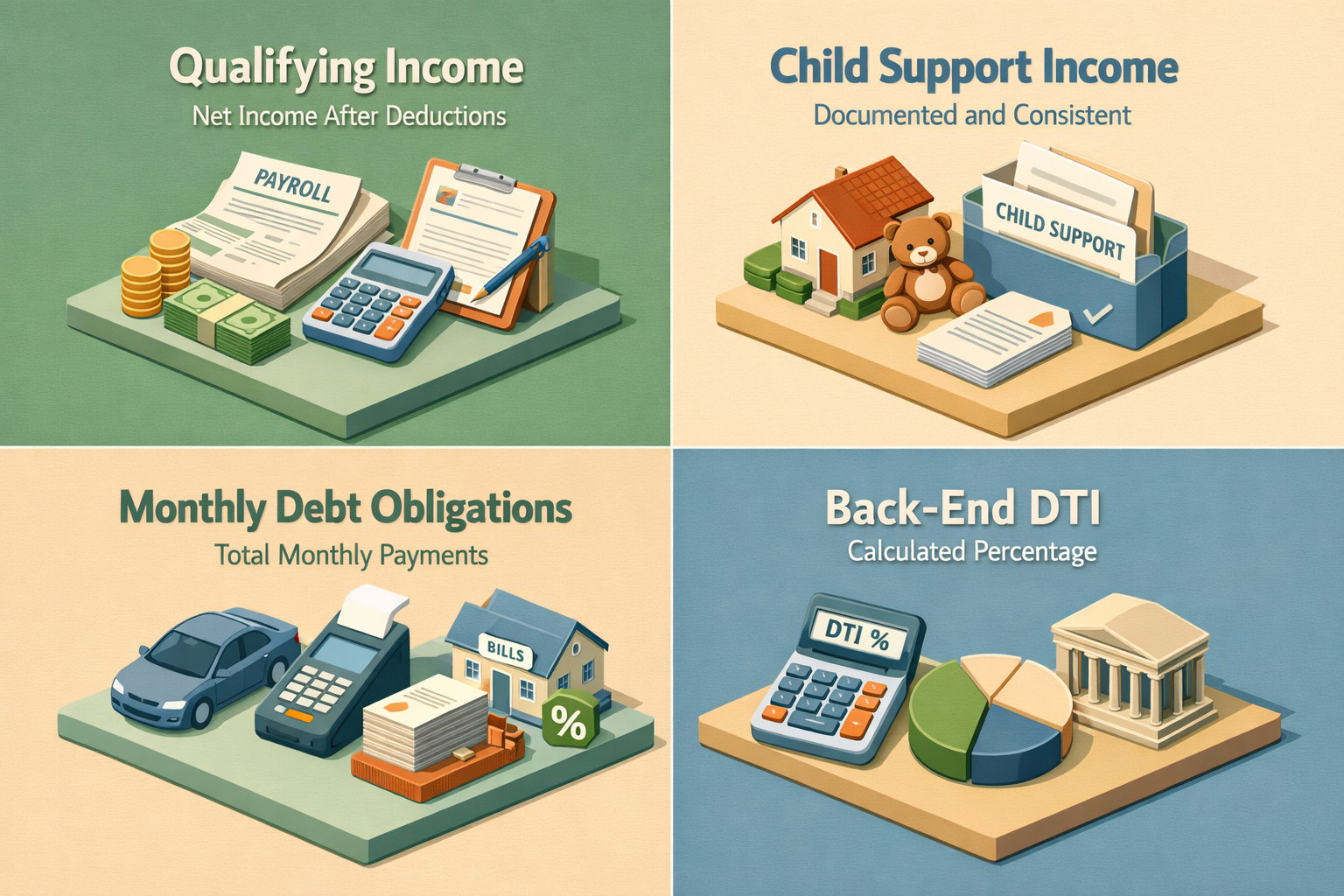
Let's walk through a practical example so the numbers make sense. Suppose you're a freelance graphic designer filing taxes as a sole proprietor with a child support obligation.
Step 1: Determine Your Qualifying Monthly Income
Review your last two years of Schedule C net income:
- Year 1 net income: $54,000
- Year 2 net income: $66,000
- Average annual income: $60,000
- Monthly qualifying income: $5,000
Step 2: Add Any Qualifying Child Support Income (If Applicable)
If you receive $800 per month in documented child support that meets lender requirements, your adjusted qualifying income may become $5,800 per month.
Step 3: Add Up All Monthly Debt Obligations
- Proposed mortgage payment (PITI): $1,600
- Child support paid: $500
- Auto loan: $350
- Minimum credit card payments: $150
- Student loan: $200
- Total monthly debts: $2,800
Step 4: Calculate Your Back-End DTI
Divide total monthly debts by qualifying monthly income:
$2,800 ÷ $5,800 = 48.3% DTI
In this scenario, using the adjusted income that includes child support received, the DTI is approximately 48%, which might still be acceptable under certain FHA or non-QM programs — though it could require strong compensating factors such as significant cash reserves or a higher credit score. Without the child support income, the DTI rises to a less favorable level, making documentation of that income critically important.
This is exactly why understanding how to calculate DTI with freelance 1099 income and child support matters so much before you apply.
Strategies Self-Employed Borrowers Can Use to Improve Their DTI
If your initial DTI calculation comes in higher than you'd like, there are several strategies worth exploring before you submit a mortgage application.
Reduce or Eliminate Smaller Debts
Paying off a credit card balance or a small installment loan before applying can remove that monthly payment from your DTI calculation. Even eliminating $150 to $200 in monthly obligations can make a meaningful difference in your ratio.
Consider a Larger Down Payment
A larger down payment reduces your loan amount, which lowers your proposed monthly mortgage payment and, in turn, reduces your front-end and back-end DTI. If you have savings or investment accounts, this strategy could open doors that might otherwise remain closed.
Explore Non-QM or Bank Statement Loan Programs
For freelancers whose tax returns significantly understate their cash flow due to deductions, bank statement mortgage programs may offer a more realistic picture of income. These programs typically allow lenders to use 12 or 24 months of average deposits — after applying an expense ratio — as qualifying income. This could potentially result in a higher qualifying income than your tax return reflects.
Work With a CPA Before Filing
If you're planning to buy a home in the next year or two, it may be worth consulting a tax professional about balancing deductions. Reducing deductions might increase your taxable income slightly, but it could significantly improve your qualifying income for mortgage purposes.
Document All Income Streams Thoroughly
Whether it's freelance income, child support received, rental income, or side contract work, thorough documentation is essential. Lenders can only count what they can verify — so keeping organized financial records isn't just good practice, it's a mortgage strategy.
Using a Debt to Income Ratio Calculator for Self-Employed Borrowers With Child Support
Online debt to income ratio calculators for self-employed borrowers with child support can be a helpful starting point when you're in the early stages of mortgage planning. These tools allow you to plug in estimated income and monthly debt figures to see where your ratio lands before you ever speak with a lender.
However, it's important to understand their limitations. Most online calculators assume a straightforward income figure — they're not designed to walk you through the nuances of averaging two years of Schedule C income, applying an expense factor to bank deposits, or determining whether child support qualifies as countable income under your specific loan program.
Use these tools as a ballpark estimate, then work with a knowledgeable mortgage loan officer who has experience with self-employed borrowers. A skilled loan officer can run a more precise analysis using actual underwriting guidelines — helping you understand exactly where you stand and what steps might improve your position before you apply.
At LoanWise, our loan professionals work with freelancers, independent contractors, and self-employed borrowers regularly. We understand the nuances of 1099 income, child support documentation, and how to structure your application for the strongest possible outcome.
●Conclusion
Navigating the mortgage process as a freelancer or 1099 contractor is undeniably more involved than it is for a salaried employee — and when child support payments enter the picture, the complexity increases further. But knowing how to calculate DTI with freelance 1099 income and child support gives you a significant advantage. You can anticipate what lenders will review, prepare the right documentation, and take proactive steps to strengthen your application before you ever submit it.
Whether you pay child support or receive it, whether your income is growing or steady, there are mortgage programs and strategies designed to serve borrowers in your situation. The key is working with professionals who understand your financial profile and can guide you toward the right solution. Connect with a LoanWise loan expert today and take the first step toward a mortgage that fits your life as a self-employed borrower.