
Buying a high-value home is an exciting milestone, but financing it with a jumbo loan can feel complicated — especially when your income comes from 1099 commission-based work at a new employer. Lenders scrutinize jumbo loan applications more closely than conventional ones, and non-traditional income adds another layer of complexity. The good news is that understanding how to qualify for a jumbo loan with 1099 commission income and a new job puts you in a much stronger position to succeed. With the right documentation, a solid financial profile, and the help of an experienced mortgage professional, approval is very much within reach.
What Makes a Jumbo Loan Different From a Conventional Mortgage
A jumbo mortgage is a mortgage that exceeds the conforming loan limits set by the Federal Housing Finance Agency (FHFA). These limits vary by location, but in most parts of the United States, any loan above approximately $766,550 typically falls into jumbo territory. Because jumbo loans can't be purchased by Fannie Mae or Freddie Mac, lenders assume more risk — and that means they apply stricter qualification standards.
For borrowers with straightforward W-2 income, jumbo underwriting is already demanding. For those with 1099 commission income at a new job, it's even more nuanced. Lenders want to feel confident that your income is stable, sufficient, and likely to continue. They'll dig deeper into your financial history, your industry, and the nature of your commission structure to make that determination.
- Higher credit score requirements: Most jumbo lenders prefer credit scores of 700 or above, and many set minimums closer to 720 or 740.
- Larger down payments: Down payment requirements for jumbo loans often range from 10% to 20% or more, depending on the loan amount and lender guidelines.
- Lower debt-to-income ratios: Jumbo lenders typically look for a debt-to-income (DTI) ratio under 43%, and many prefer it closer to 38% or lower.
- Substantial cash reserves: Lenders often require 12 months or more of mortgage payments held in reserve after closing.
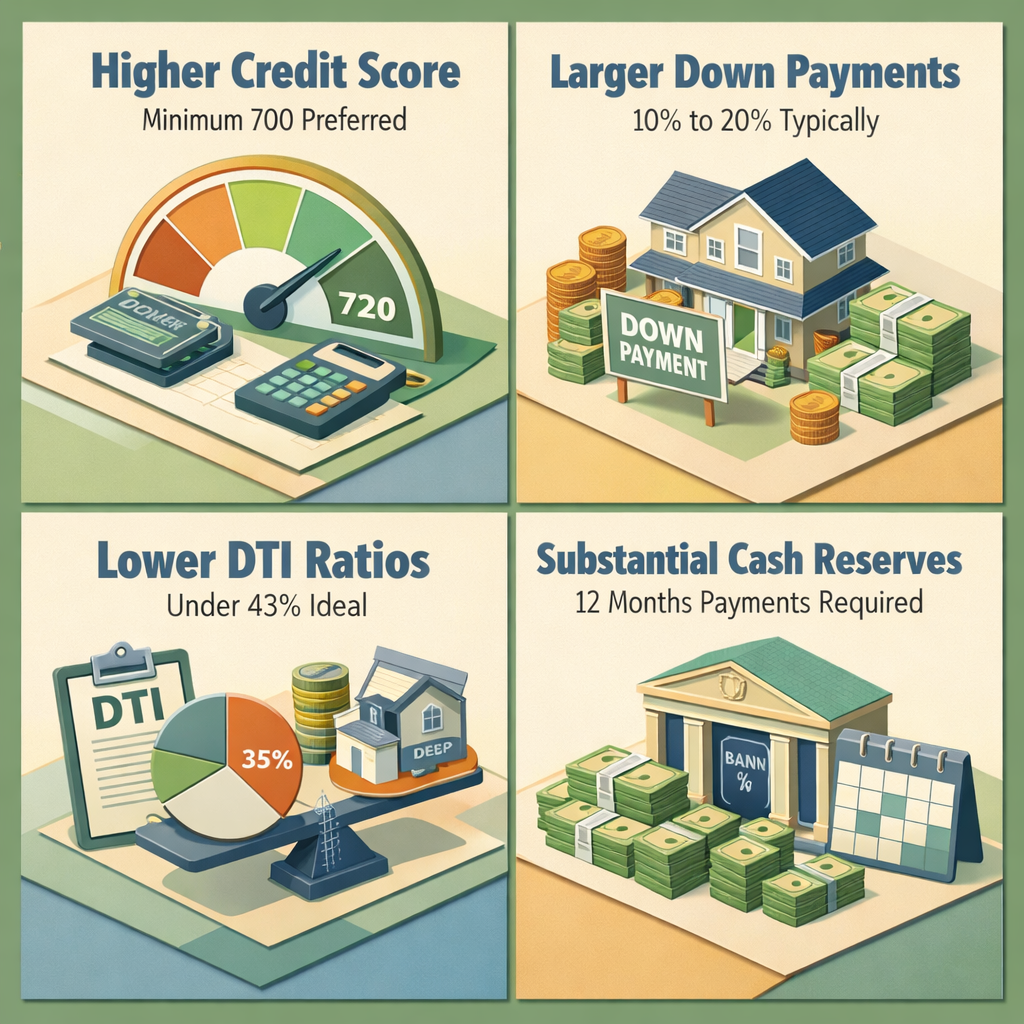
Understanding these baseline requirements helps you assess where you stand before you apply — and what areas may need strengthening.
Understanding 1099 Commission Income in the Eyes of a Mortgage Lender
When you earn income as an independent contractor, sales professional, or self-employed individual and receive a 1099 form rather than a W-2, lenders classify you differently than a traditional employee. This classification affects how your income is calculated, verified, and averaged for qualification purposes.
Commission-based income — whether you're in real estate, financial services, technology sales, or another industry — is considered variable income. It can fluctuate from month to month and year to year, which naturally makes lenders more cautious. Rather than using your highest-earning months as a baseline, most lenders will average your income over a defined period, commonly 24 months, to arrive at a qualifying figure.
For 1099 earners specifically, lenders may also factor in business expenses that appear on your tax returns. If your Schedule C shows significant deductions, the net income used for qualification could be lower than your gross earnings — a reality that surprises many borrowers. This is why it's critical to understand how your tax filings reflect your true earning capacity and to work with a mortgage professional who has experience structuring 1099 income scenarios for jumbo lending.
Key Documents Lenders Typically Request for 1099 Income
- Two years of federal tax returns (personal and business if applicable)
- 1099 forms from all income sources for the past two years
- Year-to-date profit and loss statement, especially for self-employed borrowers
- Bank statements (typically 12 to 24 months) to verify income deposits
- CPA letter or accountant verification confirming the nature and continuity of your income
The New Job Challenge: How Lenders Evaluate Recent Employment Changes
Starting a new position adds a meaningful layer of complexity to any mortgage application, but it's particularly significant for jumbo loan candidates earning 1099 commission income. Lenders want to see a track record. When you've just transitioned into a new role — even a high-paying one — that history doesn't yet exist at your new employer.
The challenge isn't necessarily that a new job disqualifies you. Rather, it's that lenders need to assess your income's sustainability and likelihood of continuation. For someone earning base salary plus commission, a lender might be more willing to use the base salary as qualifying income while treating commissions as supplemental. But for a borrower who is entirely commission-dependent at a new job, documenting consistent earning capacity becomes the central hurdle.
What Lenders Generally Look For With New Commission-Based Employment
- Employment history in the same field: If your new 1099 role is in the same industry as your prior work, lenders may view the transition more favorably. Continuity of profession matters.
- Signed employment agreement or commission structure: A written contract outlining your role, compensation plan, and expected earnings can help lenders evaluate your income potential.
- Offer letter or contractor agreement: Documentation confirming the terms of your new engagement adds credibility to your income story.
- Prior years of 1099 income in the same field: If your previous roles involved similar commission structures, two years of prior tax returns can help bridge the gap created by the new job.
Some lenders may require you to have been in your new role for a minimum period — sometimes as little as 30 days, other times longer — before they'll consider your commission income at all. This varies significantly by lender, which is why shopping multiple jumbo loan sources is advisable.
How to Qualify for a Jumbo Loan With 1099 Commission Income and a New Job: Practical Strategies
Knowing how to qualify for a jumbo loan with 1099 commission income and a new job is largely about preparation, documentation, and choosing the right lending path. Here are actionable strategies that may improve your chances of approval.
1. Build a Strong Financial Profile Ahead of Time
Before you apply, take a thorough look at your overall financial health. Reduce existing debts where possible to lower your DTI ratio. Pay down credit card balances to strengthen your credit utilization rate and potentially boost your credit score. The stronger your credit profile, the more flexibility lenders may extend when evaluating your income situation.
2. Accumulate Substantial Liquid Reserves
One of the most effective ways to offset income uncertainty is to demonstrate impressive cash reserves. Jumbo lenders often feel more comfortable approving borrowers with variable income when those borrowers have 12, 18, or even 24 months of mortgage payments sitting in accessible accounts. Reserves signal financial stability and the ability to weather income fluctuations.
3. Make a Larger Down Payment
A larger down payment reduces the lender's exposure and could tip the scales in your favor. If your budget allows, consider putting down 20% to 30% or more. This reduces the loan-to-value (LTV) ratio, which is a key risk metric for jumbo underwriters reviewing non-traditional income profiles.
4. Work With a Non-QM or Portfolio Lender
Traditional banks and mortgage companies that sell loans on the secondary market must follow strict agency guidelines. However, portfolio lenders — institutions that hold their loans in-house — and non-QM (non-qualified mortgage) lenders have more flexibility to underwrite complex income scenarios. These lenders may consider bank statement loans, asset depletion methods, or alternative documentation that better captures your true financial picture.
5. Engage a CPA Strategically
If your tax returns show lower net income due to aggressive deductions, it may be worth discussing your filing strategy with a CPA before your next tax year. While maximizing deductions has tax benefits, it can reduce the income figure lenders use for qualification. A CPA who understands mortgage underwriting can help you balance these competing interests.
Alternative Documentation Options That May Support Your Jumbo Loan Application
For borrowers whose tax returns don't fully reflect their earning power, several alternative documentation options may be worth exploring with a knowledgeable lender.
Bank Statement Loans
Bank statement mortgage programs allow lenders to use 12 to 24 months of personal or business bank statements to calculate qualifying income, rather than relying solely on tax returns. This approach can be particularly helpful for 1099 earners whose gross deposits are significantly higher than their reported net income after deductions.
Asset Depletion or Asset Dissipation
Some jumbo lenders offer asset depletion underwriting, which converts a portion of your liquid assets into a monthly income figure for qualification purposes. For example, a lender might divide your total qualifying assets by a set number of months (such as 360 for a 30-year loan) to derive a monthly income equivalent. This can be a powerful tool for high-net-worth borrowers who have accumulated significant wealth but show modest income on paper.
Profit and Loss Only Programs
Certain portfolio lenders may accept a CPA-prepared profit and loss statement as the primary income document, bypassing the need for two years of tax returns in some cases. Availability and terms vary widely, so it's important to ask lenders specifically whether this option is available for your scenario.
These alternative programs may carry slightly higher interest rates or require larger down payments compared to conventional jumbo products. However, for borrowers who genuinely don't fit the traditional income mold, they can be the key to homeownership.
Choosing the Right Lender for Your Unique Income Profile
Not all lenders are equipped — or willing — to navigate the complexity of jumbo mortgage self employed commission income new job scenarios. Choosing the right lending partner is one of the most important decisions you'll make in this process.
Start by seeking out lenders who specialize in jumbo lending and have demonstrated experience with non-traditional income borrowers. Ask direct questions about their experience with 1099 commission earners, their guidelines for new employment situations, and whether they offer bank statement or non-QM jumbo products. A lender who seems unfamiliar with these scenarios or hesitant to discuss options may not be the right fit.
Mortgage brokers can be particularly valuable here because they have access to multiple wholesale lenders and can shop your scenario across a wider range of programs than a single bank or direct lender. This increases your chances of finding a loan structure that actually works for your situation.
- Ask about overlays: Some lenders add their own restrictions on top of standard guidelines. A lender with fewer overlays may offer more flexibility for complex income profiles.
- Compare more than just rate: When evaluating jumbo loan offers, consider total loan costs, documentation requirements, and the lender's responsiveness during underwriting.
- Get pre-qualified before you shop for homes: A thorough pre-qualification — or ideally a credit-reviewed pre-approval — gives you a realistic picture of your borrowing capacity and strengthens your offer in competitive markets.
●Conclusion
Qualifying for a jumbo loan with 1099 commission income and a new job is undeniably more complex than a standard mortgage application, but it's far from impossible. The path forward requires a clear understanding of how lenders view variable income, a well-organized documentation strategy, a strong financial profile, and the right lending partner. By building your cash reserves, maintaining excellent credit, considering alternative documentation programs, and working with lenders who specialize in non-traditional income scenarios, you can position yourself as a credible and qualified borrower — even with a newer commission-based role. If you're ready to explore your options, LoanWise is here to help you navigate every step of the process with confidence.