
Securing a large home loan in the United States can already feel like a significant undertaking. But when your qualifying income comes from a rental property located outside the country, and you're pairing that with a US-based co-signer, the process becomes notably more layered. Understanding the requirements for jumbo loan with foreign property rental income and US co-signer is essential before you begin the application process. Lenders who handle these scenarios operate under stricter guidelines than conventional mortgage programs, and knowing what to expect can save you considerable time and frustration. This article walks you through the key qualification factors, documentation standards, and strategic considerations involved in this specialized financing path.
What Makes Jumbo Loans Different from Conventional Mortgages
Jumbo loans are home loans that exceed the conforming loan limits set each year by the Federal Housing Finance Agency (FHFA). Because these loans are too large to be purchased by Fannie Mae or Freddie Mac, lenders assume the full risk of holding them in their portfolios. This means lenders typically apply stricter qualification standards across the board.
For most borrowers, the key differences include higher credit score requirements, larger down payment expectations, and more rigorous income documentation. When international income enters the picture — especially from a foreign rental property — the level of scrutiny increases even further. Lenders want to be confident that the income is stable, verifiable, and likely to continue. Without the backing of a government-sponsored enterprise, they have very little room for ambiguity.
It's also worth noting that jumbo loan guidelines are not standardized the way conforming loan guidelines are. Each lender creates its own overlays and policies, which means requirements can vary meaningfully from one institution to the next. Borrowers with complex income profiles may find that shopping multiple lenders — particularly those who specialize in jumbo loan with international income requirements — yields very different outcomes.
How Lenders Evaluate Foreign Rental Property Income
Foreign rental income is not impossible to use for US mortgage qualification, but lenders do treat it differently than domestic rental income. The first challenge is verification. Lenders need to confirm that the income is real, consistent, and legally documented according to the standards of both the country where the property is located and US lending norms.
Typically, lenders may require at least one to two years of rental income history to demonstrate stability. This history is often documented through foreign tax returns, lease agreements translated into English, bank statements showing rental deposits, and sometimes a letter from a local property management company or accountant familiar with the local market.
Currency conversion is another important factor. Since rental income may be received in a foreign currency, lenders will generally convert earnings to US dollars using established exchange rates. However, some lenders apply a conservative adjustment or haircut to account for currency fluctuation risk. This could reduce the effective qualifying income below the actual rental earnings received.
Additionally, lenders may want to understand the property's location, the stability of the local rental market, and whether any mortgage or lien on the foreign property affects the borrower's overall debt picture. If the foreign property carries its own loan, that liability may also count against the borrower's debt-to-income ratio, further tightening qualification thresholds.
The Role of a US Co-Signer in Jumbo Loan Approval
A US co-signer — sometimes referred to as a non-occupant co-borrower — can play a meaningful role in helping a borrower qualify for a jumbo loan with foreign rental income. The co-signer's US-based income, credit history, and financial profile are added to the application, which may help offset concerns a lender has about the primary borrower's foreign income documentation or limited US credit history.
That said, adding a co-signer doesn't eliminate the scrutiny placed on the primary borrower's income. Lenders will still want to fully document and evaluate the foreign rental income. The co-signer functions as a supplement to the file, not a substitute for proper qualification. Both parties' debts and income will be reviewed together to calculate a combined debt-to-income ratio.
The co-signer also takes on real financial responsibility. If the primary borrower defaults or misses payments, the co-signer is legally obligated to cover those payments. This commitment shows up on the co-signer's credit report and can affect their ability to qualify for other credit during the life of the loan. Anyone considering this arrangement should weigh those implications carefully before proceeding.
From a lender's perspective, a strong US co-signer with an excellent credit score, low existing debt, and documented US employment income can be a significant positive factor in the overall application. It adds a layer of domestic financial stability that lenders value, particularly when the primary borrower's income profile is less straightforward.
Credit Score and Down Payment Standards You Should Expect
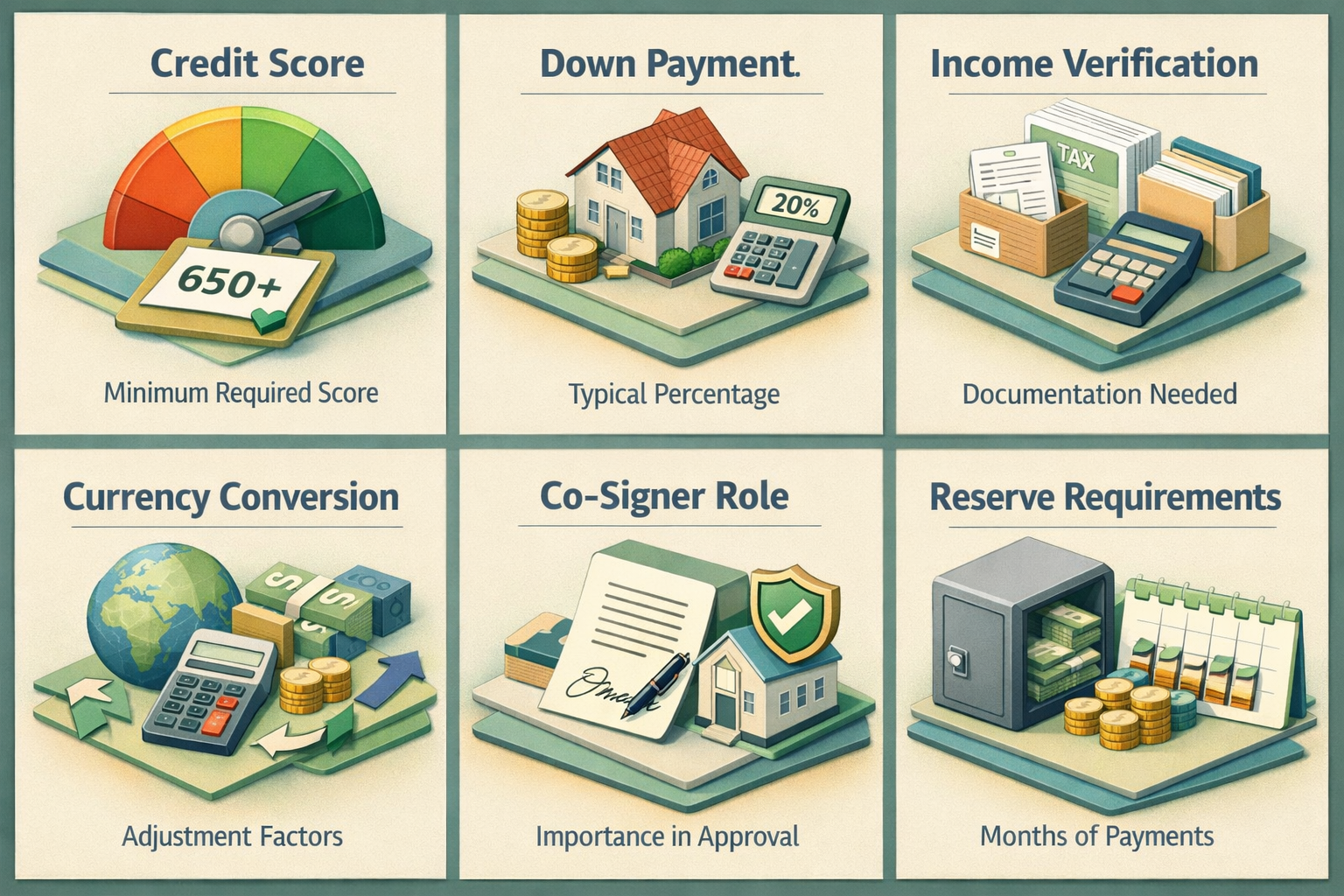
Jumbo loans typically carry higher credit score minimums than conforming loans. While exact thresholds vary by lender, many jumbo programs may require a minimum credit score in the range of 700 or higher. For borrowers with complex income profiles — such as those relying on foreign rental income — some lenders may set the bar even higher to compensate for the added documentation risk.
If the primary borrower has limited US credit history, which is common for foreign nationals or recent immigrants, this can create additional challenges. Some lenders offer programs designed for borrowers with thin US credit files, sometimes accepting foreign credit reports or alternative credit documentation. However, these programs are not universally available and may come with higher interest rates or more conservative loan-to-value ratios.
Down payment requirements for jumbo loans are also generally higher than those for conforming loans. Many lenders may expect at least 20 percent down, and some programs targeting borrowers with complex income documentation might require 25 to 30 percent or more. A larger down payment reduces the lender's exposure and may make them more comfortable extending credit when income verification is more complex than usual.
Reserve requirements are another factor. Jumbo lenders often want to see that borrowers have sufficient liquid reserves — sometimes six to twelve months' worth of mortgage payments — available after closing. This provides additional assurance that the borrower can sustain payments even if rental income is temporarily interrupted.
Key Documentation Required for This Type of Application
Meeting the requirements for jumbo loan with foreign property rental income and US co-signer means assembling a thorough and well-organized documentation package. Lenders working with complex borrower profiles need more paperwork than a standard application, and gaps in documentation are one of the most common reasons these files face delays or denials.
For the foreign rental income, you'll likely need to provide:
- Two years of foreign tax returns — translated into English and sometimes notarized by a certified translator
- Current and prior lease agreements — showing rental terms, tenant names, and monthly rental amounts
- Bank statements — typically twelve to twenty-four months, demonstrating consistent rental deposits in your account
- A letter from a foreign CPA or accountant — confirming income amounts and tax compliance in the country where the property is located
- Property management records — if applicable, showing occupancy history and rental payment records
For the US co-signer, standard documentation applies, including recent pay stubs, W-2 forms or tax returns for the past two years, bank statements, and a full credit report pull. The co-signer may also need to provide a signed explanation of their relationship to the primary borrower and their reason for co-signing.
In some cases, lenders may also request an appraisal or market valuation of the foreign property, though this practice varies. Some lenders focus primarily on the income documentation rather than the foreign asset's value, especially since appraising overseas real estate can be logistically complicated.
Finding Lenders Who Specialize in Complex Jumbo Scenarios
Not every lender has the experience or appetite to handle a jumbo application involving foreign rental income and a US co-signer. Many traditional banks and mortgage companies will decline these files simply because they fall outside their standard guidelines. This is why finding a lender who genuinely specializes in non-QM (non-qualified mortgage) or portfolio lending is so important.
Portfolio lenders keep loans on their own books rather than selling them to the secondary market. Because they're not bound by Fannie Mae or Freddie Mac guidelines, they have more flexibility to evaluate borrowers on a case-by-case basis. Non-QM lenders similarly offer alternative income documentation programs that can accommodate foreign income, self-employed borrowers, and other complex financial profiles.
Working with an experienced mortgage broker can also be a smart strategy. Brokers have access to a wide network of wholesale lenders, including those with specialized programs for international borrowers and non-traditional income sources. They can help match your specific financial profile to the lenders most likely to approve your application, saving you time and protecting your credit score from too many hard inquiries.
When evaluating lenders, ask specifically about their experience with foreign income documentation, their policies on currency conversion, and whether they've successfully closed loans involving co-signers in similar scenarios. A lender who has handled these situations before will be far better equipped to guide you through the process efficiently.
Practical Tips to Strengthen Your Jumbo Loan Application
If you're preparing to apply for a jumbo mortgage using foreign rental income with a US co-signer, there are several proactive steps that may improve your chances of approval and help you secure more favorable loan terms.
- Build or establish US credit early. If you have limited US credit history, consider opening a US bank account, applying for a secured credit card, or taking other steps to begin building a domestic credit profile well before applying for a mortgage.
- Organize your rental income documentation thoroughly. Work with a bilingual accountant or tax professional who understands both the foreign country's tax system and US lender requirements. Clean, consistent records go a long way.
- Maximize your down payment if possible. Offering a larger down payment signals financial strength and reduces the lender's risk, which can offset concerns about income complexity.
- Maintain healthy reserves. Keep liquid assets accessible and avoid large unexplained withdrawals in the months leading up to your application. Lenders will scrutinize bank statements carefully.
- Choose your co-signer wisely. A co-signer with a strong US credit profile, stable employment, and low existing debt obligations will add the most value to your application.
- Be transparent with your lender. Full disclosure of all assets, liabilities, and income sources — including the foreign property — helps lenders underwrite your file accurately and avoids delays caused by surprises during the review process.
Taking these steps before you submit your application puts you in a much stronger position and demonstrates to lenders that you're a responsible, prepared borrower — even in a complex lending scenario.
●Conclusion
Pursuing a jumbo mortgage with income from an overseas rental property and the support of a US co-signer is certainly achievable, but it requires patience, preparation, and the right lending partner. The requirements for jumbo loan with foreign property rental income and US co-signer are more involved than a standard mortgage application, but borrowers who approach the process with well-organized documentation and realistic expectations often find a path forward. Working with specialists in jumbo loan with international income requirements can make all the difference. At LoanWise, we're here to help you navigate complex financing scenarios with confidence. Connect with one of our lending specialists today to explore your options and take the next step toward your home financing goals.