
Purchasing a high-value home in the United States is an exciting goal, but it comes with a unique set of financing challenges — especially when your income flows from foreign dividend sources. If you're exploring the requirements for jumbo loan with foreign dividend income and US property, you're navigating one of the more complex corners of the mortgage market. Jumbo loans, by definition, exceed the conforming loan limits set by the Federal Housing Finance Agency (FHFA), which means they don't follow conventional Fannie Mae or Freddie Mac guidelines. That gives lenders more flexibility — but it also means stricter scrutiny of your financial profile. Whether you're a foreign national, a US resident with international investments, or a real estate investor with global income streams, understanding what lenders look for could make or break your approval.
What Makes Jumbo Loans Different From Conventional Mortgages
Before diving into income documentation, it helps to understand why jumbo loans operate by a different set of rules. Because these loans exceed conforming loan limits — which in most US counties sit above $766,550 as of recent FHFA guidelines — they can't be purchased or guaranteed by Fannie Mae or Freddie Mac. This means lenders are holding the risk on their own books, which naturally makes them more cautious.
As a result, jumbo lenders typically impose higher credit score thresholds, larger down payment requirements, and more thorough income verification standards than conventional loans. For borrowers relying on foreign dividend income, this scrutiny is even more pronounced. Lenders need to be confident that your income is stable, consistent, and verifiable — even when it originates outside the United States.
It's also worth noting that jumbo loan guidelines vary significantly from one lender to the next. Unlike government-backed loans with standardized rules, jumbo products are essentially portfolio loans, meaning each lender sets their own eligibility criteria. This could work in your favor if you shop strategically.
How Lenders Evaluate Foreign Dividend Income for US Mortgage Qualification
When a lender reviews your application, their primary concern is whether your income is reliable enough to support monthly mortgage payments over the long term. For domestic W-2 earners, this is relatively straightforward. For borrowers with jumbo loan foreign dividend income, the process is more involved.
Lenders will typically want to see a consistent history of dividend payments — often spanning two years or more. They may require official statements from the foreign brokerage or financial institution holding the assets, translated into English and sometimes certified. The dividend income must generally be denominated in a stable foreign currency or converted to US dollars using a consistent exchange rate methodology.
Some lenders may also require evidence that the foreign investments are likely to continue generating income. This could mean reviewing the nature of the investments, the financial health of the issuing companies, or the historical performance of the dividend payments. If dividends are irregular or have varied significantly year to year, lenders may average the income over a multi-year period or discount it entirely.
- Two-year history: Most lenders want at least 24 months of documented dividend income.
- Official statements: Foreign brokerage or bank statements are typically required, often translated and notarized.
- Continuance verification: Lenders may request a letter from a financial advisor or institution confirming the income is expected to continue.
- Currency stability: Income from countries with volatile currencies may face additional scrutiny or discounting.
Credit Score and Down Payment Expectations for Jumbo Borrowers
Even with solid income documentation, your credit profile plays a central role in jumbo loan approval. Most jumbo lenders look for a credit score of at least 700, though many prefer 720 or higher. Some portfolio lenders may work with scores slightly below this threshold if other financial factors are exceptionally strong, but it's less common.
For borrowers with foreign dividend income, a robust US credit history can be especially helpful in building lender confidence. If you have limited US credit history — which is common among foreign nationals or recent immigrants — some lenders may accept international credit reports or alternative credit documentation, though this varies widely by institution.
Down payment requirements for jumbo loans typically range from 10% to 30%, depending on the loan size, property type, and borrower profile. Borrowers with non-traditional income sources like foreign dividends may face requirements toward the higher end of that range. A larger down payment not only reduces the lender's risk but also demonstrates your financial commitment to the property.
Additionally, lenders will often require proof of substantial cash reserves after closing — sometimes six to twelve months of mortgage payments held in liquid accounts. These reserves serve as a financial safety net and may need to be held in US-accessible accounts for verification purposes.
Requirements for Jumbo Loan with Foreign Dividend Income and US Property: Documentation Essentials
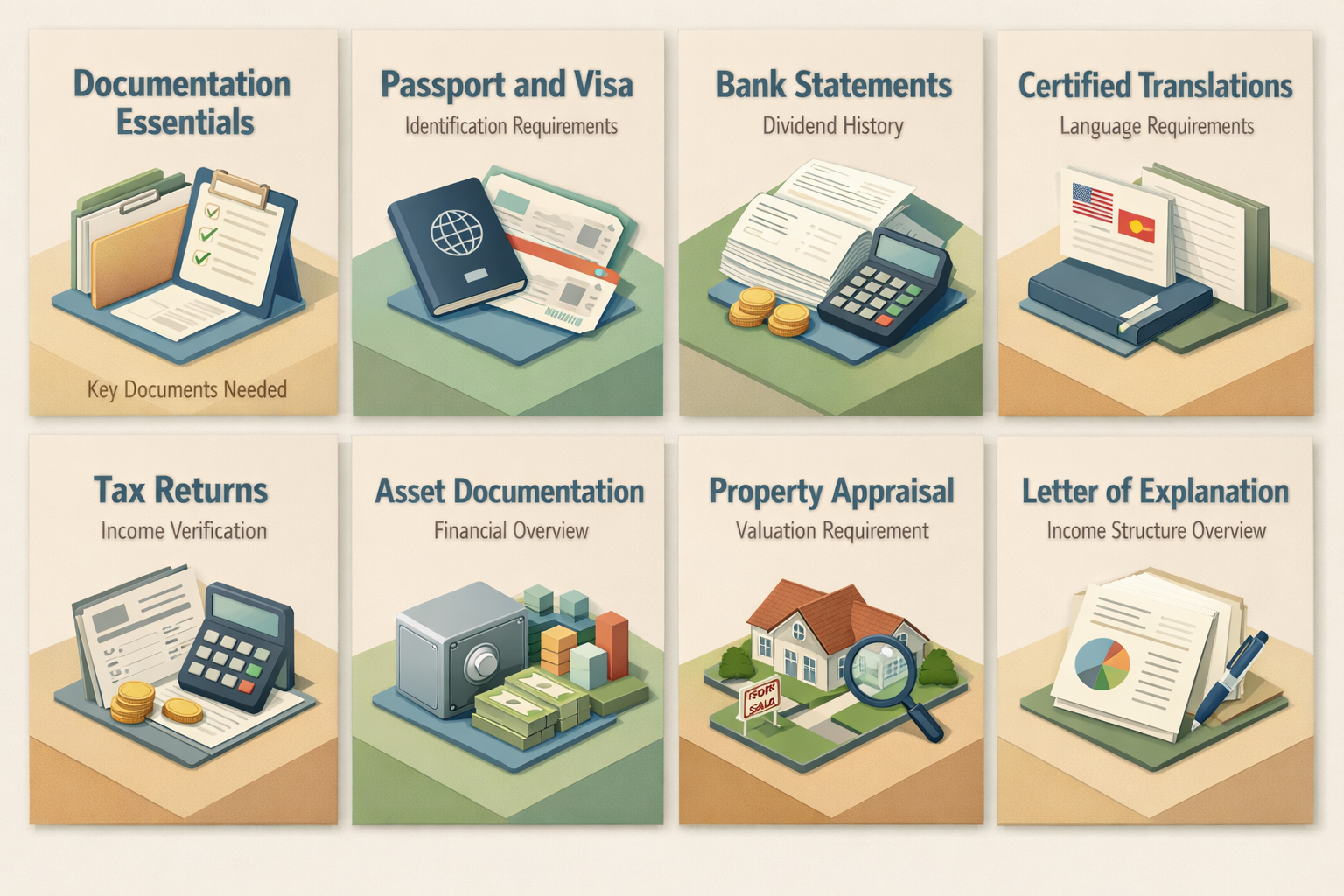
Documentation is arguably the most demanding aspect of qualifying for this type of financing. Meeting the requirements for jumbo loan with foreign dividend income and US property means preparing a thorough package that leaves little room for ambiguity. Here's what you'll likely need to gather:
- Passport and visa documentation: For non-US citizens, a valid passport and current visa or residency documentation are standard requirements.
- Foreign bank and brokerage statements: Typically covering 24 months, these should clearly show dividend deposits and account activity.
- Certified translations: If statements are not in English, certified translations may be required by the lender.
- Tax returns: US tax returns (if applicable) as well as foreign tax filings may be requested to verify reported income.
- Asset documentation: Statements for all US and foreign accounts showing liquid assets and reserves.
- Property appraisal: A full appraisal of the US property being purchased, conducted by a licensed US appraiser.
- Letter of explanation: A written explanation of your income structure, investment history, and financial situation can help underwriters understand your profile.
Some lenders that specialize in non-QM (non-qualified mortgage) or portfolio lending may have slightly different documentation checklists, but the above list reflects what's commonly expected across the industry. Starting the documentation process early — ideally three to six months before you plan to apply — gives you time to gather, translate, and organize everything properly.
Debt-to-Income Ratios and How Foreign Income Factors In
Your debt-to-income (DTI) ratio is a critical metric in any mortgage application, and jumbo loans are no exception. DTI compares your total monthly debt obligations to your gross monthly income. Most jumbo lenders prefer a DTI at or below 43%, though some may accept slightly higher ratios when compensating factors — like significant reserves or a large down payment — are present.
When calculating DTI using foreign dividend income, lenders may apply a discount to the income figure to account for currency risk, income variability, or verification challenges. For example, if your dividends average $10,000 per month but are paid in a less stable currency, a lender might use only 80% or 90% of that figure for qualifying purposes. This is a common conservative approach among portfolio lenders, though the exact treatment varies by institution.
It's also important to note that existing debt obligations — including any foreign mortgages, credit card balances, or investment loans — will typically be factored into your DTI calculation. Even debts held outside the US may appear in international credit reports or be disclosed through your tax filings, so it's best to be transparent about all obligations from the start.
Finding the Right Lender for This Niche Financing Scenario
Not every mortgage lender has experience — or appetite — for jumbo loans involving foreign dividend income. Major retail banks may have rigid guidelines that don't accommodate non-traditional income sources, while specialty portfolio lenders and private banks often have more flexibility. Partnering with a mortgage broker who has experience in jumbo and non-QM lending can significantly improve your chances of finding a suitable match.
Private banks and wealth management-affiliated lenders, in particular, may be well-suited for this scenario. If you maintain a substantial investment or deposit relationship with a US-based private bank, they may be more willing to underwrite a jumbo mortgage using your foreign asset and income profile as part of a broader wealth relationship.
Foreign national mortgage programs are another avenue worth exploring. Some lenders have developed specific products for non-US citizens purchasing American real estate, and these programs may have clearer guidelines around foreign income documentation. While interest rates on these products may be somewhat higher than standard jumbo rates, the streamlined qualification process could offset that cost.
When evaluating lenders, ask specifically about their experience with foreign dividend income, their documentation requirements, and whether they hold loans in-house or sell them to secondary market investors. Portfolio lenders who retain their loans typically have more room to accommodate unique borrower profiles.
Strategies to Strengthen Your Jumbo Loan Application
Even if your income and documentation are in order, there are several proactive steps you can take to make your application more compelling to jumbo lenders. A well-prepared borrower signals confidence and reduces perceived risk — both of which matter when underwriters are reviewing a non-standard file.
- Establish US banking relationships early: Opening US bank accounts and maintaining them with consistent activity can help demonstrate financial stability and make asset verification easier.
- Build or maintain US credit: If you don't yet have a US credit history, consider secured credit cards or other tools to begin establishing a profile well before applying.
- Increase your down payment: Offering 25% to 30% down rather than the minimum can meaningfully reduce lender hesitation around income verification challenges.
- Organize reserves in US accounts: Holding post-closing reserves in a US-accessible account simplifies verification and may be preferred or required by some lenders.
- Work with a tax professional: A CPA experienced in international taxation can help ensure your US tax filings accurately reflect your foreign income, which supports your loan application.
- Get pre-approved before property shopping: A pre-approval — even a conditional one — signals seriousness to sellers and helps you identify any documentation gaps early in the process.
Patience is also part of the equation. Jumbo loans with non-traditional income sources often take longer to underwrite than standard mortgages. Building extra time into your purchase timeline can help you avoid the pressure of rushed decisions or missed closing deadlines.
●Conclusion
Navigating the requirements for jumbo loan with foreign dividend income and US property financing is undeniably complex, but it's far from impossible. With the right preparation, the right lender partner, and a well-organized documentation package, many borrowers successfully secure jumbo financing using foreign investment income. The key is understanding that lenders in this space are looking for confidence — confidence in the stability of your income, the strength of your financial profile, and your commitment to the property. By approaching the process proactively and working with experienced professionals, you can position yourself as a compelling applicant even in one of the more nuanced corners of the mortgage market. Ready to explore your options? Connect with a LoanWise mortgage specialist who understands the unique dynamics of jumbo lending with international income sources.