
Getting approved for an FHA loan can feel like a big challenge — especially if your credit history is thin or your income needs a boost. That's where a co-signer might come in. But here's something many homebuyers don't realize: if the person co-signing your loan already owns multiple properties, the process comes with its own set of rules. Understanding the requirements for FHA loan with co-signer who owns multiple properties could make the difference between a smooth approval and an unexpected roadblock. In this guide, we'll walk you through everything you need to know, from how the FHA defines a co-signer to what lenders typically look for when that co-signer has a real estate portfolio behind them.
What Is a Co-Signer on an FHA Loan and Why It Matters
Before diving into property ownership rules, it's worth understanding what a co-signer actually does on an FHA loan. In FHA lending, the term often used is non-occupying co-borrower. This is someone who signs onto the loan and shares legal responsibility for repayment but does not plan to live in the home being purchased.
A co-signer's income, credit history, and debt obligations are all factored into the loan application. That means if a primary borrower has a lower credit score or limited income, adding a financially strong co-signer may help meet the lender's approval standards. FHA guidelines generally allow non-occupying co-borrowers, which is one reason this loan program remains popular among first-time homebuyers who might need family support to qualify.
However, lenders don't look at the co-signer in isolation. They review the co-signer's complete financial picture — including any existing mortgages, investment properties, or other real estate obligations. This is where things can get a bit more complex.
How Property Ownership Affects the Co-Signer's Financial Profile
When a co-signer already owns multiple properties, lenders pay close attention to how those properties affect the co-signer's debt-to-income ratio, or DTI. Each property likely carries its own mortgage payment, taxes, insurance, and possibly HOA fees. All of these obligations count toward the co-signer's monthly debt load.
FHA guidelines generally require that total monthly debt payments — for both the primary borrower and the co-signer — remain within acceptable limits when calculating qualifying ratios. If a co-signer owns three rental properties, for example, the payments on each of those mortgages may be counted as debt unless the co-signer can demonstrate consistent rental income to offset them.
Rental income from those properties may be counted as qualifying income, but lenders typically want to see documentation such as signed lease agreements and federal tax returns showing a history of rental earnings. Without strong documentation, lenders might not give full credit for that rental income, which could make the co-signer's DTI look less favorable.
It's also worth noting that some lenders apply a vacancy factor — typically a percentage reduction — to rental income to account for periods when a unit might be unoccupied. This is standard practice and could affect how much rental income actually counts toward the co-signer's qualifying figures.
The Key Requirements for FHA Loan With Co-Signer Who Owns Multiple Properties
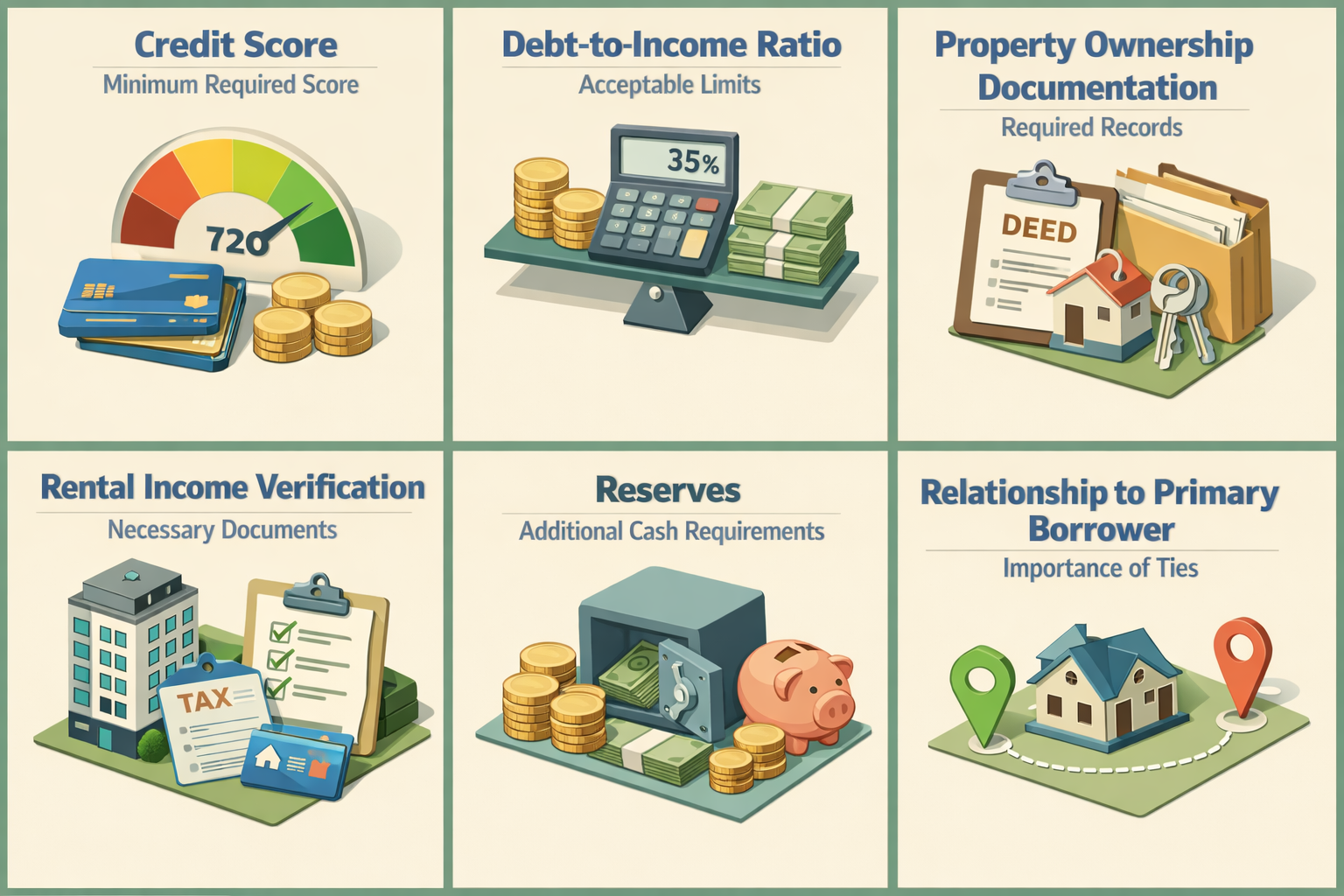
Meeting the requirements for FHA loan with co-signer who owns multiple properties involves satisfying both FHA program guidelines and the specific lender's overlays. Here are the core criteria that typically apply:
- Credit Score: The co-signer generally needs to meet FHA minimum credit score thresholds. While FHA allows scores as low as 500 with a larger down payment, most lenders prefer a score of 580 or higher for standard terms. A co-signer with multiple properties should ideally have a strong credit profile to compensate for the additional debt load those properties create.
- Debt-to-Income Ratio: FHA guidelines generally look for a DTI at or below 43%, though some lenders may allow higher ratios with compensating factors. For a co-signer carrying multiple mortgages, maintaining an acceptable DTI may require demonstrating sufficient documented income — including rental income — to offset those obligations.
- Property Ownership Documentation: Lenders will likely request mortgage statements, property tax records, and insurance documents for each property the co-signer owns. This gives underwriters a clear picture of existing financial commitments.
- Rental Income Verification: If the co-signer rents out any of those properties, lenders may require Schedule E from federal tax returns (typically for the past two years), current lease agreements, and sometimes a market rent analysis from a licensed appraiser.
- Reserves: Because the co-signer holds multiple properties, lenders may require additional cash reserves — funds set aside beyond the down payment and closing costs. Reserve requirements can vary by lender and loan scenario.
- Relationship to the Primary Borrower: FHA guidelines have traditionally placed some emphasis on the relationship between the primary borrower and the non-occupying co-borrower, particularly regarding family ties. It's best to confirm current guidelines with your lender, as policies can evolve.
Every lender may interpret these requirements slightly differently based on their internal overlays, so working with an experienced FHA lender is strongly recommended.
Understanding FHA Co-Signer Requirements Beyond Property Ownership
Beyond the property-related factors, general FHA co-signer requirements apply regardless of how many homes someone owns. These include being a U.S. citizen or eligible non-citizen, having a valid Social Security number, and demonstrating a stable employment history or income source.
A co-signer on an FHA loan is equally responsible for the debt. That means if the primary borrower misses payments, the co-signer's credit and financial standing are directly affected. Lenders evaluate this shared responsibility carefully, which is why they look at the co-signer's full financial picture so thoroughly.
One important distinction: on an FHA loan, a non-occupying co-borrower appears on the mortgage note and the deed of trust in most cases, meaning they carry both legal and financial responsibility. This is slightly different from some conventional loan structures where a guarantor might not be on the title. Buyers and co-signers should both understand this arrangement before proceeding.
It's also worth knowing that FHA loans are limited to primary residences. So while a co-signer may own investment properties, the loan being co-signed must be for the primary borrower's principal residence. This is a firm FHA rule and not subject to lender discretion.
How Multiple Property Ownership Can Actually Help a Co-Signer Qualify
It might seem like owning multiple properties would always hurt a co-signer's ability to help someone qualify for an FHA loan — but that's not necessarily true. In some cases, a well-managed real estate portfolio can actually strengthen a co-signer's financial profile.
If the co-signer has owned rental properties for several years and those properties generate consistent, well-documented rental income, that income may increase the co-signer's qualifying income significantly. A co-signer who earns substantial rental income could help a primary borrower qualify for a higher loan amount than they could on their own.
Additionally, owning multiple properties can be a sign of financial discipline and experience managing long-term debt obligations — qualities that lenders tend to view positively when evaluating overall creditworthiness. A co-signer with a long history of on-time mortgage payments across multiple properties may actually present a very favorable credit profile.
The key is documentation. Lenders want to see the full story in writing, and co-signers with real estate holdings should be prepared to provide thorough financial records. Working with a knowledgeable mortgage professional who understands how rental income and investment property obligations are calculated under FHA guidelines can make a meaningful difference in the outcome.
Common Challenges and How to Address Them Before Applying
Even with a willing co-signer, there are some common hurdles that homebuyers and their co-signers should anticipate when property ownership for FHA co-signer arrangements comes into play.
- High DTI From Multiple Mortgages: This is perhaps the most frequent issue. If the co-signer's existing mortgage obligations push their DTI above acceptable limits, even strong income may not fully compensate. One potential solution is ensuring all rental income is thoroughly documented so lenders can offset those debts appropriately.
- Inconsistent Rental Income Reporting: Co-signers who haven't consistently reported rental income on their tax returns may find that lenders won't count it. The IRS requires rental income to be reported, and lenders typically rely on tax documents for verification. If income hasn't been reported historically, it's harder to use it as a qualifying factor.
- Reserves Shortfalls: Some lenders require two to six months of mortgage payments in reserve for each financed property a co-signer holds. This can add up quickly for someone with a multi-property portfolio. Co-signers should review their liquid assets carefully before agreeing to take on this responsibility.
- Title and Legal Considerations: Being added to an FHA mortgage as a non-occupying co-borrower may affect the co-signer's ability to qualify for future loans of their own, at least until the primary borrower's loan is paid down or refinanced. Both parties should consider this long-term implication.
Preparing well in advance — gathering tax returns, lease agreements, mortgage statements, and bank records — can help avoid delays during the underwriting process. A pre-application review with an experienced mortgage advisor is often worth the time investment.
●Conclusion
Navigating the requirements for FHA loan with co-signer who owns multiple properties doesn't have to be overwhelming. With the right preparation and a clear understanding of what lenders are looking for, both primary borrowers and co-signers can approach the process with confidence. The FHA loan program exists to help more people achieve homeownership, and a co-signer with a strong real estate background may be exactly the support a borrower needs to get there. If you're ready to explore your options, speaking with a knowledgeable FHA lender is the best first step. At LoanWise, our team is here to help you understand how co-signer arrangements work and guide you toward the financing solution that fits your unique situation.