
Buying a co-op apartment is a dream for many homebuyers, especially in cities like New York where cooperative housing is a major part of the real estate landscape. But financing one can feel like navigating a maze. Unlike traditional condominiums or single-family homes, co-ops come with their own set of rules, board approvals, and lending restrictions. Now add a non-occupant co-signer to the mix, and the process becomes even more layered. If you're trying to figure out how to get a mortgage for a co-op apartment with a non-occupant co-signer, this guide is designed to walk you through exactly what to expect — from understanding co-op financing basics to meeting co-op mortgage requirements with a non-occupant co-signer by your side.
What Makes Co-op Financing Different from Standard Home Loans
Before diving into co-signers and approval strategies, it's important to understand why co-op financing is its own category in the mortgage world. When you purchase a co-op apartment, you're not actually buying real property in the traditional sense. Instead, you're buying shares in a cooperative corporation that owns the building. In return, you receive a proprietary lease that gives you the right to occupy a specific unit.
This distinction matters enormously when it comes to financing. Because there's no deed to a piece of real estate, many conventional mortgage products don't apply. Instead, lenders offer what's known as a share loan or co-op loan — a secured loan tied to the shares rather than real property. This limits the pool of lenders willing to work with co-op buyers, and it means underwriting criteria can be stricter than what you'd find with a typical home purchase loan.
Additionally, the co-op board itself plays a significant role. Even if a lender approves your loan, the co-op board must approve your application to purchase shares in the building. This two-layer approval process — lender and board — is one of the most unique challenges co-op buyers face. Boards often review your financial profile, personal references, and even your lifestyle to determine if you're a good fit for the building's community.
- Share loans are the typical financing vehicle for co-op purchases
- Fewer lenders offer co-op financing compared to conventional mortgage products
- Both lender approval and board approval are required
- Co-op boards may impose their own financial requirements beyond the lender's criteria
Understanding the Role of a Non-Occupant Co-Signer in Co-op Purchases
A non-occupant co-signer is someone who agrees to be legally responsible for the loan but does not intend to live in the property. This arrangement is fairly common in residential mortgage lending — parents often co-sign for adult children, or a financially stronger family member steps in to help a buyer qualify. However, in the co-op world, this setup introduces a unique set of complications.
From the lender's perspective, a non-occupant co-signer can strengthen a loan application by adding income, assets, and creditworthiness to the overall profile. This could help a buyer who has a solid rental history but a thin credit file, or someone who is self-employed with variable income. The co-signer's financial strength may make it easier to meet the income and debt-to-income ratio thresholds that lenders typically require.
However, the co-op board is a different story. Many co-op boards are very particular about who holds shares in the building. A non-occupant co-signer technically becomes a shareholder — or at least a financial party attached to the share loan — which some boards may view with suspicion or outright reject. It's worth understanding that the board's co-signer rules are entirely separate from the lender's policies, and both must align for the purchase to move forward.
Key considerations when bringing in a non-occupant co-signer for a co-op purchase include:
- Whether the lender's co-op loan program specifically permits non-occupant co-signers
- Whether the co-op board's bylaws allow co-signers or guarantors on share loans
- How the co-signer's credit and debt obligations will affect the overall underwriting
- The potential tax and legal implications for both parties
Co-op Mortgage Requirements Non-Occupant Co-Signer Lenders Look For
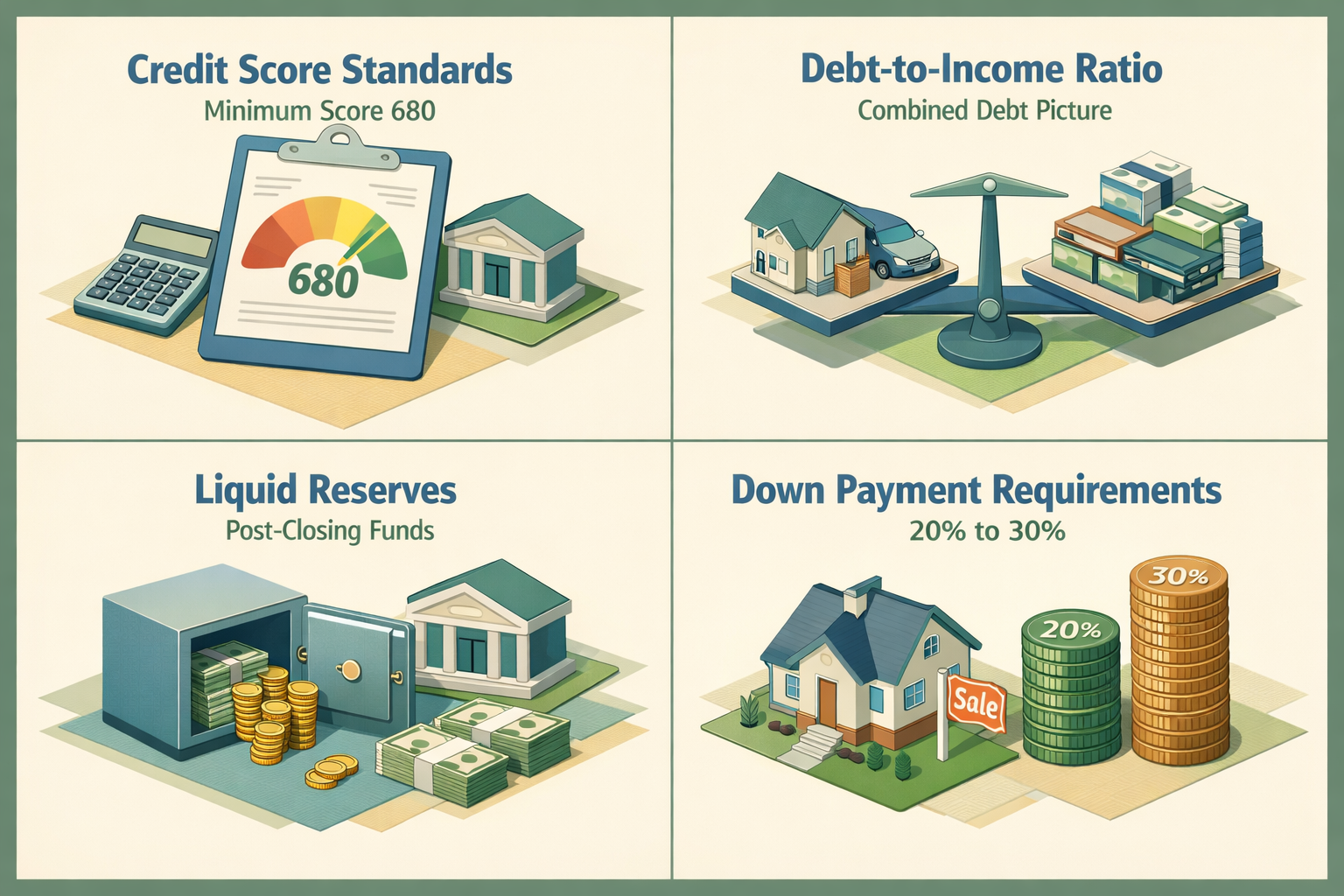
When a lender evaluates a co-op loan application that includes a non-occupant co-signer, the underwriting process tends to be more thorough than a standard application. Meeting co-op mortgage requirements with a non-occupant co-signer means satisfying criteria for both the primary borrower and the co-signer — and doing so in a way that aligns with the lender's co-op lending guidelines.
Credit Score Standards
Lenders typically expect strong credit from both the primary borrower and the non-occupant co-signer. While minimum thresholds can vary by lender, a score above 680 is often considered baseline for co-op financing, and many portfolio lenders — who are among the most active in co-op lending — may prefer scores of 700 or higher. The co-signer's credit history will be evaluated just as carefully as the borrower's, since they share legal responsibility for repayment.
Debt-to-Income Ratio
Lenders look at the combined debt picture of both the borrower and co-signer. This includes all monthly debt obligations — credit cards, car loans, student loans, other mortgages, and the proposed co-op loan payment — relative to gross monthly income. A lower combined debt-to-income ratio strengthens the application. Most lenders prefer a debt-to-income ratio below 43%, though some portfolio lenders may be more flexible depending on compensating factors like strong reserves.
Liquid Reserves and Assets
Co-op lenders often require borrowers to demonstrate significant post-closing reserves, meaning funds left in savings or investment accounts after the down payment and closing costs are paid. With a non-occupant co-signer, some lenders may count the co-signer's liquid assets as part of the reserve calculation, which can be a meaningful advantage if the primary borrower has limited savings.
Down Payment Requirements
Co-op loans frequently require larger down payments than conventional home loans — often ranging from 20% to 30% or more, depending on the building and lender. Some co-op boards even mandate a minimum down payment as part of their own rules, separate from what the lender requires. It's important to check both sets of requirements before making an offer.
Navigating the Co-op Board Approval Process with a Co-Signer
Even after a lender greenlights your co-op loan, you still need the co-op board's blessing. This stage can be unpredictable, and introducing a non-occupant co-signer adds a layer of complexity that buyers should prepare for carefully.
Many co-op boards prefer that the person purchasing shares is the sole financial party on the loan. Some boards may be open to co-signers, especially if the primary buyer's financial profile is close to meeting requirements. Others may have explicit rules in their proprietary lease or house rules that prohibit or limit co-signers or guarantors. The first step is to have your real estate attorney or the co-op's managing agent review the building's governing documents to understand the board's stance.
If the board allows co-signers, you'll typically need to present a comprehensive board package that includes financial statements, tax returns, bank statements, and letters of reference for both the primary buyer and the co-signer. Transparency is key — attempting to minimize the co-signer's role or obscure the arrangement is likely to backfire during the board interview.
Here are some practical tips for making the board application as strong as possible:
- Work with a real estate attorney who has experience with co-op transactions in your market
- Prepare a thorough and well-organized board package for both the buyer and co-signer
- Request the building's financial statements to understand the co-op's fiscal health before applying
- Ask the listing agent if the board has approved co-signer arrangements in the past
- Be prepared to answer questions about the co-signer relationship during a board interview
Finding the Right Lender for a Co-op Loan with a Non-Occupant Co-Signer
Not every lender offers co-op financing, and even fewer have established guidelines for loans that include a non-occupant co-signer. This makes lender selection one of the most critical steps in the process of learning how to get a mortgage for a co-op apartment with a non-occupant co-signer.
Portfolio lenders — banks and credit unions that hold loans on their own books rather than selling them to secondary market investors — tend to be the most active in the co-op lending space. Because they're not constrained by Fannie Mae or Freddie Mac guidelines, they often have more flexibility to underwrite non-standard situations, including non-occupant co-signers. Local and regional banks with strong presences in co-op-heavy markets like New York City may be especially well-positioned to help.
When evaluating lenders, ask these key questions upfront:
- Do you offer share loans for co-op apartments in this market?
- Do your co-op loan guidelines permit non-occupant co-signers?
- What are your minimum credit, income, and reserve requirements for co-op mortgage requirements?
- How do you calculate the co-signer's debt-to-income contribution?
- What is your typical timeline for co-op loan approval?
Working with a mortgage broker who specializes in co-op financing can also be a smart move. Brokers with co-op experience often have established relationships with portfolio lenders and can help match your specific situation — including the non-occupant co-signer component — to the right loan product. They may also be able to identify lenders who have previously approved similar applications, saving you time and reducing the risk of unnecessary credit inquiries.
Legal and Financial Responsibilities Every Co-Signer Should Understand
Becoming a non-occupant co-signer on a co-op loan is a significant financial commitment. Before agreeing to co-sign, the co-signer should fully understand the legal and financial implications — and ideally consult with an attorney or financial advisor before signing any documents.
From a legal standpoint, the co-signer is equally responsible for the debt. If the primary borrower misses payments or defaults, the lender can pursue the co-signer for the full balance owed. This liability could affect the co-signer's ability to qualify for their own future loans, since the co-op share loan will appear on their credit report as an active debt obligation.
From a financial planning perspective, the co-signer should consider:
- How the additional debt liability may affect their own debt-to-income ratio for future borrowing
- Whether they have the financial capacity to cover loan payments if the primary borrower cannot
- The potential impact on their credit score if payments are late or the loan goes into default
- Any gift tax or reporting implications if they're also contributing funds toward the down payment
It's also worth noting that being removed as a co-signer down the road — through refinancing or a formal release — may not always be straightforward. The primary borrower would typically need to qualify for the loan independently at that point, which requires demonstrating sufficient income, credit, and assets on their own. Planning for this possibility from the beginning can save both parties significant stress later.
●Conclusion
Understanding how to get a mortgage for a co-op apartment with a non-occupant co-signer requires patience, preparation, and the right team of professionals by your side. From selecting a lender who offers co-op share loans with co-signer flexibility, to satisfying the co-op board's approval requirements, every step of this journey demands careful attention to detail. The process is undeniably more complex than a standard home purchase, but for buyers who need that extra financial support to qualify, a non-occupant co-signer could be the key that unlocks the door to co-op ownership.
If you're ready to explore your options, start by connecting with a mortgage professional who has hands-on experience with co-op financing. Review the governing documents of any building you're considering, understand the co-op mortgage requirements with a non-occupant co-signer your target lender applies, and make sure your co-signer is fully informed before moving forward. With the right guidance and a well-prepared application, co-op homeownership may be closer than you think.