
More Americans than ever are earning income through freelance work, rideshare driving, delivery apps, and other gig economy platforms. At the same time, millions of homebuyers are carrying student loan debt into their mortgage applications. If that sounds like your situation, you might be wondering whether homeownership is still within reach. The good news is that it very likely is — but the path requires a clear understanding of how to calculate mortgage affordability with part-time gig income and existing student loans. In this guide, we'll walk through what lenders evaluate, how to use a mortgage affordability calculator for gig economy workers, and practical strategies to strengthen your application.
Why Gig Income and Student Loans Complicate the Affordability Picture
Traditional mortgage qualification was built around predictable W-2 employment. A lender could easily verify a borrower's salary, calculate their debt-to-income (DTI) ratio, and make a lending decision with confidence. Gig workers and part-time earners don't always fit neatly into that box, and student loan payments add another layer of complexity to the equation.
Lenders are primarily concerned with two things: your ability to repay the loan and your likelihood of doing so consistently. When your income fluctuates month to month — as it often does for gig workers — lenders need more evidence that your earnings are stable and sustainable. Add in monthly student loan payments, and your DTI ratio could climb quickly, potentially reducing the mortgage amount you qualify for.
That said, these challenges don't make homeownership impossible. They simply mean you'll need to be more prepared, more organized, and more strategic than a traditional salaried borrower. Understanding the mechanics of mortgage affordability is your first and most important step.
Understanding Debt-to-Income Ratio and Why It Matters for Gig Workers
Your debt-to-income (DTI) ratio is one of the most critical numbers in any mortgage application. It measures how much of your gross monthly income goes toward debt payments. Lenders typically look at two versions of this ratio:
- Front-end DTI: The percentage of your gross monthly income that would go toward your new housing payment, including principal, interest, taxes, and insurance (PITI).
- Back-end DTI: The percentage that covers all monthly debt obligations — including housing, student loans, car payments, credit cards, and any other recurring debts.
For most conventional loan programs, lenders often prefer a back-end DTI of 43% or lower, though some programs may allow higher ratios with compensating factors. FHA loans, for instance, may be more flexible in certain circumstances. Your student loan payments are counted in your back-end DTI, and this is where many borrowers run into friction.
Here's a simplified example: If your documented gross monthly gig income is $5,000 and your student loan payment is $400 per month, that $400 alone accounts for 8% of your DTI before a single mortgage dollar is counted. This means you'd have roughly 35% of your income remaining for a housing payment under a 43% DTI cap — translating to about $1,750 per month for all housing-related costs.
It's important to note that lenders may use the actual monthly payment on your student loans, or in some cases a percentage of the outstanding loan balance, depending on the loan program and repayment plan type. Income-driven repayment (IDR) plans can sometimes result in very low monthly payments, which may help your DTI — but lender treatment of IDR payments can vary, so it's worth confirming with your loan officer.
How Lenders Verify and Calculate Part-Time Gig Income
One of the most common questions gig workers ask is: "Will the lender count my 1099 or app-based income at all?" The answer is generally yes — but lenders want to see that it's consistent and has a history behind it.
Most lenders require at least two years of self-employment or gig income history before they'll count it toward qualifying. They'll typically ask for:
- Two years of federal tax returns (personal and, if applicable, business)
- 1099 forms from platforms or clients
- Profit and loss statements
- Bank statements showing regular deposits
Critically, lenders don't use your gross gig earnings — they use your net income after business expenses as reported on your tax returns. If you've been aggressively deducting expenses to reduce your tax liability (a common and legal strategy for self-employed workers), your qualifying income may be lower than your actual earnings. This is a trade-off worth considering as you plan your home purchase timeline.
If you've only been doing gig work for one year, or if it's a part-time supplement to a full-time W-2 job, lenders may treat the income differently. In cases where gig income is secondary, some lenders may consider it with as little as one year of history, though policies vary by lender and loan type. Checking directly with a mortgage professional familiar with non-traditional income is highly recommended.
How to Calculate Mortgage Affordability with Part-Time Gig Income and Existing Student Loans Step by Step
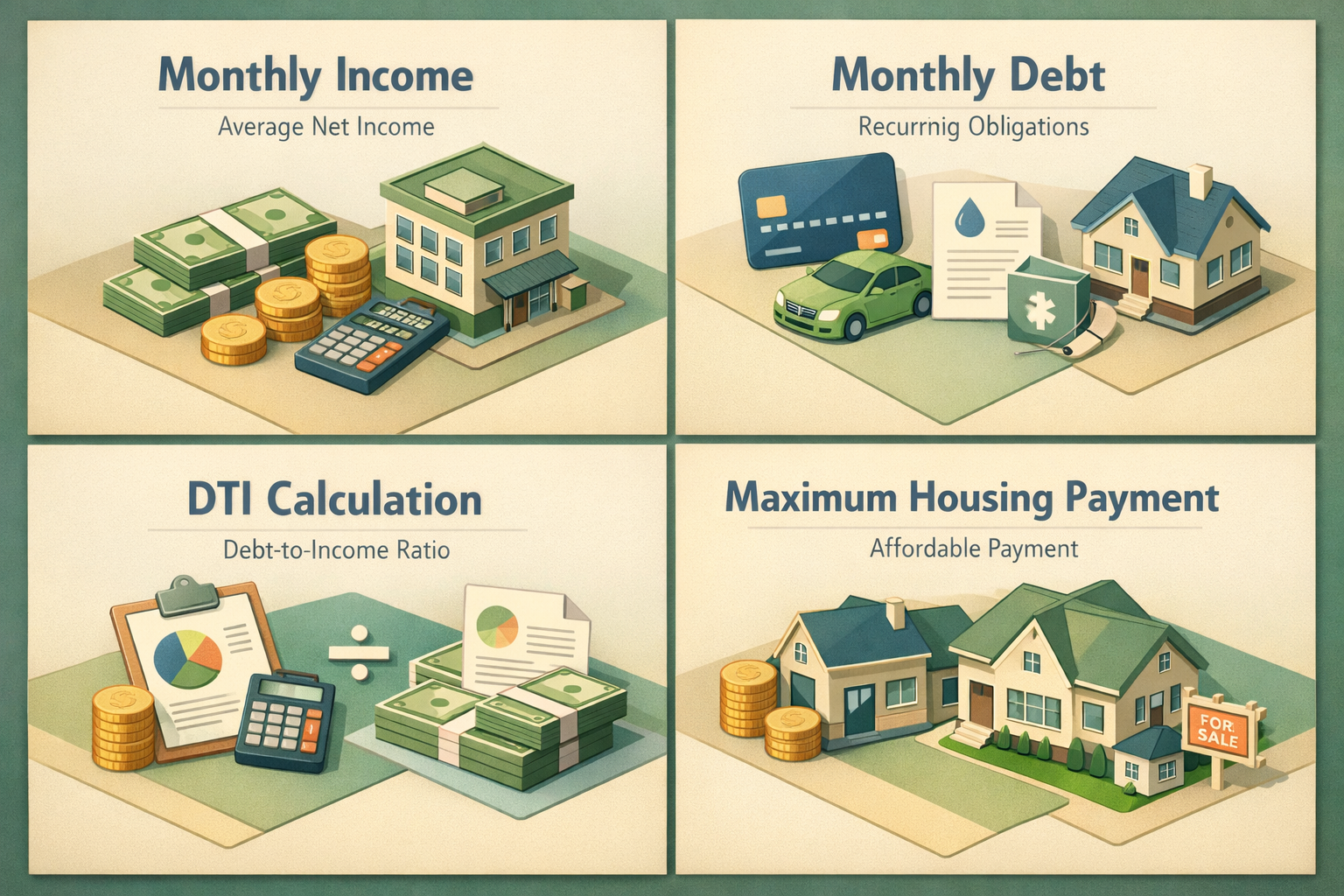
Knowing how to calculate mortgage affordability with part-time gig income and existing student loans means working through a few key figures methodically. Here's a practical framework to estimate your buying power before you speak with a lender:
Step 1: Determine Your Qualifying Monthly Income
Add your average net monthly income from all sources. For gig income, use the net figure from your last two years of tax returns, averaged together. If you also have W-2 income, add that gross monthly amount. Divide the annual net gig income total from both years by 24 to get your monthly qualifying figure.
Step 2: List All Monthly Debt Payments
Write down every recurring monthly debt obligation. This should include student loan payments, car loans, minimum credit card payments, personal loans, and any other installment or revolving debt. Do not include utilities, subscriptions, or expenses that don't appear on your credit report.
Step 3: Calculate Your Available DTI Room
Multiply your qualifying monthly income by 0.43 (or the DTI limit applicable to your target loan program). Subtract your total monthly non-housing debts from that figure. The remainder is approximately the maximum monthly housing payment a lender may be willing to approve.
Step 4: Use a Mortgage Affordability Calculator
Once you have your estimated maximum monthly payment, plug it into a mortgage affordability calculator — ideally one designed for gig economy borrowers or self-employed individuals. Enter your estimated payment, the current interest rate environment, your expected loan term, and estimated property taxes and insurance for your area. The calculator will give you a rough estimate of the purchase price range you may qualify for.
Step 5: Factor in Your Down Payment and Reserves
Your down payment affects your loan amount directly, and lenders may also require cash reserves after closing. A larger down payment reduces the loan balance, lowers your monthly payment, and may help offset a higher DTI ratio. If you're aiming for a conventional loan without private mortgage insurance (PMI), a 20% down payment is often the target, though programs with lower requirements do exist.
Loan Program Options That May Work Better for Gig Economy Borrowers
Not all loan programs treat non-traditional income the same way. Exploring your options can open doors that standard conventional loans might not.
- FHA Loans: Backed by the Federal Housing Administration, FHA loans may offer more flexibility on DTI ratios and credit scores. They require as little as 3.5% down for eligible borrowers and can be a good fit for first-time homebuyers with student loan debt, though mortgage insurance premiums apply.
- Conventional Loans (Fannie Mae/Freddie Mac): These programs have specific guidelines for self-employed and gig income documentation. Fannie Mae's guidelines, for example, include specific rules about how student loan payments in income-driven repayment plans are calculated in DTI.
- Bank Statement Loans (Non-QM): For gig workers whose tax returns underrepresent their actual cash flow, bank statement mortgage programs may offer an alternative path. These non-qualified mortgage (Non-QM) products typically use 12 to 24 months of bank statements to determine income, bypassing the need for tax returns. They often come with higher interest rates and stricter requirements, but they can be a viable option for the right borrower.
- USDA and VA Loans: If you're buying in a rural area and meet income limits, USDA loans offer zero-down financing. Veterans with gig income may also benefit from VA loan flexibility. Both programs have their own rules around income documentation.
Speaking with a loan officer who has experience with gig economy clients is strongly advisable. They can help you identify the program that best aligns with your income structure and financial profile.
Practical Strategies to Improve Your Mortgage Eligibility
If your current DTI or income documentation doesn't quite hit the mark, there are several strategies that may meaningfully improve your chances of approval:
- Pay down student loan balances strategically: Reducing your outstanding student loan balance or switching to a standard repayment plan that results in a lower monthly payment could reduce your DTI and increase your qualifying loan amount.
- Increase your documented income: If you have the ability to grow your gig work or take on a part-time W-2 position, doing so for at least 12 to 24 months before applying can boost your qualifying income. Consistency is key.
- Minimize new debt before applying: Avoid taking on new car loans, credit cards, or other debt obligations in the months leading up to your mortgage application. Even small new payments can reduce your DTI headroom.
- Build a stronger credit profile: A higher credit score may help you access better loan programs and rates, partially offsetting the challenges posed by irregular income. Pay all bills on time and keep revolving balances low.
- Save a larger down payment: A bigger down payment reduces the loan amount you need and demonstrates financial discipline to lenders. It may also help you avoid PMI and lower your monthly costs.
- Consider a co-borrower: Adding a creditworthy co-borrower with stable W-2 income can significantly strengthen the application by blending income sources and reducing the effective DTI.
●Conclusion
Figuring out how to calculate mortgage affordability with part-time gig income and existing student loans takes patience, planning, and the right guidance — but it's absolutely achievable for motivated buyers. The gig economy has changed the way millions of people earn a living, and the mortgage industry is slowly but steadily adapting. By understanding how lenders assess non-traditional income, how your student loans affect your DTI, and which loan programs may offer the most flexibility, you can walk into the homebuying process with confidence rather than uncertainty. Use a mortgage affordability calculator built for gig economy borrowers as a starting point, then connect with an experienced mortgage professional at LoanWise to map out a personalized strategy. Your path to homeownership may look a little different — but it's closer than you think.