
Holding an adjustable-rate mortgage while earning income from a foreign source puts you in a unique financial position. As interest rates shift, the appeal of locking in a fixed rate grows stronger — but the path to refinancing isn't always straightforward when your income comes from outside the United States. Lenders typically require additional documentation, and not every loan program is designed with international earners in mind. Fortunately, there are real options for refinancing ARM mortgage with foreign income, and understanding them can help you make a well-informed move. Whether you're a U.S. citizen living abroad, a foreign national working domestically, or a dual-income household with overseas earnings, this guide will walk you through what to expect and how to position yourself for success.
Understanding Adjustable-Rate Mortgages and Why Refinancing Makes Sense
An adjustable-rate mortgage, commonly called an ARM, starts with a fixed interest rate for a set introductory period — often five, seven, or ten years — before adjusting periodically based on a benchmark index. While ARMs can offer lower initial payments, they introduce long-term uncertainty. Once the adjustment period begins, your monthly payment could rise significantly depending on market conditions.
For homeowners earning income in foreign income currencies, this uncertainty can feel even more pressing. Exchange rate fluctuations combined with a rising mortgage rate could squeeze household budgets quickly. Refinancing your ARM into a fixed-rate mortgage is one way to eliminate that variable and bring more predictability to your finances. It may also be an opportunity to access home equity or reduce your overall interest costs if rates are favorable at the time of refinancing.
That said, refinancing does come with closing costs and qualification requirements. For borrowers with foreign income, the process typically involves more steps than a standard domestic refinance. Knowing what lenders look for is the first step toward a successful outcome.
How Lenders Evaluate Foreign Earned Income for Mortgage Qualification
When you apply to refinance ARM loan foreign earned income is one of the most scrutinized parts of your file. Lenders want to verify that your income is stable, consistent, and likely to continue. For domestically employed borrowers, this is relatively straightforward. For international earners, the process requires more documentation and sometimes more creativity.
Lenders will typically want to see:
- Two years of tax returns that reflect foreign income, including any IRS Form 2555 (Foreign Earned Income Exclusion) if applicable
- Employment verification from your foreign employer, often translated into English and sometimes notarized
- Bank statements showing consistent deposits, ideally in U.S. dollars or with clear currency conversion records
- Proof of continued employment or a contract showing ongoing income
One important consideration is the Foreign Earned Income Exclusion. If you file IRS Form 2555 and exclude a portion of your foreign income from U.S. taxes, some lenders may not count that excluded amount when calculating your qualifying income. This could affect your debt-to-income ratio and, in turn, how much you're able to borrow or whether you meet minimum income thresholds. It's worth discussing this nuance with a mortgage professional before you apply.
Currency risk is another factor lenders may weigh. If you earn in a foreign currency that fluctuates significantly against the U.S. dollar, a lender might apply a conservative conversion rate or request additional reserves to offset potential income volatility.
Loan Programs That May Work for Borrowers with Foreign Income
Not all loan programs treat foreign income the same way. Understanding which options might be available to you can save time and frustration during the application process.
Conventional Loans
Conventional loans backed by Fannie Mae or Freddie Mac do allow foreign income, but the lender must be able to verify it according to agency guidelines. Fannie Mae, for example, generally permits the use of foreign income if it can be properly documented and is expected to continue. The income must be converted to U.S. dollars, and the lender may require additional steps to confirm its stability. This can be a viable path for borrowers with a strong credit profile and clear income history.
Non-QM (Non-Qualified Mortgage) Loans
Non-QM loans are designed for borrowers who don't fit neatly into standard lending guidelines. These programs often offer more flexibility in how income is documented and verified. For borrowers with complex income situations — including foreign earned income that's difficult to document in traditional ways — a non-QM lender might accept bank statement loans, asset depletion methods, or alternative income verification. The trade-off is typically a higher interest rate and larger down payment or equity requirement.
Foreign National Loan Programs
If you are not a U.S. citizen or permanent resident, you may qualify under a foreign national mortgage program. These specialty programs are offered by select lenders and portfolio lenders who hold loans in-house rather than selling them to secondary market investors. They often require higher down payments, larger reserves, and may carry higher rates, but they can open doors that conventional programs close.
Jumbo Loans
For higher-value properties, jumbo loans may be an option. Some jumbo lenders are more flexible with income documentation because they set their own underwriting guidelines rather than following agency standards. If your home value exceeds conforming loan limits, a jumbo refinance with a lender experienced in international income documentation could be worth exploring.
Key Documentation Steps to Strengthen Your Refinance Application
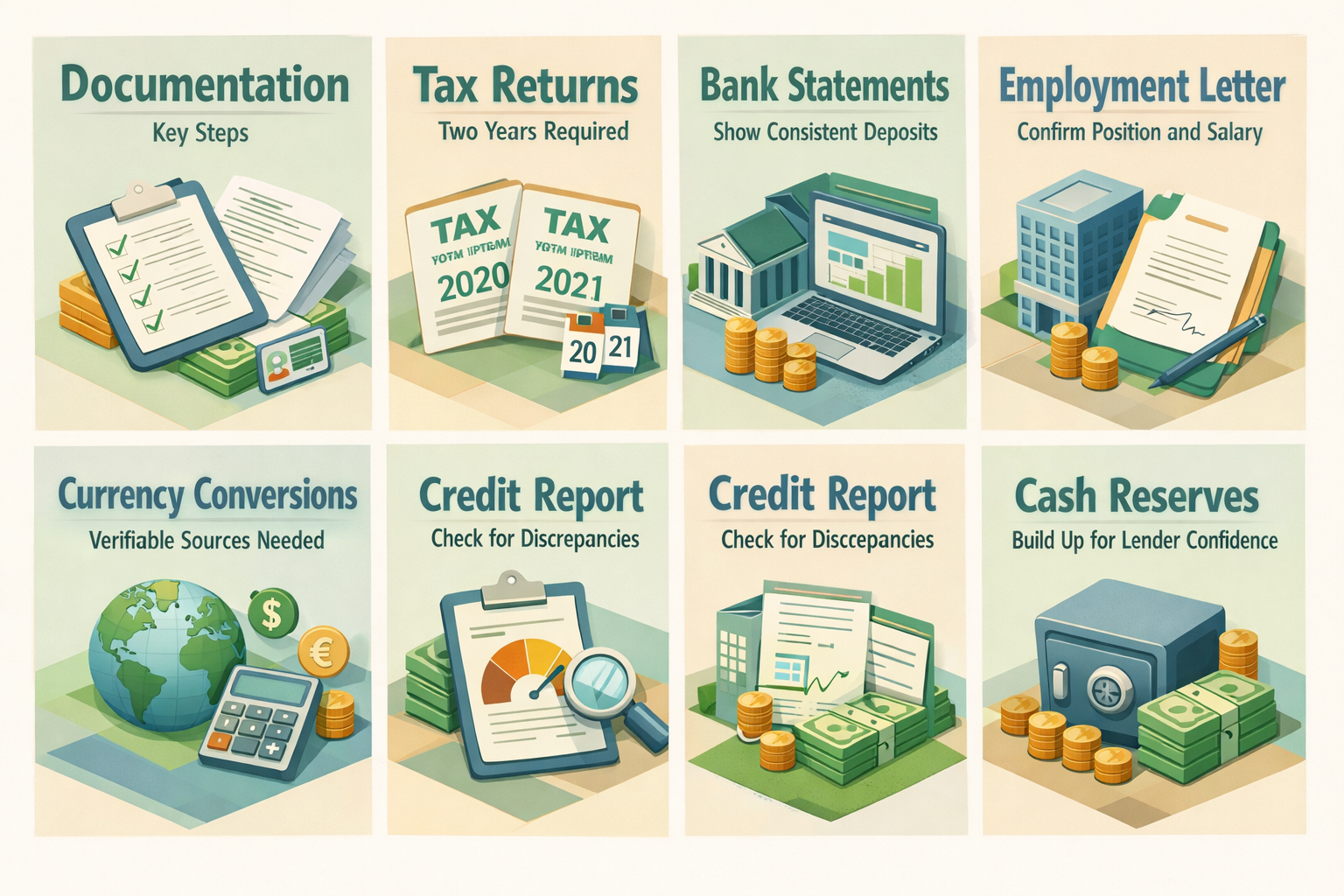
Preparation is one of the most powerful tools you have when pursuing options for refinancing ARM mortgage with foreign income. Lenders respond well to organized, thorough documentation that tells a clear and consistent financial story. Here's how to put your best foot forward:
- Organize two to three years of tax returns, including all foreign income schedules, and have them translated if they're in another language
- Compile at least 12 to 24 months of bank statements from all accounts, highlighting recurring income deposits and showing adequate reserves
- Request a letter from your employer confirming your position, salary, and the expected continuity of your employment — ideally on company letterhead with contact information for verification
- Document currency conversions using consistent, verifiable exchange rate sources so lenders can calculate your U.S. dollar equivalent income reliably
- Check your credit report in advance and address any discrepancies or outdated negative items that could affect your approval odds
- Build up cash reserves where possible, as lenders may require additional months of mortgage payments in reserve due to the perceived complexity of your income situation
Working with a mortgage broker who has experience placing loans for borrowers with international income can also be a significant advantage. They'll know which lenders are most receptive to your profile and can guide you through the specific requirements of each program.
How Your Debt-to-Income Ratio and Credit Score Play a Role
Regardless of where your income comes from, two financial metrics carry a lot of weight in any refinance application: your debt-to-income ratio (DTI) and your credit score.
Your debt-to-income ratio compares your monthly debt obligations to your gross monthly income. Most conventional lenders prefer a DTI below 43%, though some programs may allow higher ratios with compensating factors. If the Foreign Earned Income Exclusion reduces your qualifying income, your DTI could appear higher than it actually is in practical terms. This is one reason why working with a lender who understands international income nuances is so important — they may be able to count income that a less-experienced underwriter would overlook.
Your credit score is equally critical. A strong FICO score — generally 700 or above — demonstrates responsible credit behavior and can offset some of the perceived risk lenders associate with complex income documentation. If your credit score is lower, you may still qualify through non-QM channels, but expect higher rates and stricter reserve requirements.
It's also worth noting that if you have a limited U.S. credit history because you've spent time living abroad, some lenders may accept international credit references or use alternative methods to assess creditworthiness. This varies by lender, so it's best to ask upfront.
Timing Your Refinance and Weighing the Costs
Refinancing at the right time can make a meaningful difference in the long-term value of the transaction. While it's tempting to wait for the "perfect" rate, most financial advisors suggest focusing on the break-even point — the point at which your monthly savings from the new rate cover the closing costs you paid to refinance.
For example, if your closing costs total $6,000 and your new payment saves you $200 per month, your break-even point would be roughly 30 months. If you plan to stay in the home longer than that, refinancing likely makes financial sense. If you might sell or move sooner, the math may not work in your favor.
Closing costs for a refinance typically range from 2% to 5% of the loan amount, though this can vary based on your lender, loan type, and location. Some lenders offer no-closing-cost refinance options, where costs are rolled into the loan balance or offset by a slightly higher interest rate. For borrowers with foreign income who may already face higher rates due to program limitations, it's worth running the numbers carefully before choosing this route.
Currency considerations matter here too. If your income is in a foreign currency, a period of favorable exchange rates might make refinancing feel more affordable in real terms. While timing the currency market isn't a reliable strategy, being aware of how exchange rate shifts affect your effective income and savings is a smart part of the overall planning process.
●Conclusion
Navigating the options for refinancing ARM mortgage with foreign income requires a bit more legwork than a standard refinance, but it's far from impossible. The key is understanding how lenders view your income, which loan programs are designed to accommodate international earners, and how to present your financial profile in the clearest, most compelling way possible. From conventional loans with proper documentation to non-QM programs offering flexible verification methods, there are real pathways available. Start by gathering your documentation, reviewing your credit profile, and connecting with a mortgage professional who has experience in this area. With the right guidance and preparation, you can move from an adjustable-rate mortgage to a more stable loan structure — and gain greater peace of mind about your financial future.