
Buying a home is one of the most exciting milestones in life — but if your paycheck changes from month to month, the path to homeownership can feel a little less straightforward. Sales professionals, real estate agents, nurses, truck drivers, and countless other workers rely on commission income, overtime pay, or a combination of both. If that sounds like you, then knowing how to calculate mortgage affordability with commission-based overtime pay is an essential first step before you start house hunting. The good news is that lenders do consider variable income — they just have specific ways of evaluating it. Understanding their approach can help you set realistic expectations, prepare stronger documentation, and ultimately secure the home financing you deserve.
Why Variable Income Complicates the Affordability Picture
When a lender reviews your mortgage application, one of the first things they want to understand is how much reliable income you bring in each month. For salaried employees, that calculation is fairly simple — divide the annual salary by 12, and you have a stable monthly figure. But for borrowers who earn commissions or overtime, the math requires a bit more nuance.
Commission income and overtime pay are considered variable because they can fluctuate based on performance, market conditions, employer needs, or seasonal demand. A mortgage underwriter's job is to determine whether that income is likely to continue and whether it's consistent enough to support a monthly mortgage payment over the long term.
This doesn't mean variable earners are at a disadvantage — it simply means lenders use a different methodology to assess their financial capacity. Understanding that methodology is the foundation of learning how to calculate mortgage affordability with commission-based overtime pay.
- Commission income is typically earned when you close a sale, sign a contract, or hit a performance milestone. It may arrive in irregular amounts at irregular intervals.
- Overtime pay is income earned beyond your standard work hours. While it can be substantial, lenders want to see evidence that it's not just a one-time occurrence.
- Combined variable income may include both commissions and overtime together, which lenders will often evaluate as a blended figure.
The key takeaway here is that lenders are not trying to penalize variable earners — they're simply trying to paint an accurate picture of your financial stability. With the right documentation and a clear understanding of the process, many commission-based and overtime earners qualify for competitive home loans.
How Lenders Calculate Average Commission and Overtime Income
Most conventional lenders, as well as those offering FHA and VA loans, follow guidelines that require a two-year history of commission or overtime income before it can be used to qualify for a mortgage. This is a standard benchmark across many loan programs, though some lenders may have slightly different requirements.
Here's how the average income calculation typically works:
- Step 1 — Gather your W-2s and tax returns: Lenders will review your W-2 forms and federal tax returns for the past two years to identify your commission and overtime earnings.
- Step 2 — Add up total variable income: They'll combine your commission and overtime earnings across both years to get a total figure.
- Step 3 — Divide by 24 months: That total is divided by 24 to arrive at a monthly average. This monthly figure is what gets added to your base salary when calculating your qualifying income.
For example, if you earned $18,000 in commissions and overtime during Year 1 and $22,000 during Year 2, your total variable income over two years would be $40,000. Divided by 24 months, your lender might credit you with approximately $1,667 per month in variable income on top of your base pay.
It's worth noting that if your variable income has been declining year over year, some lenders may use the lower of the two years — or may not count it at all — because a downward trend may suggest that the income is not stable or likely to continue. On the other hand, a rising trend in commissions or overtime is generally viewed positively and may support your application.
Using a mortgage calculator commission overtime tool can help you estimate how much home different income scenarios affect your maximum loan amount, monthly payment, and debt-to-income ratio before you even speak to a lender.
Understanding the Debt-to-Income Ratio and How It Applies to You
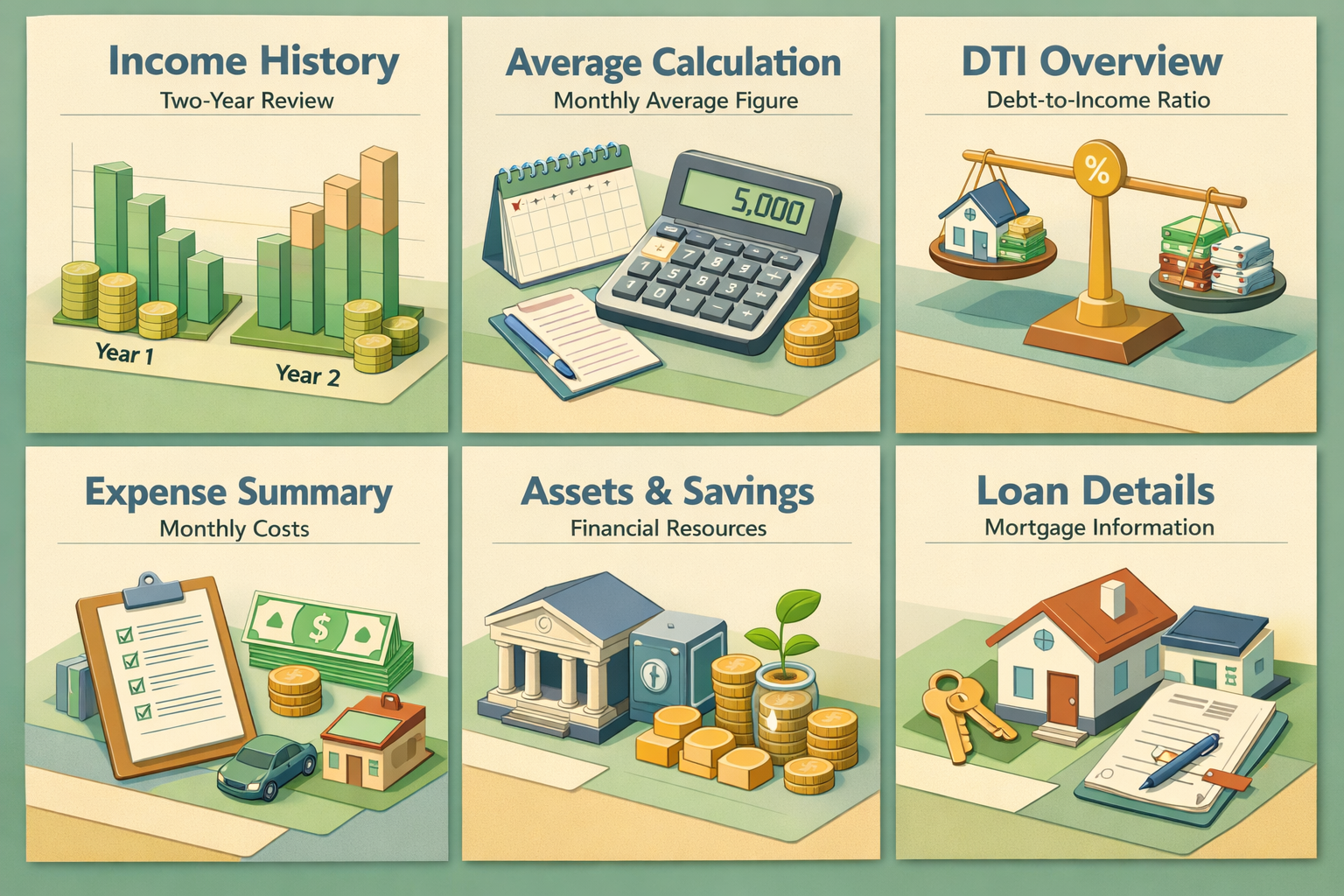
One of the most important metrics in mortgage affordability is the debt-to-income ratio, commonly called DTI. This ratio compares your total monthly debt obligations to your gross monthly income — and it plays a central role in determining how much home you can afford.
DTI is typically expressed as two numbers:
- Front-end DTI: This represents your proposed monthly housing costs (principal, interest, taxes, insurance, and HOA fees if applicable) divided by your gross monthly income.
- Back-end DTI: This includes your total monthly housing costs plus all other recurring debt payments (car loans, student loans, credit cards, etc.) divided by your gross monthly income.
Most conventional loan programs generally prefer a back-end DTI of 45% or below, though some programs may allow higher ratios under certain conditions. FHA loans tend to be somewhat more flexible. The exact threshold can vary depending on the lender, the loan program, and your overall credit profile.
Here's a simplified example: Suppose your base salary gives you $4,000/month in qualifying income, and your averaged commission and overtime income adds another $1,667/month. Your total qualifying income would be approximately $5,667/month. If your existing debts total $500/month, a lender targeting a 43% back-end DTI might allow a maximum total monthly debt of around $2,437 — leaving roughly $1,937 for your housing payment.
Knowing your DTI target helps you work backwards to estimate your maximum loan amount — and that's precisely what how to calculate mortgage affordability with commission-based overtime pay is all about.
Documentation You'll Need to Support Your Variable Income Claim
Preparation is one of the most powerful tools in a commission-based borrower's toolkit. Lenders want to see clear, consistent evidence that your variable income is real, recurring, and likely to continue. Having strong documentation ready can speed up your approval and reduce back-and-forth with underwriters.
Here's what you'll typically need to provide:
- Two years of W-2 forms from your employer, clearly showing commission and overtime line items.
- Two years of federal tax returns, including all schedules. If you also have self-employment income or freelance commissions, Schedule C may be relevant.
- Recent pay stubs covering at least the past 30 days, showing your year-to-date earnings — including the breakdown between base pay and variable compensation.
- A verification of employment (VOE) letter from your employer, ideally confirming that commission or overtime income is expected to continue.
- Commission agreement or employment contract, if available, which can clarify the structure of your compensation plan.
If you're a high earner whose commissions push your taxable income down significantly due to business deductions (common among self-employed sales professionals), it's especially important to work with a lender who understands how to interpret tax returns for variable-income borrowers. Some lenders specialize in non-QM or specialty loan programs designed for exactly this type of borrower profile.
Being organized and proactive with your documentation tells lenders that you're a serious, responsible borrower — which can work in your favor throughout the underwriting process.
Using a Mortgage Calculator for Commission and Overtime Scenarios
Online mortgage calculators are a great starting point for understanding your potential buying power before you meet with a lender. A mortgage calculator commission overtime scenario can help you model different income combinations and see how they affect your estimated loan amount and monthly payment.
Here's how to use a basic mortgage affordability calculator effectively when you have variable income:
- Enter your base monthly income: Start with just your guaranteed base salary converted to a monthly figure.
- Add your averaged variable income: Using the two-year averaging method described earlier, add your estimated monthly commission and overtime average to your base figure.
- Input your monthly debts: Include all recurring debt payments — car loans, student loans, minimum credit card payments, and any other obligations.
- Adjust for down payment and interest rate: Experiment with different down payment amounts and interest rate assumptions to see how each variable shifts your affordability range.
- Check the DTI output: A good calculator will show you whether your estimated housing payment keeps you within a reasonable DTI range.
Keep in mind that online calculators provide estimates — not guarantees. Actual lender decisions depend on your full credit profile, the specific loan program, and how the underwriter interprets your income documentation. That said, running these numbers in advance gives you a realistic benchmark and helps you walk into lender conversations with confidence.
It's also worth modeling a conservative scenario — one where you only count your base salary — to understand your floor-level affordability. This can help you identify a purchase price range that remains comfortable even in months when commissions are lower than average.
Tips to Strengthen Your Mortgage Application as a Variable Income Earner
Beyond understanding the math, there are several strategic steps you can take to improve your chances of approval and potentially qualify for a larger loan amount.
- Build a strong credit score: Since variable income can raise questions for underwriters, a high credit score — typically 700 or above — can serve as a positive counterbalance and may help you qualify for better interest rates.
- Reduce existing debt before applying: Paying down credit card balances or eliminating a car payment can lower your DTI and free up room for a higher mortgage payment.
- Save a larger down payment: A down payment of 20% or more eliminates the need for private mortgage insurance (PMI) and reduces your monthly costs. It also signals financial stability to lenders.
- Maintain employment consistency: If possible, avoid changing jobs or switching from a salaried position to a purely commission-based role in the months before applying. Lenders value stability and continuity of employment.
- Work with an experienced mortgage professional: Not all lenders treat commission and overtime income the same way. A mortgage advisor who has worked with variable-income borrowers will know which loan programs and underwriting approaches best fit your situation.
- Consider a co-borrower: If a spouse or partner has stable W-2 income, adding them to the loan application could strengthen your qualifying income and improve your overall DTI picture.
These steps may not all apply to every borrower, but even implementing two or three of them could meaningfully improve your mortgage readiness.
●Conclusion
Understanding how to calculate mortgage affordability with commission-based overtime pay doesn't have to feel overwhelming. While variable income adds a layer of complexity to the mortgage qualification process, it's a well-established scenario that experienced lenders navigate every day. By knowing how lenders average your income, what documentation they require, and how your DTI shapes your buying power, you can approach the homebuying process with clarity and confidence.
Whether you're a sales professional, a healthcare worker logging overtime shifts, or anyone whose paycheck varies from month to month, your path to homeownership is very much achievable. Start by gathering your income records, run the numbers using a mortgage calculator commission overtime tool, and reach out to a knowledgeable mortgage advisor who can help you find the right loan program for your unique situation. At LoanWise, we're here to help you turn your income — in all its forms — into the keys to your new home.