
Earning a commission-based income offers plenty of financial rewards, but it can also create real challenges when you're trying to refinance your home. If you currently have an adjustable-rate mortgage (ARM) and your paycheck varies month to month, you might be wondering whether refinancing is even possible. The good news is that it often is — you just need to understand how lenders look at your income and which loan programs are best suited for your situation. This guide walks through the key options for refinancing an ARM mortgage with fluctuating commission income, so you can approach the process with confidence.
Why Refinancing an ARM Makes Sense for Commission Earners
An adjustable-rate mortgage can feel like a smart choice when rates are low, but as market conditions shift, the unpredictability of both your rate and your income can create serious financial pressure. Commission earners — including real estate agents, mortgage brokers, sales professionals, and financial advisors — already manage income that rises and falls with business cycles. Adding an ARM that adjusts periodically can make monthly budgeting even harder.
Refinancing into a fixed-rate mortgage could help stabilize your housing costs. With a predictable monthly payment, you're better positioned to manage the natural highs and lows of a commission-based career. Even if today's fixed rates are higher than your current ARM rate, the long-term stability may be worth the trade-off — especially if your ARM is approaching an adjustment period that could push your rate significantly higher.
Beyond payment stability, refinancing may also allow you to tap into home equity, reduce your loan term, or eliminate private mortgage insurance (PMI) if your home's value has increased. For commission earners who've seen strong earning years, a well-timed refinance could align your mortgage structure with your broader financial goals.
How Lenders Evaluate Fluctuating Commission Income
One of the biggest hurdles when you refinance ARM mortgage with commission income is how lenders assess your qualifying income. Unlike salaried borrowers who can hand over a pay stub, commission earners often need to provide more documentation and demonstrate income consistency over time.
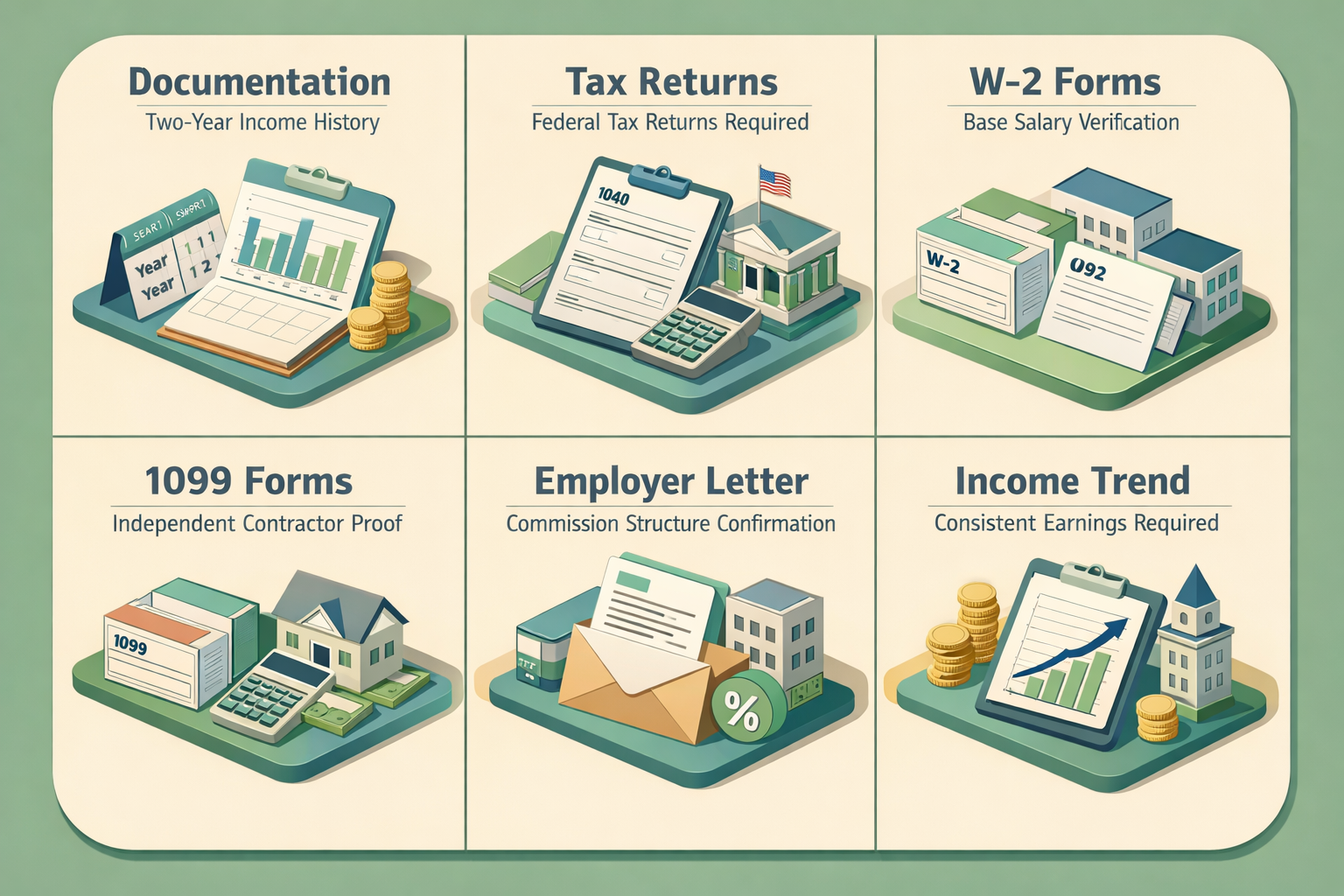
Most conventional lenders typically require a two-year history of commission income to consider it stable enough for qualification. They'll usually average your earnings over those two years using your federal tax returns and, in some cases, year-to-date profit-and-loss statements. If your income has been trending downward, lenders may use the lower figure or decline the application altogether — even if your most recent year was strong.
Here's what lenders commonly look for when evaluating commission-based borrowers:
- Two years of federal tax returns showing commission income
- W-2 forms if you receive any base salary alongside commissions
- 1099 forms if you're classified as an independent contractor
- Year-to-date earnings statements or a current pay stub
- Employer verification letter confirming your commission structure is likely to continue
- Consistent or increasing income trend over the two-year review period
It's worth noting that lenders may also scrutinize business-related deductions on your tax returns. Heavy write-offs — common among self-employed commission earners — can reduce your stated income and affect your debt-to-income (DTI) ratio, which is a key factor in loan approval.
Conventional Refinance: A Solid Path When Documentation Is Strong
If you have a solid two-year income history and your tax returns reflect healthy earnings, a conventional refinance through Fannie Mae or Freddie Mac may be a viable route. These programs typically offer competitive rates and flexible term options — from 10 to 30 years — which gives you room to tailor the loan to your budget.
To qualify, you'll generally need a credit score of at least 620, though higher scores tend to unlock better rates. Your DTI ratio should ideally fall below 45%, though some programs may allow slightly higher ratios with compensating factors like significant cash reserves or a strong credit history.
Commission earners who've had two consecutive strong income years and minimal deductions on their returns may find conventional refinancing straightforward. However, if your income fluctuates widely or you claimed significant deductions, you might need to explore alternative programs.
Non-QM Loans: Flexible Options for Refinancing ARM Mortgage With Fluctuating Commission Income
Non-qualified mortgage (Non-QM) loans have become an increasingly popular solution for borrowers whose income doesn't fit neatly into traditional lending boxes. These are one of the most relevant options for refinancing an ARM mortgage with fluctuating commission income when standard documentation requirements are difficult to meet.
Non-QM lenders may accept alternative forms of income verification, which can be a major advantage for commission-based borrowers. Some common Non-QM income documentation methods include:
- Bank statement loans: Lenders average 12 to 24 months of personal or business bank deposits to estimate qualifying income, bypassing traditional tax returns entirely.
- Profit-and-loss statement loans: A CPA-prepared P&L may be accepted in place of full tax returns, which can be helpful if your returns show heavy deductions.
- Asset depletion loans: If you've accumulated significant savings or investment assets, some lenders may allow those assets to be converted into a projected monthly income stream for qualification purposes.
- 1099-only loans: Designed specifically for 1099 contractors and commission earners, these programs may use only your 1099 earnings to qualify without requiring full tax returns.
Non-QM loans do tend to carry higher interest rates than conventional products, reflecting the additional risk lenders assume with alternative documentation. However, for borrowers who cannot qualify through traditional channels, they can provide a meaningful path to rate stability and a fixed monthly payment.
FHA Streamline Refinance: A Simplified Option Worth Considering
If your current ARM is an FHA-insured loan, you may be eligible for an FHA Streamline Refinance. This program is designed to make refinancing easier and faster by reducing the documentation requirements compared to a standard refinance. In many cases, full income verification may not be required at all — which can be a significant benefit for commission earners with complex income histories.
To use the FHA Streamline program, you generally need to meet these conditions:
- Your current mortgage must already be FHA-insured
- You must be current on your mortgage payments with a strong on-time payment history
- The refinance must result in a net tangible benefit — typically a lower rate, lower payment, or a move from an ARM to a fixed-rate loan
- You cannot take cash out through this program
Because income documentation requirements are reduced, the FHA Streamline can be an attractive option for commission earners who might struggle to show qualifying income on paper but have been reliably paying their mortgage. It's worth discussing with your lender whether this path is available to you.
VA and USDA Interest Rate Reduction Refinance Loans for Eligible Borrowers
If you're a qualifying veteran, active-duty service member, or surviving spouse, the VA Interest Rate Reduction Refinance Loan (IRRRL) — sometimes called a VA Streamline — offers a similar simplified path. Like the FHA Streamline, it typically requires limited income documentation and no appraisal in most cases. The goal is simply to refinance your existing VA loan into a lower rate or more stable payment structure.
For borrowers in rural or eligible suburban areas with a USDA loan, the USDA Streamlined Assist Refinance may offer comparable benefits. Both programs focus on reducing the borrower's financial burden without requiring the full documentation stack of a conventional refinance.
For commission earners who qualify for these programs, they can represent some of the most accessible refinancing options available — especially when income documentation might otherwise complicate the process.
Practical Steps to Strengthen Your Refinance Application
Regardless of which program you pursue, there are several steps you can take to improve your chances of a successful refinance:
- Maintain clean tax returns: While deductions reduce your tax burden, they also reduce your qualifying income. Consider discussing the trade-off with a tax advisor before filing.
- Build cash reserves: Having six to twelve months of mortgage payments in a savings or investment account signals financial stability and may help offset income variability in lenders' eyes.
- Improve your credit score: Paying down revolving debt and avoiding new credit applications before refinancing can meaningfully boost your score and qualify you for better rates.
- Reduce your DTI ratio: Paying off smaller debts — like a car loan or credit card balance — before applying can improve your debt-to-income ratio and expand your program options.
- Work with a knowledgeable mortgage broker: A broker who specializes in non-traditional borrower profiles may have access to lenders and programs that retail banks simply don't offer.
- Document income consistency: Even if your earnings fluctuate, showing a pattern of consistent deposits and responsible financial management can build a compelling case for approval.
Timing also matters. If you're approaching an ARM adjustment date, it may be worth accelerating your refinance timeline to lock in a fixed rate before your payment increases. Acting proactively gives you more negotiating room and avoids the urgency of a last-minute application.
●Conclusion
Navigating the options for refinancing an ARM mortgage with fluctuating commission income may feel overwhelming at first, but the right strategy can make the process manageable. Whether you qualify for a conventional refinance, a Non-QM bank statement loan, or a streamlined government program, there are meaningful paths forward for commission-based homeowners. The key is understanding how lenders view your income, preparing your documentation carefully, and working with professionals who understand the unique challenges of variable-pay borrowers. At LoanWise, we're here to help you find the financing solution that fits your life — not just your pay stub. Connect with one of our lending specialists today to explore your refinance options.