
Carrying an adjustable-rate mortgage while earning commission-based income can feel like balancing two moving targets at once. Your monthly payment could shift just as your paycheck fluctuates — and that combination can create real financial stress. The good news is that there are solid options for refinancing ARM mortgage with commission-based income, and many homeowners in this situation successfully make the move to more stable financing each year. Whether you're a real estate professional, a sales executive, or a self-employed borrower whose earnings vary by season, this guide walks you through what lenders look for, which loan programs may fit your profile, and how to position yourself for approval.
Understanding Why ARM Refinancing Matters for Commission Earners
An adjustable-rate mortgage starts with a fixed introductory period — often three, five, seven, or ten years — and then adjusts periodically based on a market index. When that adjustment period arrives, your rate and payment can increase meaningfully. For a borrower with a steady salary, a modest rate increase might be manageable. For someone whose income rises and falls with commission cycles, that same increase could create a real cash-flow problem.
That's why so many commission-based earners look to refinance out of their ARM before the adjustment window opens. Locking in a fixed rate provides payment predictability, which is especially valuable when your take-home pay isn't predictable month to month. A fixed-rate loan lets you plan your household budget around a stable mortgage obligation, even during slower earning periods.
Beyond payment stability, refinancing can potentially lower your overall interest costs if market rates have moved in your favor since you first closed your loan. Even if rates haven't dropped dramatically, the peace of mind that comes with a fixed payment may outweigh a slightly higher rate for many commission-based homeowners.
How Lenders Evaluate Commission-Based Income for Mortgage Qualification
This is where commission earners often run into friction. Conventional mortgage guidelines — including those set by Fannie Mae and Freddie Mac — typically require lenders to average your commission income over a two-year period. Lenders will generally ask for your two most recent years of federal tax returns, W-2s, and recent pay stubs to establish a qualifying income figure.
If your commission income has been consistent or trending upward over those two years, qualification tends to be more straightforward. However, if your earnings dipped in one year — even temporarily — lenders may use the lower figure, or they might average the two years together, which could reduce your qualifying income. A declining income trend can raise additional concerns for underwriters.
It's also worth noting that many commission earners write off business expenses on their tax returns, which is smart tax planning but can reduce the net income that shows up on paper. Lenders using tax returns look at adjusted gross income or a calculated net figure, not your gross commission total. That gap between what you earn and what appears on your return can sometimes limit your qualifying loan amount.
Self-employed commission earners — such as independent real estate agents or independent contractors — may face additional documentation requirements, including business bank statements, a CPA letter verifying self-employment, and profit-and-loss statements.
Exploring Your Options for Refinancing ARM Mortgage with Commission-Based Income
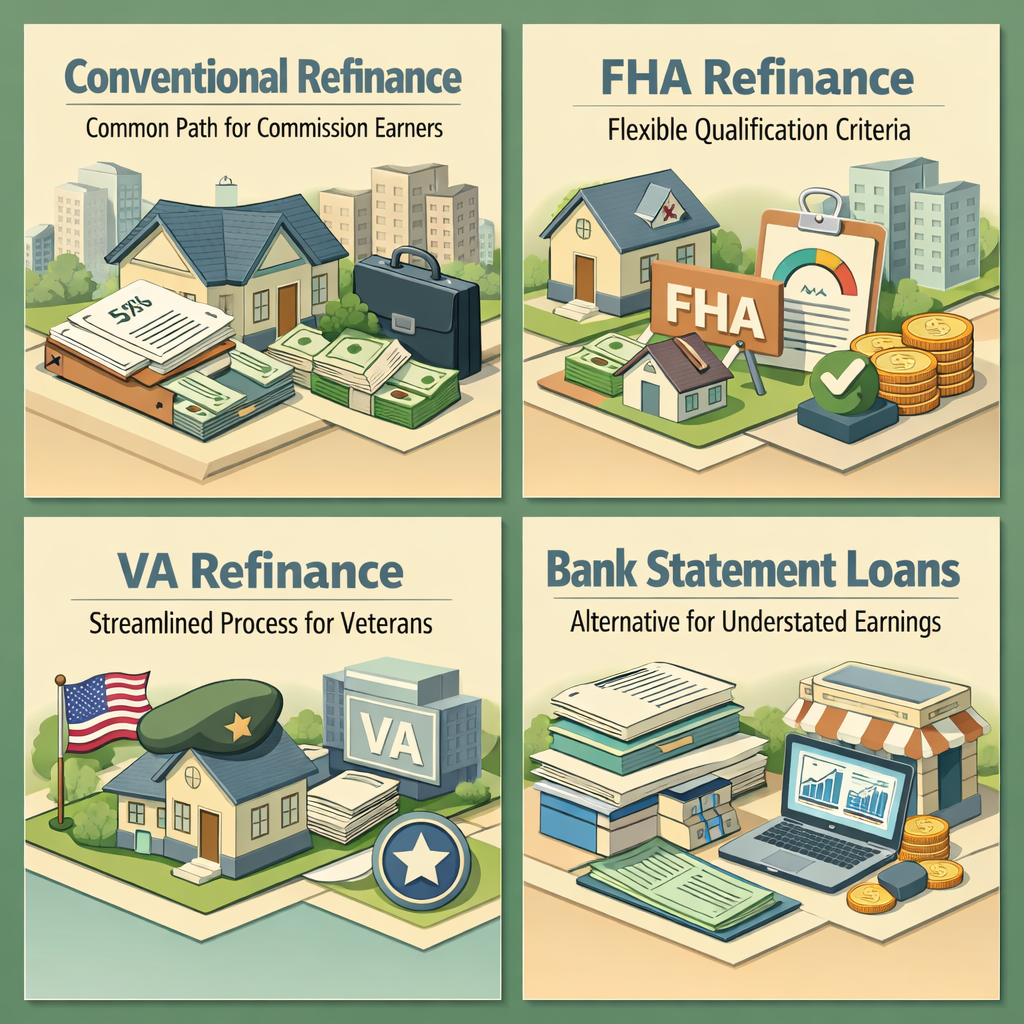
The good news is that multiple loan programs may accommodate your income type. The right fit depends on your documentation, credit profile, home equity, and how much flexibility your lender offers.
Conventional Fixed-Rate Refinance
A conventional refinance into a 15-year or 30-year fixed-rate mortgage is the most common path for commission earners who can document two years of income via tax returns. If your averaged income meets the debt-to-income requirements — which conventional guidelines typically cap around 43% to 50% depending on compensating factors — you may qualify for competitive rates without needing specialty programs.
FHA Refinance
An FHA streamline or standard FHA refinance could be an option if your original mortgage is already FHA-insured. FHA loans tend to allow slightly more flexible qualification criteria, including a higher allowable debt-to-income ratio in some cases. For commission earners with moderate credit scores or higher debt loads, FHA may open doors that conventional underwriting closes.
VA Refinance (IRRRL or Cash-Out)
If you're an eligible veteran or active-duty service member, the VA Interest Rate Reduction Refinance Loan — commonly called an IRRRL — can be one of the simplest refinancing paths available. The IRRRL often requires minimal income documentation since it's a streamlined product. For eligible borrowers, this could be a particularly efficient way to move from an ARM to a fixed-rate VA loan.
Bank Statement Loans and Non-QM Programs
For commission earners whose tax returns understate their true earnings due to deductions, bank statement loan programs — often called non-QM or non-qualified mortgage products — may offer a workable alternative. These programs typically use 12 to 24 months of personal or business bank statements to calculate income rather than relying on tax returns. While interest rates on non-QM products are generally higher than conventional rates, they can make refinancing accessible when standard documentation falls short.
Strengthening Your Refinance Application as a Commission Earner
Regardless of which program you pursue, there are several strategies that may improve your chances of approval and help you secure a better rate when you refinance ARM mortgage commission earnings.
- Build your credit score before applying. Most loan programs reward higher credit scores with lower rates and more favorable terms. Paying down revolving debt and avoiding new credit inquiries in the months before you apply could give your score a meaningful boost.
- Reduce your debt-to-income ratio. Because commission income can be averaged or adjusted downward during underwriting, your qualifying income may be lower than expected. Paying off installment loans or reducing credit card balances can help bring your DTI within acceptable guidelines.
- Increase your home equity position. Refinancing with at least 20% equity allows you to avoid private mortgage insurance on conventional loans, which lowers your monthly payment and strengthens your overall application.
- Maintain consistent documentation. Lenders want to see that your commission income is stable and likely to continue. A letter from your employer confirming your compensation structure, recent pay stubs showing year-to-date earnings, and a strong two-year income history all help build the lender's confidence.
- Work with a lender experienced in commission income. Not all loan officers are equally familiar with how to structure a file for variable-income borrowers. Choosing a lender who regularly works with sales professionals, realtors, or self-employed borrowers can make a significant difference in how your application is presented to underwriting.
Timing Your ARM to Fixed Rate Refinance Around Your Income Cycle
Timing matters more for commission earners than for salaried borrowers, because the income figures lenders use reflect a snapshot of your recent financial history. If possible, apply for your ARM to fixed rate commission income refinance during or shortly after a strong earning period. When your most recent year of tax returns shows strong commission income, your averaged qualifying income is more likely to meet lender thresholds.
Conversely, applying immediately after a slow year — even if you've recently recovered — may result in a lower qualifying income figure. If you know a strong year is behind you and your taxes have been filed, that's often a good window to move forward with your refinance application.
It's also worth monitoring interest rate trends. While no one can predict exactly where rates will move, refinancing while rates are relatively favorable compared to your current ARM rate makes the most financial sense. If your ARM is approaching its first adjustment and rates have softened, acting before the adjustment could lock in a meaningfully better long-term rate.
Common Pitfalls to Avoid When Refinancing with Variable Earnings
Commission-based borrowers sometimes run into avoidable obstacles during the refinancing process. Being aware of these upfront can save time and frustration.
- Applying too soon after a career change. If you recently moved to a commission-based role from a salaried position — or switched industries — lenders may not have enough history to average your new income. Many programs require at least two years in the same line of work to count commission earnings fully.
- Overlooking the impact of business write-offs. Heavy deductions reduce your taxable income, which is great for your tax bill but can hurt your qualifying income. Consider speaking with a mortgage professional before tax season to understand how your deduction strategy affects your refinancing options.
- Ignoring closing costs. Refinancing comes with costs — typically ranging from 2% to 5% of the loan amount — and recouping those costs takes time. Make sure the monthly savings from your new rate justify the upfront investment, especially if you plan to sell or relocate within a few years.
- Skipping a rate lock. Once you've found favorable terms, locking your rate protects you from market movement during the processing period. Commission earners who are focused on a busy selling season sometimes neglect this step, only to see rates shift before closing.
●Conclusion
Navigating the options for refinancing ARM mortgage with commission-based income takes a bit more planning than a standard refinance, but it's absolutely achievable with the right preparation and the right lending partner. From conventional fixed-rate programs to FHA, VA, and non-QM bank statement products, there are multiple pathways designed to accommodate borrowers whose income doesn't fit a simple salary mold. The key is understanding how lenders view your earnings, organizing your documentation carefully, and timing your application strategically. At LoanWise, we work with commission-based homeowners every day to find refinancing solutions that match their unique financial picture. Connect with a LoanWise mortgage specialist today and take the first step toward a more stable, predictable mortgage payment — no matter how your income flows.