For many veterans and active-duty service members, the VA loan program is one of the most powerful home financing tools available. It offers no down payment, competitive interest rates, and flexible qualification standards. But what happens when your financial picture includes an inherited property or child support obligations? Understanding how to qualify for a VA loan with inherited property and child support is essential for veterans who want to make the most of their hard-earned benefit. This guide walks you through the key eligibility rules, how lenders evaluate these unique financial circumstances, and what steps you can take to improve your chances of approval.
Understanding VA Loan Eligibility Basics
Before diving into the specifics of inherited property and child support, it helps to understand the foundation of VA loan eligibility. The Department of Veterans Affairs guarantees a portion of each loan issued by approved private lenders, which allows those lenders to offer more favorable terms to qualifying borrowers.
To be eligible, you typically need to meet one of the following service requirements:
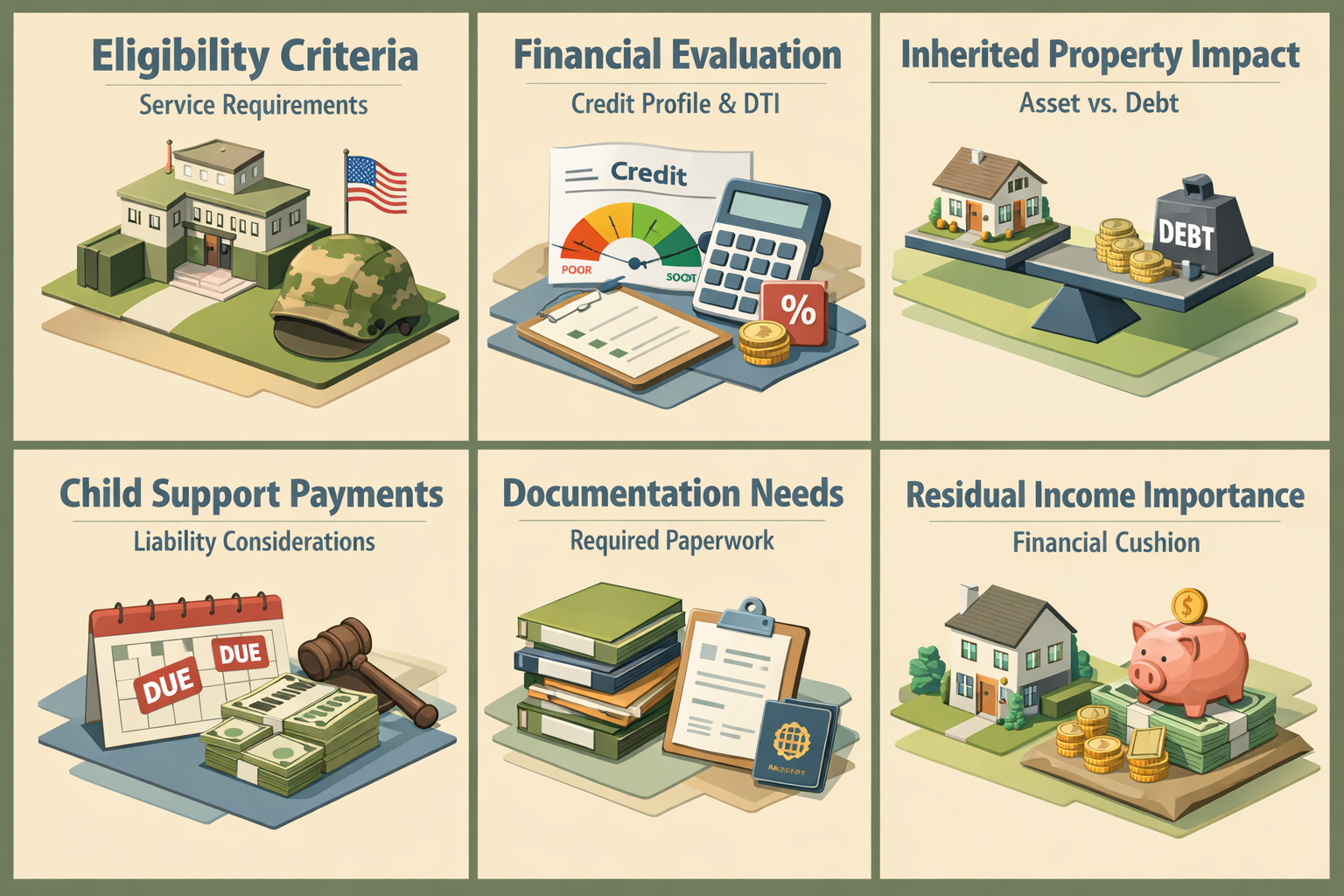
- 90 consecutive days of active service during wartime
- 181 days of active service during peacetime
- Six or more years of service in the National Guard or Reserves
- You are the surviving spouse of a service member who died in the line of duty or from a service-related disability
Beyond service history, lenders will evaluate your credit profile, debt-to-income (DTI) ratio, residual income, and employment history. VA loans don't have a strict minimum credit score set by the VA itself, though most lenders prefer a score of at least 620. The program is designed to be flexible, but lenders still apply their own overlays and standards during underwriting.
Understanding these baseline requirements sets the stage for how inherited property and child support fit into the bigger picture of your loan application.
How Inherited Property Affects Your VA Loan Application
Inheriting a property can be both a financial opportunity and a complicating factor when you're applying for a VA loan eligibility review. Lenders look at inherited property from several angles, and the impact it has on your application depends largely on how the property is being used and whether it carries any financial obligations.
When Inherited Property Works in Your Favor
If you've inherited a property free and clear — meaning there's no mortgage or lien attached — it may strengthen your overall financial profile. Owning real estate outright can be viewed as a positive asset, potentially boosting your net worth and demonstrating financial stability. In some cases, if the inherited property generates rental income, that income may also be counted toward your qualifying income, provided you can document it properly.
To use rental income from an inherited property, lenders will typically want to see:
- A signed lease agreement showing rental terms
- Recent bank statements reflecting consistent rental deposits
- A history of receiving the income, often for at least 12 to 24 months
- A property appraisal or tax records to verify ownership
When Inherited Property Could Complicate Things
On the other hand, if the inherited property still carries a mortgage, that debt will likely be counted as part of your monthly obligations. This can raise your DTI ratio, which measures how much of your gross monthly income goes toward debt payments. VA guidelines generally prefer a DTI at or below 41%, though exceptions may be made for borrowers with strong residual income.
Additionally, if you're inheriting the property jointly with siblings or other family members, only your share of any rental income or debt obligation would typically be factored into the loan calculation. It's important to work with a VA-approved lender who understands how to document and evaluate these nuanced situations.
Child Support Obligations and VA Loan Eligibility Child Support Rules
Child support is one of the most common financial obligations that can affect a VA loan application. Whether you're the one paying child support or receiving it, the rules differ — and understanding both sides is critical when exploring VA loan eligibility child support considerations.
If You Pay Child Support
Child support payments you're obligated to make are treated as a recurring monthly liability. This means lenders will add your monthly child support payment to your total debt load when calculating your DTI ratio. If you have significant child support obligations, this could reduce the loan amount you qualify for or make it harder to meet DTI thresholds.
Here's what lenders will typically want to verify:
- A copy of the court order or divorce decree specifying the support amount
- Evidence that payments are being made on time, such as bank statements or payment receipts
- The remaining duration of the obligation, especially if it's close to ending
It's worth noting that if child support payments are set to end soon — typically within 10 to 12 months — some lenders may choose not to count them as a recurring liability, which could help your DTI ratio. Always ask your lender about their specific policy on this.
If You Receive Child Support
On the flip side, if you receive child support, that income may be used to help you qualify for a larger loan amount. However, it must meet certain documentation standards. Lenders will generally require:
- A court order or legal agreement showing the support obligation
- Proof that you've been receiving consistent payments, typically for the past 12 months
- Evidence that the payments are likely to continue for at least three years into the future
Consistency and documentation are key. If payments have been sporadic or undocumented, lenders may not be able to count the income, even if you've been receiving it for years. Working with a knowledgeable lender can help you gather the right paperwork and present your income in the strongest possible way.
How to Qualify for VA Loan with Inherited Property and Child Support: Putting It All Together
When you combine the complexity of inherited property with child support obligations, the application process can feel layered. But veterans in this situation aren't without options. Knowing how to qualify for a VA loan with inherited property and child support comes down to preparation, documentation, and choosing the right lender.
Here are some practical strategies to strengthen your application:
- Get your documents organized early. Whether it's a deed for the inherited property, a lease agreement, court orders for child support, or bank statements, having everything ready speeds up the underwriting process and reduces delays.
- Work with a VA-experienced lender. Not all lenders handle VA loans the same way. A lender who specializes in VA financing will be better equipped to navigate the nuances of inherited property income, partial ownership situations, and child support obligations.
- Improve your residual income position. VA loans place significant weight on residual income — the money left over after all monthly obligations are paid. If your DTI is elevated due to child support or a mortgage on inherited property, strong residual income can still help you qualify for VA loan approval.
- Pay down other debts if possible. Reducing credit card balances or other installment loans before applying can lower your DTI and offset the impact of child support or property-related liabilities.
- Consider how the inherited property will be used. If you plan to sell the inherited property, the proceeds could be used to pay off debts or fund closing costs. If you plan to rent it, document the income trail carefully.
It's also worth requesting a VA Certificate of Eligibility (COE) early in the process. This document confirms your entitlement and is required before a lender can finalize your loan. You can obtain it through the VA's eBenefits portal, through your lender, or by mail.
The Role of Residual Income in Strengthening Your VA Loan Case
One of the features that sets VA loans apart from conventional and FHA financing is the residual income requirement. Rather than relying solely on a DTI ratio, VA underwriters also check whether you have enough money left over each month after paying all major expenses — including housing, taxes, and recurring debts like child support.
The VA sets minimum residual income thresholds based on loan size, family size, and region of the country. For example, a family of four in the Western United States may be held to a different standard than a single borrower in the Midwest. While specific thresholds can vary and lenders may apply their own standards, the concept is straightforward: the VA wants to make sure you have a cushion to cover everyday living expenses without financial strain.
This requirement can actually work in your favor if your income is strong. Even if your DTI ratio is slightly above the preferred 41% due to child support payments, a lender may still approve your loan if your residual income comfortably exceeds the minimum threshold. This is one reason why working with a VA specialist matters — they can help you see the full picture of your qualifying strength rather than focusing on a single metric.
Veterans who receive disability compensation may also benefit from the fact that VA disability income is typically non-taxable, which means it's grossed up for qualifying purposes in many cases, boosting its apparent value in the income calculation.
Common Mistakes to Avoid When Applying with These Financial Factors
Even well-prepared borrowers can run into trouble during the VA loan process if they're not careful. Here are some common missteps to watch out for when navigating inherited property and child support situations:
- Failing to disclose the inherited property. Lenders will discover real estate holdings during underwriting. Attempting to omit an inherited property — even one you share with family members — can raise red flags and delay or derail your application.
- Not documenting rental income properly. If you're using rental income from an inherited property to qualify, incomplete or inconsistent documentation can cause that income to be excluded entirely. Make sure lease agreements are current and bank statements clearly show deposits.
- Assuming child support won't be counted. Some borrowers are surprised to learn that even informal child support arrangements can affect their application. If you have a court order, lenders are required to account for it.
- Not checking if support obligations are expiring soon. If your child support payments are winding down, alert your lender. Some lenders may not count obligations that are ending within the next 10 to 12 months, which could significantly improve your DTI.
- Skipping pre-approval. Getting pre-approved before house hunting gives you a realistic picture of what you can afford and reveals any documentation gaps before they become deal-breakers.
By staying proactive and transparent throughout the process, you're much more likely to reach the closing table without unnecessary complications.
●Conclusion
Qualifying for a VA loan when you have an inherited property and child support obligations is absolutely achievable — but it does require a thoughtful, well-documented approach. The VA loan program was designed with veterans in mind, and its flexible guidelines around residual income and debt evaluation make it one of the more accommodating home financing options available today. By understanding how lenders view your inherited property, how child support payments factor into your DTI and income calculations, and how to build a strong overall financial case, you can move forward with confidence. If you're ready to explore your options, connect with a VA-approved lending specialist at LoanWise who can help you navigate these unique circumstances and find the right path to homeownership.