
For veterans and active-duty service members, the VA loan is one of the most powerful home financing tools available. It offers competitive interest rates, no down payment requirements, and no private mortgage insurance. But what happens when a borrower wants to purchase a home with someone who isn't a U.S. citizen or permanent resident? Understanding how to qualify for a VA loan with co-borrower foreign national is a topic that doesn't get nearly enough attention, yet it matters deeply for military families with international ties. Whether you're married to a foreign national spouse, co-purchasing with a non-citizen partner, or simply exploring your options, this guide will walk you through what the rules typically look like, where the challenges arise, and what you can do to improve your chances of approval.
The Basics of VA Loan Eligibility and Co-Borrower Rules
The VA loan program is administered by the U.S. Department of Veterans Affairs and is available to eligible veterans, active-duty service members, National Guard members, reservists, and surviving spouses. One of its most attractive features is that it doesn't require a down payment on qualifying loans, making homeownership more accessible for those who've served.
When it comes to co-borrowers, the VA has specific rules that can complicate things significantly. According to VA guidelines, the agency will only guarantee the portion of a loan that covers an eligible veteran's interest in the property. This means that if a non-veteran, non-military co-borrower is added to the loan, the VA guarantee may only apply to part of the total loan amount — not the full balance.
This limitation has real consequences. Lenders may require a down payment to cover the unguaranteed portion of the loan. For example, if a veteran and a civilian co-borrower each own 50% of the property, the VA may only guarantee the veteran's 50% share, leaving the other half exposed from the lender's perspective. The same principle generally applies when the co-borrower is a foreign national.
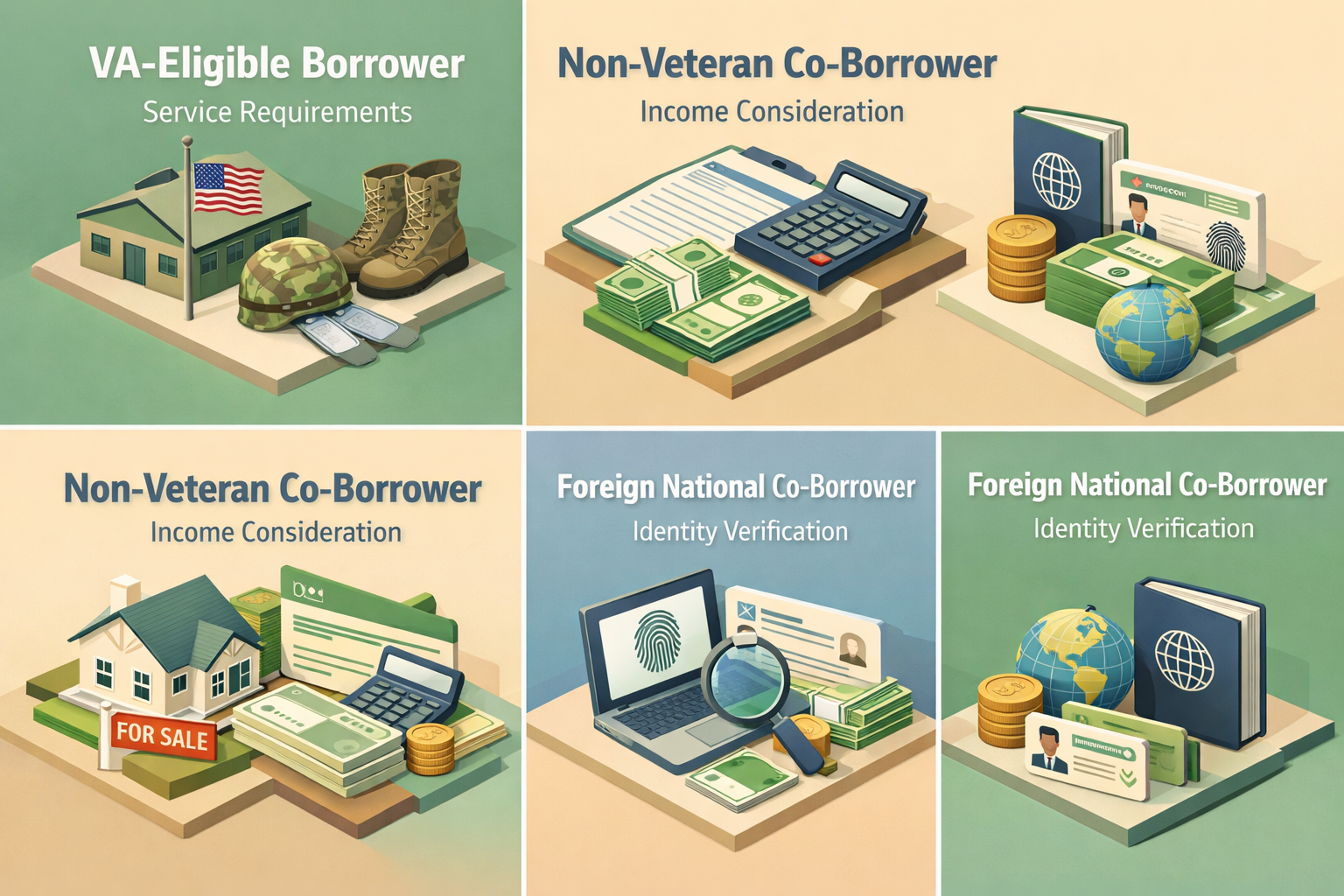
- VA-eligible borrower: Must meet service requirements, have a valid Certificate of Eligibility (COE), and satisfy lender credit and income standards.
- Non-veteran co-borrower: Their income and credit are considered, but the VA guarantee may be reduced.
- Foreign national co-borrower: Adds an additional layer of complexity around identity verification, credit history, and lender willingness to approve the loan.
Why Foreign National Co-Borrowers Create Unique Lending Challenges
Adding a foreign national as a co-borrower on any mortgage — including a VA loan — introduces several hurdles that lenders must carefully evaluate. These challenges aren't insurmountable, but they do require preparation and the right lending partner.
Credit History Verification
Most foreign nationals don't have a U.S. credit history, which is the standard benchmark lenders use to assess creditworthiness. Without a Social Security Number or Individual Taxpayer Identification Number (ITIN), pulling a conventional credit report may not be possible. Some lenders may accept alternative documentation, such as international credit reports, bank statements, or rental payment histories, but this varies considerably from one lender to another.
Income Documentation
If your co-borrower earns income in a foreign currency or works for a foreign employer, documenting that income to U.S. lending standards can be complex. Lenders typically want to see stability, consistency, and verifiability. Foreign income may require additional documentation such as translated tax returns, employer letters, or certified financial statements.
Visa and Immigration Status
The co-borrower's legal status in the United States plays a significant role. Lenders generally distinguish between non-permanent resident aliens, permanent residents (green card holders), and non-resident foreign nationals. Each category carries different levels of risk from a lender's perspective, and VA loan guidelines don't fully address all of these scenarios, leaving much of the decision-making to individual lenders.
Lender Overlays
Even when the VA's own guidelines might technically permit a certain arrangement, many lenders impose their own additional requirements — known as overlays — that can restrict who they'll accept as a co-borrower. This means that some lenders may decline a foreign national co-borrower entirely, while others may have specific programs or flexibility to work with these situations.
How to Qualify for VA Loan with Co-Borrower Foreign National: Step-by-Step Guidance
Navigating this process requires a clear strategy. Here's a practical breakdown of the steps that may help you move forward successfully when a foreign national is involved in your VA loan application.
Step 1 — Confirm Your VA Eligibility
Before anything else, the veteran borrower should obtain their Certificate of Eligibility (COE) from the VA. This document confirms that you meet the service requirements necessary to access the VA loan benefit. You can request a COE through the VA's online portal, through your lender, or by mail.
Step 2 — Identify the Co-Borrower's Legal Status
Work with your lender to clearly establish your co-borrower's immigration and residency status. A foreign national who holds a green card or permanent resident status may be treated differently than someone on a temporary visa or with no U.S. residency. This distinction can significantly affect your options and the lender's willingness to proceed.
Step 3 — Gather Alternative Credit Documentation
If the foreign national co-borrower lacks a U.S. credit profile, start collecting alternative documentation early. This might include international credit reports from their country of origin, 12 to 24 months of bank statements showing consistent account activity, proof of on-time rental payments, or reference letters from foreign financial institutions.
Step 4 — Prepare Thorough Income Documentation
Foreign income needs to be documented carefully. Gather translated tax returns, pay stubs in the local currency with exchange rate documentation, employer verification letters, and any other evidence of stable, ongoing income. The lender will want to confirm that this income is likely to continue for at least three years.
Step 5 — Shop for a VA-Approved Lender with Foreign National Experience
Not every VA-approved lender has experience with foreign national co-borrowers. It's worth researching and comparing lenders who have handled similar situations before. A lender with this experience is more likely to know how to document the file properly and navigate VA underwriting successfully.
Step 6 — Understand the Down Payment Implications
Because the VA guarantee may only cover the eligible veteran's share of the loan, a down payment could be required to cover the unguaranteed portion. Discuss this clearly with your lender before proceeding so you can plan your finances accordingly.
VA Loan Co-Signer Requirements vs. Co-Borrower Rules Explained
There's an important distinction between a co-signer and a co-borrower, and understanding it can help you explore the right options for your situation.
A co-borrower is someone who shares legal ownership of the property and whose income and credit are used to qualify for the loan. They appear on both the mortgage and the title. A co-signer, on the other hand, agrees to take on responsibility for the debt if the primary borrower defaults, but they may not hold an ownership interest in the property.
VA loan co-signer requirements are distinct from what's allowed with a co-borrower. The VA generally does not permit non-occupying co-signers in the traditional sense. The program is designed specifically for veterans and, in joint loan scenarios, the VA's guarantee structure changes depending on who's on the loan.
When a non-veteran, non-military spouse is added as a co-borrower and they will occupy the property, lenders may be more flexible. However, when the co-borrower is a foreign national who may not be a permanent resident or who does not have strong U.S. financial ties, lenders tend to apply much stricter scrutiny. The international co-borrower mortgage landscape is nuanced, and it's essential to work with professionals who understand both VA guidelines and international lending complexities.
- Veteran + U.S. citizen spouse: Standard VA loan, full guarantee typically available.
- Veteran + permanent resident spouse: Often approved with proper documentation; lender policies vary.
- Veteran + non-resident foreign national: Most complex scenario; reduced VA guarantee and potential down payment required.
Strategies to Strengthen Your Application When a Foreign National Is Involved
Even when the path forward feels complicated, there are several strategies that may meaningfully improve your chances of a successful loan approval.
Build or Establish U.S. Credit for the Co-Borrower
If there's time before your home purchase, consider helping the foreign national co-borrower establish a U.S. credit profile. This could involve opening a secured credit card, becoming an authorized user on an existing account, or applying for a credit-builder loan. Even a limited credit history in the U.S. may make it easier for lenders to evaluate the co-borrower's financial responsibility.
Maximize the Veteran Borrower's Financial Profile
Since the VA loan is anchored by the eligible veteran's entitlement, strengthening the veteran's own credit score, income documentation, and debt-to-income ratio can make the overall application more competitive. A strong primary borrower profile may help offset some of the additional risk lenders perceive from a foreign national co-borrower.
Consider a Larger Down Payment
Offering a larger down payment — even beyond what may be required — can reduce the lender's exposure and demonstrate financial commitment. This may be especially helpful when the VA guarantee only covers part of the loan, as it reduces the overall risk on the unguaranteed portion.
Work with a HUD-Approved Housing Counselor
A HUD-approved housing counselor can help you understand your options, review your financial readiness, and guide you through the documentation process. This is particularly valuable when dealing with a non-standard lending scenario like a foreign national co-borrower VA loan.
Explore Portfolio Lenders
Portfolio lenders keep loans on their own books rather than selling them to the secondary market. This gives them more flexibility to approve non-standard applications. While they may not offer VA loan products directly, exploring their options alongside a VA loan could reveal creative financing solutions for your situation.
Common Misconceptions About Foreign Nationals and VA Loans
There's a lot of confusion surrounding this topic, and misinformation can lead borrowers to either give up prematurely or move forward with unrealistic expectations. Let's address some of the most common misconceptions.
"Foreign nationals can never be on a VA loan."
This isn't entirely accurate. While VA guidelines are restrictive and the process is more complex, it's not categorically impossible for a foreign national to serve as a co-borrower on a VA loan. It depends heavily on the lender, the co-borrower's status, and the specific circumstances of the loan.
"The VA guarantee always covers the full loan."
This is only true when all borrowers are eligible veterans or qualifying spouses. When a non-veteran co-borrower is added, the VA guarantee may be reduced to cover only the veteran's share, which can affect loan terms and down payment requirements.
"All VA lenders handle these situations the same way."
Lender overlays mean that policies can vary dramatically. One lender might decline a foreign national co-borrower outright, while another may have an established process for evaluating such applications. Shopping multiple lenders is not just advisable — it's often essential in these scenarios.
"The co-borrower's income won't be considered."
In most cases, if someone is listed as a co-borrower, their income and debts will be factored into the qualification analysis. This is actually beneficial when the foreign national co-borrower has a strong income, even if documenting it requires extra effort.
●Conclusion
Understanding how to qualify for a VA loan with co-borrower foreign national requires patience, preparation, and the right team of professionals on your side. The VA loan program remains one of the most valuable benefits available to those who've served our country, and that benefit doesn't disappear simply because a co-borrower has international roots. It does, however, require a more deliberate approach — from gathering alternative credit documentation and verifying foreign income, to finding a lender experienced with these unique scenarios.
If you or someone you love is navigating this situation, start by confirming your VA eligibility, understanding your co-borrower's legal status, and reaching out to lenders who specialize in complex VA loan cases. With the right guidance, many veterans in this position have found a path to homeownership. At LoanWise, we're committed to helping you explore every available option so you can make the most informed decision possible. Reach out to our team today to discuss your specific situation and get the expert support you deserve.