
Navigating the jumbo mortgage market can feel overwhelming, especially when your income comes from rental properties located outside the United States. Many lenders treat foreign income with extra scrutiny, and jumbo loans — which already carry stricter standards than conventional conforming mortgages — add another layer of complexity. The good news is that it's entirely possible to understand how to qualify for jumbo loan with foreign rental property income and US co-signer arrangements, as long as you know what lenders are looking for and how to prepare. This guide walks you through the core requirements, documentation strategies, and practical tips to strengthen your application from the start.
What Makes Jumbo Loans Different from Conventional Mortgages
A jumbo loan is a mortgage that exceeds the conforming loan limits set by the Federal Housing Finance Agency (FHFA). In most parts of the United States, any loan above $766,550 (as of recent guidelines) falls into jumbo territory, though high-cost areas may have higher thresholds. Because these loans can't be purchased by Fannie Mae or Freddie Mac, lenders assume the full risk — and they respond by setting significantly tighter qualification standards.
Unlike standard mortgages, jumbo loans typically require higher credit scores, larger down payments, lower debt-to-income (DTI) ratios, and more substantial cash reserves. Many lenders want to see at least 12 months of mortgage payments sitting in liquid accounts after closing. For borrowers with income sourced from foreign rental property income, these elevated benchmarks make thorough documentation even more critical.
It's also worth noting that jumbo lending isn't standardized the way conforming loans are. Each lender sets its own guidelines, which means requirements can vary meaningfully from one institution to another. This flexibility can actually work in your favor — some portfolio lenders and private banks are more experienced with international income profiles and may offer more accommodating terms.
Understanding How Lenders View Foreign Rental Property Income
Foreign rental income refers to money earned from residential or commercial properties located outside the US. While domestic rental income is relatively straightforward to verify — through tax returns, lease agreements, and bank statements — foreign rental income introduces several challenges that lenders must work through carefully.
First, lenders need to confirm that the income is stable, recurring, and likely to continue. Income from a rental property in another country may be subject to different legal frameworks, currency fluctuations, and tax treatment. Most US lenders will want to see a consistent two-year history of receiving this income before they'll consider using it to qualify a borrower.
Currency risk is another factor. If your rental income is denominated in a foreign currency, lenders may apply a conservative conversion rate or discount the income to account for exchange rate volatility. It's a good idea to speak with your lender upfront about which currency they'll use for calculations and whether they apply any haircut to the figures.
Some lenders — particularly those offering non-QM (non-qualified mortgage) or portfolio jumbo products — are more comfortable with foreign income than others. These lenders often have internal guidelines specifically designed for international borrowers, expatriates, and investors with global asset profiles.
Documentation You'll Likely Need for Foreign Income Verification
Preparing a thorough documentation package is one of the most important steps when applying for a jumbo loan using foreign rental property income. While exact requirements vary by lender, you should generally expect to gather the following:
- Lease agreements: Signed rental contracts in the country where the property is located, ideally translated into English by a certified translator.
- Bank statements: At least 12 to 24 months of bank records showing consistent rental deposits, ideally from an account in your name.
- Foreign tax returns: If the country where your property is located requires rental income reporting, providing translated copies of those tax filings can strengthen your case.
- Property appraisal or valuation: Some lenders may request a professional valuation of the foreign property to assess its legitimacy and market value.
- Evidence of property ownership: Title documents, deed copies, or equivalent legal proof of ownership translated into English.
- US tax returns: If you report foreign income on your US federal tax return — which many green card holders and citizens are required to do — this can serve as a strong verification tool.
The more organized and complete your documentation package is, the smoother the underwriting process is likely to be. Consider working with a mortgage advisor who has experience handling international income profiles before you submit your application.
The Role of a US Co-Signer in Strengthening Your Jumbo Loan Application
Adding a US-based co-signer to your jumbo loan application can meaningfully improve your chances of approval, particularly when your primary income source is foreign rental income. A co-signer — sometimes called a co-borrower in mortgage contexts — shares legal responsibility for the loan and allows the lender to evaluate a combined financial profile rather than relying solely on yours.
For lenders who are cautious about foreign income, a US co-signer offers several advantages. The co-signer typically has a domestic credit history, US-sourced income that's easy to verify, and a tax profile that aligns with standard underwriting expectations. This can help offset concerns the lender might have about currency risk, income continuity, or documentation gaps related to your foreign rental earnings.
However, it's important to understand that a co-signer takes on real financial responsibility. If you miss payments, the co-signer's credit score and financial standing will be affected. Both parties should fully understand the commitment before moving forward.
When selecting a co-signer, lenders will evaluate their credit score, income, existing debt obligations, and overall financial stability. A co-signer with a strong credit profile — generally 720 or higher for jumbo purposes — and low existing debt can make a meaningful difference in both approval odds and the interest rate offered. This is a key element of understanding how to qualify for jumbo loan with foreign rental property income and US co-signer arrangements.
Key Credit and Financial Benchmarks Jumbo Lenders Typically Expect
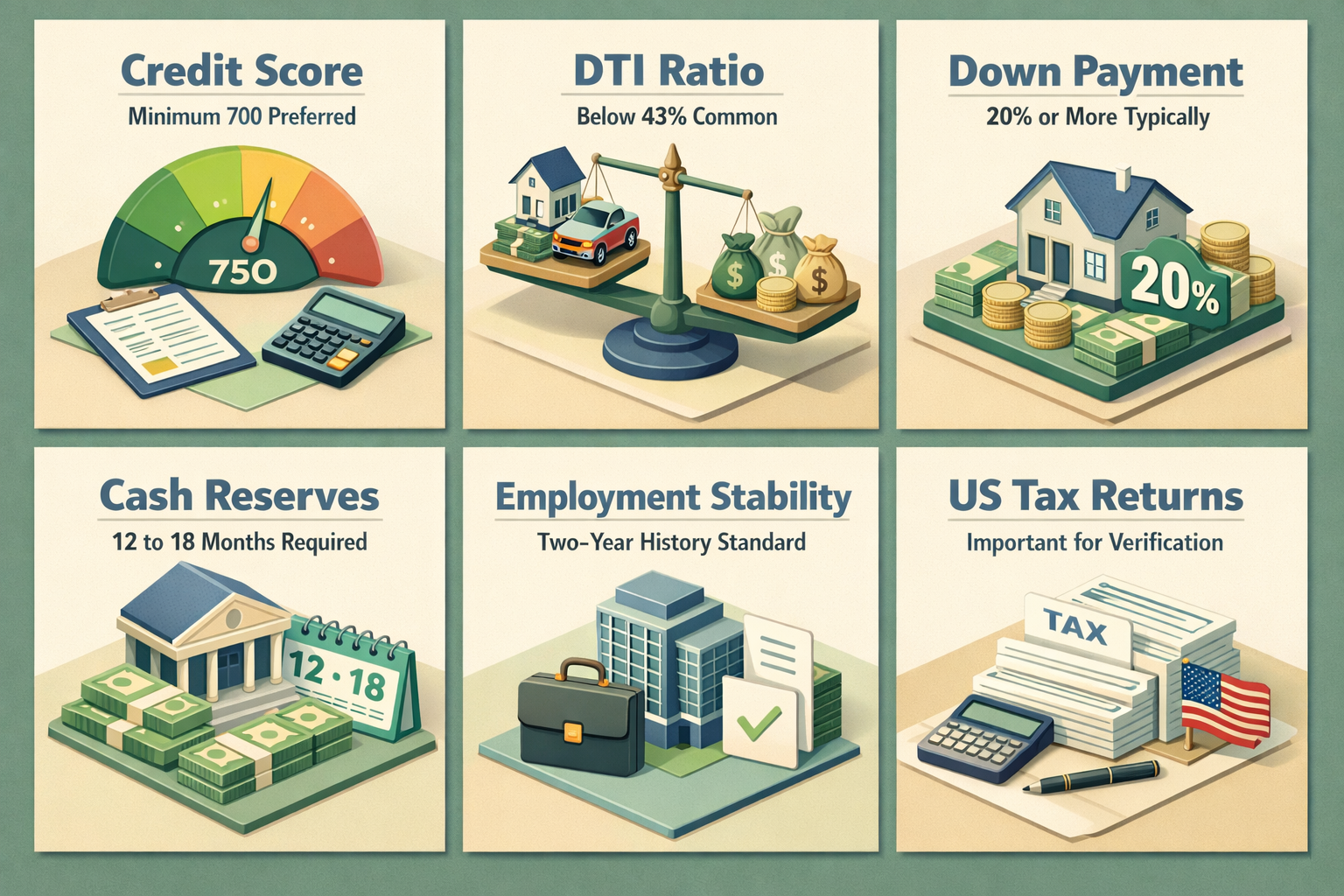
Whether you're applying alone or with a co-signer, you'll need to meet a set of financial benchmarks that are generally more demanding than those for standard home loans. Here's what many jumbo lenders look for:
- Credit score: Most jumbo lenders prefer a minimum credit score of 700, though many look for 720 or higher. Some non-QM jumbo products may accept scores in the 680 range, but the terms are likely to be less favorable.
- Debt-to-income ratio (DTI): A DTI below 43% is a common benchmark, though many lenders prefer 38% to 40% or lower for jumbo borrowers. If your foreign rental income is discounted or partially excluded, your DTI could be pushed higher than expected.
- Down payment: Jumbo loans commonly require a down payment of 20% or more, though some lenders may accept as little as 10% to 15% with compensating factors like strong reserves or a co-signer.
- Cash reserves: Lenders often require 12 to 18 months of mortgage payments in liquid reserves post-closing. Some may require more, especially when income sources are complex or international.
- Employment and income stability: Even with rental income, lenders generally want evidence of stable, ongoing income. A two-year history is the standard benchmark for self-employed and non-traditional income sources.
Meeting these benchmarks — or coming close with strong compensating factors — is essential to a successful jumbo application with foreign income in the mix.
Choosing the Right Lender for Your International Income Profile
Not all mortgage lenders are equipped to handle applications that involve foreign rental income. Traditional banks with rigid underwriting guidelines may decline these applications outright, while portfolio lenders, private banks, and non-QM lenders may welcome them with well-structured documentation.
Portfolio lenders are financial institutions that keep loans on their own books rather than selling them to the secondary market. Because they aren't bound by Fannie Mae or Freddie Mac guidelines, they have more flexibility to evaluate non-traditional income profiles. Many cater specifically to high-net-worth individuals, foreign nationals, and borrowers with complex financial situations.
Private banks and wealth management divisions of larger financial institutions also tend to have more sophisticated underwriting capabilities. If you have significant assets deposited with a bank, that relationship may open the door to more flexible jumbo lending terms — sometimes referred to as asset-depletion or asset-based qualifying.
Non-QM lenders offer another avenue. These lenders specialize in loans that fall outside standard qualified mortgage guidelines, and they often have specific programs for borrowers who earn foreign income, work abroad, or hold international investments. Rates may be slightly higher than traditional jumbo products, but approval is often more attainable for complex income profiles.
Working with a mortgage broker who has access to multiple lender options — including portfolio and non-QM products — could be especially helpful when your income profile doesn't fit neatly into conventional underwriting boxes.
Practical Strategies to Improve Your Jumbo Loan Approval Odds
Beyond gathering the right documents and selecting the right lender, there are several proactive steps that could meaningfully improve your chances of qualifying for a jumbo mortgage with foreign rental income. Here are some strategies worth considering:
- Build US credit history: If you have limited credit activity in the United States, start establishing it well before applying. Secured credit cards, US-based bank accounts, and small installment loans can help build a domestic credit profile.
- Report foreign income on US tax returns: If you're a US citizen, green card holder, or resident for tax purposes, reporting your foreign rental income on your federal tax return creates a paper trail that US underwriters can work with more comfortably.
- Reduce existing debt: Paying down outstanding balances before applying can lower your DTI ratio and make your overall financial picture more attractive to lenders.
- Increase your down payment: A larger down payment reduces the lender's risk exposure and may offset concerns about income documentation complexity.
- Maintain substantial liquid reserves: Demonstrating that you have significant cash or liquid assets available after closing signals financial strength and reduces perceived risk.
- Work with experienced professionals: A mortgage advisor, tax professional familiar with international income, and a real estate attorney who understands cross-border transactions can all help you navigate the process more effectively.
Understanding jumbo loan requirements foreign income US co-signer dynamics is much easier when you have a knowledgeable team guiding your application from start to finish. If you want to explore jumbo loan requirements foreign income in more detail, reviewing dedicated resources can help you prepare a stronger application.
●Conclusion
Qualifying for a jumbo loan when your income comes from foreign rental properties is genuinely achievable — but it does require thoughtful preparation, the right documentation, and the right lending partner. Adding a US co-signer with a strong financial profile can be a powerful tool for bridging the gap between your income profile and a lender's risk appetite. By understanding how to qualify for jumbo loan with foreign rental property income and US co-signer structures, you put yourself in a much stronger position to secure the high-value home financing you're looking for. At LoanWise, we're here to help you explore your options and connect with lenders who understand the nuances of international income. Reach out today to start the conversation.