
Losing a job is stressful enough on its own — but if you're trying to buy a home or refinance while navigating a career transition, the financial complexity can feel overwhelming. Two income sources that often come into play during this period are severance packages and 401k withdrawals. Both can provide meaningful cash flow in the short term, but lenders don't always treat them the way borrowers expect. Understanding how to calculate DTI with recent severance package and 401k withdrawal income is essential if you want to position yourself for mortgage approval. This guide breaks down what lenders look for, how the math works, and what you can do to strengthen your application.
What Is DTI and Why It Matters for Mortgage Approval
Your debt-to-income ratio (DTI) is one of the most important numbers a mortgage lender will review. It compares your total monthly debt obligations to your gross monthly income. The result, expressed as a percentage, helps lenders determine whether you can comfortably afford a new mortgage payment on top of your existing financial responsibilities.
DTI is typically calculated in two ways:
- Front-end DTI: This includes only your proposed housing costs — principal, interest, taxes, insurance, and any HOA fees — divided by your gross monthly income.
- Back-end DTI: This includes all monthly debt payments (housing, car loans, student loans, credit cards, etc.) divided by your gross monthly income.
Most conventional loan programs prefer a back-end DTI at or below 43%, though some programs may allow higher ratios depending on compensating factors. FHA loans can sometimes permit DTIs up to 50% or higher with strong credit and reserves. The key takeaway is that the higher your verified income, the lower your debt-to-income ratio — and the easier it is to qualify.
The challenge with severance pay and 401k withdrawals is that they're considered non-recurring or one-time income sources. This changes how — and whether — lenders will count them in your DTI calculation.
How Lenders View Severance Pay as Income
Severance packages are negotiated agreements between an employer and a departing employee. They may be paid as a lump sum or in regular installments over a set period of time. From a lender's perspective, the structure of your severance payment matters significantly.
Lump-Sum Severance
If you received your severance as a single lump-sum payment, most lenders will not count it as qualifying income for DTI purposes. This is because it doesn't represent a reliable, ongoing income stream. Lenders are looking for income that's likely to continue for at least two to three years into the future. A one-time payment typically doesn't meet that standard.
Installment-Based Severance
If your severance is being paid in regular monthly installments — similar to a salary — some lenders may consider including it in your income calculation, but only if the payments are documented and have a defined continuation period. Even then, most lenders may apply conservative treatment, requiring that the payments continue for at least three years beyond the closing date.
It's worth noting that lender guidelines vary. Some portfolio lenders or non-QM (non-qualified mortgage) programs may take a more flexible approach, especially if you have strong assets, solid credit history, and a documented severance agreement. Working with a knowledgeable loan officer who understands alternative income documentation could make a meaningful difference in your situation.
How 401k Withdrawals Factor Into Debt-to-Income Ratio Calculation With One-Time Income
A 401k withdrawal is another form of income that carries specific rules under mortgage underwriting guidelines. Like severance, the way lenders treat it depends largely on whether it's a one-time event or a structured, ongoing distribution.
One-Time 401k Withdrawals
If you took a single withdrawal from your 401k — perhaps to cover living expenses after a layoff or to fund a down payment — most traditional lenders will not count that amount as income for DTI purposes. The debt-to-income ratio calculation with one-time income is a common challenge for borrowers in career transitions, and 401k withdrawals are a prime example of why this gets complicated.
The funds may still matter in your application, but likely as assets rather than income. Lenders may look at your remaining 401k balance as a financial reserve, which can serve as a compensating factor when your income profile is less straightforward.
Ongoing 401k Distributions (Retirement Income)
The situation is different if you're taking regular, scheduled distributions from your retirement account — as retirees often do. Lenders are generally more willing to count systematic retirement distributions as qualifying income, particularly if you can document them over a consistent period (typically 12 to 24 months of bank statements or 1099-R forms). The distributions also need to be likely to continue for a reasonable period into the future.
If you're under age 59½ and taking early 401k withdrawals, you may also face a 10% IRS penalty on top of ordinary income taxes, which reduces the actual take-home value of that income and should be factored into your overall financial planning.
Step-by-Step: How to Calculate DTI With Recent Severance Package and 401k Withdrawal
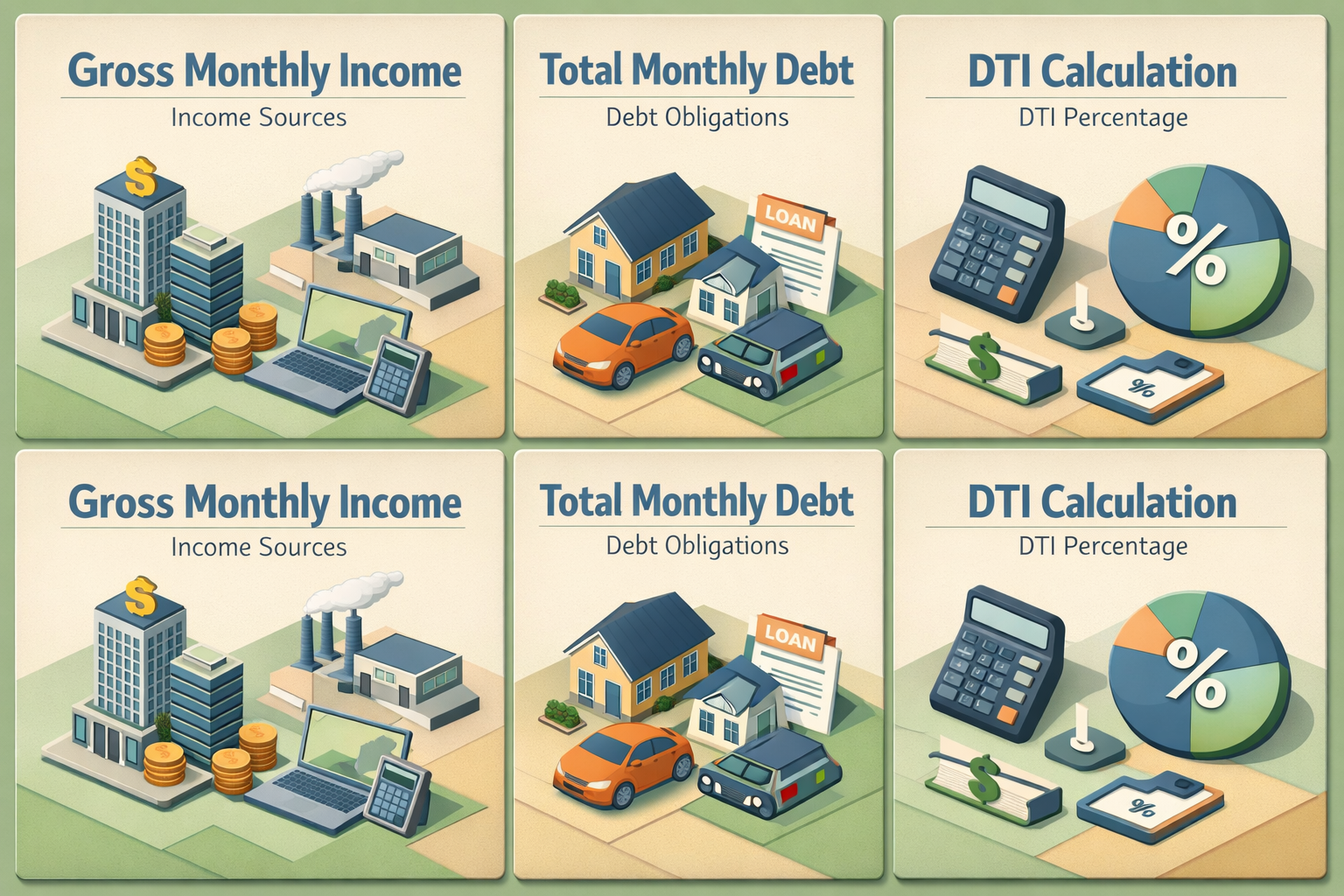
Understanding the mechanics behind the calculation helps you see exactly where your application stands. Here's a practical framework for working through how to calculate DTI with recent severance package and 401k withdrawal income in your own scenario.
Step 1 — Identify Your Gross Monthly Income
Start by listing all income sources a lender is likely to count. This may include:
- New employment income (if you've started a new job)
- Part-time or freelance income with a documented two-year history
- Rental income from investment properties (subject to underwriting rules)
- Social Security or pension income
- Alimony or child support (if documented and likely to continue)
- Ongoing 401k distributions (if structured and verifiable)
Add up only the income that your lender is likely to accept. For most borrowers using severance or 401k withdrawals as primary income, this is the hardest part of the calculation — and the most honest one.
Step 2 — Calculate Your Total Monthly Debt Obligations
List all monthly debt payments that appear on your credit report or that you're obligated to pay, including:
- Proposed mortgage payment (PITI + HOA)
- Car loan or lease payments
- Student loan payments
- Minimum credit card payments
- Personal loan payments
- Any other installment debts
Step 3 — Divide and Interpret
Divide your total monthly debt payments by your gross monthly income and multiply by 100 to get your DTI percentage. For example, if your verified monthly income is $5,000 and your total monthly debts (including your proposed mortgage) are $2,000, your DTI would be 40% — which may fall within qualifying range for many programs.
If your only income comes from a lump-sum severance or a one-time 401k withdrawal, you may find that your qualifying income is lower than you expected, which could increase your DTI beyond program limits. This is when exploring alternative loan programs or waiting until you have documented employment income may be the most practical path forward.
Compensating Factors That Can Strengthen Your Application
Even if your DTI is higher than lenders prefer due to non-recurring income, there are several compensating factors that may help your application. Lenders don't always make decisions based on a single number — they evaluate the overall risk profile of a borrower.
- Strong credit score: A credit score well above the minimum threshold for your loan program can help offset a less-than-ideal DTI.
- Significant cash reserves: If you have substantial assets in bank accounts, investment accounts, or retirement funds (beyond what you've withdrawn), lenders may view your application more favorably. Some programs allow asset depletion income calculations, where lenders divide your liquid assets over a set number of months to create a qualifying income figure.
- Large down payment: A higher down payment reduces the loan-to-value ratio, which may give the lender more confidence in the loan's risk profile.
- Documented job offer: If you've recently been laid off but have a signed offer letter from a new employer with a defined start date and salary, some lenders may use that future income to qualify you.
- Non-QM loan programs: Non-qualified mortgage programs are specifically designed for borrowers whose income doesn't fit traditional underwriting boxes. These may include bank statement loans, asset-based lending, or DSCR loans for real estate investors.
Documentation You'll Need to Support Your Income Claims
Lenders will want to verify every income source you claim. Being organized and proactive with your paperwork can speed up the underwriting process and reduce the likelihood of last-minute surprises. Here's what you'll likely need:
For Severance Income
- A copy of your severance agreement, signed by both parties
- Bank statements showing severance deposits
- A letter from your former employer confirming the amount and duration of payments
- Your most recent pay stubs or final pay statement
For 401k Withdrawals
- Your most recent 401k or retirement account statements
- 1099-R forms showing distributions for the past one to two years
- Bank statements confirming the deposits
- Documentation of the withdrawal type (hardship, regular distribution, rollover, etc.)
General Income Documentation
- Two years of federal tax returns (W-2s and 1040s)
- Recent pay stubs if you've started a new job
- Signed offer letter with salary details (if applicable)
Keep in mind that underwriting requirements can vary by lender, loan program, and investor. It's always worth confirming the exact documentation list with your loan officer before submitting your application.
●Conclusion
Navigating mortgage qualification during a period of career transition is challenging, but it's not impossible. The key is understanding that lenders evaluate income based on its reliability and continuity — not just its dollar value. Knowing how to calculate DTI with recent severance package and 401k withdrawal income gives you a realistic picture of where your application stands before you ever speak to an underwriter. Whether your income qualifies under traditional guidelines or you need to explore non-QM options, being informed puts you in a stronger position to make smart financial decisions. At LoanWise, we work with borrowers in all kinds of financial situations. Reach out to one of our experienced loan advisors to explore what mortgage options may be available to you — even if your income looks a little unconventional right now.