
Buying a home is one of the most significant financial decisions most people will ever make. For many first-time homebuyers, an FHA loan offers a more accessible path to homeownership — thanks to its flexible credit requirements and lower down payment thresholds. But what happens when a co-borrower is involved, carries deferred student loan debt, and earns part-time income? These are very real circumstances for millions of Americans, and understanding the requirements for FHA loan with co-borrower student loan deferment and part-time income can make the difference between approval and a missed opportunity. This guide breaks down the key guidelines, lender expectations, and practical strategies to help you navigate the process with confidence.
What Is an FHA Loan and Why Co-Borrowers Matter
An FHA loan is a government-backed mortgage insured by the Federal Housing Administration. It's designed to make homeownership more attainable for borrowers who may not qualify for conventional financing. FHA loans typically allow lower credit scores and smaller down payments — often as low as 3.5% — compared to conventional loan programs.
A co-borrower is someone who applies for a mortgage alongside the primary borrower and shares equal responsibility for repaying the loan. Adding a co-borrower can strengthen an application by combining incomes or offsetting credit weaknesses. However, the co-borrower's financial profile — including their debts and income sources — is fully evaluated by the lender, just like the primary borrower's.
This is where things can get nuanced. When a co-borrower has student loans in deferment and relies on part-time income, lenders must carefully assess how those factors influence the overall loan eligibility. It's not necessarily a deal-breaker, but it does require a thorough understanding of FHA guidelines and careful documentation.
Who Typically Benefits from a Co-Borrower Arrangement?
Co-borrower arrangements are common among:
- Recent graduates who are beginning their careers and may have part-time or entry-level employment
- Couples where one partner carries student loan debt from graduate or professional school
- Family members purchasing a home together to share housing costs
- First-time homebuyers who need additional income on the application to qualify for a larger loan amount
In each of these scenarios, the co-borrower's student loan status and employment type can significantly shape the application outcome.
How FHA Guidelines Handle Deferred Student Loans
One of the most frequently misunderstood areas of FHA lending involves deferred student loans. Many borrowers assume that if a student loan is in deferment — meaning no payments are currently required — it won't count against their debt-to-income (DTI) ratio. Unfortunately, that's not how FHA guidelines typically work.
Under current FHA policy, lenders are generally required to include a projected monthly payment for deferred student loans in the borrower's total monthly debt obligations, even if payments haven't started yet. If no actual payment amount is listed on the credit report, the lender may be required to calculate a hypothetical payment based on a percentage of the outstanding loan balance. This is commonly set at 1% of the total outstanding student loan balance per month, though lenders should always verify the most current HUD guidelines, as policies may be updated.
Why This Policy Exists
The rationale is straightforward: deferment is temporary. At some point, repayment will begin, and the FHA wants to ensure that borrowers — and their co-borrowers — can sustain mortgage payments once all debts become active. By accounting for future student loan payments upfront, lenders reduce the risk of borrowers becoming overextended when deferment ends.
For a co-borrower with a large student loan balance, this could meaningfully raise the household's total monthly debt obligation, potentially pushing the DTI ratio above acceptable thresholds. This is why understanding the numbers before applying is so important.
What Happens If the Co-Borrower Has an Income-Driven Repayment Plan?
If the co-borrower's student loans are on an income-driven repayment (IDR) plan with a documented monthly payment — even if that payment is zero — FHA lenders may be able to use that lower figure instead of the 1% calculation in some cases. Documentation from the loan servicer is typically required. Borrowers should consult their lender about current FHA guidelines on this, as interpretation and policy can vary.
Part-Time Income and FHA Loan Qualification Standards
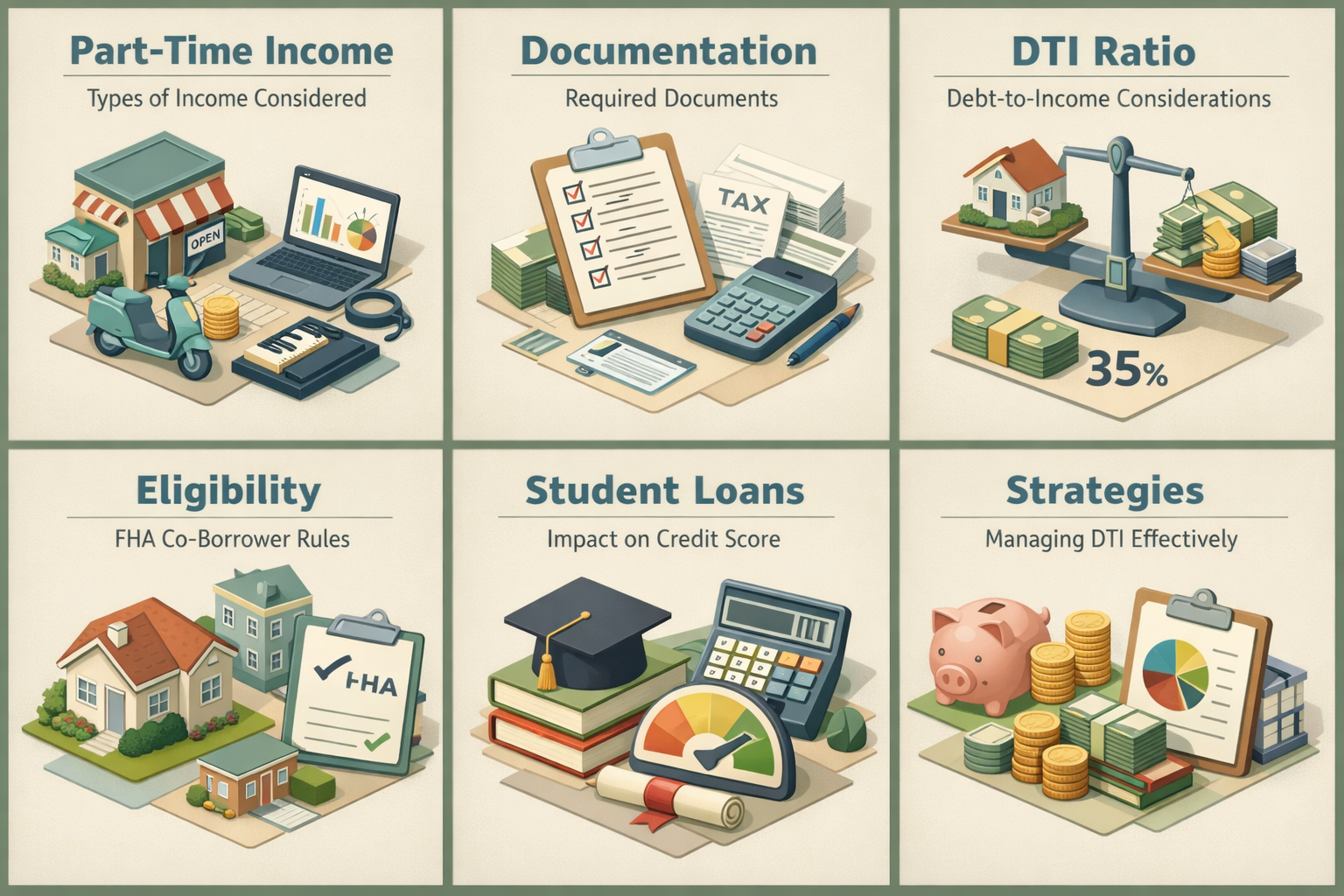
Part-time income can absolutely be used to qualify for an FHA loan — but there are conditions. FHA guidelines generally require that part-time income be stable and consistent over a meaningful period of time before a lender will count it toward qualifying income. This means documentation matters enormously.
Typically, lenders look for a two-year history of part-time employment to establish that the income is reliable and likely to continue. If a co-borrower has been working part-time for less than two years, the lender may still consider the income, but it often requires additional justification — such as a letter from the employer confirming continued employment or evidence of increasing hours over time.
Types of Part-Time Income That May Be Counted
- W-2 part-time employment: Income from a steady part-time job with a consistent employer is usually the easiest to document and verify.
- Seasonal part-time work: May be considered if it has occurred consistently over two or more years in the same field.
- Gig economy or freelance work: Typically treated similarly to self-employment income and may require tax returns, 1099s, and a longer history to qualify.
- Second jobs: A co-borrower working two part-time jobs may have both incomes counted if both meet the stability requirements.
What Lenders Look for When Reviewing Part-Time Income
Lenders evaluating a co-borrower's part-time earnings will typically request recent pay stubs, W-2 forms for the past two years, and federal tax returns. They want to see that the income has been consistent and shows no signs of declining. If hours have been cut recently or the employer has indicated that work is seasonal with no guarantee of continuation, the lender may discount or exclude the income from the qualifying calculation.
It's also worth noting that lenders may average part-time income over a 24-month period, which means short-term increases in hours might not significantly boost the qualifying income figure.
Debt-to-Income Ratio Considerations for Co-Borrowers with Student Debt
The debt-to-income (DTI) ratio is one of the most critical factors in any mortgage approval. It measures how much of a borrower's gross monthly income goes toward debt payments. For FHA loans, lenders generally look for a front-end DTI — housing expenses only — of no more than 31%, and a back-end DTI — all monthly debts including housing — of no more than 43%. However, FHA may allow higher DTI ratios in certain circumstances with compensating factors.
When a co-borrower has deferred student loans, the calculated monthly payment (often using the 1% rule) is added to the total monthly debt load. If that co-borrower also has part-time income, the qualifying income may be lower than expected. Together, these two factors can push the combined DTI ratio higher than the lender's threshold.
Strategies to Manage DTI with a Co-Borrower
- Pay down other debts: Reducing balances on credit cards or auto loans before applying can lower the overall DTI ratio meaningfully.
- Increase income documentation: If the co-borrower has received raises or additional hours, ensuring all income is fully documented can improve the qualifying ratio.
- Explore compensating factors: FHA guidelines allow lenders to approve loans with higher DTI ratios when strong compensating factors exist, such as significant cash reserves, a strong credit score, or a large down payment.
- Consider a non-occupant co-borrower: In some cases, a family member can be added as a non-occupant co-borrower to boost income without affecting DTI negatively, depending on the structure of the loan.
Understanding how DTI is calculated — and working proactively to optimize it — can significantly improve a co-borrower's chances of meeting the requirements for FHA loan with co-borrower student loan deferment and part-time income.
Credit Score and FHA Co-Borrower Eligibility with Student Debt
FHA co-borrower eligibility with student debt is also influenced by credit history. FHA loans are known for their relatively flexible credit score requirements compared to conventional loans, but there are still minimums to be aware of.
Generally speaking, a credit score of 580 or higher allows borrowers to qualify for the 3.5% minimum down payment. Scores between 500 and 579 may still qualify, but typically require a 10% down payment. Scores below 500 are generally not eligible for FHA financing.
When there's a co-borrower involved, most lenders will use the lower of the two middle credit scores to determine the qualifying credit tier. This means if the primary borrower has excellent credit but the co-borrower has a lower score due to student loan history or limited credit, the co-borrower's score could become the determining factor.
How Student Loan History Affects Credit
Student loans themselves aren't inherently damaging to credit. In fact, a consistent on-time payment history on student loans can build positive credit history over time. However, missed payments, defaulted student loans, or loans in collections can significantly harm a credit score. For a co-borrower who has experienced any of these issues, addressing them before applying — either through rehabilitation, consolidation, or dispute resolution — could improve their score and strengthen the overall application.
It's also worth noting that deferred student loans typically don't report active payment activity to the credit bureaus during deferment, which means the co-borrower may have limited recent positive payment history. Building credit through other means — such as a secured credit card or small personal loan — during deferment could help offset this gap.
Documentation Checklist for FHA Applications Involving Part-Time Income and Deferred Loans
Preparation is everything when it comes to FHA loan applications that involve complex income situations. Lenders will want to verify every aspect of the co-borrower's financial picture, and having documents ready in advance can speed up the underwriting process considerably.
For Part-Time Income Verification
- Most recent 30 days of pay stubs from all part-time employers
- W-2 forms for the past two years
- Federal tax returns (Form 1040) for the past two years, especially if income varies
- A written verification of employment (VOE) from the employer confirming position, hours, and pay rate
- Any documentation supporting income consistency or longevity of employment
For Deferred Student Loan Documentation
- Most recent student loan statement showing current balance and deferment status
- Deferment approval or forbearance letter from the loan servicer
- Documentation of income-driven repayment plan terms, if applicable
- Evidence of any planned repayment start date
General FHA Application Documents
- Government-issued photo ID for all borrowers
- Social Security numbers for credit check authorization
- Two months of recent bank statements for all accounts
- Gift letter, if any portion of the down payment is a gift
- Signed purchase contract, if already under contract on a property
Being thorough with documentation not only supports a smoother approval process but also helps underwriters make informed decisions that work in the borrower's favor.
Tips for Strengthening Your FHA Application as a Co-Borrower
Meeting the minimum requirements for FHA loan with co-borrower student loan deferment and part-time income is a meaningful first step, but taking proactive measures to strengthen the overall application can improve your approval odds and potentially secure better loan terms.
Build Reserves Before Applying
Having cash reserves — savings beyond your down payment and closing costs — is a strong compensating factor recognized by FHA lenders. Even a few months of mortgage payments in reserve can offset concerns about part-time income stability or elevated DTI ratios. Start saving early and avoid large withdrawals from your accounts in the months leading up to your application.
Communicate Openly with Your Lender
Don't wait for an underwriter to raise questions about your co-borrower's student loan deferment or employment situation. Address these factors upfront with your loan officer. An experienced FHA loan approval with a co-borrower can help you structure the application in the most favorable way, identify potential issues early, and suggest documentation strategies that support your case.
Consider Timing the Application Strategically
If the co-borrower is approaching two years of part-time employment or expects their student loans to enter an income-driven repayment plan with a lower monthly payment, it might be worth waiting a few months before applying. Timing can sometimes make a meaningful difference in how the lender views income stability and debt load.
Work with an FHA-Approved Lender
Not all lenders interpret FHA guidelines the same way, and lender overlays — additional requirements set by individual lenders beyond FHA minimums — can vary. Shopping around and working with an FHA-approved lender experienced in non-traditional income situations could open doors that a less specialized lender might close. LoanWise connects borrowers with lending professionals who understand the nuances of FHA co-borrower eligibility with student debt and part-time income scenarios.
●Conclusion
Navigating the mortgage process with a co-borrower who carries deferred student loans and earns part-time income is undeniably more complex than a straightforward application — but it's far from impossible. The key is understanding how FHA guidelines handle each of these variables, preparing thorough documentation, and working with a lender who has experience in these situations. By managing your DTI carefully, building credit strategically, and presenting your income history clearly, you and your co-borrower can position yourselves for a successful outcome. If you're ready to explore your FHA loan options or want a clearer picture of how your co-borrower's profile might affect your application, connect with a LoanWise lending specialist today. We're here to help you move forward with clarity and confidence.