
For many veterans and active-duty service members, the VA loan is one of the most powerful home financing tools available. It offers competitive interest rates, no down payment requirement, and no private mortgage insurance. But what happens when a veteran wants to purchase a home with a spouse or partner who isn't a U.S. citizen? Understanding how to qualify for a VA loan with a co-borrower who is a foreign national is a topic that affects more military families than you might expect. The rules are nuanced, and lender guidelines can vary significantly. This article walks you through what you need to know before applying.
What the VA Says About Non-Veteran Co-Borrowers
The Department of Veterans Affairs does permit co-borrowers on VA-backed loans, but it draws a clear distinction between different types of co-borrowers. According to VA guidelines, the strongest scenario is when a veteran co-borrows with another eligible veterans. In that case, both borrowers' entitlements may be used, and the loan remains fully VA-guaranteed.
When a veteran purchases a home with a non-veteran co-borrower — such as a civilian spouse or a foreign national — the rules shift. The VA will only guarantee its portion of the loan tied to the veteran's entitlement. The remaining portion associated with the non-veteran co-borrower is not covered by the VA guaranty. This means lenders may treat part of the loan as a conventional obligation, which could affect underwriting standards, required documentation, and even the interest rate offered.
It's important to understand that the VA itself sets baseline eligibility rules, but individual lenders — known as VA-approved lenders — often apply their own overlay guidelines on top of those baselines. These overlays can be more restrictive, especially when a non-citizen co-borrower is involved.
Defining a Foreign National in the Context of Mortgage Lending
In the mortgage world, a foreign national typically refers to someone who is not a U.S. citizen and does not hold permanent residency status (a green card). This category can include visa holders, individuals on work permits, or those who reside primarily outside the United States. Lenders treat foreign nationals differently from permanent residents because of the added risk factors involved — such as limited U.S. credit history, income documentation challenges, and the possibility that the individual may return to their home country.
It's worth noting that there's a meaningful difference between a non-permanent resident alien and a foreign national in lending terminology. Non-permanent residents who hold valid visas and work legally in the U.S. may have access to more conventional financing options. True foreign nationals — those with no U.S. residency status — face the most restrictive lending environment, and most traditional VA lenders may decline to process these applications entirely.
Understanding where your co-borrower falls in this spectrum is one of the first steps toward determining which lenders might be willing to work with your situation.
VA Loan Co-Borrower Requirements You Need to Know
When it comes to VA loan co-borrower requirements, the rules are detailed and depend heavily on who the co-borrower is. Here's what veterans and their co-borrowers should generally be prepared for:
- The primary borrower must be VA-eligible: At least one borrower must be an eligible veteran, active-duty service member, or qualifying surviving spouse with a valid Certificate of Eligibility (COE).
- Co-borrowers must occupy the property: VA loans are intended for primary residences. Both the veteran and the co-borrower are typically expected to live in the home.
- Income and credit review applies to all borrowers: The lender will evaluate the credit profile and income of all co-borrowers on the application. A foreign national co-borrower with little or no U.S. credit history may complicate the underwriting process.
- Documentation requirements increase: Foreign national co-borrowers may need to provide international credit reports, proof of income from abroad, passport documentation, visa status verification, and sometimes additional financial disclosures.
- Partial VA guaranty applies: Because the VA only guarantees the veteran's portion of the loan, lenders may require a down payment or charge additional fees to cover the non-guaranteed portion.
These requirements can vary between lenders, so it's strongly recommended to speak directly with a VA loan co-borrower requirements experienced lender in handling mixed-status co-borrower situations before proceeding with a full application.
How Lenders Evaluate Risk When a Foreign National Is Involved
Lenders that do work with foreign national mortgage scenarios — even within a VA loan context — tend to apply heightened scrutiny. Here's how they typically assess the added risk:
Credit History: One of the biggest challenges for foreign national co-borrowers is the absence of a U.S. credit score. American lenders rely primarily on FICO scores generated from U.S. credit bureaus. If a co-borrower has never had a U.S. credit card, auto loan, or other tradeline, they may have no scoreable credit file at all. Some lenders may accept international credit reports or alternative credit documentation, but this is not universal.
Income Verification: Verifying income earned in a foreign country introduces currency risk, exchange rate considerations, and documentation hurdles. Lenders may require translated documents, certified financials, or proof that foreign income is stable and likely to continue.
Asset Documentation: Foreign bank accounts and assets may be considered, but lenders may apply additional scrutiny or discount their value when calculating reserves.
Legal Residency and Stability: Lenders want to feel confident that a co-borrower has ties to the property and the country. A foreign national who does not live primarily in the U.S. or whose visa status is temporary may be viewed as a higher flight risk, which affects the lender's appetite to approve the loan.
How to Qualify for a VA Loan With a Co-Borrower Who Is a Foreign National: A Step-by-Step Approach
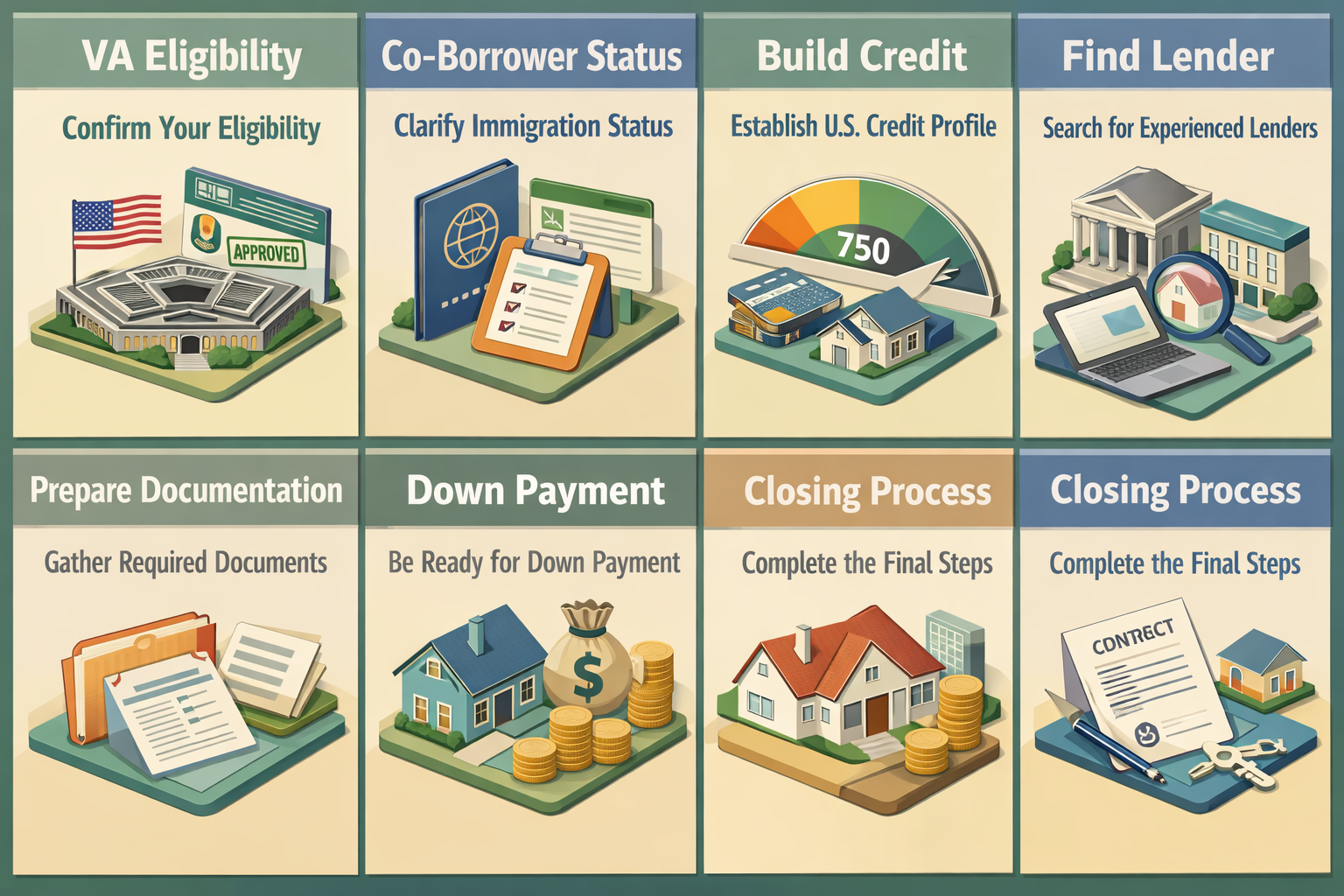
While this is a challenging financing situation, it isn't necessarily impossible. Here's a practical roadmap that may help eligible veterans navigate the process:
- Step 1 — Confirm your VA eligibility: Obtain your Certificate of Eligibility through the VA or with the help of your lender. This confirms your entitlement amount and sets the stage for your application.
- Step 2 — Clarify your co-borrower's immigration status: Determine whether your co-borrower is a non-permanent resident alien, a visa holder, or a true foreign national with no U.S. residency. This distinction matters greatly to lenders.
- Step 3 — Build a U.S. credit profile for the co-borrower: If your co-borrower doesn't have U.S. credit history, work on establishing it before applying. Secured credit cards, authorized user status on existing accounts, or other tradelines can help build a credit file over time.
- Step 4 — Find a VA-approved lender with foreign national experience: Not all VA lenders will accept applications involving foreign national co-borrowers. Search for lenders who specialize in non-QM or niche mortgage products alongside VA loans. Portfolio lenders — those who keep loans in-house rather than selling them on the secondary market — may have more flexibility.
- Step 5 — Prepare comprehensive documentation: Gather international credit reports, employment verification letters, translated financial statements, proof of income, tax records from the co-borrower's home country, and any relevant visa or immigration documents.
- Step 6 — Be prepared for a potential down payment: Because the VA guaranty may only cover the veteran's portion, lenders could require a down payment on the unguaranteed portion of the loan. Having cash reserves ready strengthens your application considerably.
- Step 7 — Work with a HUD-approved housing counselor or VA-experienced loan officer: Professional guidance can help you avoid common pitfalls and find lenders genuinely equipped to handle your situation.
Alternative Financing Paths Worth Considering
If the VA loan route proves too restrictive for your specific situation, there may be other financing options to explore. Many military families in mixed-citizenship situations end up considering alternatives either alongside or instead of the VA loan.
Conventional loans with a non-citizen co-borrower: Fannie Mae and Freddie Mac guidelines do permit non-citizen co-borrowers under certain conditions. Non-permanent resident aliens with valid employment authorization may qualify under conventional guidelines, though foreign nationals with no U.S. residency still face significant hurdles.
Foreign national mortgage programs: Some specialty lenders offer dedicated foreign national mortgage products. These loans are typically structured as non-QM (non-qualified mortgage) loans and often require larger down payments — sometimes 25% to 40% — along with higher interest rates. However, they're specifically designed to accommodate borrowers without U.S. residency or credit history.
Portfolio lending: Community banks, credit unions, and private lenders that hold loans in their own portfolios rather than selling them on the secondary market may have more flexibility in their underwriting standards. They can sometimes craft solutions that larger institutions cannot.
Each of these paths carries its own trade-offs in terms of cost, documentation burden, and approval likelihood. A knowledgeable mortgage advisor can help you compare your options side by side.
●Conclusion
Navigating how to qualify for a VA loan with a co-borrower who is a foreign national requires patience, preparation, and the right lending partner. The VA loan benefit is a well-earned reward for military service, and while the rules around non-citizen co-borrowers add complexity, they don't necessarily close the door entirely. By understanding the VA loan co-borrower requirements, building a strong financial profile for both borrowers, and seeking out lenders experienced in these unique scenarios, eligible veterans may still find a path to homeownership — even in mixed-status households. At LoanWise, we're committed to helping borrowers understand their full range of options so they can make informed, confident decisions about their home financing journey. Reach out to a lending specialist today to explore what's possible for your unique situation.