
Running a mobile food truck business is an exciting venture — but growing it into a multi-vehicle operation takes real capital. If you own a home with equity built up, you might be wondering whether a Home Equity Line of Credit, or HELOC, could help fund that expansion. Understanding HELOC requirements for a mobile food truck with multiple vehicles isn't always straightforward, because it sits at the crossroads of personal real estate lending and business asset financing. This guide breaks down what lenders typically look for, how a HELOC works in this context, and what alternative paths might be worth exploring alongside it.
What Is a HELOC and How Does It Work for Business Purposes?
A Home Equity Line of Credit is a revolving credit line secured by the equity in your primary residence or, in some cases, an investment property. Unlike a traditional home equity loan that delivers a lump sum, a HELOC functions more like a credit card — you draw funds as needed during a set draw period, typically five to ten years, and repay what you've used.
When it comes to using a HELOC for business assets like food trucks, lenders generally don't restrict how borrowers spend the funds once approved. This means a qualified homeowner could, in theory, tap into their home equity to purchase, equip, or upgrade mobile food trucks. However, the approval process is anchored to your personal financial profile — not your business revenues — which creates a unique set of considerations.
Because the loan is secured by real estate rather than the food trucks themselves, lenders focus heavily on the property's appraised value, your existing mortgage balance, and your creditworthiness as an individual. The food trucks won't be listed as collateral; your home is. This distinction is critical for food truck entrepreneurs to understand before applying.
Core HELOC Eligibility Criteria Lenders Typically Evaluate
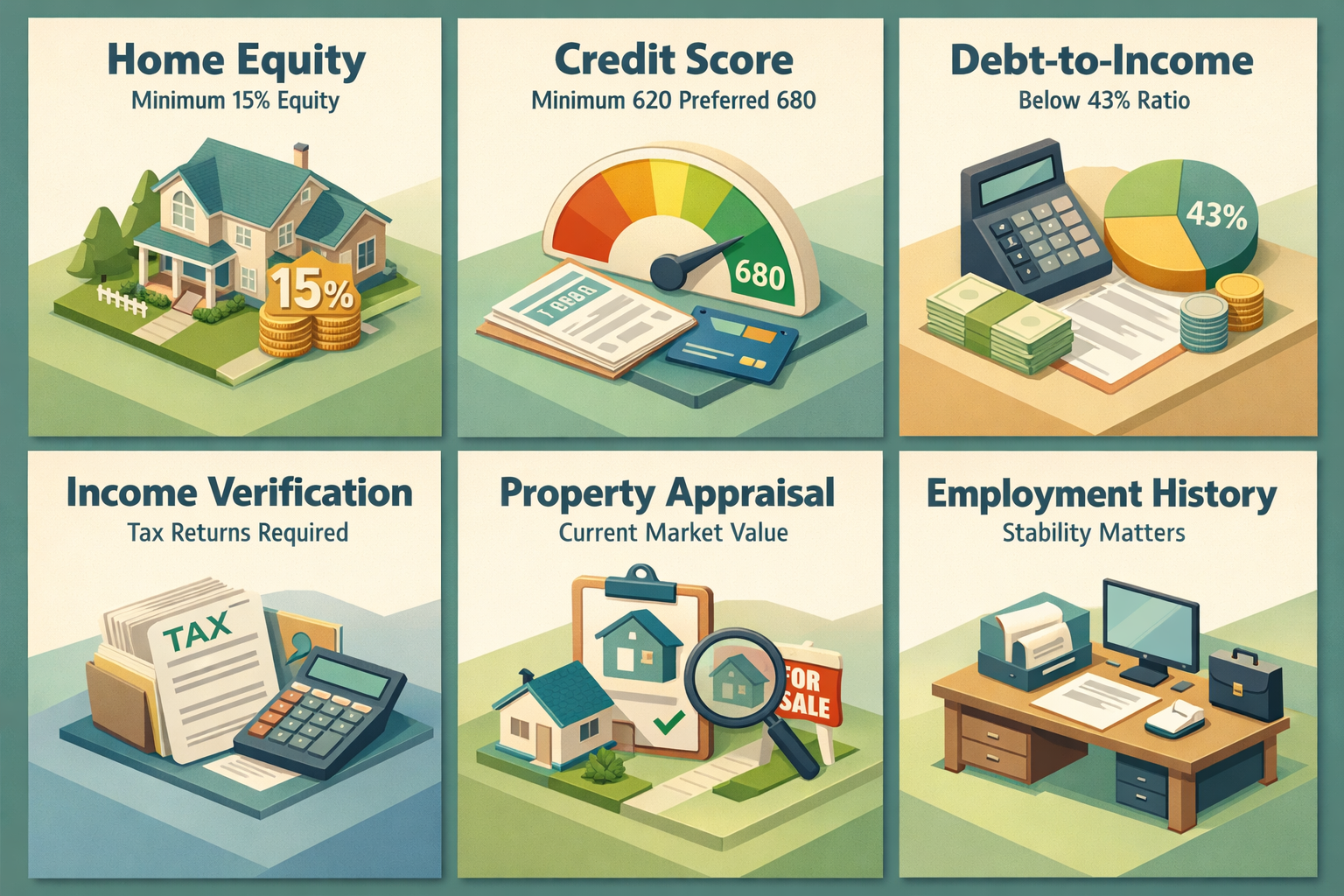
Understanding HELOC requirements for a mobile food truck with multiple vehicles starts with knowing what lenders examine on your personal financial record. While standards can vary by institution, several criteria tend to be consistent across most mortgage lenders and credit unions.
- Home Equity: Most lenders require that you retain at least 15% to 20% equity in your home after the HELOC is factored in. For example, if your home is worth $400,000 and you owe $280,000, you may have sufficient equity to qualify for a meaningful credit line — though the exact amount will depend on the lender's combined loan-to-value (CLTV) limits.
- Credit Score: A credit score of 620 is often cited as a minimum threshold, but many lenders prefer scores of 680 or higher for HELOC approval, and better rates typically come with scores above 740.
- Debt-to-Income Ratio (DTI): Lenders typically want your total monthly debt obligations — including your existing mortgage and the projected HELOC payments — to remain below 43% of your gross monthly income. Self-employed food truck owners may need to provide additional documentation to verify their income.
- Income Verification: Expect to provide tax returns, W-2s or 1099s, and possibly profit-and-loss statements. If your food truck business is your primary income source, lenders may average two years of self-employment income to determine your qualifying figure.
- Property Appraisal: Lenders will likely require a current appraisal or automated valuation to confirm your home's market value before finalizing a credit line amount.
Meeting these benchmarks doesn't guarantee approval, but it sets a solid foundation. Lenders may also review employment history and the overall stability of your financial situation.
Why Multiple Food Trucks Add Complexity to the HELOC Conversation
Expanding from one truck to a full fleet is a significant operational leap — and it introduces financial complexity that can affect your HELOC application in indirect ways. If you've taken on business debt to purchase previous trucks, those obligations may appear in your personal credit profile, particularly if you signed personal guarantees or financed the vehicles under your name.
Each truck you've financed could contribute to your monthly debt load, pushing your debt-to-income ratio higher and potentially reducing the HELOC amount you qualify for. Similarly, if your business is structured as a sole proprietorship or a single-member LLC without strong separation of finances, lenders may blend your business and personal cash flows together during underwriting.
There's also the matter of income volatility. Mobile food businesses often experience seasonal fluctuations, and lenders typically want to see consistent, stable income over time. If your tax returns show significant swings in net income from year to year, it could raise flags during the review process. Providing a clear explanation of revenue trends — along with supporting documentation — may help address lender concerns.
It's worth noting that while a HELOC can fund the purchase of additional trucks, it does not create a direct lien on those vehicles. This means if the business struggles, your home remains at risk as the underlying collateral. This is a serious consideration that every food truck owner should weigh carefully before proceeding.
Preparing a Strong HELOC Application as a Self-Employed Food Truck Operator
Self-employed borrowers — which includes most food truck owners — often face additional scrutiny during the mortgage underwriting process. Lenders tend to be conservative when evaluating variable income, so preparation is key. Here are several steps that may strengthen your application:
- Organize Two Years of Tax Returns: Lenders typically average your net self-employment income over two years. If your most recent year shows strong growth, that momentum may work in your favor — but both years need to be documented thoroughly.
- Maintain Clean Personal and Business Credit: Pay down revolving balances where possible and avoid opening new credit accounts in the months leading up to your application. A higher personal credit score can unlock more favorable HELOC terms.
- Reduce Visible Debt Obligations: If you've financed food truck equipment or vehicles personally, lowering those balances — or refinancing them into a business structure — may improve your DTI ratio.
- Document Business Stability: Letters from accountants, a business plan, or a record of permits and health certifications can help lenders see your operation as stable and professionally managed.
- Work with a Lender Familiar with Self-Employed Borrowers: Not all lenders apply the same flexibility. Some credit unions and community banks may offer more nuanced underwriting for self-employed individuals than large national lenders.
Being proactive and transparent with your lender can go a long way. Providing organized documentation upfront often reduces delays and demonstrates the kind of financial discipline lenders want to see.
HELOC for Business Assets vs. Dedicated Food Truck Financing Options
A HELOC isn't the only path to funding a food truck fleet. It's important to compare it against other food truck financing options to determine which approach aligns best with your goals and risk tolerance.
Equipment and Vehicle Loans: These are loans specifically designed to finance commercial vehicles and equipment. Because the truck itself serves as collateral, lenders may require less personal financial exposure than a HELOC. Interest rates vary, but fixed monthly payments can make budgeting more predictable.
SBA Loans: The Small Business Administration offers several loan programs that could apply to food truck businesses, including the SBA 7(a) loan for working capital and equipment, and the SBA Microloan program for smaller funding needs. These may offer competitive rates and longer repayment terms, though the application process tends to be more involved.
Business Lines of Credit: Similar in structure to a HELOC, a business line of credit lets you draw funds as needed. These are tied to business performance rather than personal real estate, which means your home isn't at risk — though qualification criteria can be stricter for newer businesses.
Using a HELOC for business assets like food trucks offers one key advantage: access to larger credit lines at potentially lower interest rates than unsecured business loans, particularly for homeowners with strong equity. However, the trade-off is that your personal property is on the line. Many financial advisors suggest that entrepreneurs use HELOCs strategically — perhaps to bridge a short-term funding gap — rather than as the sole source of capital for a growing fleet.
How Lenders View Risk When Real Estate Secures Business Expansion
When a homeowner uses real estate equity to fund business operations, lenders take a close look at overall financial risk. While they won't necessarily ask for a business plan the way a commercial lender might, they'll assess whether your income — business or otherwise — is sufficient to service the HELOC reliably.
One important factor is how the HELOC draw period transitions into the repayment phase. During the draw period, borrowers often make interest-only payments, which can feel manageable. But once the repayment period begins, the full principal and interest payments kick in. For food truck operators managing multiple vehicles and operating expenses, it's worth modeling out those future payment scenarios before committing to a HELOC.
Lenders may also consider current market conditions. In a rising interest rate environment, variable-rate HELOCs can become more expensive over time. If rates increase significantly, your monthly cost of borrowing could climb — adding pressure to a business that may already have thin margins, as is common in the food service industry.
Understanding how lenders evaluate this risk helps food truck owners enter the application process with realistic expectations. Some lenders may cap the HELOC at a lower amount than expected if they perceive elevated risk, particularly for borrowers whose primary income is tied to a single business category.
●Conclusion
Understanding HELOC requirements for a mobile food truck with multiple vehicles requires looking at your financial situation from two angles: the personal real estate side, which determines whether you qualify, and the business side, which shapes how much risk you're taking on. A HELOC can be a powerful tool for food truck entrepreneurs with solid home equity, strong credit, and documented income — but it works best as part of a broader financing strategy rather than a standalone solution.
Before applying, it's worth speaking with a mortgage professional who understands the nuances of self-employed borrowing. At LoanWise, we work with homeowners and entrepreneurs to find financing paths that make sense for their goals. Reach out today to explore your home equity options and see how we can help your food truck business grow — without putting your financial foundation at risk.