
If you're a freelancer, commission-based worker, or someone who receives child support, you've probably wondered how lenders view your finances when you apply for a mortgage. The truth is, knowing how to calculate DTI with freelance commission income and child support can make a significant difference in whether your loan application gets approved. Your debt-to-income ratio — commonly known as DTI — is one of the most important numbers a lender looks at. It tells them how much of your monthly income is already committed to debt payments. But when your income isn't a simple, steady paycheck, things get a little more nuanced. Don't worry, though. With the right knowledge and preparation, you can navigate this process with confidence.
What Is a Debt-to-Income Ratio and Why Does It Matter?
Your debt-to-income ratio is calculated by dividing your total monthly debt obligations by your gross monthly income, then multiplying by 100 to get a percentage. For example, if your monthly debts total $2,000 and your gross monthly income is $6,000, your DTI would be roughly 33%.
Lenders use this figure to assess your ability to manage monthly payments and repay borrowed money. A lower DTI generally signals that you're a lower-risk borrower, which may improve your chances of mortgage approval and could even influence the interest rate you're offered.
Most conventional loan programs typically prefer a DTI at or below 45%, though some government-backed programs like FHA loans may allow slightly higher ratios under certain conditions. That said, every lender has its own thresholds, and qualifying factors like credit score and down payment size can also influence how much flexibility a lender may extend.
The challenge for freelancers and commission earners is that their income isn't always straightforward to calculate. Unlike a salaried employee who receives a consistent paycheck, self-employed borrowers and commission workers may see their earnings fluctuate significantly from month to month or year to year.
How Lenders Typically Calculate Freelance and Commission Income
When it comes to variable income sources like freelance work or sales commissions, lenders typically look for consistency and stability before they'll count that income toward your qualifying amount. Here's what that often looks like in practice:
- Two-year average: Most lenders prefer to see at least two years of self-employment or commission income. They'll usually average the income reported on your last two federal tax returns to determine a monthly qualifying figure.
- Tax returns and transcripts: Expect lenders to request your full personal tax returns, including all schedules, as well as IRS tax transcripts to verify accuracy. Schedule C is especially important for sole proprietors and freelancers because it shows both revenue and business expenses.
- Net income, not gross revenue: One thing that surprises many freelancers is that lenders typically use your net income after business deductions, not your total invoiced amount. If you've claimed significant write-offs to lower your tax bill, this may reduce the income figure used in your DTI calculation.
- Commission income documentation: For commission-based employees — those who receive a W-2 from an employer but earn primarily through commissions — lenders may also average two years of earnings and request year-to-date pay stubs, employer verification letters, or both.
It's worth noting that if your income has declined from year one to year two, some lenders may use the lower figure or average down more conservatively. Trending income upward, on the other hand, may work in your favor.
Does Child Support Count as Income for a Mortgage Application?
Yes — child support can count as qualifying income for mortgage purposes, but there are important conditions that typically must be met before a lender will include it in your DTI calculation.
Most lenders follow guidelines that require child support income to be:
- Documented with a legal agreement: You'll generally need a court order, divorce decree, or legally binding separation agreement that specifies the payment amount and terms.
- Verified as received: Lenders often want to see a history of consistent, on-time payments — typically for the past 12 months. Bank statements showing regular deposits are commonly requested.
- Expected to continue: Most lender guidelines require that the income is likely to continue for at least three years from the date of the mortgage application. If the child is close to the age of majority or the support agreement is set to expire soon, lenders may not count that income.
It's also important to know that if you're the one paying child support, those monthly obligations will be counted as a debt in your DTI calculation — meaning they'll work against your ratio. This is true even if the payments aren't reflected on your credit report.
Being upfront with your lender about both received and paid support obligations is essential. Hiding or omitting this information during the application process can cause serious complications at closing.
Step-by-Step: How to Calculate DTI With Freelance Commission Income and Child Support
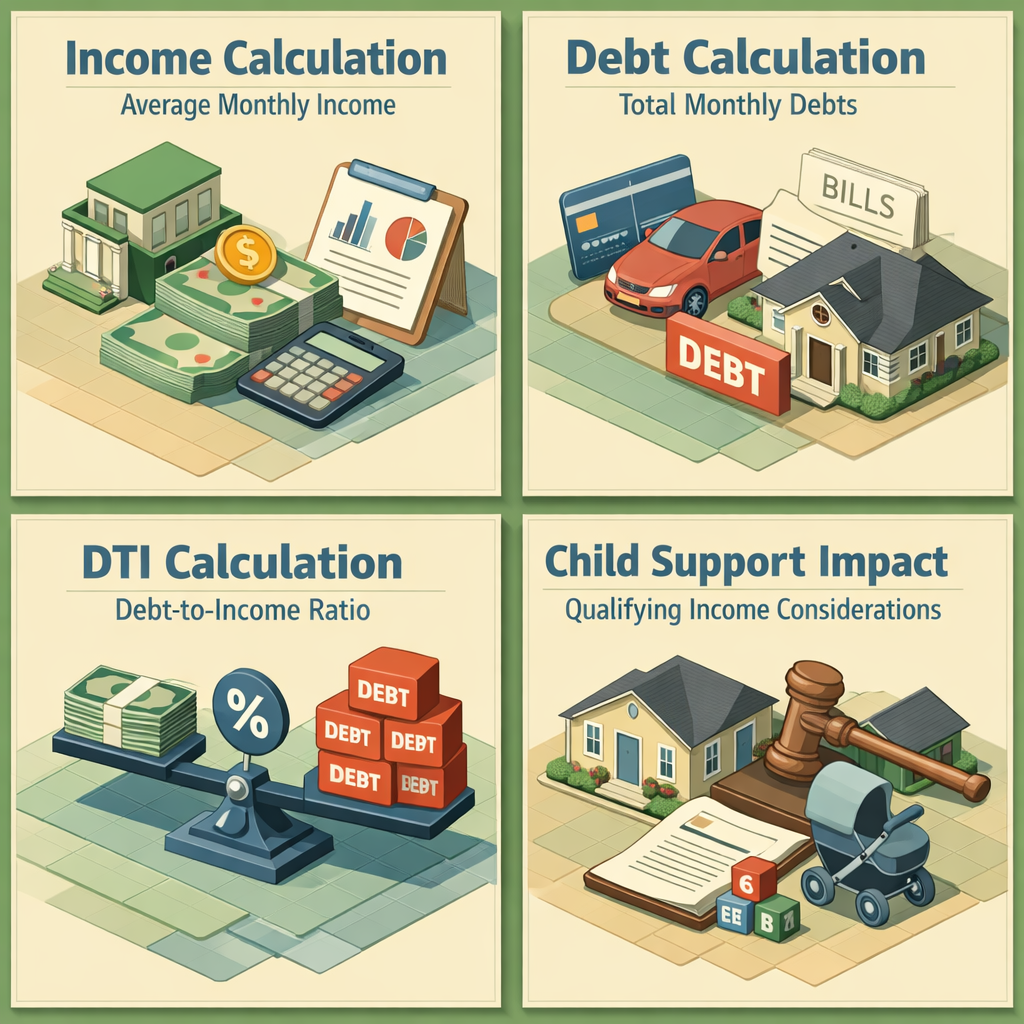
Now let's walk through a practical example of how to calculate DTI with freelance commission income and child support so you can see how the numbers might come together in a real mortgage scenario.
Imagine a borrower named Maya. She works as a freelance graphic designer and also earns commission from occasional brand consulting projects. She receives child support payments from her ex-spouse and is applying for a home loan.
Step 1 — Calculate average monthly income from freelance and commission work:
- Year 1 net freelance income (after deductions): $54,000
- Year 2 net freelance income (after deductions): $60,000
- Two-year average: $57,000 ÷ 12 = $4,750/month
Step 2 — Add qualifying child support income:
- Monthly child support received: $800 (documented, consistent for 14 months, expected to continue 4+ years)
- Total qualifying monthly income: $4,750 + $800 = $5,550/month
Step 3 — Add up total monthly debt obligations:
- Proposed new mortgage payment (PITI): $1,400
- Car loan: $350
- Student loan: $200
- Credit card minimum payment: $75
- Total monthly debts: $2,025
Step 4 — Divide total debts by total income:
- $2,025 ÷ $5,550 = approximately 36.5% DTI
In this example, Maya's DTI falls within a range that many lenders would consider acceptable for conventional mortgage programs. However, if she were also paying child support, that amount would be added to her debt side of the equation, potentially pushing her DTI higher.
Common Documentation Lenders May Request From Non-Traditional Earners
Preparation is everything when you have a non-traditional income profile. Gathering the right paperwork early in the process can help your mortgage move forward smoothly. Here's what lenders commonly ask for:
- Two years of personal federal tax returns with all schedules attached
- Two years of business tax returns if you operate as an LLC, S-Corp, or partnership
- Year-to-date profit and loss statement prepared by a CPA or licensed accountant
- IRS tax transcripts (Form 4506-C is typically used by lenders to request these)
- Business bank statements — often 12 to 24 months' worth
- Commission income history through pay stubs, employer letters, or 1099 forms
- Court-ordered child support documents showing the payment amount and duration
- 12 months of bank statements showing receipt of child support payments
Keep in mind that requirements may vary by lender and loan program. Working with a mortgage professional who has experience with self-employed borrowers or non-traditional income situations can help you identify exactly what's needed — and avoid delays that could derail your timeline.
Strategies to Strengthen Your DTI Before Applying
If your current DTI is higher than you'd like, there are several strategies that may help you improve it before submitting a mortgage application. While none of these are overnight fixes, they can make a meaningful difference over time.
- Pay down existing debts: Reducing or eliminating smaller debt balances — like credit cards or personal loans — can lower your monthly obligation total and improve your DTI noticeably.
- Avoid taking on new debt: Applying for new credit cards or financing large purchases before your mortgage closes can increase your monthly obligations and raise red flags for lenders.
- Increase documented income: For freelancers and commission earners, growing your verifiable income over time — and keeping accurate records — strengthens the income side of your DTI equation. Note that this typically means two years of documented history, so planning ahead matters.
- Consider a co-borrower: If a trusted family member or partner has stable income and strong credit, adding them as a co-borrower may help offset a higher DTI.
- Explore non-QM loan options: Non-qualified mortgage programs are designed for borrowers with complex income profiles. These products may use bank statements rather than tax returns to verify income, which can sometimes result in a higher qualifying income figure for those who write off significant business expenses.
It's always a good idea to speak with a mortgage advisor before making any major financial moves. What works for one borrower's situation may not be the best path for another.
●Conclusion
Understanding how to calculate DTI with freelance commission income and child support is one of the most important steps a non-traditional earner can take before applying for a mortgage. While the process can feel more complex than it would be for a salaried borrower, it's absolutely manageable with the right preparation and guidance. Lenders want to see consistency, documentation, and a clear picture of your financial stability — and with a little planning, you can present exactly that.
At LoanWise, we work with borrowers across a wide range of income situations, including freelancers, commission-based professionals, and individuals navigating family financial obligations. If you're ready to explore your mortgage options or simply want to get a clearer picture of where you stand, connect with a LoanWise lending expert today. We're here to help you move forward with clarity and confidence.