
High-value home purchases often require financing that goes beyond conventional loan limits — and that's exactly where jumbo loans come in. But for borrowers whose income comes from less traditional sources, such as equity compensation or international investments, the path to approval can feel unclear. If you're wondering how to qualify for a jumbo loan with stock options and foreign dividend income, you're not alone. Many high-earning professionals, executives, and globally minded investors face this exact challenge. The good news is that lenders do have frameworks for evaluating these income types — it simply requires understanding what's needed and preparing your documentation carefully.
What Makes Jumbo Loans Different From Conventional Mortgages
Jumbo loans are mortgage products designed for loan amounts that exceed the conforming loan limits set by the Federal Housing Finance Agency (FHFA). Because they can't be purchased by Fannie Mae or Freddie Mac, lenders carry the full risk of these loans on their own books. That means they tend to apply stricter underwriting standards across the board.
Typically, jumbo loan borrowers can expect lenders to scrutinize credit scores, debt-to-income (DTI) ratios, cash reserves, and income documentation more carefully than they would for a conventional loan. A credit score of 700 or higher is often expected, though many lenders may require 720 or above for the most competitive terms. Down payment requirements can also be higher, frequently ranging from 10% to 20% or more depending on the loan size and lender guidelines.
What makes jumbo lending particularly nuanced is that each lender sets its own standards. There's no single government-backed rulebook to follow. This flexibility can actually work in a borrower's favor when income sources are complex — but it also means that shopping around and working with an experienced mortgage professional becomes especially important.
How Lenders View Stock Options as Income for Jumbo Qualification
Stock options and equity compensation — including Restricted Stock Units (RSUs), Incentive Stock Options (ISOs), and Non-Qualified Stock Options (NQSOs) — are increasingly common forms of income for corporate employees and executives. However, lenders don't treat this income the same way they treat a regular salary, and that distinction matters when you're applying for a jumbo mortgage.
Generally speaking, lenders may consider stock option income when it has a demonstrated history and a reasonable expectation of continuance. Most lenders will want to see at least a two-year history of receiving and exercising stock options. They'll typically look at your tax returns, W-2s, and employer documentation to verify the income and confirm that additional grants are likely in the future.
RSUs that vest on a regular schedule may be easier for lenders to document and use as qualifying income compared to options that require active exercise decisions. The key factors lenders often evaluate include:
- Vesting schedule: Is the income predictable and recurring?
- Employment stability: Are you still with the employer granting the equity?
- Grant letters: Can you provide documentation showing future equity awards?
- Tax treatment: How has the income been reported on prior returns?
Because stock-based income can fluctuate significantly from year to year, lenders may average the income over a two-year period rather than using the most recent year's figure alone. This approach helps them calculate a stable, reliable qualifying income amount.
Using Foreign Dividend Income to Support Your Jumbo Loan Application
Foreign dividend income adds another layer of complexity to the jumbo loan qualification process. Many investors hold positions in international stocks, foreign mutual funds, or overseas real estate investment trusts that generate dividend income denominated in a foreign currency. While this type of income can absolutely be considered by jumbo lenders, it typically requires additional verification steps.
Lenders will generally want to confirm that the foreign dividend income is stable, ongoing, and legally accessible by the borrower in the United States. Key documentation requirements may include:
- Foreign tax returns or account statements showing consistent dividend payments over at least two years
- Brokerage or custodian statements from the foreign institution holding the investments
- Currency conversion documentation to convert income into U.S. dollars at a recognized exchange rate
- Evidence of income repatriation — showing that funds have been or can be transferred to a U.S. bank account
One important consideration is currency risk. Lenders may apply a conservative approach when converting foreign income to USD, particularly if the originating currency is volatile. Additionally, some lenders may require that the foreign income be deposited into a U.S. account for a defined period before they'll count it toward qualification.
It's also worth noting that U.S. tax reporting of foreign income is essential. Lenders will typically want to see that your foreign dividends are reported on your U.S. federal tax returns — whether through Schedule B, Form 1116 for foreign tax credits, or other relevant forms. Gaps in reporting can raise red flags during underwriting.
Building the Right Documentation Package for Complex Income Sources
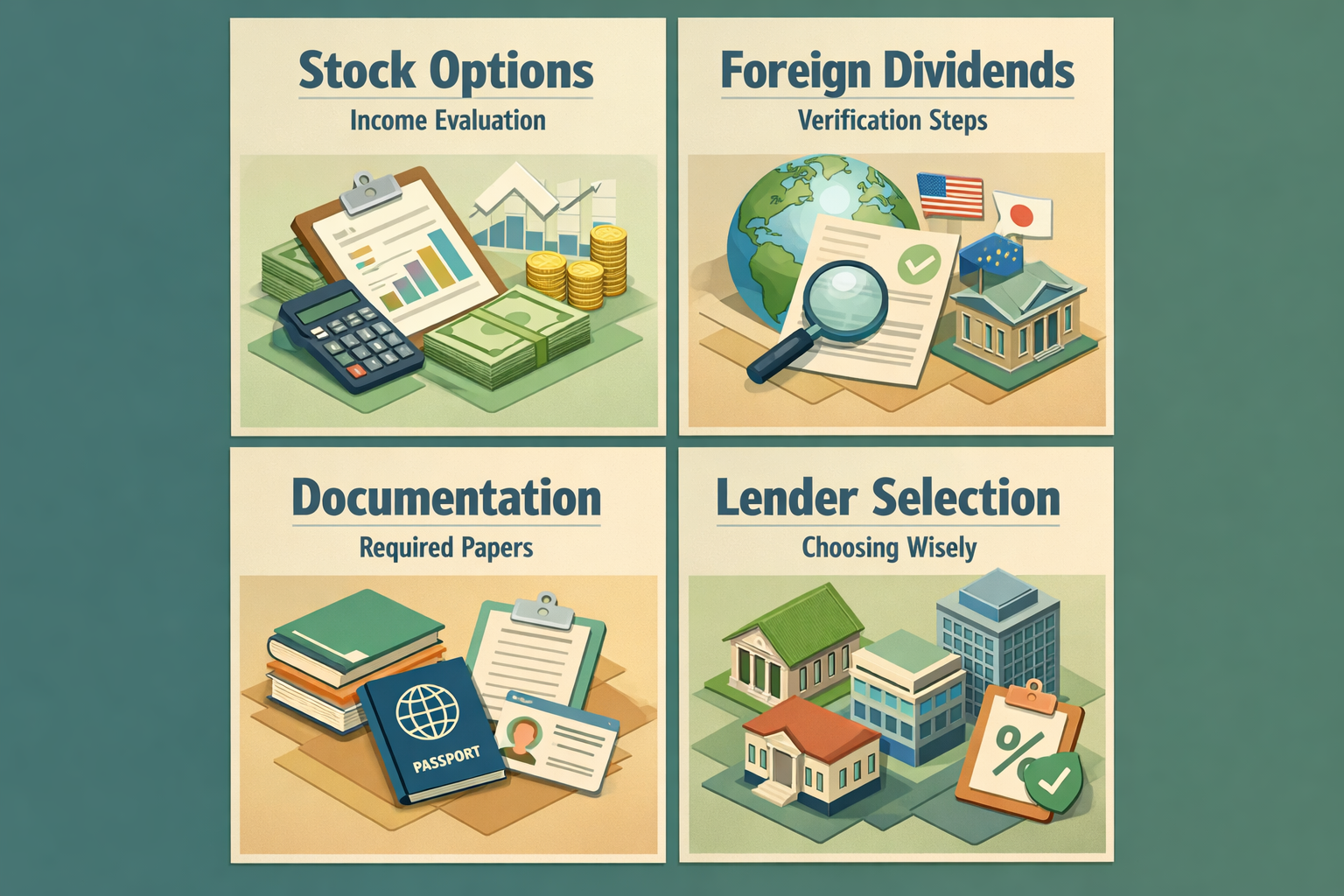
One of the most effective ways to strengthen a jumbo loan application with non-traditional income is to prepare a comprehensive and well-organized documentation package before you approach a lender. Underwriters dealing with complex income scenarios rely heavily on the paper trail you provide, and a thorough package can significantly speed up the approval process.
For stock option and equity compensation income, consider gathering the following:
- Federal tax returns (typically two years, both personal and any applicable business returns)
- W-2s and any 1099 forms related to stock compensation
- Most recent pay stubs showing year-to-date earnings
- Equity grant agreements or award letters from your employer
- Brokerage statements showing the history of option exercises or RSU vesting events
For foreign dividend income, your documentation package might include:
- Two years of U.S. federal tax returns including all foreign income schedules
- Foreign brokerage or investment account statements (often requiring certified translation if not in English)
- Proof of currency conversion and recent exchange rates
- Bank statements showing deposits of foreign income into your U.S. accounts
Working with a CPA who has experience in international tax matters can be particularly helpful here. A well-prepared letter from your accountant explaining the nature and history of your income sources may carry meaningful weight during underwriting review.
How to Qualify for a Jumbo Loan With Stock Options and Foreign Dividend Income Using Alternative Paths
If traditional jumbo loan underwriting presents obstacles due to the complexity of your income, there are alternative mortgage structures worth exploring. Non-QM (non-qualified mortgage) jumbo products have expanded considerably in recent years and may offer more flexible guidelines for borrowers with unique financial profiles.
Some lenders offer asset-depletion or asset-dissipation programs, where the value of your liquid investment portfolio — including stock holdings — is calculated as a monthly income stream over a defined period. This approach can be especially useful when actual realized income from stock options is irregular or lower in a given year.
Bank statement loans are another option sometimes available in the jumbo space. Rather than relying on tax returns alone, these programs may allow lenders to average deposits over 12 to 24 months of bank statements to establish qualifying income. If your foreign dividends and stock proceeds flow through your U.S. bank accounts, this type of program could offer a viable path forward.
Portfolio lenders — those who hold loans on their own books rather than selling them on the secondary market — often have the most flexibility in underwriting non-traditional income. Because they set their own guidelines, they may be more willing to consider the full picture of a borrower's financial strength, including international investment income and equity compensation, when evaluating creditworthiness.
Strengthening Your Overall Financial Profile Before Applying
Beyond income documentation, there are several proactive steps borrowers can take to improve their standing before applying for a jumbo loan. Since jumbo lenders place significant weight on financial reserves, having ample liquid assets — typically enough to cover six to twelve months of mortgage payments — can go a long way toward reassuring an underwriter.
Your debt-to-income ratio is another critical factor. Even if your income is strong, carrying high balances on credit cards, car loans, or other debts can push your DTI above acceptable thresholds. Paying down existing obligations before applying may meaningfully improve your qualification profile.
Credit history matters too. Jumbo lenders tend to look closely at the quality of your credit profile, not just your score. A long history of on-time payments, low utilization of revolving credit, and minimal derogatory marks will all work in your favor. If you have any blemishes on your credit report, addressing them proactively — or being prepared to explain them — is a smart move.
Finally, consider the timing of stock option exercises. If you plan to exercise a large block of options and use the proceeds for your down payment, doing so well in advance of your mortgage application may help lenders track those funds clearly and avoid questions about their origin during the underwriting process.
Finding the Right Lender for Your Unique Jumbo Scenario
Not every lender is equally equipped to handle the nuances of jumbo loan qualification with stock options and foreign dividend income. Some larger retail banks may have rigid guidelines that make approval difficult for borrowers with complex income, while specialized jumbo lenders and portfolio institutions may have dedicated underwriting teams with experience in exactly these situations.
When evaluating lenders, it can be helpful to ask directly about their experience with equity-based compensation and international investment income. A lender who's handled similar borrower profiles before will be better positioned to guide you through the process and anticipate potential sticking points before they become problems.
Working with a mortgage broker or loan officer who specializes in high-net-worth or jumbo lending can also be advantageous. These professionals often have access to multiple lender relationships and can match your specific profile to the institution most likely to qualify for a jumbo loan on favorable terms.
Transparency is essential throughout the process. Disclosing the full nature of your income sources upfront — rather than letting the underwriter discover complexities mid-process — builds credibility and helps the lender structure your loan file more effectively from the start.
●Conclusion
Understanding how to qualify for a jumbo loan with stock options and foreign dividend income requires patience, preparation, and the right lending partner. While these income types add complexity to the underwriting process, they're far from insurmountable obstacles. With thorough documentation, a strong overall financial profile, and a lender experienced in complex borrower scenarios, homebuyers and investors with non-traditional income streams can successfully secure the jumbo financing they need. Take the time to organize your records, consult with a knowledgeable tax professional, and explore both traditional and alternative jumbo lending options. The right mortgage is within reach — it simply takes a more strategic approach to get there.