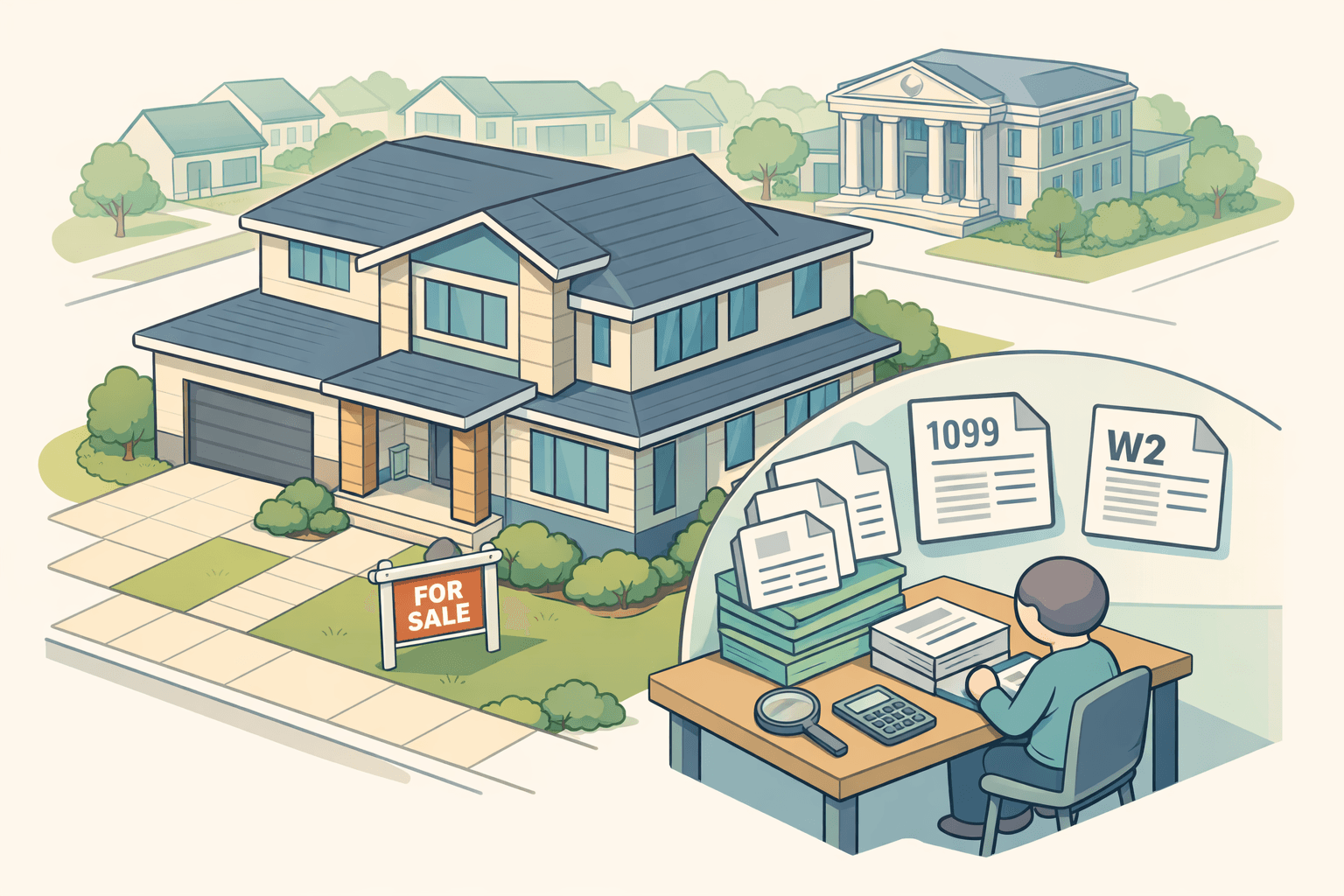
Buying a high-value home is an exciting milestone, but financing it often comes with a more complex approval process — especially if your income doesn't fit neatly into one category. If you earn both self-employment income reported on a 1099 and salaried income reported on a W2, you're what lenders call a mixed-income borrower. This situation is increasingly common among consultants, freelancers with part-time employment, real estate investors, and professionals who run side businesses. The good news is that understanding how to qualify for a jumbo loan with mixed 1099 and W2 income is entirely achievable — it just requires the right preparation and documentation strategy. This guide walks you through everything you need to know.
What Makes Jumbo Loans Different From Conventional Mortgages
Before diving into income documentation, it helps to understand why jumbo loans come with stricter requirements in the first place. A jumbo loan is any mortgage that exceeds the conforming loan limits set by the Federal Housing Finance Agency (FHFA). These limits vary by location, but in most U.S. counties, any loan above a certain threshold — often exceeding $766,550 as of recent guidelines — is considered a jumbo loan.
Because jumbo loans can't be purchased or guaranteed by Fannie Mae or Freddie Mac, lenders take on the full risk themselves. That means they typically apply tighter underwriting standards to protect their investment. For borrowers, this translates to higher credit score requirements, larger down payment expectations, lower debt-to-income (DTI) ratio thresholds, and more thorough income verification.
For salaried W2 earners, this process is relatively straightforward. But when self-employment income — reported on 1099 forms — is part of the picture, lenders need to dig deeper to verify income stability and sustainability. That's where many mixed-income borrowers feel the process gets complicated.
How Lenders View Mixed 1099 and W2 Income Sources
Lenders generally evaluate each income stream separately before combining them for qualifying purposes. Your W2 income is typically viewed as more predictable and reliable, since it comes from an employer and is subject to consistent withholding. Your 1099 income, on the other hand, may be seen as variable — and lenders often want evidence that it's been consistent over time before they'll count it toward your qualifying income.
Most jumbo lenders will want to see at least two years of both income types before they consider blending them. If your self-employment income is newer than 24 months, some lenders may choose to exclude it entirely or give it less weight in their calculations. Others may be willing to use a shorter history if the income is in the same field as your primary employment or if there's a compelling explanation for the timeline.
It's also worth noting that 1099 income is often calculated differently than W2 income. Lenders typically use your net self-employment income after deductions — not your gross earnings. This means that if you've claimed significant business expenses on your tax returns to reduce your taxable income, the income figure lenders use for qualification purposes may be lower than what you actually deposited into your bank account. This is one of the most common surprises borrowers encounter during the jumbo mortgage application process.
Key Documentation You'll Need to Pull Together
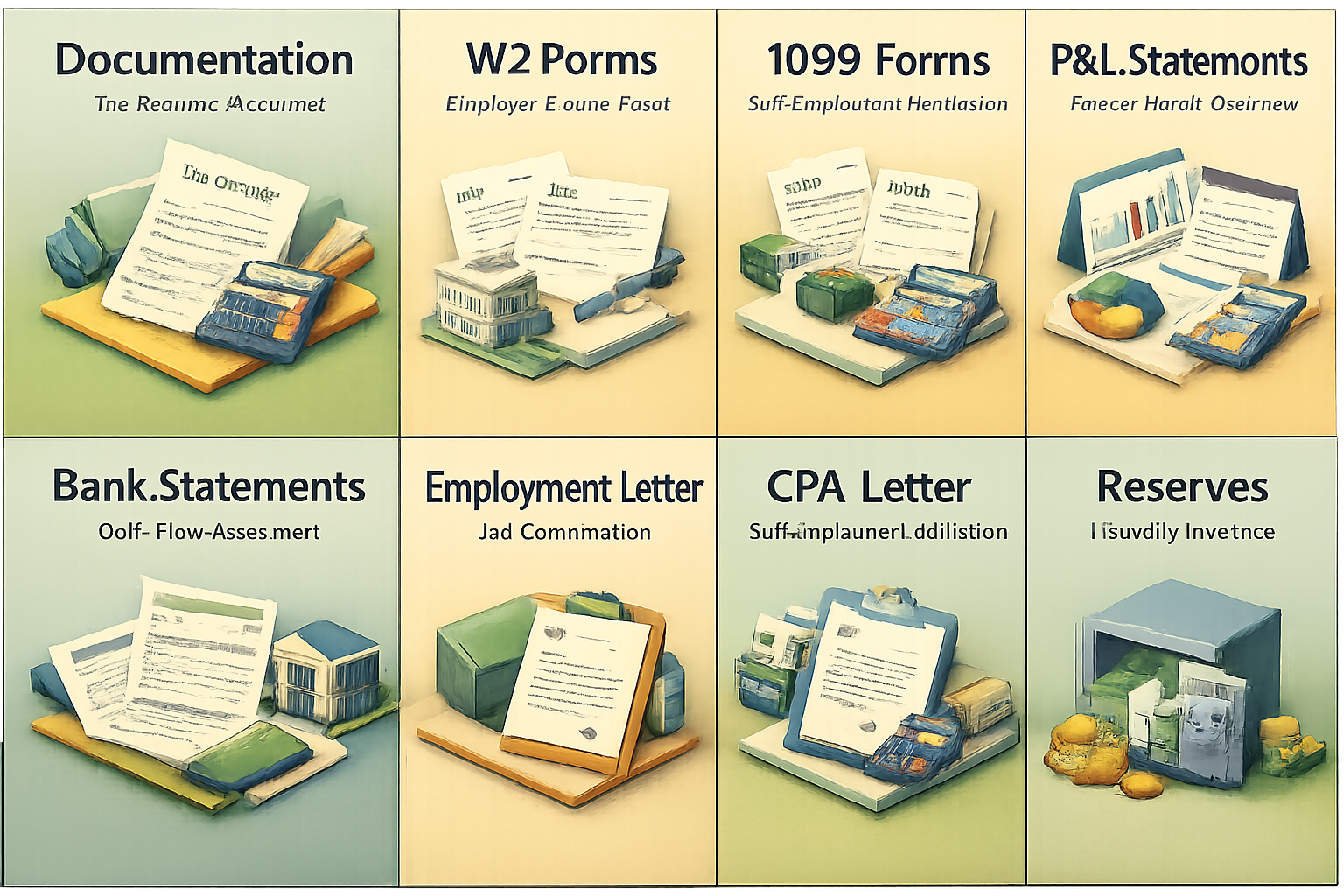
Preparing a thorough documentation package is one of the most effective things you can do when applying for a jumbo loan with mixed 1099 and W2 income. The more organized and complete your records are, the smoother the underwriting process is likely to go. Here's what most jumbo lenders will expect:
- Two years of personal tax returns (IRS Form 1040): These give lenders a full picture of your total income, including all schedules relevant to self-employment, such as Schedule C, Schedule E, or Schedule F depending on the nature of your work.
- Two years of W2 forms: These document your salaried income history and confirm employer relationships.
- Two years of 1099 forms: These verify your self-employment or contract income sources and show consistency over time.
- Profit and loss (P&L) statements: Some lenders — especially those offering non-QM jumbo products — may request a year-to-date P&L prepared by a CPA or licensed accountant to verify current income trends.
- Business bank statements: If you operate as a sole proprietor or LLC, lenders may want 12 to 24 months of business bank statements to verify deposits and assess cash flow patterns.
- Personal bank statements: These help demonstrate liquidity and the ability to cover mortgage payments, especially for large loan amounts.
- Employment verification letter: For your W2 position, a letter from your employer confirming your role, income, and likelihood of continued employment can strengthen your application.
- CPA letter or tax preparer statement: A signed letter from your accountant confirming the nature of your self-employment and its expected continuity can be a valuable supporting document.
The more clearly you can tell the story of your income — including how it's earned, how long it's been consistent, and why it's likely to continue — the more confidence a lender can have in your application.
Credit Score and Debt-to-Income Benchmarks for Jumbo Borrowers
Beyond income documentation, there are two financial metrics that carry significant weight in any jumbo loan application: your credit score and your debt-to-income (DTI) ratio.
For jumbo loans, lenders typically look for a minimum credit score of 700 or higher, though many prefer scores of 720 or above — and some lenders reserve their best rates and terms for borrowers with scores of 740 or higher. If your credit score falls below these benchmarks, it may be worth taking steps to improve it before applying, such as paying down revolving balances or resolving any errors on your credit report.
Your DTI ratio compares your total monthly debt obligations to your gross monthly income. Jumbo lenders often prefer a DTI of 43% or lower, though some may allow slightly higher ratios depending on other compensating factors like a large down payment or significant cash reserves. Because 1099 income is calculated on a net basis, mixed-income borrowers may see a lower qualifying income figure — which can push their DTI higher than expected. This is why managing existing debt before applying is especially important for this borrower profile.
Cash reserves also play a notable role in jumbo underwriting. Lenders frequently require borrowers to demonstrate that they have enough liquid assets to cover anywhere from six to twelve months of mortgage payments after closing. For mixed-income borrowers, robust reserves can serve as a powerful compensating factor if other parts of the application are borderline.
Down Payment Expectations and Loan-to-Value Ratios
Jumbo loans typically require larger down payments than conforming mortgages. While some lenders may offer jumbo products with as little as 10% down, most prefer — and many require — a down payment of 20% or more. This reduces the lender's exposure on a large loan and demonstrates the borrower's financial strength.
For mixed-income borrowers, a larger down payment can do more than just meet the lender's minimum — it can improve your approval odds. A lower loan-to-value (LTV) ratio signals to underwriters that you have significant equity in the property from day one, which reduces the lender's risk in scenarios where income variability could create repayment challenges.
It's also worth considering where your down payment funds are coming from. Lenders will typically require that down payment funds be sourced and seasoned — meaning the money has been in your accounts for a certain period, usually 60 days or more. Gift funds may be allowed under some lender guidelines, but they typically need to be documented with a gift letter, and lenders may look more favorably on funds that are entirely your own.
Non-QM Jumbo Options for Complex Income Scenarios
If your income profile doesn't fit neatly within the guidelines of a traditional jumbo loan, you may still have options through non-qualified mortgage (non-QM) products. These loan programs are designed specifically for borrowers whose financial situations don't conform to conventional underwriting rules — including self-employed individuals, those with fluctuating income, and mixed-income borrowers like yourself.
Some common non-QM alternatives for the jumbo loan mixed income 1099 W2 scenario include:
- Bank statement loans: Instead of using tax returns, lenders calculate your income based on 12 to 24 months of bank deposits. This can be particularly helpful if your tax deductions significantly reduce your net income on paper.
- Asset depletion loans: If you have substantial liquid assets, some lenders will convert a portion of those assets into a hypothetical monthly income figure for qualification purposes — even if your documented income is lower than ideal.
- 1099-only income loans: Some non-QM lenders will qualify you based solely on your 1099 income history without requiring full tax returns, which can simplify the documentation process for contract workers.
- DSCR loans (for investment properties): If you're purchasing a rental property, debt service coverage ratio loans evaluate the property's rental income rather than your personal income — which can sidestep the complexity of your mixed-income situation entirely.
Non-QM jumbo products typically come with slightly higher interest rates than traditional jumbo loans, reflecting the additional risk the lender assumes. However, they may represent the most practical path to homeownership for borrowers with complex income profiles, and the rate difference has the potential to narrow as your financial profile strengthens over time.
Strategies to Strengthen Your Jumbo Loan Application
Knowing how to qualify for a jumbo loan with mixed 1099 and W2 income is one thing — but taking proactive steps to present your strongest possible application is what truly makes the difference. Here are several strategies worth considering:
- Work with a lender experienced in self-employed borrowers: Not all lenders are equally comfortable with complex income scenarios. Choosing one who regularly works with mixed-income or self-employed borrowers can make the underwriting process significantly smoother.
- Avoid large new deductions before applying: While tax deductions benefit you at tax time, they can reduce your qualifying income for mortgage purposes. If you're planning to apply for a jumbo loan in the near future, consider speaking with your accountant about the trade-offs.
- Show income stability and growth: If your 1099 income has been growing year over year, lenders may view this positively. Conversely, declining self-employment income — even if still substantial — can raise red flags. Be prepared to explain any significant fluctuations.
- Build your reserves: The more liquid assets you have available after closing, the more confidence lenders tend to have. Demonstrating several months of mortgage payments in reserve can offset concerns about income variability.
- Consider a co-borrower: If a spouse or partner has strong, consistent W2 income, adding them to the application may help balance out the perceived risk associated with your 1099 earnings.
- Get pre-approved early: Starting the pre-approval process well in advance gives you time to address any documentation gaps, resolve credit issues, or adjust your financial picture before you're under contract on a property.
Each of these steps may help present a more complete and reassuring picture to jumbo lenders — one that highlights your financial responsibility alongside the complexity of your income sources.
●Conclusion
Navigating the jumbo mortgage process with mixed income doesn't have to feel overwhelming. While lenders do apply higher standards for these large loans, they also recognize that modern professionals often earn income in multiple ways — and many are well-equipped to handle the financial responsibility that comes with a high-value home. The key is preparation: understanding what documentation you'll need, knowing which metrics lenders prioritize, and choosing the right lending partner for your situation.
At LoanWise, we work with borrowers across a wide range of income profiles — including those balancing W2 employment with self-employment income. Whether you're exploring traditional jumbo products or non-QM alternatives, our team can help you find a path forward that aligns with your financial goals. Reach out to a LoanWise mortgage specialist today to get started on your jumbo loan application with confidence.