
If you're a freelancer or independent contractor hoping to buy a home, you've likely heard the term debt-to-income ratio — or DTI — come up in conversations about mortgage qualification. But when your income comes from 1099 contracts rather than a traditional paycheck, and you're also managing alimony payments, the math gets a bit more complicated. Understanding how to calculate DTI with freelance 1099 income and alimony payments is essential if you want to approach your mortgage application with confidence. Lenders look at DTI as one of the most important indicators of your ability to repay a loan, and knowing how each piece of your financial picture fits into that calculation could make the difference between an approval and a denial.
What DTI Actually Means for Mortgage Borrowers
Your debt-to-income ratio is a simple comparison of your monthly debt obligations to your gross monthly income. Lenders use it to assess how much financial strain you're already under before adding a mortgage payment to the mix. The formula itself is straightforward: divide your total monthly debt payments by your gross monthly income, then multiply by 100 to get a percentage.
For example, if your total monthly debts add up to $2,000 and your gross monthly income is $6,000, your DTI would be approximately 33%. Most conventional loan programs prefer to see a DTI at or below 43%, though some lenders may allow higher ratios under certain conditions. Government-backed programs like FHA loans can sometimes be more flexible, depending on compensating factors such as strong credit scores or larger down payments.
There are actually two types of DTI that lenders often calculate. The front-end DTI — sometimes called the housing ratio — only includes your proposed housing costs, such as the principal, interest, taxes, and insurance. The back-end DTI includes all monthly debt obligations, and this is the number most lenders focus on. When you're a freelancer with alimony obligations, the back-end DTI is where things can get nuanced quickly.
How Lenders Verify and Average Freelance 1099 Income
One of the biggest hurdles for freelancers applying for a mortgage is proving consistent, reliable income. Unlike a salaried employee who can hand over a pay stub, independent contractors and self-employed borrowers typically need to provide a more comprehensive paper trail. Lenders generally want to see two years of tax returns, including your Schedule C if you're a sole proprietor, along with your 1099 forms and possibly profit-and-loss statements.
The tricky part is that lenders don't simply use the gross amount on your 1099s. They typically use your net income after business deductions as reported on your tax returns. If you've written off a significant portion of your earnings — as many freelancers do — your qualifying income may be considerably lower than what your 1099s show. This can lower your effective gross monthly income and push your DTI higher.
To calculate your average monthly income, lenders will typically add your net self-employment income from the past two years and divide by 24 months. If your income has been increasing year over year, some lenders may use a 12-month average or apply a trending income approach, though this varies by lender and loan program. If your income has declined, lenders may use the lower of the two years' figures, which could further impact your DTI calculation.
- Required documents often include: two years of personal tax returns, Schedule C or Schedule K-1, 1099 forms from clients, a year-to-date profit-and-loss statement, and business bank statements.
- Lenders may also request a letter from a licensed accountant or CPA to verify the nature and stability of your freelance business.
- Some non-QM (non-qualified mortgage) lenders offer bank statement loans that use 12 or 24 months of bank deposits to calculate income instead of tax returns, which may benefit freelancers with high write-offs.
Where Alimony Fits Into the Debt-to-Income Equation
Alimony — also known as spousal support — can affect your DTI calculation in one of two ways, depending on whether you're the one paying it or receiving it. Understanding this distinction is critical when figuring out how alimony impacts your debt-to-income ratio during the mortgage qualification process.
If you are paying alimony, lenders typically treat it as a monthly debt obligation, much like a car payment or student loan. This means the monthly alimony amount gets added to your total monthly debts before calculating your back-end DTI. If your alimony payments are substantial, this could significantly raise your DTI and reduce how much mortgage you qualify for.
On the other hand, if you are receiving alimony, you may be able to count it as qualifying income — but only under certain conditions. Most lenders require that the alimony payments be documented in a divorce decree or legal separation agreement and that they have a remaining duration of at least three years. If the alimony is expected to end within three years, many lenders won't count it as reliable income for mortgage qualification purposes.
It's also worth noting that disclosing alimony is voluntary under the Equal Credit Opportunity Act. You don't have to reveal it if you'd prefer it not to be considered. However, if you're receiving alimony and want it counted as income to improve your qualifying position, you'll need to disclose it and provide documentation. Consulting with a mortgage professional can help you determine which approach works best for your specific situation.
Step-by-Step: How to Calculate DTI With Freelance 1099 Income and Alimony Payments
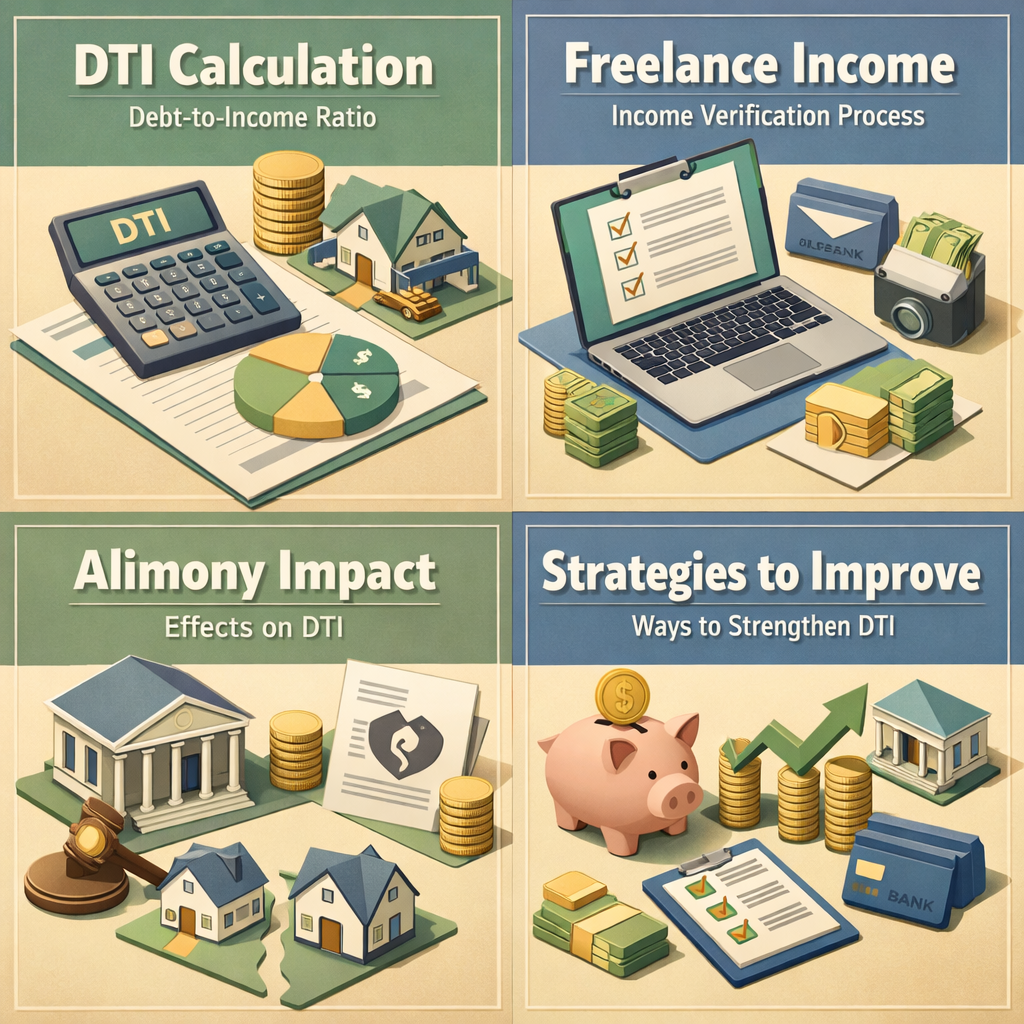
Let's walk through a practical example so the numbers become clearer. Suppose you're a freelance graphic designer who files taxes as a sole proprietor. Over the past two years, your net self-employment income after deductions was $54,000 in Year 1 and $66,000 in Year 2. Your average annual income over two years is $60,000, which translates to a gross monthly qualifying income of $5,000.
Now let's add your monthly obligations. You pay $400 per month in alimony, $300 in student loan payments, and $250 in auto loan payments. Your proposed new mortgage payment — including principal, interest, taxes, and insurance — would be approximately $1,400 per month. Here's how the back-end DTI calculation would look:
- Alimony payment: $400
- Student loan payment: $300
- Auto loan payment: $250
- Proposed mortgage payment: $1,400
- Total monthly debts: $2,350
Dividing $2,350 by $5,000 gives you a back-end DTI of 47%. For many conventional loan programs, this would exceed the preferred threshold. You might need to either reduce your debts, find ways to demonstrate a higher qualifying income, or explore loan programs with more flexible DTI requirements.
Now consider the reverse scenario: you're receiving $400 per month in alimony that is expected to continue for at least five more years. If your lender counts it as income, your gross monthly qualifying income rises to $5,400. Running the same calculation — but removing alimony from the debt column and adding it to the income column — your total monthly debts drop to $1,950, and your DTI improves to approximately 36%, which is within a very comfortable range for most lenders.
Strategies Freelancers Can Use to Strengthen Their DTI Profile
If your DTI is coming in higher than you'd like, there are several strategies that might help you improve your position before applying for a mortgage. It's worth exploring these options with a licensed mortgage professional, as the right approach will depend on your individual financial situation.
Reduce or Pay Down Existing Debts
Paying off a credit card balance or eliminating a small installment loan before applying can meaningfully lower your total monthly obligations. Even removing one debt from the calculation can shift your DTI by a few percentage points, which might be enough to move you into an approvable range. Prioritize debts with the highest monthly payments relative to their remaining balances.
Increase Your Qualifying Income
If your freelance income DTI calculation is being dragged down by heavy tax deductions, it may be worth discussing with your accountant whether reducing certain write-offs in the year prior to applying for a mortgage could increase your net qualifying income. This is a trade-off — you'd pay slightly more in taxes — but it could make homeownership more accessible. Some lenders offering non-QM programs may also accept bank statement income, which could reflect a higher income figure than your tax returns.
Consider a Larger Down Payment
A larger down payment reduces the loan amount, which lowers your proposed monthly payment and, in turn, reduces your front-end and back-end DTI. It also signals financial strength to lenders, which may help offset a DTI that's on the higher end of the acceptable range.
Explore Non-QM and Portfolio Loan Options
Not all mortgage products follow the same DTI rules. Non-qualified mortgage programs and portfolio loans held by individual lenders may have more flexibility when it comes to self-employed borrowers with irregular income streams. These programs often come with slightly higher interest rates, but they may provide a viable path to homeownership for freelancers who don't fit neatly into conventional qualification boxes.
Common Mistakes Freelancers Make When Applying for a Mortgage
Even well-prepared freelancers can stumble during the mortgage application process. Being aware of common pitfalls may help you avoid delays or denials.
Underestimating How Tax Deductions Affect Qualifying Income
Many freelancers are surprised to learn that the income lenders use for qualification is their net income — not their gross 1099 earnings. If you've maximized deductions to reduce your tax burden, your qualifying income may be much lower than expected. Planning ahead, ideally one to two years before applying, gives you time to adjust your strategy if needed.
Failing to Document Alimony Agreements Properly
Whether you're paying or receiving alimony, lenders will want to see a finalized legal agreement. Informal arrangements or verbal agreements typically won't be accepted. Make sure your divorce decree or separation agreement clearly outlines the payment amounts and duration, as lenders rely on this documentation to determine how alimony factors into your DTI.
Opening New Lines of Credit Before Closing
Taking on new debt — even something as routine as a store credit card — can raise your DTI and potentially jeopardize your loan approval. Avoid opening new accounts or making large purchases on credit from the time you apply until after your loan closes.
Not Shopping Multiple Lenders
Different lenders have different underwriting guidelines, especially when it comes to self-employed borrowers. One lender might view your freelance income structure unfavorably, while another may have more accommodating policies. Shopping around — and working with a mortgage broker who has access to multiple lenders — can be particularly valuable for borrowers with complex income profiles.
●Conclusion
Navigating the mortgage process as a freelancer with alimony in your financial picture isn't always simple, but it's absolutely manageable with the right preparation. Understanding how to calculate DTI with freelance 1099 income and alimony payments gives you a clear starting point for evaluating your mortgage readiness and identifying areas for improvement. Whether you're paying or receiving alimony, the key is documentation, planning, and working with a lender who understands the nuances of self-employment income. At LoanWise, we're here to help borrowers like you find the right loan program for your unique situation. Reach out to one of our mortgage specialists today to get a personalized DTI review and explore your home financing options.