
Qualifying for a conventional loan can feel like an uphill battle when your income doesn't come from a traditional paycheck. If you're a freelancer, independent contractor, or self-employed professional who receives 1099 income, you may already know that lenders tend to scrutinize your finances more closely. Add child support into the equation — whether you're receiving it or paying it — and the process can feel even more complicated. But here's the good news: it's entirely possible to qualify for a conventional loan with 1099 income and child support. With the right preparation, documentation, and understanding of how lenders evaluate non-traditional income, you can position yourself as a strong borrower and move closer to homeownership.
Understanding How Lenders View 1099 Income for Mortgage Qualification
When a lender evaluates your mortgage application, one of the first things they'll examine is your income stability and consistency. For W-2 employees, this is relatively straightforward — a pay stub or employer letter often does the job. For 1099 earners, lenders typically require a deeper look into your financial history to confirm that your income is reliable and likely to continue.
Under conventional loan requirements for 1099 income, lenders generally want to see at least two years of self-employment history. This means two years of federal tax returns — both personal and, if applicable, business returns — are usually required. Lenders will often average your net income over those two years to arrive at a qualifying figure. It's worth noting that this could work against you if your business deductions significantly reduce your taxable income, which is a common situation for self-employed individuals.
Some lenders may also accept 1099 forms and bank statements as supplemental documentation to help paint a fuller picture of your earning capacity. If your most recent year's income is substantially higher than the prior year, lenders might use only the most recent year's figures — but this varies by lender and loan program guidelines. Working with a mortgage professional who understands self-employed borrower scenarios can make a significant difference in how your income is calculated and presented.
Key Conventional Loan Requirements for Self-Employed Borrowers
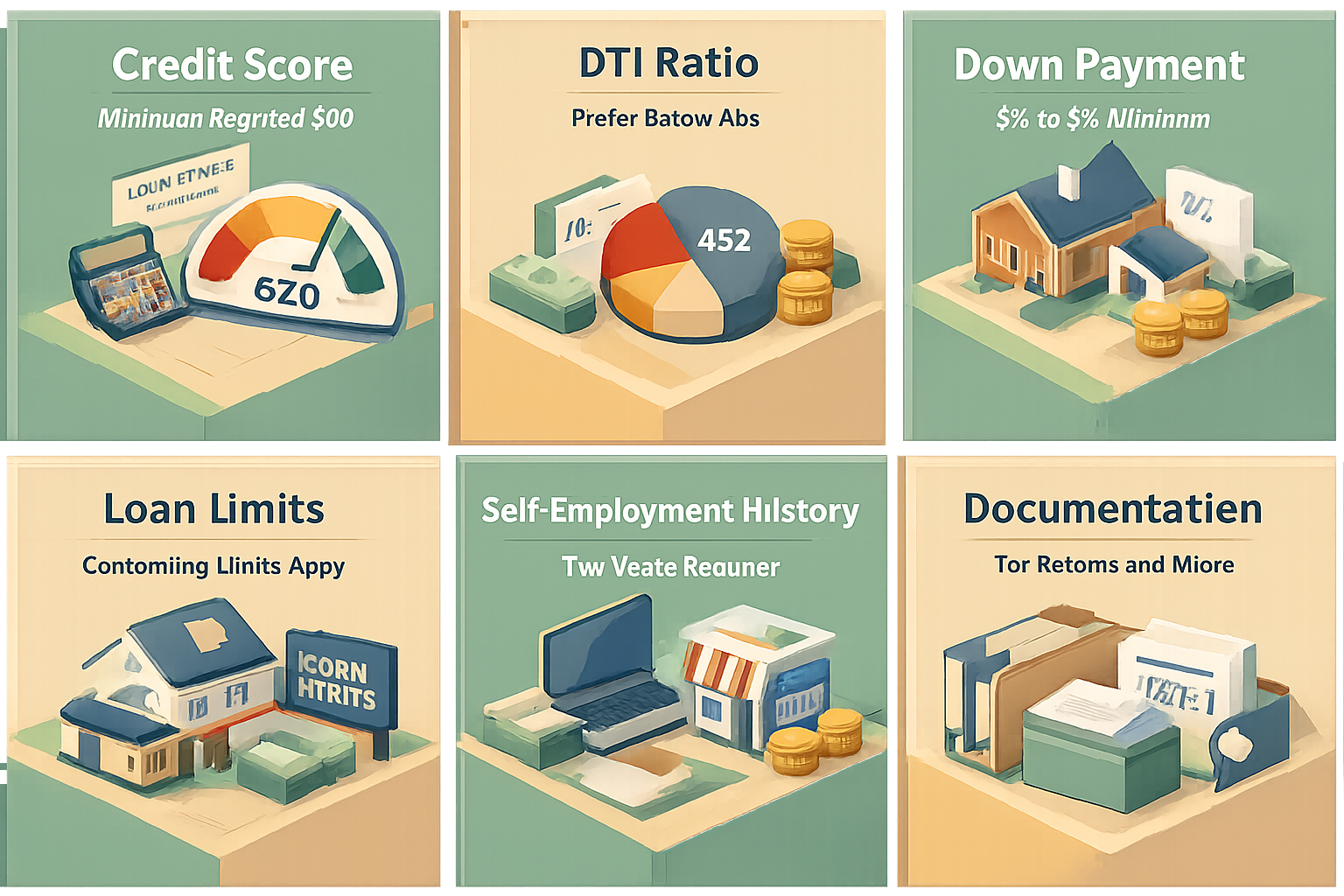
Beyond income documentation, there are several core conventional loan requirements that all borrowers — including self-employed individuals — must meet. Understanding these benchmarks can help you identify where you stand and what areas may need improvement before you apply.
- Credit Score: Conventional loans typically require a minimum credit score of 620, though a higher score — ideally 740 or above — can help you secure more favorable interest rates and terms.
- Debt-to-Income Ratio (DTI): Lenders generally prefer a DTI ratio at or below 45%, though some loan programs may allow up to 50% with compensating factors. Your total monthly debt obligations, divided by your gross monthly income, must fall within this range.
- Down Payment: Conventional loans often require a minimum down payment of 3% to 5%, though putting down 20% or more eliminates the need for private mortgage insurance (PMI).
- Loan Limits: Conventional loans must stay within conforming loan limits set by the Federal Housing Finance Agency (FHFA), which are updated annually.
- Self-Employment History: As noted, two years of documented self-employment history is typically expected, though some lenders may consider borrowers with one year of self-employment under specific circumstances.
Meeting these benchmarks as a 1099 earner is absolutely achievable — it simply requires more thorough preparation and documentation than what a salaried employee might need to provide.
How Child Support Affects Your Mortgage Application
Child support can influence your mortgage qualification in two very different ways, depending on whether you're the one receiving it or paying it. Understanding both sides of the equation is essential when you're learning how to qualify for a conventional loan with 1099 income and child support.
If You Receive Child Support
Child support income can be counted as qualifying income for a conventional mortgage, but lenders typically have specific requirements before they'll include it. Generally, you'll need to demonstrate that the payments are consistent, documented, and likely to continue for at least three years from the date of your mortgage application. Documentation usually includes a copy of your divorce decree or legal separation agreement, along with bank statements or deposit records showing you've been receiving the payments consistently — often for the past 12 months.
If the payments are irregular or the paying party has a history of missed payments, lenders may be hesitant to include this income in their calculations. Stability and continuity are key factors lenders look for when evaluating non-wage income sources.
If You Pay Child Support
On the other side, if you're obligated to pay child support, those payments are counted as part of your monthly debt obligations when calculating your DTI ratio. This can meaningfully reduce your purchasing power, especially if you're already managing business expenses or other debts. If your DTI is borderline, child support payments could tip the ratio beyond acceptable limits. In this case, strategies such as paying down other debts, increasing your documented income, or saving a larger down payment may help bring your DTI within qualifying range.
Documenting Your Income: What Self-Employed Borrowers Need to Gather
Strong documentation is the cornerstone of a successful mortgage application for any 1099 earner. Because lenders can't simply call your employer to verify your income, they rely heavily on the paper trail you provide. Being organized and proactive about gathering your documents can speed up the approval process and reduce the likelihood of delays or denials.
Here's what lenders typically request from self-employed borrowers applying for a conventional loan:
- Two years of personal federal tax returns — including all schedules, particularly Schedule C for sole proprietors
- Two years of business tax returns — if you operate as an LLC, S-Corp, or partnership
- Year-to-date profit and loss (P&L) statement — often prepared by a CPA or licensed tax professional
- 1099 forms — from all clients or payers over the past two years
- Business bank statements — typically 12 to 24 months, to demonstrate consistent cash flow
- Personal bank statements — to show financial reserves and verify income deposits
- Business license or CPA letter — to confirm active self-employment status
If you're also including child support as qualifying income, add your legal support agreement and 12 months of bank statements showing receipt of those payments to your documentation package. The more organized and complete your file, the smoother your application journey is likely to be.
Strategies to Strengthen Your Application as a 1099 Borrower
If you're serious about homeownership, there are practical steps you can take right now to strengthen your application. These strategies apply whether you're in the early planning stages or preparing to apply within the next few months.
Minimize Business Deductions Strategically
One of the most common challenges for self-employed borrowers is that aggressive tax deductions — while financially smart — can dramatically reduce your net income on paper. Since lenders use your taxable net income rather than your gross revenue to calculate qualifying income, a lower net income means a lower loan amount. In the year or two before you plan to apply, you might consider working with a tax advisor to find the right balance between deductions and qualifying income.
Build Up Your Cash Reserves
Lenders feel more confident when self-employed borrowers have strong cash reserves. Having several months' worth of mortgage payments sitting in a savings or investment account signals financial resilience — especially important for borrowers with variable income. Some loan programs may have specific reserve requirements, and exceeding those minimums can work in your favor.
Improve and Protect Your Credit Score
Your credit score remains one of the most important factors in any mortgage application. Pay all bills on time, avoid opening new lines of credit in the months before applying, and keep your credit utilization low. Even a modest improvement in your credit score can open the door to better rates and more favorable terms.
Work with an Experienced Mortgage Professional
Not all lenders handle self-employed borrower files the same way. Partnering with a loan officer who has specific experience with conventional loan requirements for 1099 income and self-employed borrowers can make a real difference in how your application is structured and presented to underwriters.
Exploring Fannie Mae and Freddie Mac Guidelines for Non-Traditional Income
Conventional loans are governed by guidelines set by Fannie Mae and Freddie Mac, the two government-sponsored enterprises that purchase and securitize most conventional mortgages in the United States. Both agencies have detailed guidelines about how self-employment income and other non-traditional income sources — including child support — should be evaluated and documented.
Fannie Mae's guidelines, for example, outline specific methods for calculating self-employment income from Schedule C, S-Corp returns, and partnership returns. These guidelines allow lenders to add back certain non-cash deductions — such as depreciation and depletion — to your net income, which may result in a higher qualifying income than the taxable figure alone suggests. This is another reason why working with an experienced lender who understands these nuances can be especially valuable for 1099 borrowers.
Freddie Mac similarly provides guidance on variable income, including 1099-based earnings, and both agencies recognize child support as an eligible income source when it meets continuity and documentation requirements. Being aware of these agency guidelines — and ensuring your lender is applying them correctly — can give you confidence that your application is being evaluated fairly and thoroughly.
It's also worth noting that lenders have some discretion in how they apply these guidelines, and some may impose overlays — additional requirements beyond what Fannie Mae or Freddie Mac mandate. If one lender's overlays make it difficult for you to qualify, another lender operating under the same core guidelines might have a more flexible approach for self-employed applicants.
●Conclusion
Learning how to qualify for a conventional loan with 1099 income and child support is all about preparation, documentation, and understanding how lenders evaluate non-traditional income. While the process may require more effort than a standard W-2 application, it's far from impossible. Thousands of self-employed homebuyers successfully secure conventional financing every year by working with knowledgeable mortgage professionals, organizing their financial records, and strategically positioning their income profiles. Whether you're receiving child support that strengthens your qualifying income or navigating the DTI impact of support payments, every piece of your financial picture matters. At LoanWise, we're here to help you understand your options, make sense of the requirements, and take confident steps toward the home you deserve. Reach out to a LoanWise mortgage specialist today to start building your personalized path to approval.