
Tapping into your home's equity through a home equity line of credit can be a smart financial move — especially when your property includes unique features like an accessory dwelling unit or an adjacent vacant lot. But understanding HELOC requirements for property with existing accessory dwelling unit and vacant lot situations is more nuanced than a standard single-family application. Lenders often take a closer look at how these features affect your property's appraised value, its income potential, and the overall risk profile of the loan. Whether you're a homeowner looking to fund renovations, a real estate investor seeking to leverage equity, or a refinancer exploring your options, this guide walks you through what you need to know before you apply.
What Is a HELOC and How Does It Work for Complex Properties
A home equity line of credit, commonly known as a HELOC, is a revolving credit line secured by the equity in your home. Unlike a traditional mortgage or home equity loan, a HELOC lets you borrow only what you need, when you need it, up to a set credit limit — similar to how a credit card works. During the draw period, which typically lasts five to ten years, you can access funds and make interest-only payments. After that, the repayment period begins, and you'll pay down both principal and interest.
For most homeowners, this is straightforward. But when your property includes an accessory dwelling unit — such as a detached guest house, garage apartment, or in-law suite — or an adjacent vacant lot, lenders may treat your application differently. These features can influence how the property is classified, how it's appraised, and ultimately how much equity lenders will allow you to access. Understanding the distinction upfront can save you significant time and frustration during the approval process.
Lenders typically rely on a licensed appraiser to determine your property's current market value. When an ADU or vacant lot is present, the appraiser must decide how to incorporate those elements into the overall valuation. This process can vary based on local zoning, comparable sales data, and lender-specific guidelines — making it important to work with a lender experienced in these types of properties.
How an Accessory Dwelling Unit Affects HELOC Eligibility and Valuation
An accessory dwelling unit is a secondary residential structure located on the same lot as the primary home. It may be attached — like a basement apartment — or detached, like a backyard cottage. In recent years, ADUs have grown in popularity as homeowners look to generate rental income or house extended family members. However, from a lending standpoint, the presence of an ADU introduces a few important considerations.
First, lenders will want to verify that the ADU is legal and permitted under local zoning laws. An unpermitted ADU could raise red flags during the appraisal and may even limit your ability to qualify for a HELOC. If the unit was built without proper permits, lenders might discount its value or exclude it from the appraisal altogether. In some cases, they may decline the application or require the borrower to address the permitting issue before proceeding.
Second, if your ADU is currently rented out, lenders may factor the rental income into their assessment of your financial profile. This could work in your favor by strengthening your debt-to-income ratio — a key metric lenders use to gauge your ability to repay. However, documentation will likely be required, such as a signed lease agreement and proof of rental income from recent tax returns.
Third, an ADU that adds livable square footage and genuine utility to a property can meaningfully boost its appraised value, which in turn increases the equity available for a HELOC. Properties with well-maintained, permitted ADUs may be viewed more favorably than those without, particularly in markets where rental demand is strong. That said, how much value the ADU contributes will depend on local market conditions and the appraiser's professional judgment.
Vacant Lot Equity: Can It Help or Hurt Your HELOC Application
A vacant lot adjacent to or included with your primary residence adds another layer of complexity when you're exploring accessory dwelling unit financing or a HELOC. Whether that lot helps or hurts your application largely depends on how lenders and appraisers treat it.
In many cases, a vacant lot attached to your parcel may be included in the overall property appraisal, which could increase the total appraised value and therefore the usable equity. This is particularly common when both the primary home equity and the lot share a single parcel number. However, if the vacant lot is on a separate parcel, lenders may treat it as a distinct asset — and some lenders may not include it in the collateral for a HELOC at all.
Lenders tend to be cautious about vacant lot equity because undeveloped land is generally harder to sell quickly in a foreclosure scenario. This perceived liquidity risk can cause some lenders to apply stricter loan-to-value requirements or to limit the credit line accordingly. It's worth noting that lender policies on this vary, so shopping around and speaking with multiple lenders is a practical strategy.
On the other hand, if the vacant lot has development potential — such as approved zoning for an additional dwelling unit — its value in the eyes of a well-informed appraiser could be meaningful. In high-demand real estate markets, developable lots adjacent to existing homes may command strong valuations. Homeowners in these situations may find that their overall property equity is more substantial than they initially expected.
Core HELOC Requirements Lenders Typically Evaluate
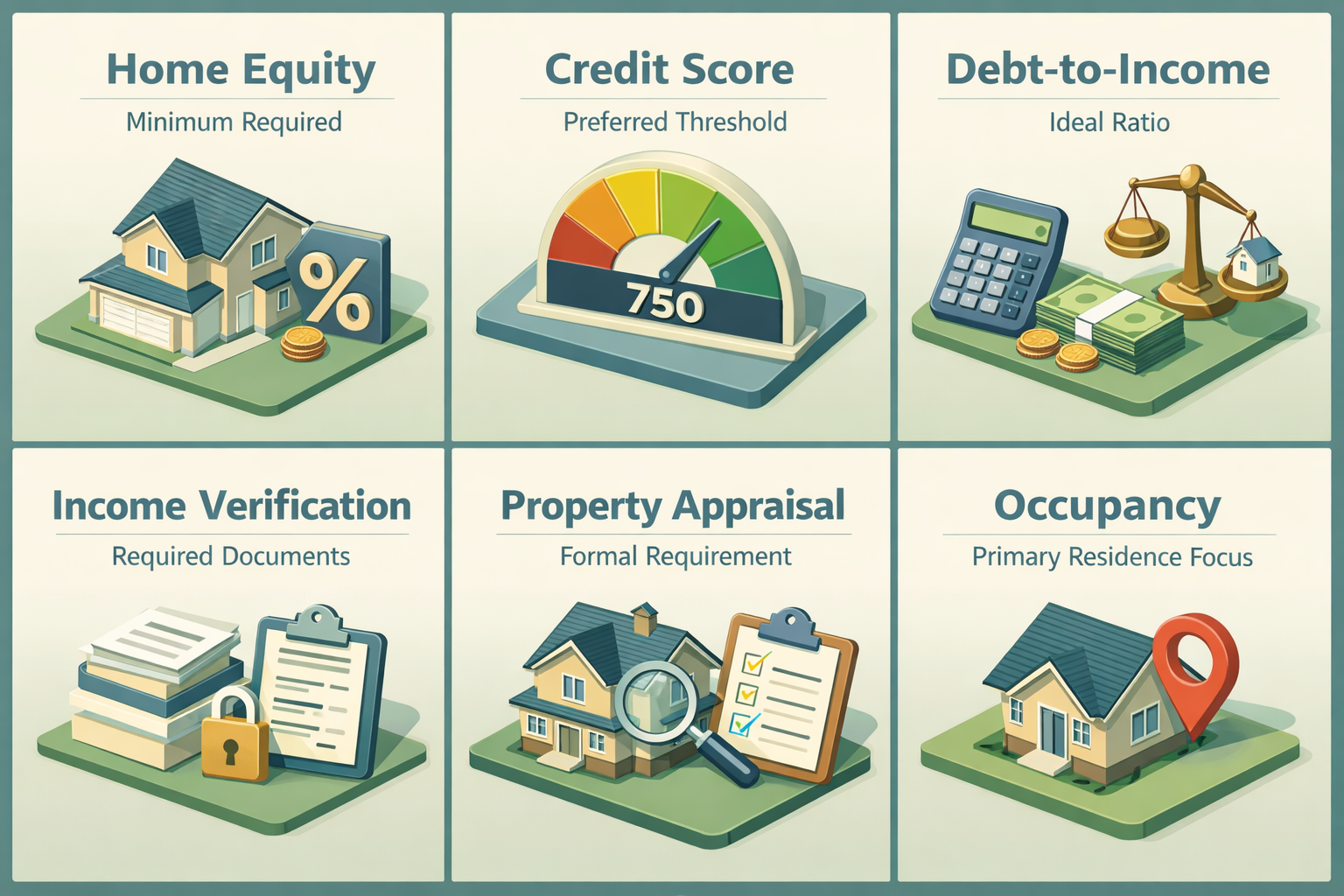
Regardless of whether your property includes an ADU or a vacant lot, most lenders apply a consistent set of HELOC requirements when evaluating your application. Understanding these benchmarks can help you prepare and potentially strengthen your position before you apply.
- Home Equity: Lenders generally require that you retain at least 15% to 20% equity in your home after the HELOC is established. This means if your home is appraised at a certain value, your combined mortgage balance and HELOC limit typically cannot exceed 80% to 85% of that value — a metric known as the combined loan-to-value ratio, or CLTV.
- Credit Score: A credit score of at least 620 is commonly cited as a minimum threshold, though many lenders prefer scores of 680 or higher for competitive rates and terms. Borrowers with stronger credit profiles may access higher credit limits and more favorable interest rates.
- Debt-to-Income Ratio: Lenders typically look for a debt-to-income (DTI) ratio below 43%, although some lenders may allow higher ratios depending on compensating factors like strong credit or significant equity.
- Income Verification: Expect to provide recent pay stubs, W-2 forms, or tax returns. Self-employed borrowers may need to supply two years of tax returns and profit-and-loss statements.
- Property Appraisal: A formal appraisal is almost always required. For properties with ADUs or vacant lots, the appraisal process may take longer and involve additional scrutiny.
- Occupancy: Most HELOC products are designed for primary residences, though some lenders do offer HELOCs on investment properties or second homes — often at stricter terms.
Meeting these requirements is the foundation of a successful HELOC requirements application. Properties with ADUs and vacant lots may introduce additional documentation needs, but they don't automatically disqualify you from accessing your equity.
Understanding HELOC Requirements for Property with Existing Accessory Dwelling Unit and Vacant Lot: What Lenders Want to See
When it comes to understanding HELOC requirements for property with existing accessory dwelling unit and vacant lot scenarios specifically, lenders are going to focus on a few additional areas beyond the standard checklist. Being prepared with the right documentation and knowledge can make the process smoother.
Zoning and Permit Documentation: Lenders and appraisers will likely request documentation confirming that your ADU is legally permitted. This may include building permits, a certificate of occupancy, or a letter from your local municipality. For the vacant lot, zoning verification and any existing surveys or plat maps may also be requested.
Property Classification: Lenders need to determine how to classify your property. Is it a single-family home with an ADU? A multi-family property? The classification affects which loan programs apply and which underwriting guidelines govern the application. Properties that blend residential use with additional structures can sometimes fall into gray areas, so clear communication with your lender is essential.
Appraisal Comparables: For properties with ADUs and vacant lots, appraisers may have difficulty finding true comparable sales — often called "comps" — in your area. A lack of comps can result in a more conservative appraisal. In some cases, the appraiser may need to make adjustments based on cost approach or income approach methods rather than purely comparable sales.
Title and Legal Description: If the vacant lot is on a separate parcel, lenders will want to understand the legal relationship between the parcels. Some lenders may require both parcels to be consolidated into one, while others may simply focus on the primary parcel for collateral purposes.
Working with a lender who has experience with non-standard or complex properties is one of the most valuable steps you can take. They'll be better equipped to guide you through these specific documentation requirements and help set realistic expectations.
Strategies to Strengthen Your Application and Maximize Approval Odds
If you're planning to apply for a home equity line of credit on a property that includes an ADU or a vacant lot, a few proactive strategies may improve your chances of approval and help you secure more favorable terms.
- Get Your ADU Permitted: If your accessory dwelling unit was built without permits, consider working with your local building department to bring it into compliance before applying. This can meaningfully affect both the appraisal value and lender acceptance.
- Order a Pre-Appraisal: Some homeowners choose to commission a private appraisal before formally applying. This can give you a realistic sense of your property's value and potential equity — helping you avoid surprises during the lender's formal appraisal.
- Reduce Your Existing Debt: Paying down credit cards or other revolving debt before applying can lower your DTI ratio and potentially boost your credit score, making you a more attractive borrower.
- Document Rental Income Thoroughly: If your ADU is rented out, gather documentation well in advance. Lease agreements, bank deposit records, and Schedule E from your tax return are all commonly requested.
- Shop Multiple Lenders: HELOC guidelines can vary significantly from one lender to another, especially for properties with unique characteristics. Community banks, credit unions, and portfolio lenders may have more flexible underwriting criteria for complex properties than larger national institutions.
- Consult a Mortgage Professional: A knowledgeable mortgage advisor can review your specific situation, explain how your property's features may be treated, and connect you with lenders who are well-suited for your needs.
●Conclusion
Navigating understanding HELOC requirements for property with existing accessory dwelling unit and vacant lot situations doesn't have to feel overwhelming. With the right preparation, documentation, and professional guidance, many homeowners are able to successfully access the equity in these types of properties. The key is to approach the process with realistic expectations, to work with lenders experienced in complex property types, and to ensure that all structures and parcels are well-documented and legally compliant.
At LoanWise, we're here to help you explore your home equity options — no matter how unique your property may be. Whether you're a homeowner, a real estate investor, or someone considering a refinance, our team can help you understand what lenders are looking for and how to position your application for success. Reach out to a LoanWise mortgage advisor today to start the conversation and take the next step toward unlocking your property's full potential.