
For real estate investors and high-net-worth borrowers with international holdings, understanding how to qualify for a jumbo loan with foreign rental property income and US property can open the door to significant financing opportunities. Jumbo loans — mortgages that exceed conforming loan limits set by Fannie Mae and Freddie Mac — come with stricter qualification standards than conventional loans. When you add foreign rental income to the equation, the process becomes even more nuanced. Lenders must carefully verify income that originates outside the United States, which means borrowers need to be well-prepared with the right documentation and a clear understanding of what underwriters are looking for. The good news is that with the right approach, qualifying is entirely achievable.
What Makes Jumbo Loans Different From Conventional Mortgages
Jumbo loans are designed for borrowers purchasing or refinancing high-value properties that exceed the conforming loan limits established each year by the Federal Housing Finance Agency (FHFA). Because these loans can't be purchased by Fannie Mae or Freddie Mac, lenders assume greater risk — and that risk is reflected in stricter qualification requirements.
Typically, jumbo loan lenders look for stronger credit profiles, larger down payments, and more substantial financial reserves than what's required for conforming loans. Credit score thresholds often start around 700 or higher, though some lenders may require scores closer to 720 or 740 for loan amounts in the higher ranges. Down payment requirements frequently range from 10% to 20% or more, depending on the loan amount and lender guidelines.
Debt-to-income (DTI) ratios are also scrutinized more carefully. While conventional loans may allow DTIs up to 45% or even 50% in some cases, jumbo lenders often prefer to see DTIs closer to 43% or lower. Cash reserves — funds available after closing — are another major factor. Many jumbo lenders require borrowers to demonstrate anywhere from six to twelve months of mortgage payments held in liquid or semi-liquid accounts.
Understanding these baseline requirements is essential before you layer in the additional complexity of foreign rental income. Meeting the core jumbo standards gives your application a solid foundation.
How Lenders View Foreign Rental Property Income
Foreign rental income introduces a layer of complexity that not all lenders are equipped or willing to handle. Because the income originates outside the US regulatory framework, verifying its stability, consistency, and legitimacy requires additional due diligence on the lender's part.
In general, lenders want to see that foreign rental income is stable, recurring, and likely to continue. They may apply a discount to foreign rental income — meaning they might only count a portion of it toward your qualifying income. Some lenders use 75% of gross rental income as a baseline after factoring in vacancy and expenses, similar to how they treat US rental income, but guidelines can vary significantly by lender and loan program.
It's also worth noting that not all jumbo lenders accept foreign rental income at all. Portfolio lenders — those who keep loans on their own books rather than selling them on the secondary market — tend to have more flexible guidelines and may be more open to using international income sources. Working with a mortgage broker or lender experienced in non-QM or portfolio jumbo products can make a meaningful difference in your chances of approval.
Currency risk is another consideration. If your rental income is denominated in a foreign currency, lenders may apply additional scrutiny due to exchange rate fluctuations that could affect the reliability of that income stream over time.
Essential Documentation for Foreign Rental Income Verification
When it comes to documenting foreign rental income, more is generally better. Lenders will want to establish a clear paper trail that demonstrates the income is real, consistent, and expected to continue. While specific requirements vary by lender, here are the types of documentation commonly requested:
- Foreign tax returns: Two years of tax returns from the country where the rental property is located, translated into English by a certified translator if necessary.
- Lease agreements: Current signed lease agreements for the foreign rental property, also translated if applicable.
- Bank statements: Twelve to twenty-four months of bank statements showing regular rental deposits, ideally in a US or internationally recognized account.
- Property ownership documentation: Title or deed records confirming your ownership of the foreign property.
- US tax returns: If you report foreign rental income on your US tax returns (as required for US citizens and permanent residents), Schedule E or equivalent documentation is typically expected.
- Currency exchange records: Documentation showing how foreign income is converted to US dollars, if applicable.
Borrowers who are not US citizens may also need to provide additional documentation related to their visa status, residency, and eligibility to hold a US mortgage. Foreign nationals purchasing US property face their own set of requirements, which we'll explore in the next section.
Qualifying as a Foreign National With US Property and Overseas Income
For foreign nationals — non-US citizens who don't hold a green card or permanent residency — the path to a jumbo loan on a US property involves specialized loan programs. Standard conforming loan programs are generally not available to foreign nationals, but portfolio lenders and certain non-QM lenders do offer jumbo mortgage products tailored to this borrower profile.
In these scenarios, the lender is effectively underwriting the loan without the ability to rely on US credit history, US tax returns, or US income verification in the traditional sense. Rental income from overseas properties becomes a central part of the income picture, which means its documentation must be especially thorough.
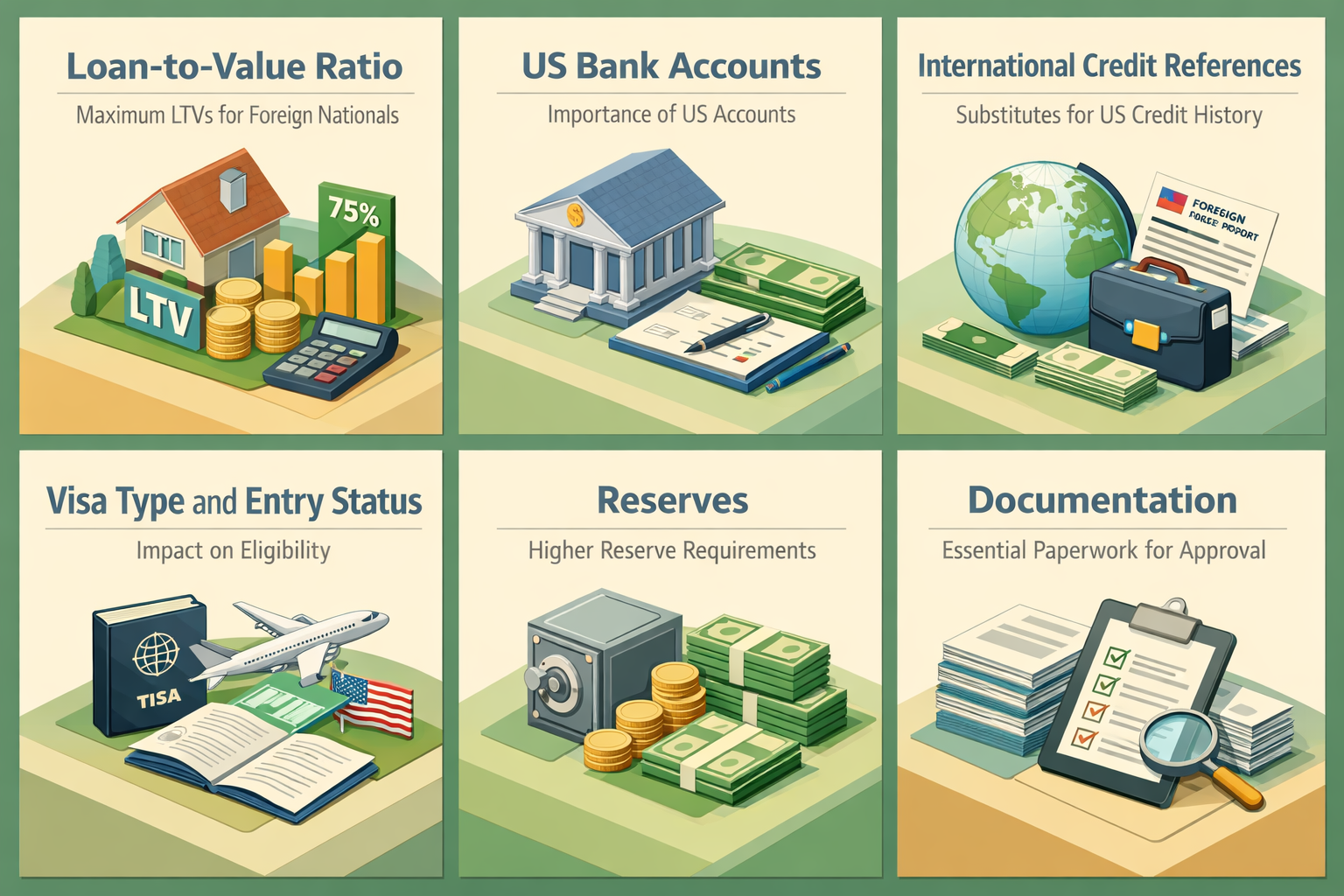
Key factors lenders typically evaluate for foreign national jumbo borrowers include:
- Loan-to-value (LTV) ratio: Foreign national borrowers may face lower maximum LTVs, often around 65% to 75%, meaning larger down payments are typically required.
- US bank accounts: Lenders often prefer that borrowers maintain funds in US-based accounts, as this demonstrates a financial connection to the US and simplifies asset verification.
- International credit references: Some lenders accept credit reports or bank reference letters from foreign financial institutions as a substitute for a US credit history.
- Visa type and entry status: The borrower's visa classification can affect eligibility. Certain visa categories may restrict or complicate mortgage qualification.
- Reserves: Reserve requirements for foreign national jumbo loans are often higher — sometimes twelve months or more of total housing payments.
Working with a lender who specializes in jumbo loan foreign rental income US property scenarios is strongly recommended, as general mortgage lenders may not have the expertise or product options to accommodate this borrower type.
Debt-to-Income Ratios and How Foreign Income Is Calculated
Your debt-to-income ratio plays a critical role in jumbo loan qualification, and understanding how lenders calculate it when foreign rental income is involved is essential. DTI compares your total monthly debt obligations — including the proposed new mortgage payment — to your gross monthly income.
When lenders include foreign rental income in your qualifying income, they typically don't use the full gross rent amount. Instead, they may apply a vacancy factor or expense adjustment, much like they do with US rental income reported on Schedule E. If your foreign rental income is reported on US taxes, underwriters may use the net rental income after expenses as shown on your tax returns. If no US tax documentation exists, lenders may apply their own internal adjustment — often discounting gross rent by 25% or more to account for vacancy, maintenance, and management costs.
This means it's important to understand your effective qualifying income before applying. For example, if your foreign property generates $3,000 per month in gross rent, a lender using a 75% income factor might count only $2,250 toward your qualifying income. Running these numbers in advance — ideally with a mortgage professional familiar with international income scenarios — helps you set realistic expectations and target the right loan amount.
Strong US-based income, if available, can complement foreign rental income and reduce the complexity of your application. Borrowers with a combination of domestic employment income and foreign rental income are often viewed more favorably than those relying solely on overseas sources.
Strategies to Strengthen Your Jumbo Loan Application
Qualifying for a jumbo loan with foreign rental income requires a proactive approach. Here are strategies that may improve your chances of approval and potentially secure better loan terms:
- Report foreign income on US taxes: If you're a US citizen or permanent resident, reporting your foreign rental income on your federal tax return — even if you receive a foreign tax credit — creates a verifiable domestic paper trail that lenders can more easily use.
- Maintain consistent income history: Lenders want to see at least two years of consistent foreign rental income. Gaps, new leases, or recently acquired properties may not qualify as stable income.
- Build substantial US-based reserves: Keeping significant liquid assets in US bank accounts demonstrates financial strength and reduces lender risk, potentially offsetting concerns about foreign income volatility.
- Work with a portfolio or non-QM lender: These lenders have more flexibility in how they evaluate income and may offer programs specifically designed for borrowers with international income sources.
- Consider a larger down payment: Reducing your loan-to-value ratio by putting more money down can make your application more attractive, particularly if your income documentation is complex.
- Hire a CPA experienced in international taxation: A tax professional who understands both US and foreign tax law can help you organize your financial records in a way that satisfies lender requirements.
- Get a certified translation of all foreign documents: Lenders typically require that foreign-language documents be translated by a certified professional. Having these ready in advance speeds up the underwriting process.
The more organized and well-documented your financial profile is, the smoother the qualification process tends to be — even with the added complexity of international income.
Finding the Right Lender for Your Unique Borrower Profile
Not every lender is equipped to handle the nuances of how to qualify for a jumbo loan with foreign rental property income and US property. Choosing the right lending partner may be just as important as the strength of your financial profile itself.
Portfolio lenders — typically community banks, private banks, and select mortgage companies — are often the best fit for borrowers in this situation. Because they retain the loans they originate rather than selling them to the secondary market, they can set their own underwriting guidelines and may be more willing to consider foreign income sources.
Non-QM (non-qualified mortgage) lenders are another strong option. These lenders specialize in borrowers who fall outside conventional underwriting guidelines — including self-employed borrowers, those with complex income structures, and foreign nationals. Many non-QM lenders have specific programs designed to accommodate foreign rental income and may use bank statement analysis or asset depletion methods as alternative income verification tools.
When evaluating lenders, ask directly whether they accept foreign rental income for jumbo loans, what documentation they require, and whether they have experience with borrowers in your specific situation. A lender who hesitates or seems unfamiliar with the scenario may not be the right partner for your application.
A knowledgeable mortgage broker can also be an invaluable resource. Brokers have access to multiple lenders and can help strengthen your application by matching your unique financial profile to a lender whose guidelines align with your situation — saving you time, effort, and the potential impact of multiple hard credit inquiries.
●Conclusion
Navigating jumbo loan foreign rental income US property qualification is undeniably complex, but it's far from impossible. With the right preparation, thorough documentation, and a lending partner who understands international income scenarios, borrowers with overseas rental holdings can successfully secure jumbo financing on US property. The key is to start early — gather your financial records, work with experienced professionals, and take the time to find a lender who specializes in this type of borrower profile. At LoanWise, we understand that today's real estate investors and high-value borrowers often have global financial footprints. Reach out to our team to explore jumbo loan options tailored to your unique situation and take the next step toward your US property goals.