
Purchasing a high-value home in the United States while relying partly on income from overseas rental properties is a challenge that more borrowers are facing today. Whether you're a foreign national building wealth in the US, an expat returning home, or a real estate investor with an international portfolio, understanding how to qualify for a jumbo loan with foreign property rental income and US co-signer support can open doors that might otherwise seem firmly closed. Jumbo loans — those that exceed conforming loan limits set by the Federal Housing Finance Agency — come with stricter underwriting standards, and adding cross-border income to the picture introduces an extra layer of complexity. The good news is that with the right preparation, documentation, and lending partner, approval is absolutely achievable.
What Makes Jumbo Loans Different From Conventional Financing
Before diving into the specifics of foreign income and co-signers, it helps to understand why jumbo loans operate under a different set of rules. Because these loans exceed conforming limits — which in most US markets means loan amounts above $766,550 as of recent guidelines — they cannot be purchased by Fannie Mae or Freddie Mac. That means lenders carry the risk entirely on their own books or sell them to private investors.
As a result, jumbo lenders tend to apply more rigorous qualification criteria. Borrowers typically need stronger credit scores, larger cash reserves, lower debt-to-income (DTI) ratios, and more substantial down payments compared to conventional loan applicants. Most lenders look for credit scores of at least 700 to 720, though some portfolio lenders may accept slightly lower scores depending on other compensating factors.
These stricter standards make documentation quality especially important. Every source of income must be clearly verified, consistent, and traceable — and that's where foreign rental income can become particularly tricky to present in a way lenders find acceptable.
How Lenders View Foreign Property Rental Income
Rental income from overseas properties is not automatically disqualifying — but it does require careful handling. Lenders who consider jumbo loan foreign income from overseas rental properties want to see that the income is stable, verifiable, and likely to continue. Most underwriters will treat foreign rental income similarly to domestic rental income, though they may apply additional scrutiny or apply a larger vacancy factor when calculating eligible income.
Here's what lenders typically look for when evaluating overseas rental income:
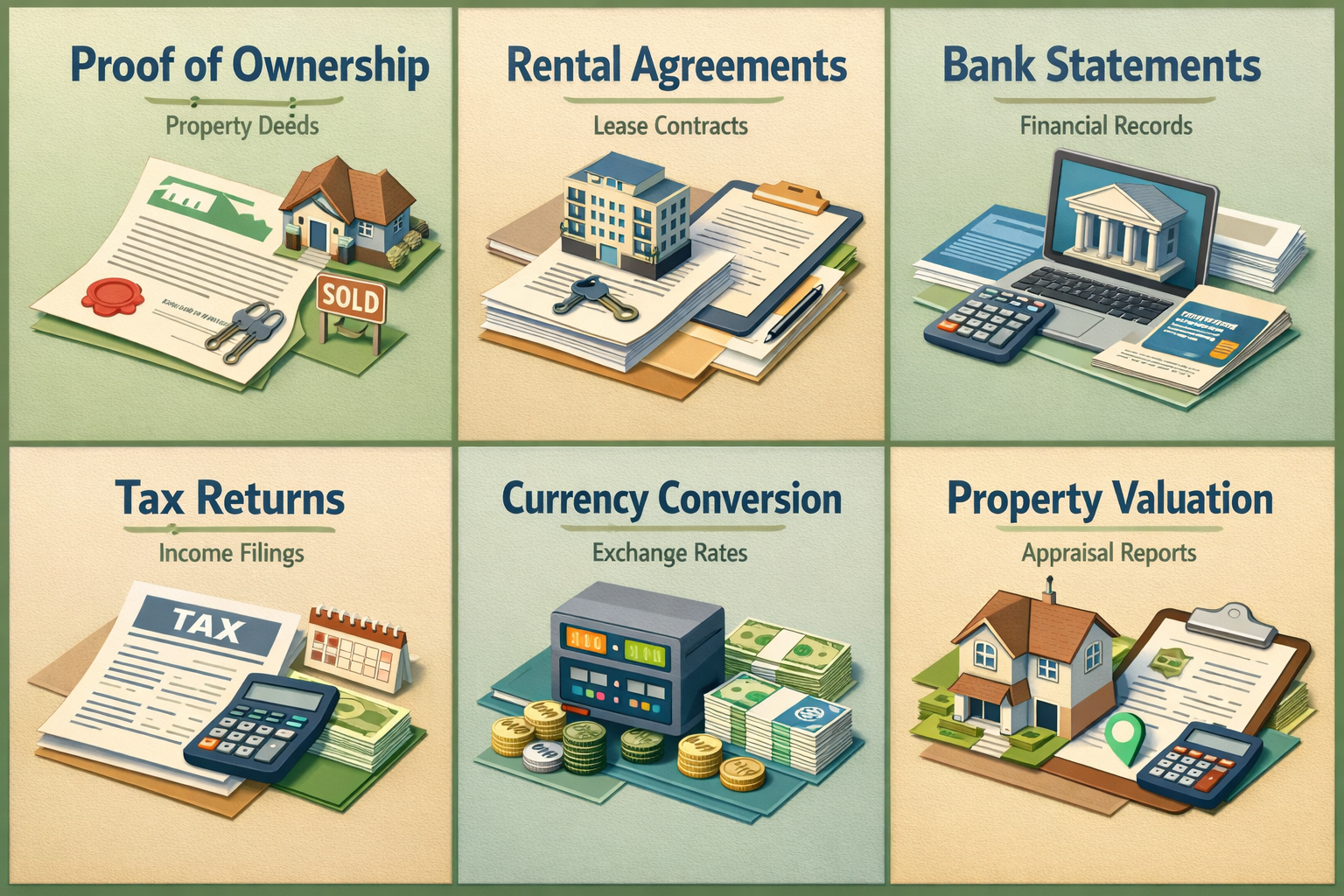
- Proof of ownership: A deed, title document, or official property registration from the country where the property is located, ideally translated into English by a certified translator.
- Rental agreements or lease contracts: Copies of current leases, translated if necessary, showing the tenant, rental amount, and lease term.
- Bank statements: At least 12 to 24 months of bank statements showing consistent rental deposits, ideally from a US-based account where the funds have been transferred.
- Tax returns or foreign tax documentation: Evidence that rental income has been reported, either on a US tax return (if the borrower is a US taxpayer) or on foreign tax filings that a lender's underwriter can evaluate.
- Currency conversion history: A consistent record of converting foreign currency to US dollars, which lenders may use to account for exchange rate risk.
It's worth noting that not all lenders accept foreign rental income at all. Portfolio lenders, private banks, and non-QM (non-qualified mortgage) lenders are often more flexible than conventional jumbo lenders, and they may be the best fit for borrowers relying on international income streams.
The Role of a US Co-Signer in Strengthening Your Application
A US co-signer can be a powerful tool for borrowers whose income or credit profile doesn't fully meet a lender's jumbo requirements on its own. When a creditworthy US-based individual agrees to co-sign the loan, their income, assets, and credit history are added to the application — potentially making approval more likely and improving the loan's terms.
A co-signer US property arrangement works by having both the primary borrower and the co-signer legally responsible for repaying the loan. This reduces the lender's risk, which is especially meaningful in a jumbo loan with overseas rental income where the loan balance is substantial.
Ideal co-signers for a jumbo loan typically include:
- A US citizen or permanent resident with strong, verifiable domestic income
- Someone with a credit score of 720 or higher
- An individual with low existing debt obligations relative to their income
- A family member, spouse, or business partner with documented financial stability
It's important to understand that co-signing is a significant financial commitment. The co-signer's credit will be affected by the loan, and if the primary borrower defaults, the co-signer becomes fully liable. Both parties should fully understand this responsibility before proceeding.
Lenders will underwrite the combined application, meaning they'll review both borrowers' income, debts, credit, and assets together. When foreign rental income is the primary borrower's main qualifying income source, a strong US-based co-signer's domestic income can bridge the gap and satisfy the lender's DTI requirements more comfortably.
Step-by-Step Approach to Qualifying for This Type of Jumbo Loan
Understanding how to qualify for a jumbo loan with foreign property rental income and US co-signer is much clearer when broken into actionable steps. Here's a practical roadmap:
Step 1: Organize Your Foreign Income Documentation Early
Give yourself at least three to six months before applying to gather and organize all relevant documents. This includes lease agreements, bank statements, property ownership proof, and any tax records related to the overseas property. Having certified English translations ready in advance will speed up the underwriting process considerably.
Step 2: Establish a Clear Paper Trail in the US
If your foreign rental income flows into an overseas account before being transferred to the US, lenders want to see that full chain of movement. Open a US bank account if you haven't already, and make sure foreign rental deposits are transferred regularly and consistently. Irregular or lump-sum transfers can raise questions during underwriting.
Step 3: Select the Right Co-Signer
Work with your co-signer to pull their credit reports, assess their DTI, and gather their income documentation before applying. A co-signer who is already pre-informed and prepared will make the process much smoother. Make sure they fully understand the legal implications of co-signing a jumbo-sized mortgage.
Step 4: Identify Lenders Who Accept Foreign Income on Jumbo Products
Not every lender will entertain this application type. Focus your search on portfolio lenders, private banks, and non-QM lenders with established processes for evaluating international income. Working with a mortgage broker who specializes in complex or non-traditional borrower profiles can save significant time.
Step 5: Strengthen Compensating Factors
Where documentation gaps exist, compensating factors can help. These may include a larger down payment (often 20% to 30% or more on jumbo loans), substantial US-based liquid reserves, a strong credit profile for both borrower and co-signer, and a low combined DTI ratio.
Common Documentation Challenges and How to Handle Them
Even well-prepared borrowers often encounter documentation hurdles when combining foreign rental income with a jumbo application. Here are some of the most common challenges and practical ways to address them:
Currency Exchange Fluctuations
Lenders may be cautious about income denominated in a foreign currency because exchange rate shifts can affect the effective US dollar value of that income. To address this, some lenders may average the income over 12 to 24 months using historical exchange rates, or they may apply a conservative discount. Providing a consistent history of transfers at stable or favorable rates can help build the lender's confidence.
Lack of US Tax Return History for the Rental Property
If the property is located overseas and the borrower hasn't been required to report that rental income on a US tax return, lenders may have difficulty verifying it through standard channels. In these cases, providing foreign tax filings, certified lease agreements, and bank statements showing deposits may serve as acceptable alternatives, though lender policies vary widely.
Property Valuation in a Foreign Market
Some lenders may want to understand the property's value and equity position to assess its viability as an income source. A certified appraisal or official property valuation from the country in question, translated into English, may be requested. Not all lenders require this, but having it available proactively can strengthen the file.
Co-Signer's Existing Liabilities
If your co-signer already carries significant debt — including their own mortgage, car loans, or student loans — their DTI may be too high to provide meaningful benefit. Review their full liability picture before naming them as a co-signer to avoid surprises during underwriting.
Lender Types Most Likely to Approve This Scenario
Knowing where to apply is just as important as knowing how to apply. The following lender categories are generally more receptive to complex jumbo applications involving foreign income:
- Portfolio lenders: These are banks or credit unions that hold their loans in-house rather than selling them on the secondary market. Because they set their own underwriting guidelines, they often have more flexibility to evaluate non-traditional income sources.
- Private banks and wealth management lenders: High-net-worth borrowers with international income profiles are often well-served by private banking divisions that specialize in jumbo and super-jumbo lending.
- Non-QM lenders: Non-qualified mortgage lenders are specifically designed to serve borrowers who don't fit the conventional mold. They may use bank statement programs, foreign income documentation, or asset depletion methods to qualify borrowers.
- Specialty mortgage brokers: A broker with experience in international borrower profiles can connect you with lenders who are already equipped to handle foreign rental income documentation, saving you from repeated declines at standard banks.
It's always worth comparing options across multiple lender types. Rates and terms for non-conventional jumbo products can vary significantly, so shopping carefully — ideally with a broker who can submit to multiple lenders simultaneously — is a smart strategy.
●Conclusion
Qualifying for a jumbo loan when your income comes partly from overseas rental properties is certainly more involved than a standard mortgage application — but it's far from impossible. The key is to approach the process with thorough documentation, a clear paper trail, a well-prepared US co-signer, and the right lending partner. Understanding how to qualify for a jumbo loan with foreign property rental income and US co-signer arrangements gives you a meaningful advantage when navigating this complex but rewarding path to homeownership or real estate investment in the US market. At LoanWise, we work with borrowers of all backgrounds and income profiles to find financing solutions that make sense. If you're ready to explore your jumbo loan options, reach out to our team today and let's build a strategy tailored to your unique situation.