
Purchasing a high-value home in the United States is an exciting goal — but when your income comes from overseas investments, securing the right financing can feel like navigating a maze. If you receive dividends from foreign holdings and you're eyeing a property that requires a jumbo loan, you may already be wondering how lenders will view your financial profile. The good news is that it's entirely possible to learn how to qualify for a jumbo loan with foreign dividend income and a US co-signer — you just need to understand the process, prepare your documentation carefully, and work with the right lender. This guide walks you through everything you need to know.
What Makes Jumbo Loans Different from Conventional Mortgages
Before diving into the specifics of foreign income and co-signers, it helps to understand what sets jumbo loans apart. A jumbo loan is a mortgage that exceeds the conforming loan limits set by the Federal Housing Finance Agency (FHFA). For most areas of the United States, this limit sits above $766,550 as of recent guidelines, though it may be higher in certain high-cost markets.
Because jumbo loans don't conform to Fannie Mae or Freddie Mac guidelines, lenders carry the risk entirely on their own books. This means they tend to apply stricter underwriting standards compared to conventional loans. Borrowers typically encounter requirements such as:
- Higher credit score thresholds — often 700 or above, though many lenders prefer 720 or higher
- Lower debt-to-income (DTI) ratios — commonly below 43%, with some lenders preferring closer to 38% or 40%
- Larger down payments — often ranging from 10% to 20% or more of the purchase price
- Substantial cash reserves — lenders may require 6 to 24 months of mortgage payments held in liquid assets
These stricter standards exist because lenders want assurance that borrowers can comfortably manage large loan balances. When foreign income enters the picture, lenders add another layer of scrutiny — but that doesn't make approval impossible.
How Lenders View Foreign Dividend Income in Jumbo Underwriting
Foreign dividend income refers to earnings paid to shareholders from companies based outside the United States. For borrowers who hold international investments — whether in European equities, Asian markets, or emerging economies — this income can represent a significant and reliable portion of their financial picture. However, lenders tend to approach it with caution.
The core challenge is verifiability. US-based lenders are most comfortable with income that can be easily confirmed through domestic tax records, pay stubs, and employer documentation. Foreign dividend income requires additional steps to validate, including:
- Two years of foreign tax returns or equivalent documentation translated into English
- Brokerage or investment account statements showing consistent dividend deposits over at least 24 months
- Evidence that the income is expected to continue — often demonstrated through company financial health or portfolio stability
- Currency conversion documentation, since lenders typically convert foreign earnings to US dollars using a recent exchange rate
Most jumbo lenders will want to see a two-year history of receiving foreign dividends before they'll count it as qualifying income. If the income has been irregular or has fluctuated significantly, lenders may average it over that period or discount it partially. Some lenders may only count a portion of jumbo loan foreign dividend income — for example, 75% to 90% of the documented amount — to account for currency and market risk. It's worth asking each lender directly how they handle this type of income in their underwriting guidelines.
The Role of a US Co-Signer in Strengthening Your Jumbo Application
One of the most effective strategies for borrowers with foreign income is bringing a qualified US co-signer into the loan. A co-signer is someone who agrees to share legal responsibility for the mortgage, which means their income, credit profile, and assets are also considered by the lender during underwriting.
A strong US co-signer can meaningfully improve your application in several ways:
- Credit profile support — If your US credit history is thin or non-existent, a co-signer with a well-established credit record helps reassure lenders about repayment reliability.
- Income verification simplicity — US-sourced income from a co-signer is straightforward for lenders to verify through W-2s, tax returns, and pay stubs, which may offset some of the complexity of your foreign dividend documentation.
- Debt-to-income ratio improvement — Combining incomes can help bring the overall DTI ratio within acceptable thresholds, especially for larger loan amounts.
- Asset backing — A co-signer who holds significant US-based assets adds another layer of financial confidence for the lender.
It's important to note that a co-signer takes on real financial responsibility. If you're unable to make payments, the lender can pursue the co-signer for the full loan balance. This means your co-signer needs to fully understand the commitment — and lenders will underwrite them just as thoroughly as the primary borrower.
Key Documentation You'll Need to Prepare for Approval
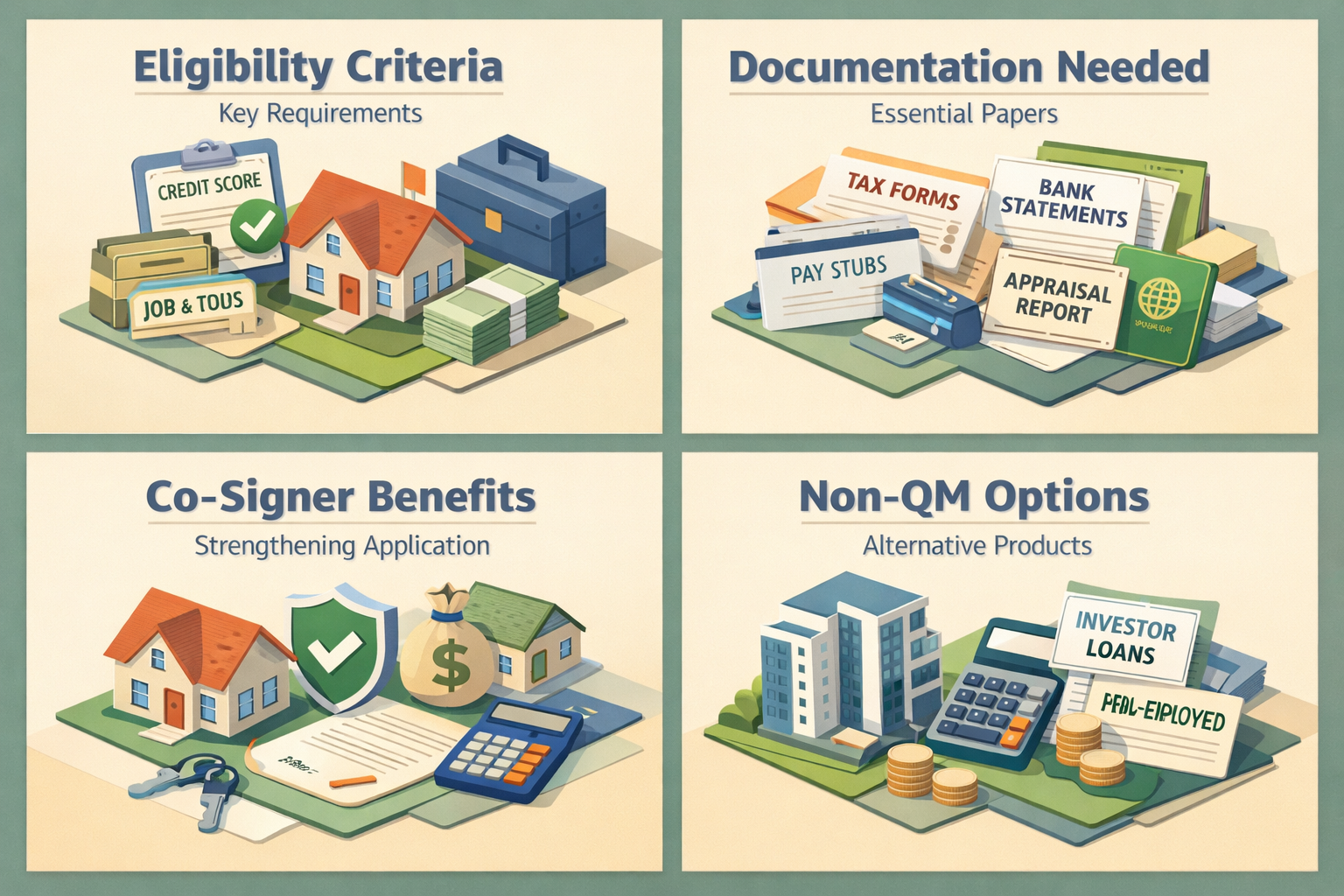
Knowing how to qualify for a jumbo loan with foreign dividend income and a US co-signer starts with building a thorough and well-organized documentation package. Lenders dealing with international income profiles expect more paperwork — and being proactive about gathering it can significantly speed up the approval process.
For the Primary Borrower with Foreign Dividend Income
- Passport and visa documentation confirming legal residency or status in the US
- Two years of foreign tax returns, translated and potentially notarized
- 12 to 24 months of international brokerage statements showing dividend deposits
- A letter from a financial advisor or certified accountant confirming the nature, source, and expected continuity of the dividend income
- Recent currency exchange rate documentation for income conversion
- US tax returns if you file them, including any foreign income disclosures (such as FBAR filings)
For the US Co-Signer
- Two years of federal tax returns (personal and business if self-employed)
- Recent W-2s or 1099s
- Recent pay stubs (if traditionally employed)
- Bank and asset account statements
- Authorization for a full credit check
Organizing these documents before approaching lenders demonstrates preparedness and can help you move through underwriting more efficiently. Working with a mortgage broker who specializes in non-QM or jumbo lending for international borrowers may also be worth considering, as they often have access to a wider range of lenders familiar with these situations.
Understanding Non-QM Jumbo Products Designed for Complex Borrowers
Not every jumbo loan follows the same rulebook. The lending market includes a growing segment of non-qualified mortgage (non-QM) products that are specifically designed for borrowers whose income profiles don't fit neatly into traditional underwriting boxes. These products may be particularly relevant for borrowers relying on foreign dividend income.
Non-QM jumbo lenders often use alternative documentation methods, which might include:
- Asset depletion underwriting — Lenders calculate a monthly income figure based on total liquid assets divided over a set period (often 60 to 84 months), which can help borrowers with large investment portfolios qualify even if their traditional income documentation is limited.
- Bank statement programs — Some lenders accept 12 to 24 months of bank statements in lieu of tax returns, which may work well if your dividend income flows consistently into a personal or business account.
- Foreign national loan programs — A number of portfolio lenders and private institutions offer dedicated programs for non-US citizens or residents with foreign income, often with slightly higher rates or larger down payment requirements to offset the additional risk.
It's worth noting that non-QM loans often carry higher interest rates than traditional jumbo products. However, for borrowers with foreign dividend income and US co-signer arrangements, the trade-off may be well worth it if it means securing financing for a property they otherwise couldn't purchase. Rates and terms vary widely by lender, so comparing multiple options is strongly recommended.
Strategies to Improve Your Jumbo Loan Eligibility Before Applying
If you're not quite ready to apply today, there are several proactive steps you can take to strengthen your position before submitting a jumbo loan application. These strategies apply whether you're working with foreign dividend income, a co-signer, or both.
- Build a US credit history early — Open a US bank account, apply for a secured credit card, and maintain a consistent payment record. Lenders want to see that you manage US-based credit responsibly.
- Maintain consistent dividend deposits — The more stable and predictable your foreign dividend income appears over a 24-month window, the more confident lenders will feel using it in their calculations.
- Reduce existing debt obligations — Paying down credit cards, car loans, or other liabilities lowers your DTI ratio and gives lenders more confidence in your ability to handle a large monthly mortgage payment.
- Increase your down payment savings — A larger down payment reduces the lender's risk and may open doors to more favorable rates and terms, even in non-QM programs.
- Choose your co-signer strategically — Look for a co-signer who has a strong credit score (720 or higher), stable employment, and low personal debt. The stronger their financial profile, the more your joint application benefits.
- Consult a lender early — Speaking with a jumbo-focused mortgage professional before you're ready to buy can help you understand exactly what gaps exist in your profile and how to address them.
Finding the Right Lender for This Type of Financing
Not every lender is equipped to handle a jumbo application involving foreign dividend income and a US co-signer. Many traditional banks rely on automated underwriting systems that may flag or decline non-standard income profiles without a thorough manual review. This makes lender selection one of the most important decisions in your borrowing journey.
Here's what to look for when searching for the right financing partner:
- Portfolio lenders — These institutions hold loans on their own balance sheets rather than selling them to the secondary market, giving them more flexibility to underwrite complex income situations manually.
- Private banks and wealth management arms — High-net-worth individuals with foreign investment income are often well-served by private banking divisions that specialize in customized jumbo solutions.
- Mortgage brokers with non-QM experience — A broker with established relationships across multiple jumbo and non-QM lenders can shop your profile to lenders who are most likely to qualify for a jumbo loan your scenario.
- International mortgage specialists — Some mortgage companies specifically focus on foreign nationals and international borrowers, offering products and underwriting expertise tailored to this audience.
When speaking with potential lenders, be upfront about your income structure from the very beginning. Explain that your income is derived from foreign dividends and that you intend to include a US co-signer. A lender who responds with clarity and confidence — rather than confusion — is likely one with genuine experience in this space. Understanding how to qualify for a jumbo loan with foreign dividend income and a US co-signer ultimately comes down to partnering with professionals who know how to present your file in the strongest possible light.
●Conclusion
Qualifying for a jumbo loan when your income comes from international dividend sources may require more preparation than a standard mortgage application — but it's far from out of reach. By understanding how lenders evaluate foreign income, leveraging the support of a qualified US co-signer, assembling thorough documentation, and exploring non-QM products designed for complex borrowers, you can put together a compelling application for high-value home financing. The key is to start early, work with experienced professionals, and approach the process with patience and thoroughness. LoanWise is here to help you navigate every step of the journey toward homeownership.