
Financing a high-value home is already a significant undertaking, but when a portion of your earnings comes from international investments, the process can feel even more complex. If you're wondering how to qualify for a jumbo loan with foreign dividend income, you're certainly not alone. Many real estate investors, high-net-worth individuals, and globally mobile professionals rely on dividends from overseas holdings — and lenders have specific ways of evaluating that income. The good news is that with the right preparation, documentation, and lender match, qualifying is very much achievable.
What Is a Jumbo Loan and Who Typically Needs One
A jumbo loan is a type of mortgage that exceeds the conforming loan limits set by the Federal Housing Finance Agency (FHFA). These limits are updated annually and vary by location, but in most parts of the United States, any loan exceeding approximately $766,550 (as of recent guidelines) may fall into jumbo territory. In high-cost areas, those thresholds are higher.
Because jumbo loans can't be purchased by Fannie Mae or Freddie Mac, lenders take on the full risk of these loans themselves. That's why the qualification standards tend to be stricter than those for conventional mortgages. Lenders typically look for borrowers with strong credit profiles, substantial assets, and verifiable income — all of which become more nuanced when income flows from international dividend-paying investments.
Jumbo loans are commonly used by:
- Luxury homebuyers purchasing properties in high-cost markets
- Real estate investors acquiring high-value rental or investment properties
- High-net-worth individuals with diversified, global income streams
- Homeowners refinancing larger loan balances to access better rates or terms
If your financial profile includes jumbo loan investment income from overseas, understanding how lenders interpret that income is the first step toward a successful application.
How Lenders View Foreign Dividend Income
Foreign dividend income refers to earnings distributed by international corporations or foreign investment funds that you hold shares in. While this type of income can be consistent and substantial, lenders don't automatically treat it the same way as a domestic W-2 salary or U.S.-based dividend payments.
Here's why lenders approach it with extra scrutiny:
- Currency risk: Dividends paid in a foreign currency introduce exchange rate volatility, which could affect the real dollar value of your income over time.
- Regulatory differences: Foreign companies operate under different reporting and disclosure rules, making income verification more complex.
- Continuity concerns: Lenders want assurance that the income will continue for at least three years, which can be harder to establish with overseas holdings.
- Tax implications: Foreign dividend income may be subject to withholding taxes in the country of origin, which can reduce the net amount available to support loan repayment.
That said, many portfolio lenders and non-QM (non-qualified mortgage) lenders are experienced in handling global income structures and may be more flexible than traditional banks. Finding the right lender is often just as important as having the right income.
Documentation Requirements You Should Prepare
When it comes to how to qualify for a jumbo loan with foreign dividend income, documentation is everything. Lenders need to build a clear, verifiable picture of your financial life — and that picture becomes more detailed when international income is involved.
Here are the key documents most lenders will likely request:
- Two years of personal tax returns (U.S. filed): This includes all schedules, particularly Schedule B for interest and dividend income. If you're a U.S. citizen or permanent resident with foreign investments, you're generally required to report this income to the IRS.
- Foreign tax returns or financial statements: Some lenders may also request documentation from the country where the dividends originate to cross-reference income amounts.
- Brokerage or investment account statements: At least 12 to 24 months of statements showing consistent dividend deposits can help establish a track record of income continuity.
- Dividend history letters or corporate documentation: If dividends come from a private foreign company in which you have ownership, a letter or formal financial summary from that entity may be needed.
- Currency conversion records: Statements showing how foreign dividend payments were converted to U.S. dollars, including exchange rates used, add clarity to your income picture.
- FBAR or FATCA disclosures: If applicable, documentation showing compliance with foreign bank account reporting requirements demonstrates financial transparency to lenders.
Being proactive with this paperwork — and having a CPA or financial advisor familiar with international income help you organize it — can significantly streamline your application.
Credit, Reserves, and Down Payment Expectations for Jumbo Borrowers
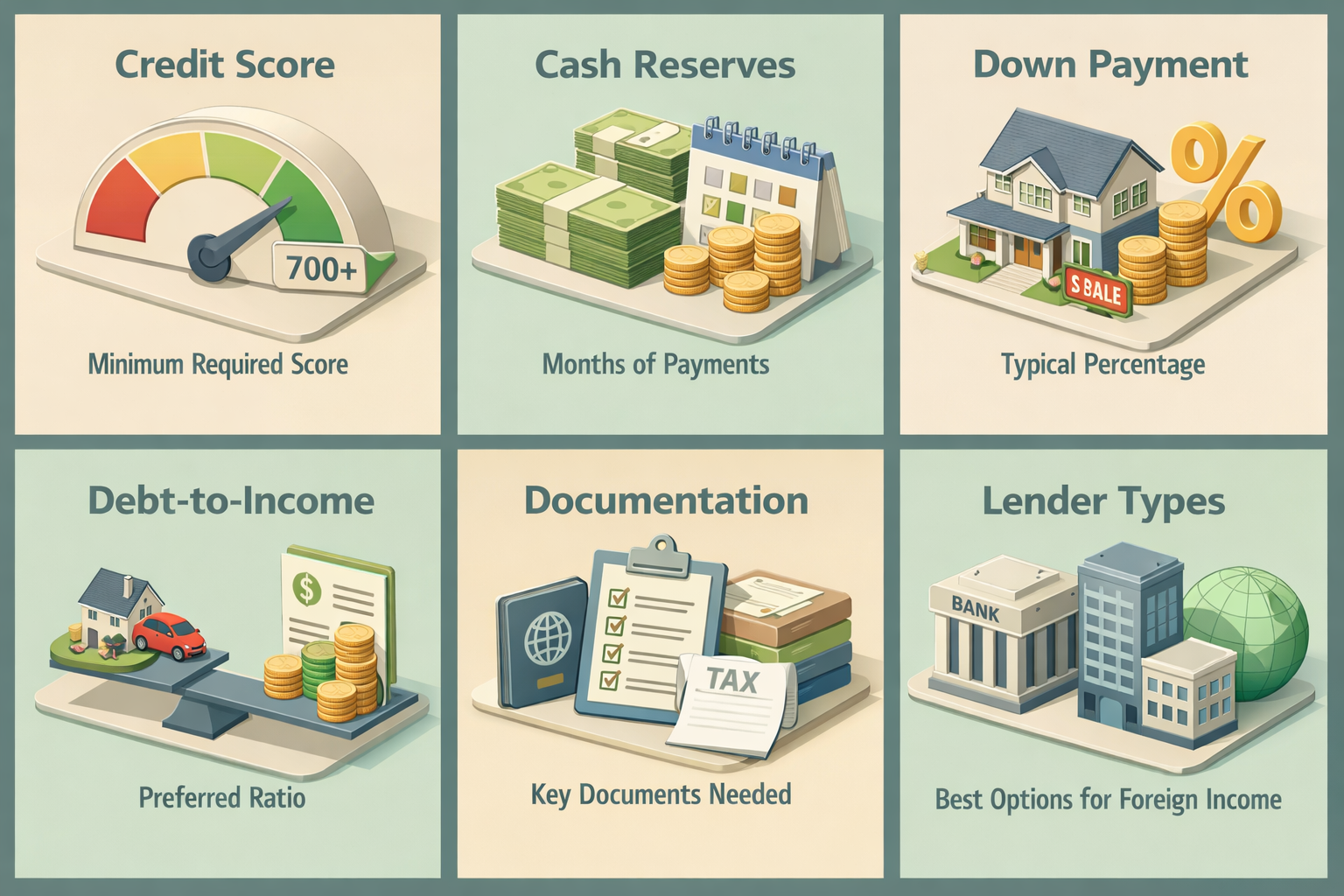
Beyond income documentation, jumbo loan lenders typically apply higher standards across several other qualifying criteria. If you're relying on foreign dividend income, meeting these benchmarks becomes even more important, as strong financials elsewhere in your profile can help offset the additional complexity of your income source.
Credit Score Requirements
Most jumbo lenders prefer a credit score of at least 700, though many look for scores of 720 or higher. Some portfolio lenders may work with slightly lower scores depending on the overall strength of the application. A pristine credit history — free of late payments, collections, or recent derogatory marks — can make a meaningful difference when your income structure is unconventional.
Cash Reserves
Jumbo loan applicants are generally expected to demonstrate substantial liquid reserves after closing. This often means showing 6 to 12 months (or more) of mortgage payments in accessible accounts. For borrowers with foreign dividend income, lenders may require even larger reserve cushions to account for potential income variability.
Down Payment Considerations
Jumbo loans typically require a larger down payment than conforming loans. A 20% down payment is fairly common, though some lenders may accept less depending on the borrower's overall financial strength. A larger down payment not only reduces your loan-to-value ratio but also signals financial stability — something lenders appreciate when evaluating less conventional income streams.
Debt-to-Income Ratio
Your debt-to-income (DTI) ratio compares your monthly debt obligations to your gross monthly income. Most jumbo lenders prefer a DTI below 43%, and some prefer it even lower — around 36% to 38%. If your foreign dividend income is only partially counted by the lender, this ratio could shift, so it's wise to reduce other debts before applying.
Choosing the Right Type of Lender for Global Income Structures
Not all lenders are equipped — or willing — to evaluate foreign dividend income. Choosing the right lending partner can be the difference between approval and a frustrating denial. Here are the types of lenders most likely to accommodate your situation:
Portfolio Lenders
Portfolio lenders keep loans on their own books rather than selling them to the secondary market. This gives them the flexibility to set their own underwriting guidelines. Many are more experienced with non-traditional income types, including jumbo loan investment income from international sources.
Non-QM Lenders
Non-qualified mortgage lenders specialize in borrowers who don't fit neatly into standard agency guidelines. They may use asset depletion models, bank statement analysis, or other alternative income verification methods — all of which could be beneficial if your foreign dividends are difficult to document through traditional channels.
Private Banks and Wealth Management Divisions
High-net-worth borrowers with complex international portfolios may find private banking divisions at large financial institutions to be a strong fit. These institutions are often accustomed to working with global clients and may offer customized jumbo mortgage solutions alongside other wealth management services.
Mortgage Brokers With Jumbo Expertise
Working with a mortgage broker who specializes in jumbo or non-QM lending can save you significant time. They have access to multiple lenders and can match your specific income profile — including foreign dividends — to the lender most likely to approve your application on favorable terms.
Strategies to Strengthen Your Jumbo Loan Application
If you're preparing to apply for a jumbo loan with foreign dividend income and your income includes foreign dividends, a few strategic steps could meaningfully improve your chances of approval.
- Consolidate foreign income into U.S. accounts early: Consistently depositing foreign dividend payments into a U.S.-based bank account over 12 to 24 months creates a traceable domestic income trail that lenders can verify more easily.
- Work with an internationally experienced CPA: A tax professional who understands foreign income reporting can help ensure your returns accurately reflect all income while remaining compliant with IRS requirements — a key factor in lender trust.
- Reduce outstanding debts before applying: Paying down credit cards, car loans, or other obligations before your application can lower your DTI and make your income stretch further in the lender's calculations.
- Demonstrate income stability: Two or more years of consistent dividend payments at similar or growing levels can help lenders feel confident that the income will continue. Avoid large one-time distributions that may look unusual or unsustainable.
- Get pre-approved before house hunting: A pre-approval letter signals to sellers that you're a serious, qualified buyer — especially important in competitive luxury markets where sellers may be skeptical of complex income scenarios.
- Consider asset-based qualification: If documenting income proves challenging, some lenders allow high-asset borrowers to qualify for a jumbo loan based on the depletion of their investment portfolio rather than traditional income streams. This could be a useful backup approach.
●Conclusion
Understanding how to qualify for a jumbo loan with foreign dividend income requires a combination of thorough documentation, smart lender selection, and a well-prepared financial profile. While the process involves more moving parts than a standard mortgage application, it's far from impossible — especially for borrowers who plan ahead and work with knowledgeable professionals. Whether you're purchasing a luxury home, refinancing an existing high-value property, or expanding your real estate investment portfolio, the right lender and the right strategy can open the door to the financing you need. At LoanWise, we're here to help you navigate complex income scenarios with clarity and confidence. Reach out today to connect with a jumbo loan specialist who understands your world.